
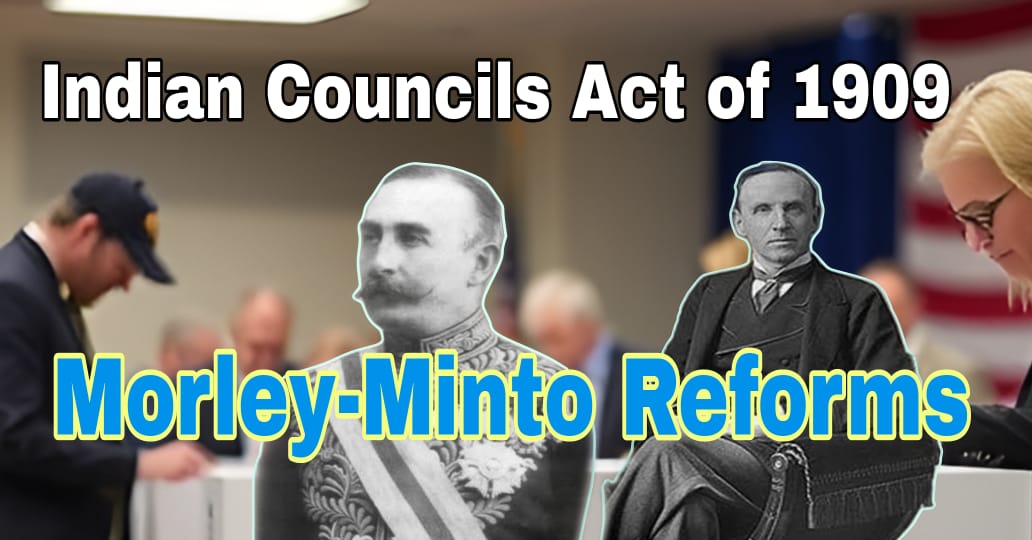
Indian Councils Act of 1909 (Morley-Minto Reforms)
The Indian Councils Act of 1909, popularly known as the Morley-Minto Reforms, marked a significant milestone in the constitutional history of India. It aimed to placate growing political unrest by introducing limited reforms in governance, while simultaneously strengthening British control.
Historical Context
The early 20th century saw a surge in political consciousness in India. The partition of Bengal in 1905 and the Swadeshi movement had intensified nationalist demands. Simultaneously, the Muslim League, founded in 1906, began advocating for Muslim interests. The British Government sought to balance these conflicting demands by introducing reforms aimed at appeasing both moderate nationalists and communal interests.
Lord Morley, the Secretary of State for India, and Lord Minto, the Viceroy of India, crafted the 1909 reforms to address these challenges while maintaining British dominance.
Key Features of the Indian Councils Act, 1909
● Central Legislative Council:— The number of members was increased from 16 to 60.
● Provincial Legislative Councils:— The number of members varied from province to province, reflecting local conditions.
This expansion provided more opportunities for Indian representation, though power remained concentrated with the British.
● Central Legislative Council:— The act retained an official majority, ensuring that British officials could outvote non-official members.
● Provincial Legislative Councils:— For the first time, non-official members were given a majority, allowing limited Indian influence in provincial legislation.
Members of legislative councils were granted greater freedom to:
(i) Ask supplementary questions.
(ii) Move resolutions on the budget and other public matters.
● While these functions were largely advisory, they marked an important step toward parliamentary-style debate.
● For the first time, Indians were associated with the Viceroy’s and Governors’ Executive Councils.
● Satyendra Prasad Sinha became the first Indian member of the Viceroy’s Executive Council, serving as the Law Member.
● This inclusion symbolized a limited recognition of Indian capabilities in governance.
● The act introduced separate electorates for Muslims, allowing only Muslim voters to elect Muslim members.
● This system institutionalized communal representation and is often criticized for fostering divisions.
● Lord Minto earned the title of “Father of Communal Electorate“ for this provision.
● The act provided separate representation for:
(i) Presidency corporations
(ii) Chambers of commerce
(iii) Universities
(iv) Zamindars
● This provision aimed to include diverse interest groups in governance.
Significance of the Indian Councils Act, 1909
The act’s communal representation provisions had far-reaching consequences:
● It formalized the division of Indian society along religious lines.
● It marked the beginning of communal politics in India, which later influenced the partition of the country.
● The act expanded opportunities for Indians to participate in legislative councils and executive bodies.
● It marked a step forward in the gradual Indianization of governance, although the British retained ultimate control.
● The act’s provisions for budget discussions and resolutions laid the groundwork for parliamentary practices in India.
● It fostered political debate and encouraged the development of a political culture among Indians.
● Despite its significance, the act fell short of nationalist demands for self-governance and elected representation.
● The British intended it to appease moderates while containing the growing influence of extremists within the Indian National Congress.
Criticism of the Indian Councils Act, 1909
The introduction of separate electorates is widely criticized for:
● Dividing Indian society along communal lines.
● Encouraging communal politics that later escalated into religious tensions.
● The act retained official majorities in the Central Legislative Council and key decision-making powers with the British.
● Indians’ participation was largely symbolic, with limited influence over governance.
● The representation granted to special interest groups (e.g., zamindars, chambers of commerce) often excluded ordinary Indians.
● The act primarily catered to the elite, leaving the broader population underrepresented.
Legacy of the Indian Councils Act, 1909
The act served as a foundation for subsequent reforms, such as:
● Government of India Act, 1919 (Montagu-Chelmsford Reforms).
● Government of India Act, 1935.
Each reform built upon the principles introduced in 1909, gradually expanding Indian representation.
● The act’s communal provisions set a precedent for the separate representation of religious and communal groups, which influenced later political developments.
● It marked the beginning of a shift in nationalist politics, with growing demands for independence and communal interests asserting themselves.
● The act encouraged political debate and advocacy, fostering the growth of Indian political leaders and movements.
● It also highlighted the limitations of British reforms, strengthening demands for Swaraj (self-rule).
Conclusion
The Indian Councils Act of 1909 represented a significant yet flawed step in India’s constitutional development. While it expanded Indian representation and introduced deliberative elements in governance, it failed to address the growing aspirations for self-governance. The introduction of separate electorates for Muslims sowed the seeds of communalism, a legacy that deeply impacted India’s political landscape. Despite its limitations, the act remains an important milestone, reflecting the complexities of colonial rule and the gradual evolution of India’s political institutions.
| Morley–Minto Reforms: Impacts on Indian Society |
|---|
| The Indian Councils Act of 1909, popularly known as the Morley–Minto Reforms, marked an important turning point in the constitutional development of colonial India. It was introduced in the backdrop of increasing nationalist agitation after the partition of Bengal in 1905, the Swadeshi movement, and the demand for greater Indian participation in governance. The reforms were named after Lord Morley, the Secretary of State for India, and Lord Minto, the Viceroy of India, who together attempted to balance the growing political aspirations of Indians with the British objective of maintaining control. One of the most significant features of the Act was the expansion of both the Central and Provincial Legislative Councils. For the first time, the number of non-official Indian members was substantially increased, and in the provinces, Indians held a majority, though the Central Legislature continued to be dominated by British officials. Members were granted limited powers, such as the right to ask supplementary questions, move resolutions on budgetary and public matters, and participate in debates. Although these powers were largely consultative, they marked the beginning of a deliberative political culture in India. Another major development was the association of Indians with the Executive Councils of the Viceroy and Governors. This symbolized the entry of Indians into higher levels of administration. Satyendra Prasad Sinha’s appointment as the first Indian Law Member in the Viceroy’s Executive Council was celebrated as a milestone. However, the most controversial provision was the introduction of separate electorates for Muslims, allowing them to elect their representatives independently of Hindu voters. This not only recognized communal identities in the political structure but also institutionalized them, thereby laying the foundation of communal politics in India. The reforms had profound political importance. On one hand, they exposed Indian leaders to parliamentary practices and gave them a platform to voice concerns, which prepared the ground for future political developments. On the other hand, the continuation of official dominance, restricted powers, and communal representation frustrated nationalists and led to disillusionment with the British government’s sincerity in granting self-rule. The communal electorate in particular created divisions within Indian society, fostering political separatism that later crystallized into the demand for Pakistan. In terms of impact on Indian society and politics, the Act represented both progress and regression. It expanded political participation, gave recognition to educated elites, and brought various interest groups—such as landlords, chambers of commerce, and universities—into the councils. At the same time, it alienated sections of Indian society by favoring elites and by sowing the seeds of communalism. Thus, while it was hailed as a modest constitutional advance, its legacy is equally remembered for deepening divisions and delaying the process of true representative democracy in India. |
Mains Practice Question
UPSC & BPSC (CSE) Mains Questions on Indian Councils Act of 1909
1. Short Answer Questions (150 words)
| [Q2.] Discuss the political importance of the Indian Councils Act, 1909. How did it shape the course of Indian political affairs in the early 20th century? (150 words) |
| [Q5.] How did the Morley–Minto Reforms influence the relationship between the Congress and the Muslim League? Analyze with examples. (150 words) |
| [Q6.] Evaluate the limitations of the Indian Councils Act, 1909 in the context of Indian demands for self-government. (150 words) |
2. Long Answer Questions (250 words)
| [Q1.] The Indian Councils Act, 1909 has been described as both a milestone and a misstep in India’s constitutional development. Critically evaluate. (250 words) |
| [Q3.] “The introduction of separate electorates under the Morley–Minto Reforms institutionalized communalism in Indian politics.” Examine this statement with reference to its long-term implications. (250 words) |
| [Q4.] Explain how the Indian Councils Act, 1909 affected Indian society and political participation. Did it strengthen the nationalist movement or weaken it? (250 words) |
| [Q7.] The Indian Councils Act, 1909 was less about reform and more about control. Do you agree? Substantiate your answer. (250 words) |
_
Hiya, I’m really glad I’ve found this information. Nowadays bloggers publish only about gossips and internet and this is really frustrating. A good site with exciting content, this is what I need. Thanks for keeping this web-site, I’ll be visiting it. Do you do newsletters? Can’t find it.
Saved as a favorite, I really like your blog!