
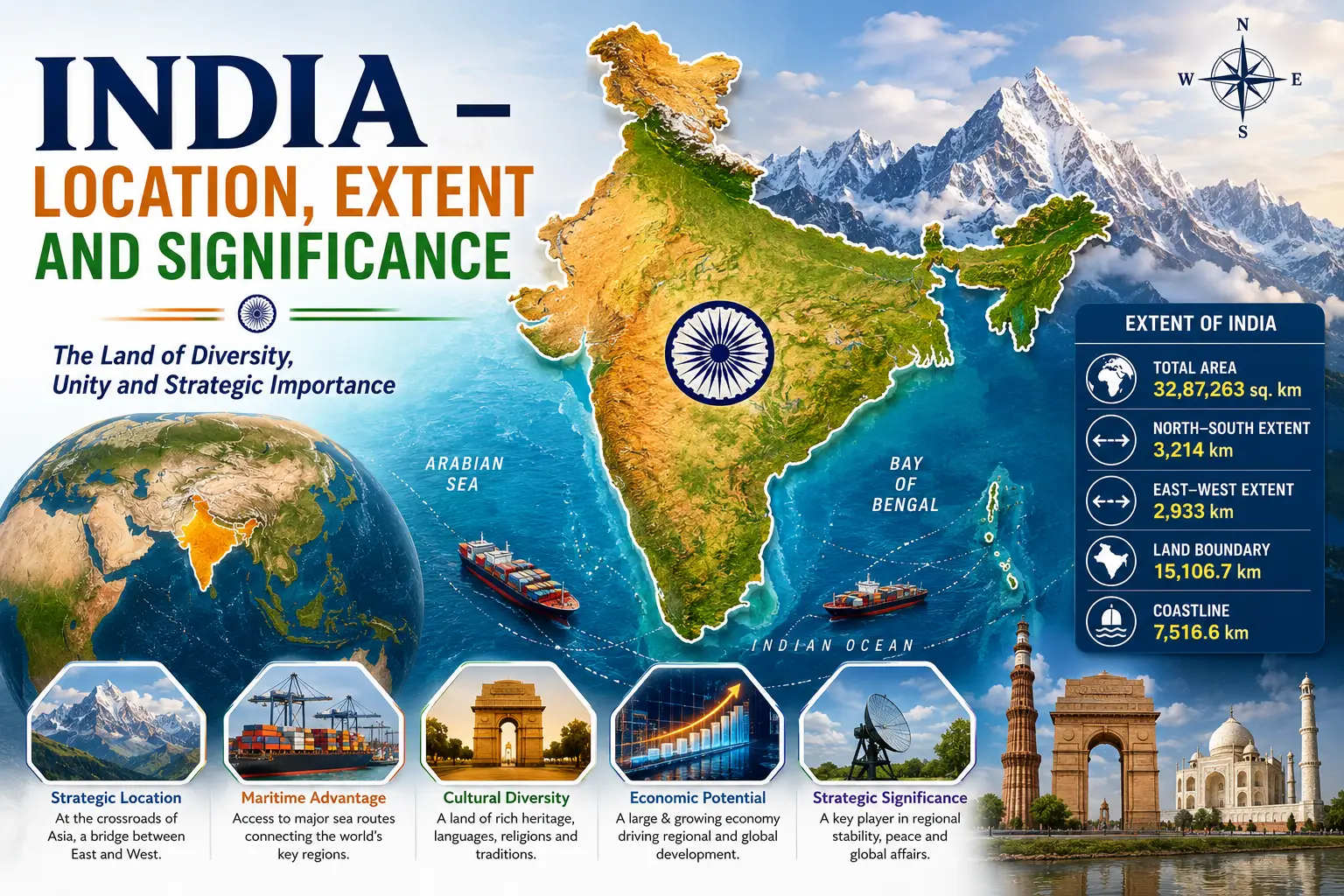
Chapter 1: India – Location, Extent and Significance
Chapter 1: India – Location, Extent and Significance
(For UPSC, BPSC, SSC Prelims & Mains – Detailed Notes with Key Facts, Explanations, and Exam-Oriented Analysis)
India is one of the largest and most geographically diverse countries in the world. It occupies a prominent central position in South Asia and lies entirely in the Northern and Eastern Hemispheres. Its vast size (seventh largest country by area, approximately 3.28 million sq km), strategic location, unique physical features (Himalayas in the north, Indian Ocean in the south), and immense cultural diversity qualify it as a subcontinent.
The geographical position of India has profoundly shaped its:
- Climate: Tropical monsoon system.
- Economy: Agriculture, trade routes, resources.
- History & Culture: Protection from invasions, spread of Indian civilization.
- Strategic Importance: Dominance in the Indian Ocean Region (IOR).
Relevance for Exams: Questions on location frequently appear in Prelims (mapping, coordinates, extreme points) and Mains (GS-1 Geography: climatic influence, strategic significance, subcontinent identity).
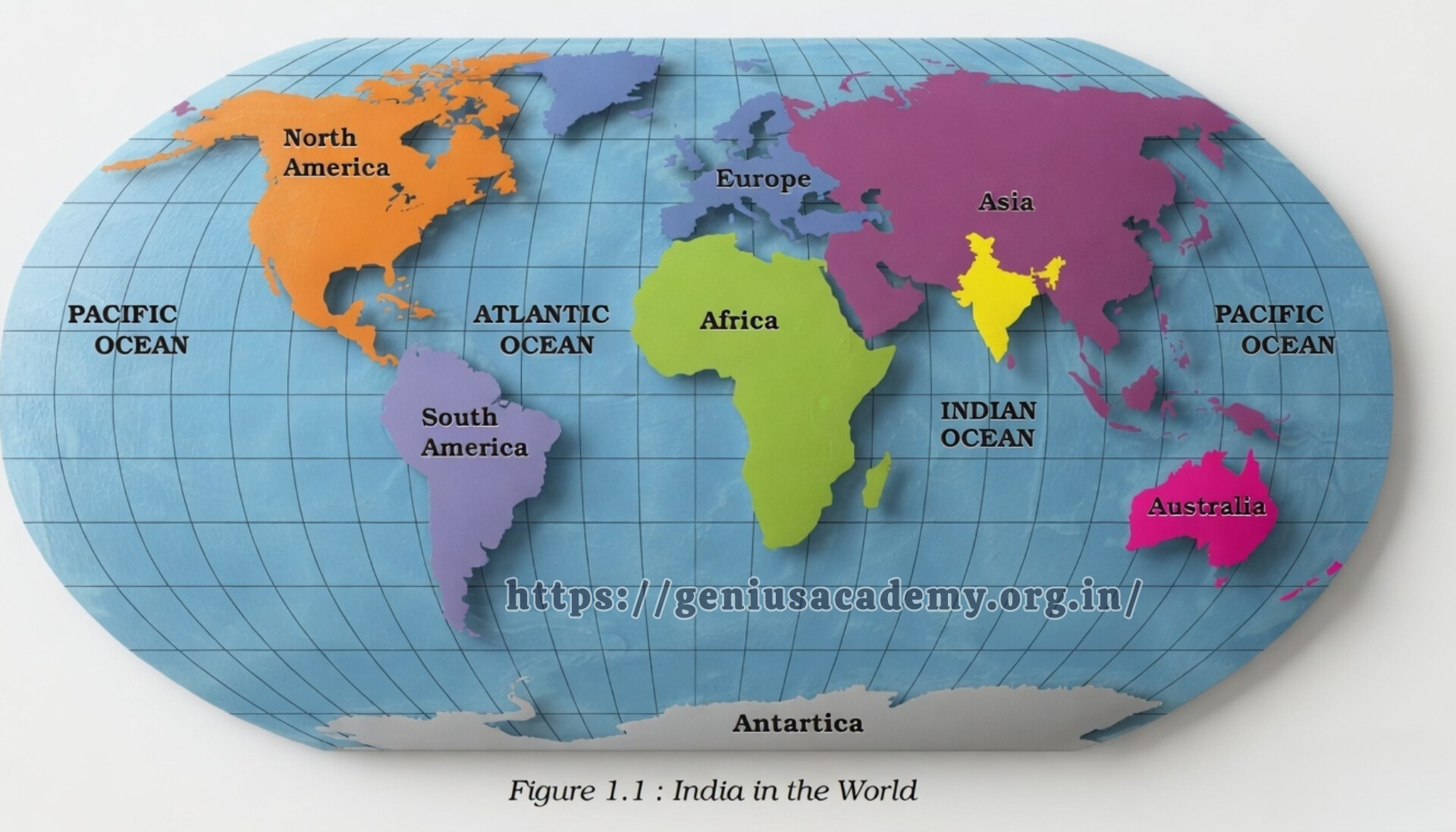
1. Location of India
India is situated in the south-central part of Asia. It is bordered by:
- South: Indian Ocean.
- Southwest: Arabian Sea.
- Southeast: Bay of Bengal.
- Entirely in the Northern Hemisphere (North of Equator).
- Entirely in the Eastern Hemisphere (East of Prime Meridian).
- Latitudinal Extent (Mainland): 8°4′ N to 37°6′ N.
- With Andaman & Nicobar Islands: 6°45′ N to 37°6′ N.
- Southernmost Point: Indira Point (Great Nicobar Island) at 6°45′ N (submerged partially in 2004 Tsunami; also called Pygmalion Point).
- Longitudinal Extent: 68°7′ E to 97°25′ E (approx. 30° span).
Key Fact: The standard meridian for Indian Standard Time (IST) is 82°30′ E, passing near Mirzapur (Uttar Pradesh).
1. What is the Geoid?
Answer:—
Introduction
The geoid is the irregular, equipotential surface of Earth’s gravity field that best approximates global mean sea level (MSL). It is the surface to which oceans would conform if undisturbed by tides, currents, and winds. Unlike a perfect sphere or even a smooth ellipsoid, the geoid is “lumpy” due to uneven mass distribution inside Earth (density variations in crust and mantle), mountains, ocean trenches, and rotational effects.
- Oblate Spheroid (Ellipsoid) Approximation: Earth is flattened at the poles and bulges at the equator due to rotation (centrifugal force). Equatorial diameter ≈ 12,756 km; polar diameter ≈ 12,714 km (difference ~42 km). Flattening factor ≈ 1/298.257.
- Geoid vs Ellipsoid: The geoid undulates ±100 metres around the reference ellipsoid (WGS84 is the standard).
Key Impacts of Earth’s Geoid Shape
1. Impact on Distances: Latitudes vs Longitudes
This directly relates to why India’s north-south extent (3,214 km) exceeds its east-west extent (2,933 km) despite both spanning ~30°.
- Latitudes (Parallels): Nearly constant spacing because they are parallel circles. However, due to oblateness:
- Distance per degree of latitude: ~110.6 km at equator → ~111.7 km at poles (average ~111 km).
- Slight increase poleward as the surface curves less sharply near flattened poles.
- Longitudes (Meridians): Converge at poles. Distance per degree:
- Maximum at equator (~111.3 km).
- Decreases with cosine of latitude: Distance = 111.3 × cos(latitude).
- At 30°N (relevant for India): ~96 km per degree.
Implication for India: At mid-latitudes, east-west contraction shortens the physical distance. On a perfect sphere, distances would be more uniform; oblateness + convergence explains the ~281 km difference.
2. Gravity and Sea Level Variations
- Gravity is stronger at poles (closer to centre + less centrifugal force) and weaker at equator.
- The geoid is the true “level” surface: water flows to follow it.
- Geoid Undulations: Up to +80 m (e.g., around New Guinea) to -100 m (e.g., Indian Ocean south of India). These affect precise elevation measurements and ocean circulation.
3. Geodetic and Surveying Impacts
- Elevations: Orthometric height (true above MSL) = Ellipsoidal height (GPS) minus geoid undulation (N). Formula: H = h – N.
- Deflection of the Vertical: Angle between plumb line (normal to geoid) and normal to ellipsoid → errors in astronomical latitude/longitude if ignored.
- GPS/Coordinate Systems: WGS84 ellipsoid is used for global positioning; local adjustments account for geoid for cm-level accuracy in surveying, engineering, and navigation.
4. Geographical and Environmental Impacts
- Climate & Oceanography: Influences ocean currents, sea surface topography, and monsoon patterns indirectly through gravity anomalies.
- Mapping & GIS: Projections and datums (e.g., WGS84 vs local) must correct for geoid-ellipsoid separation to avoid positional errors (up to 100+ metres).
- Biodiversity & Settlement: Minor but cumulative effects on local topography, drainage, and soil formation.
- Tectonics: Long-term monitoring of geoid changes helps study post-glacial rebound, mantle convection, and sea-level rise.
5. Practical Applications and Modern Relevance
- Satellite Altimetry (e.g., GRACE, GOCE missions): Maps gravity field and geoid with high precision.
- Navigation: Aviation, maritime, and missile guidance require geoid corrections.
- Climate Change Studies: Accurate geoid models track ice melt and sea-level changes.
- Everyday Impact: Negligible for casual use but critical for precision agriculture, construction, and defence.
Summary Table: Sphere vs Oblate Spheroid vs Geoid
| Aspect | Perfect Sphere | Oblate Spheroid (Ellipsoid) | True Geoid |
|---|---|---|---|
| Shape | Round | Flattened poles, equatorial bulge | Irregular, lumpy |
| Distance per ° Lat. | Constant (~111 km) | Slight variation (110.6–111.7 km) | Minor local adjustments |
| Distance per ° Long. | Varies with cos(lat) | Same, with better accuracy | Same + gravity effects |
| Gravity | Uniform | Stronger at poles | Varies locally |
| Use | Simplification | Global coords (WGS84) | Precise MSL & elevations |
Conclusion:
Earth’s geoid shape — a slightly oblate, gravity-defined “potato” — introduces small but significant corrections in measurements, navigation, and geography. While negligible for broad-scale maps, it is vital for high-precision work. In the context of India’s extent, oblateness and convergence of meridians elegantly explain observed distance variations, reinforcing the need for ellipsoidal models over simplistic spherical assumptions in geography and geodesy. This understanding underpins accurate mapping, strategic planning, and scientific analysis.
2. Extent of India
The extent of India refers to its latitudinal and longitudinal spread, which determines its size, time variation, climatic diversity, strategic location, and geopolitical importance. India is the 7th largest country in the world and lies entirely in the Northern and Eastern Hemispheres. Its vast extent makes it a subcontinent with significant regional variations.
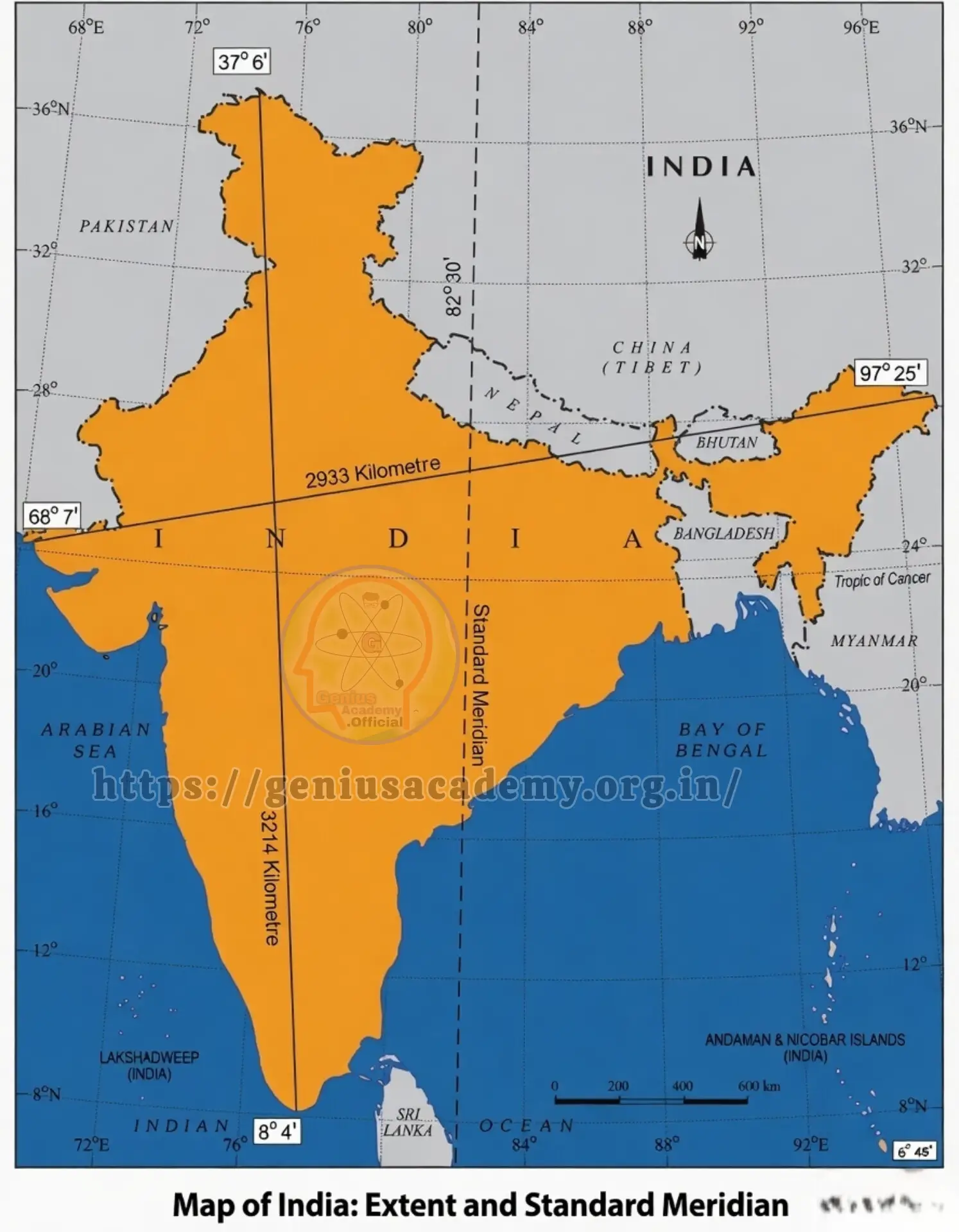
Mainland India: 8°4′ N to 37°6′ N latitude. With Andaman & Nicobar Islands: 6°45′ N to 37°6′ N latitude.
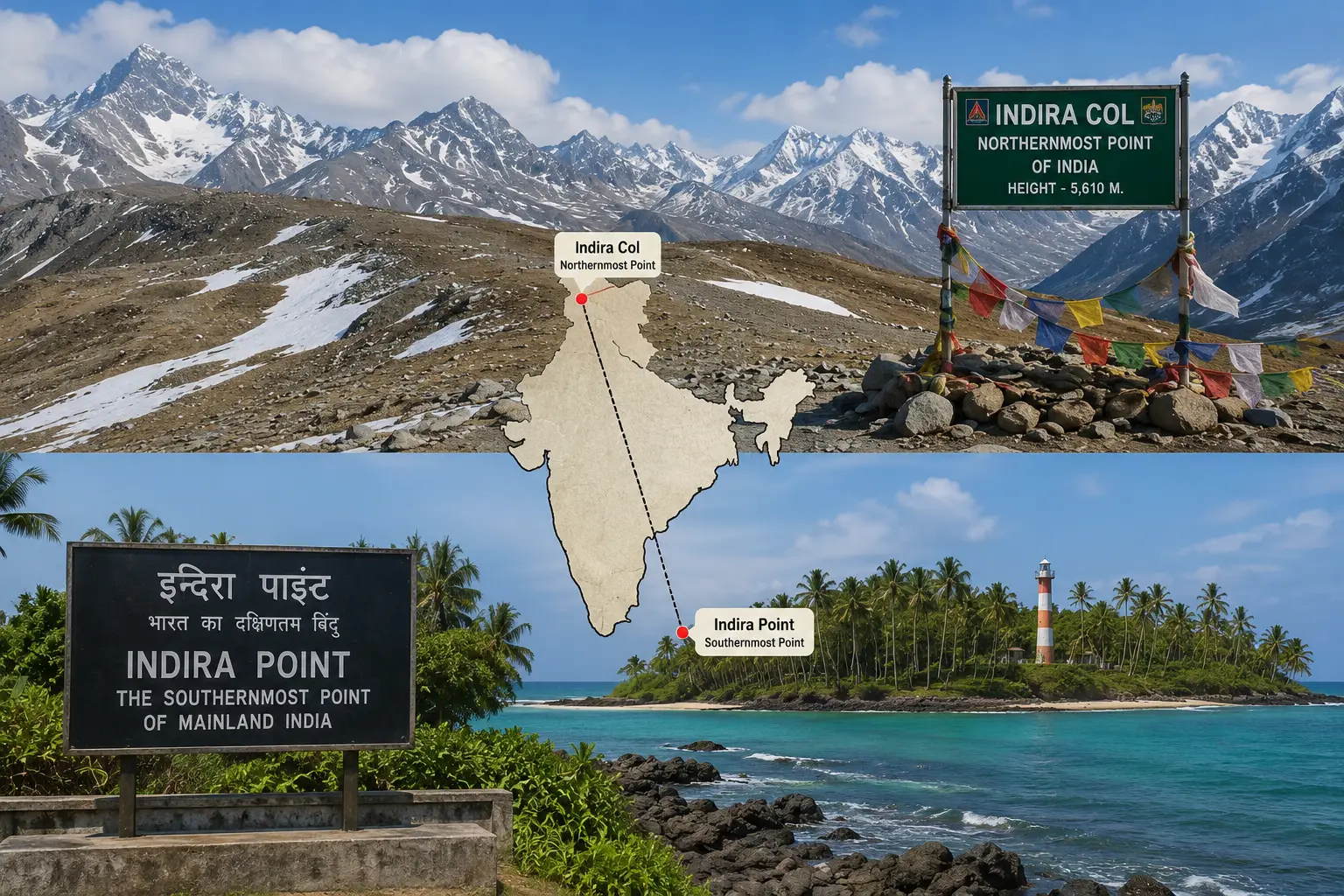
- Southernmost Point (Overall): Indira Point (Pygmalion Point), Great Nicobar Island — 6°45′ N (partially submerged during 2004 Tsunami).
- Southernmost Point of Mainland: Kanyakumari (Cape Comorin), Tamil Nadu — 8°4′ N.
- Northernmost Point: Indira Col, Siachen Glacier, Ladakh (near India-China border) — 37°6′ N.
North-South Distance: Approximately 3,214 km (Indira Col to Kanyakumari).
Key Fact: The Tropic of Cancer (23°30′ N) passes almost through the middle of India, dividing it into tropical (south) and subtropical/temperate (north) zones. It traverses 8 States: Gujarat, Rajasthan, Madhya Pradesh, Chhattisgarh, Jharkhand, West Bengal, Tripura, Mizoram.
India: 68°7′ E to 97°25′ E longitude (approx. 30° span).
- Westernmost Point: Guhar Moti (near Sir Creek), Rann of Kutch, Gujarat — 68°7′ E.
- Easternmost Point: Kibithu, Arunachal Pradesh — 97°25′ E.
East-West Distance: Approximately 2,933 km (Guhar Moti to Kibithu).
Standard Meridian: 82°30′ E (passes near Mirzapur, Uttar Pradesh) → Basis of Indian Standard Time (IST = UTC +5:30).
Both latitudinal and longitudinal extents are roughly 30°, yet actual distances differ:
| Parameter | Latitudinal (N-S) | Longitudinal (E-W) | Reason |
| Extent | ~29° (8°4’N – 37°6’N) | ~29.3° (68°7’E – 97°25’E) | – |
| Distance | 3,214 km | 2,933 km | Latitudes are parallel; longitudes converge at poles |
| Distance per Degree | ~111 km (almost constant) | Max at Equator (~111 km), decreases poleward | Earth is a geoid (oblate spheroid) |
Explanation:
- Distance between two latitudes (parallels) remains nearly constant everywhere (~111 km per degree).
- Distance between two longitudes (meridians) is maximum at the Equator and zero at the Poles (they converge). Since India lies away from the Equator, E-W distance is shorter.
A. Climatic Diversity
- Wide latitudinal span → Tropical monsoon climate in south to alpine climate in Himalayas.
- Influences monsoon, vegetation, and biodiversity.
B. Time Variation
- Longitudinal span of ~30° → 2-hour difference (30° × 4 minutes = 120 minutes).
- Sunrise in Arunachal Pradesh is ~2 hours earlier than in Gujarat.
- Single time zone (IST) adopted for administrative unity, national integration, and coordination in railways, defence, and governance.
C. Strategic & Geopolitical Importance
- Central position in South Asia and Indian Ocean.
- Controls key maritime routes.
- Large size provides strategic depth against northern threats (Himalayas act as barrier).
D. Agricultural & Economic Diversity
- Varied latitudes support diverse crops (rice in south/east, wheat in north, spices in south).
E. Challenges
- Regional disparities in development.
- Administrative coordination across vast distances.
- Disaster management (cyclones in east/south, earthquakes in north).
| Direction | Point | Location | Latitude/Longitude |
| Northernmost | Indira Col | Siachen, Ladakh | 37°6′ N |
| Southernmost (Mainland) | Kanyakumari | Tamil Nadu | 8°4′ N |
| Southernmost (Overall) | Indira Point | Great Nicobar | 6°45′ N |
| Easternmost | Kibithu | Arunachal Pradesh | 97°25′ E |
| Westernmost | Guhar Moti / Sir Creek | Gujarat (Rann of Kutch) | 68°7′ E |
Mains-type Question
1. Explain why the north-south extent of India is greater than the east-west extent despite both covering nearly 30 degrees.
Answer:—
Introduction
India is a vast country with significant latitudinal and longitudinal extent. It stretches over nearly 30 degrees in both latitude and longitude. However, the actual ground distance covered in the north-south direction is greater than in the east-west direction. This difference arises due to the fundamental geometry of the Earth’s grid system and has profound implications for India’s climate, time management, and strategic outlook.
Body
1. Coordinates and Actual Distances
- Latitudinal Extent (North-South): India extends from 8°4′ N (Kanyakumari, mainland) to 37°6′ N (Indira Col, Siachen Glacier, Ladakh), covering approximately 29 degrees.
- Total North-South distance = 3,214 km.
- Longitudinal Extent (East-West): India extends from 68°7′ E (Guhar Moti near Sir Creek, Gujarat) to 97°25′ E (Kibithu, Arunachal Pradesh), covering approximately 29.3 degrees.
- Total East-West distance = 2,933 km.
Thus, despite almost equal angular extent (~30°), the north-south physical distance is 281 km more than the east-west distance.
2. Geometric Explanation: Latitudes vs Longitudes The Earth is an oblate spheroid (geoid). This shape and the nature of the coordinate system explain the difference:
- Latitudes (Parallels):
- These are circles drawn parallel to the Equator.
- The distance between two consecutive latitudes remains almost constant (approximately 111 km per degree) throughout the globe.
- This is because latitudes never converge; they are true parallels.
- Hence, 29° of latitudinal extent produces a consistent linear distance of roughly 3,214 km.
- Longitudes (Meridians):
- These are semi-circles joining the North and South Poles.
- All meridians converge at the Poles and are widest apart at the Equator.
- The distance between two consecutive longitudes is maximum at the Equator (~111.3 km per degree) and decreases progressively towards the Poles, becoming zero at the Poles.
- Since India lies between 8° N and 37° N (away from the Equator), the east-west distance per degree of longitude is less than 111 km. This results in a shorter ground distance (2,933 km) for nearly the same angular coverage.
Mathematical Insight: Distance between longitudes = 111.3 km × Cos(latitude). At higher latitudes (e.g., 30° N), Cos(30°) = 0.866, so distance per degree reduces to ~96 km. This cumulative reduction shortens the total east-west span.
3. Implications of this Differential Extent
A. Climatic Implications
- The larger north-south extent allows India to experience a wide variety of climates — tropical in the south to alpine in the Himalayas.
- The Tropic of Cancer (23°30′ N) passes through the middle, dividing the country into tropical and subtropical zones.
- This results in diverse vegetation, cropping patterns (rice in south, wheat in north), and rich biodiversity.
B. Time Implications
- The longitudinal extent of ~30° creates a time difference of nearly 2 hours (30° × 4 minutes = 120 minutes).
- Eastern states like Arunachal Pradesh witness sunrise much earlier than western states like Gujarat.
- To avoid administrative chaos, India follows a single time zone based on 82°30′ E (Indian Standard Time), promoting national unity.
C. Strategic and Geopolitical Implications
- The greater north-south stretch, combined with the Himalayan barrier in the north, provides strategic depth against potential threats from the north.
- The relatively shorter east-west span makes the Siliguri Corridor (Chicken’s Neck) a critical vulnerability point.
- India’s central position in the Indian Ocean, enabled by its peninsular extent, gives it commanding influence over major maritime trade routes.
Conclusion
The difference in India’s north-south and east-west extents, despite nearly equal angular coverage, is a direct result of the Earth’s spherical geometry — parallel latitudes versus converging longitudes. This unique geographical characteristic has shaped India’s climatic diversity, agricultural richness, administrative uniformity, and strategic positioning. It is one of the fundamental reasons why India is rightly called a subcontinent — a large, distinct geographical entity with its own physical, cultural, and strategic identity. Understanding this extent is crucial not only for physical geography but also for appreciating India’s unity in diversity and its role in regional and global geopolitics.
(Word Count: ~380) Key Value Additions: Data, diagram-friendly explanation, multi-dimensional implications, and linkage with subcontinent identity — ideal for scoring maximum marks.
3. India’s Territorial Waters and Maritime Zones
India is a prominent maritime nation with a coastline of 7,516.6 km and a vast maritime frontier. It has a 15,106.7 km land border and an equally significant maritime boundary. India’s maritime zones are governed by the United Nations Convention on the Law of the Sea (UNCLOS, 1982), which India ratified in 1995. These zones provide sovereign rights, resource jurisdiction, and strategic depth in the Indian Ocean Region (IOR).
With an Exclusive Economic Zone (EEZ) of approximately 2.37 million sq km (almost 73% of India’s land area), these maritime zones are vital for the Blue Economy, national security, energy security, and India’s emergence as a leading Indo-Pacific power.
- Total Coastline: 7,516.6 km
- Mainland: 6,100 km
- Islands: 1,416.6 km
- Coastal States (9): Gujarat, Maharashtra, Goa, Karnataka, Kerala (West Coast); Tamil Nadu, Andhra Pradesh, Odisha, West Bengal (East Coast).
- Coastal Union Territories (4): Andaman & Nicobar Islands, Lakshadweep, Puducherry, Dadra & Nagar Haveli and Daman & Diu.
- Baseline: Low-water line along the coast (straight baseline method applied for indented coasts and islands).
| Maritime Zone | Distance from Baseline | Area (India) | Rights & Sovereignty | Key Features |
|---|---|---|---|---|
| Internal Waters | Landward of baseline | — | Full sovereignty (same as land) | Ports, bays, estuaries |
| Territorial Sea | 12 nautical miles (~22 km) | ~1,93,000 sq km | Full sovereignty over water, seabed, subsoil & airspace | Right of innocent passage for foreign ships |
| Contiguous Zone | 12–24 nautical miles | — | Control for customs, fiscal, immigration & sanitary laws | Buffer zone for enforcement |
| Exclusive Economic Zone (EEZ) | Up to 200 nautical miles | ~2.37 million sq km | Sovereign rights over living & non-living resources | Fishing, oil/gas, minerals, wind energy |
| Continental Shelf | Up to 350 nautical miles (extended claim) | — | Rights over seabed resources | Deep-sea mining |
| High Seas | Beyond EEZ | — | Freedom of navigation, overflight, fishing (with regulations) | International waters |
Note: India claims an extended continental shelf beyond 200 NM in the Arabian Sea and Bay of Bengal, submitted to the UN Commission on the Limits of the Continental Shelf (CLCS).
A. Economic Significance (Blue Economy)
- Fisheries: Supports 4+ million fishers; India is among top fish-producing nations.
- Hydrocarbons: Mumbai High, Krishna-Godavari basin, KG-D6 block.
- Minerals: Polymetallic nodules in Central Indian Ocean Basin (allocated by ISA).
- Renewable Energy: Offshore wind and tidal energy potential.
- Trade & Ports: 95% of India’s trade by volume moves through sea; 12 major and 200+ minor ports.
- Tourism & Aquaculture: Coastal and island tourism.
B. Strategic & Security Significance
- Controls vital Sea Lanes of Communication (SLOCs) — Persian Gulf oil route, Malacca Strait.
- Andaman & Nicobar Islands act as “sentinels” at the entrance of the Strait of Malacca.
- Lakshadweep provides strategic depth in the Arabian Sea.
- Enables maritime domain awareness against piracy, terrorism, and smuggling.
- Supports SAGAR policy (Security and Growth for All in the Region) and Indo-Pacific Oceans Initiative (IPOI).
C. Environmental & Scientific Importance
- Marine biodiversity hotspots (coral reefs in Lakshadweep & Andaman).
- Climate change studies and blue carbon sequestration.
- Maritime Boundary Disputes:
- Sir Creek with Pakistan (undelimited).
- Historical issues with Bangladesh (resolved by PCA in 2014).
- Overlapping claims with Sri Lanka and Maldives.
- Illegal, Unreported and Unregulated (IUU) Fishing by foreign vessels.
- Chinese Presence: Increased activity of Chinese research vessels and fishing militia in Indian EEZ.
- Enforcement Gaps: Vast EEZ area vs limited naval/coast guard assets.
- Climate Change: Sea-level rise, coastal erosion, cyclones (especially on east coast).
- Pollution & Over-exploitation: Marine plastic, oil spills, overfishing.
- Maritime India Vision 2030 & Amrit Kaal Vision 2047.
- SAGAR Policy (2015) — cooperative maritime security.
- Sagarmala Programme — port-led development.
- PM Matsya Sampada Yojana — fisheries sector.
- National Maritime Domain Awareness (NMDA) Project.
- Coastal Security Scheme (Phase I & II).
- Deep Ocean Mission (2021) — exploration of deep-sea resources.
- Indian Navy’s Maritime Doctrine & Strategy for the Indian Ocean Region.
- Submission of extended continental shelf claims to CLCS.
| Interlinkages with Other Topics (Mains Value Addition) 👉 Geography + Economy: Blue Economy target of $1 trillion by 2030–35. 👉 Geography + Security: Maritime security in Indo-Pacific, QUAD, IORA, BIMSTEC. 👉 Disaster Management: Cyclone preparedness in coastal states. 👉 International Relations: Freedom of Navigation Operations (FONOPs), UNCLOS compliance. |
| Revision Tips: 👉 Memorise exact figures and UNCLOS distances. 👉 Practice drawing a map showing maritime zones. 👉 Link with current affairs (e.g., Chinese incursions, deep-sea mining, cyclone relief). These notes are comprehensive and sufficient for writing high-quality 10–15 mark answers in UPSC Mains. |
Mains-type Question
2. Explain why the north-south extent of India is greater than the east-west extent despite both covering nearly 30 degrees.
Answer:—
Introduction
India is a major maritime nation with a vast coastline and strategically located in the Indian Ocean Region (IOR). It possesses both extensive land and maritime frontiers. While India shares a 15,106.7 km long land border with seven neighbouring countries passing through 16 States and 2 Union Territories, its maritime frontiers are equally vital. Governed by the United Nations Convention on the Law of the Sea (UNCLOS, 1982), India’s maritime zones provide sovereign rights, resource jurisdiction, and strategic depth. These zones are critical for India’s economic development, national security, and foreign policy in the Indo-Pacific region.
Body
1. India’s Maritime Frontiers: Basic Facts
- Total Coastline: Approximately 7,516.6 km.
- Mainland coastline: 6,100 km
- Island coastline: 1,416.6 km (Andaman & Nicobar and Lakshadweep)
- The coastline touches 9 States (Gujarat, Maharashtra, Goa, Karnataka, Kerala, Tamil Nadu, Andhra Pradesh, Odisha, West Bengal) and 4 Union Territories — Lakshadweep, Dadra and Nagar Haveli and Daman and Diu, Puducherry, and Andaman and Nicobar Islands.
- India’s maritime zones are measured from the baseline (low-water line along the coast).
2. Major Maritime Zones under UNCLOS
| Maritime Zone | Distance from Baseline | Rights & Jurisdiction | Significance |
|---|---|---|---|
| Territorial Sea | 12 nautical miles (~21.9 km) | Full sovereignty over water, seabed, subsoil, airspace | Complete control; right of innocent passage for foreign ships |
| Contiguous Zone | 12–24 nautical miles | Enforcement of customs, fiscal, immigration, sanitary laws | Preventive jurisdiction |
| Exclusive Economic Zone (EEZ) | Up to 200 nautical miles | Sovereign rights over living & non-living resources, energy production | Fishing, oil & gas, minerals, wind energy |
| Continental Shelf | Up to 350 nautical miles (in some cases) | Rights over seabed resources | Deep-sea mining, hydrocarbons |
- Territorial Sea (12 NM): India exercises full sovereignty here, similar to land territory. Any violation is treated as an infringement of sovereignty.
- Contiguous Zone (24 NM): Acts as a buffer zone for law enforcement.
- EEZ (200 NM): India has exclusive rights for exploration and exploitation of resources. India’s EEZ covers approximately 2.37 million sq km — almost 73% of its land area.
3. Strategic and Economic Significance
Economic Importance (Blue Economy):
- India’s EEZ is rich in fisheries, hydrocarbons (Krishna-Godavari basin, Mumbai High), polymetallic nodules, and renewable energy potential.
- The Blue Economy contributes significantly to GDP through marine fisheries, ports, shipping, coastal tourism, and aquaculture.
- Sagarmala Project and PM Matsya Sampada Yojana aim to harness this potential.
Strategic and Security Importance:
- Maritime zones provide strategic depth and act as the first line of defence.
- Andaman & Nicobar Islands (located at the mouth of Malacca Strait) and Lakshadweep enhance India’s ability to monitor and secure sea lanes of communication (SLOCs).
- Protection against non-traditional threats like piracy, illegal fishing, smuggling, and marine terrorism.
- Supports Act East Policy, Indo-Pacific Vision, and QUAD maritime cooperation.
- India has been pushing for freedom of navigation and rules-based order in the IOR against assertive powers.
4. Challenges in Managing Maritime Zones
- Boundary Delimitation Disputes: With Pakistan (Sir Creek), Bangladesh (resolved in 2014), and Sri Lanka.
- Illegal Activities: Chinese fishing vessels, illegal unreported and unregulated (IUU) fishing.
- Environmental Issues: Marine pollution, coral bleaching, and impact of climate change on coastal areas.
- Infrastructure Gaps: Need for modern coastal surveillance, deep-sea ports, and naval capacity building.
- Enforcement: Vast EEZ area makes constant patrolling challenging despite Indian Navy and Coast Guard efforts.
5. Government Initiatives
- Maritime India Vision 2030 & Amrit Kaal Vision 2047.
- SAGAR (Security and Growth for All in the Region) policy.
- Coastal Security Scheme and National Maritime Domain Awareness Project.
- Submission of extended continental shelf claims to the UN Commission on the Limits of the Continental Shelf (CLCS).
Conclusion
India’s territorial waters and maritime zones, extending from 12 nautical miles of full sovereignty to 200 nautical miles of resource rights, represent a massive untapped opportunity as well as a critical security frontier. With a 7,516.6 km coastline and a large EEZ, India is naturally positioned as a leading maritime power. Effective management of these zones through technological upgradation, international cooperation, and sustainable development will be crucial for realising the vision of Atmanirbhar Bharat and establishing India as a net security provider in the Indian Ocean Region. In an era of growing maritime competition, securing these frontiers is integral to India’s economic prosperity and strategic autonomy.
(Word Count: ~520) Marks Scoring Elements:
- Precise data and facts
- Structured table for clarity
- Multi-dimensional analysis (economic, strategic, environmental)
- Linkage with current schemes and policies
- Balanced conclusion with forward-looking vision
This answer is suitable for 15-mark questions in UPSC Mains GS Paper 1 (Geography) or GS Paper 3 (Security/Disaster Management).
4. Extreme Points of India
The extreme points of India mark the northern, southern, eastern, and western limits of the country. These points are crucial for understanding India’s geographical extent, strategic location, climatic diversity, border management, and geopolitical significance. They highlight India’s vast territorial spread and its position as a subcontinent.
Knowledge of extreme points is frequently tested in Prelims (mapping questions) and Mains (analytical questions on strategic importance, border disputes, and regional development).
| Direction | Extreme Point | Location | Latitude / Longitude | Key Remarks |
|---|---|---|---|---|
| Northernmost | Indira Col | Siachen Glacier, Ladakh (J&K) | 37°6′ N | Disputed area; lies near India-China border; strategically sensitive due to Siachen conflict |
| Southernmost (Mainland) | Kanyakumari | Tamil Nadu | 8°4′ N | Also known as Cape Comorin; confluence of Arabian Sea, Bay of Bengal & Indian Ocean; major pilgrimage & tourism site |
| Southernmost (Overall) | Indira Point | Great Nicobar Island, Andaman & Nicobar | 6°45′ N | Also called Pygmalion Point; partially submerged during 2004 Indian Ocean Tsunami; southernmost tip of India |
| Easternmost | Kibithu | Arunachal Pradesh | 97°25′ E | Near India-Myanmar border; located in Lohit district; strategically important for border management |
| Westernmost | Guhar Moti (or Sir Creek area) | Rann of Kutch, Gujarat | 68°7′ E | Marshy, disputed with Pakistan in Sir Creek region; important for maritime boundary |
A. Strategic and Defence Importance
- Northernmost (Indira Col): Lies in the world’s highest battlefield (Siachen Glacier). It is a critical point in the India-China border dispute (Western Sector of LAC). Control over this area affects dominance in Ladakh and Aksai Chin.
- Easternmost (Kibithu): Guards the eastern frontier with Myanmar. Important for counter-insurgency operations and infrastructure development under Act East Policy.
- Westernmost (Guhar Moti / Sir Creek): Sensitive due to India-Pakistan maritime boundary dispute. Rich in hydrocarbons and affects EEZ claims.
- Southernmost Points: Indira Point and Kanyakumari provide strategic depth in the Indian Ocean. Andaman & Nicobar Islands (near Indira Point) act as “sentinels” of the Malacca Strait.
B. Climatic and Environmental Significance
- Vast north-south stretch (from 6°45’N to 37°6’N) creates huge climatic variation — from tropical (Kanyakumari) to alpine/cold desert (Indira Col).
- Influences monsoon patterns, biodiversity, and vegetation (tropical rainforests in Nicobar vs cold desert in Ladakh).
C. Economic and Tourism Importance
- Kanyakumari: Major tourist destination; solar energy and tidal energy potential.
- Indira Point: Ecological importance; part of Great Nicobar Biosphere Reserve.
- Sir Creek: Potential for mangrove conservation and fisheries.
D. Geopolitical Implications
- Extreme points define India’s territorial integrity. Any encroachment (e.g., Siachen, Sir Creek) has direct national security implications.
- They strengthen India’s claim as a subcontinent with natural boundaries.
- North-South Extent: ~3,214 km (Indira Col to Kanyakumari).
- East-West Extent: ~2,933 km (Guhar Moti to Kibithu).
- The northernmost point is disputed with China, while the westernmost involves a maritime dispute with Pakistan.
- Indira Point was renamed after former Prime Minister Indira Gandhi. It was submerged by about 4–5 metres during the 2004 Tsunami but remains India’s southernmost point.
- Harsh Terrain: Siachen (world’s highest battlefield) — extreme cold, high altitude, frequent avalanches.
- Border Disputes: Indira Col (China), Sir Creek (Pakistan).
- Connectivity Issues: Kibithu and Indira Point have difficult access; require all-weather infrastructure.
- Climate Change Impact: Rising sea levels threaten Indira Point and Kanyakumari coastline.
- Development vs Ecology: Tourism pressure at Kanyakumari and conservation needs in Nicobar.
- Border Infrastructure: BRO (Border Roads Organisation) projects in Ladakh and Arunachal Pradesh.
- Vibrant Villages Programme: For border villages near extreme points.
- Coastal Security: Strengthening Andaman & Nicobar Command.
- Disaster Management: Tsunami Early Warning System after 2004 event.
- Tourism Development: Swadesh Darshan and PRASHAD schemes for Kanyakumari.
- Geography + Security: Siachen and LAC disputes.
- Geography + Environment: Biodiversity from tropical south to cold north.
- Geography + Economy: Blue Economy around southern points.
- IR: Neighbourhood First and Act East Policy linkages.
Mains-type Question
3. “Examine the strategic and economic significance of India’s southernmost and northernmost points.
Answer:—
Introduction
India’s northernmost and southernmost points represent the geographical extremities of the country and embody its vast latitudinal diversity. The northernmost point — Indira Col (37°6′ N) on the Siachen Glacier in Ladakh — and the southernmost points — Indira Point (6°45′ N) in Great Nicobar Island and Kanyakumari (8°4′ N) on the mainland — are not merely geographical markers. They hold profound strategic and economic importance, shaping India’s defence posture, maritime ambitions, and regional influence in the Indo-Pacific.
Body
1. Northernmost Point: Indira Col (Siachen Glacier)
Strategic Significance
- Indira Col lies in the Western Sector of the Line of Actual Control (LAC) with China and dominates the Saltoro Ridge.
- It acts as a strategic wedge preventing physical linkage between China and Pakistan in the Karakoram region.
- Control over Siachen provides oversight of routes leading to Aksai Chin, Shaksgam Valley (ceded by Pakistan to China in 1963), and the Karakoram Pass.
- Since Operation Meghdoot (1984), India has maintained a permanent presence here, making Siachen the world’s highest battlefield. It serves as a critical outpost against potential two-front threats.
- Recent Chinese infrastructure developments near Shaksgam Valley have further enhanced its relevance for surveillance and deterrence.
Economic Significance
- Though limited due to extreme terrain, the region holds potential for glacier-fed water resources (source of the Nubra and Shyok rivers, feeding the Indus system).
- Strategic control indirectly supports long-term economic security by safeguarding Ladakh’s connectivity and future trade routes.
- Emerging interest in high-altitude tourism and scientific research (glaciology and climate studies) offers niche economic opportunities.
2. Southernmost Points: Indira Point and Kanyakumari
Strategic Significance
- Indira Point (Great Nicobar): India’s southernmost territory lies just 80–90 nautical miles from Indonesia and near the Six Degree Channel.
- It provides unparalleled maritime surveillance over the Strait of Malacca (one of the world’s busiest chokepoints) and approaches to the South China Sea.
- Together with the Andaman and Nicobar Command (ANC), it strengthens India’s forward naval presence and counters China’s “String of Pearls” strategy.
- The Great Nicobar Project (₹75,000–1,00,000 crore, progressing in 2026) includes a major transshipment port at Galathea Bay, dual-use airport, and township — enhancing military logistics and power projection.
- Kanyakumari (Mainland): Marks the confluence of the Arabian Sea, Bay of Bengal, and Indian Ocean.
- Vital for southern peninsular coastal defence and naval operations.
- Supports maritime domain awareness along the southern sea lanes.
Economic Significance
- Indira Point / Great Nicobar: The Galathea Bay International Container Transshipment Terminal aims to handle 4.4 million TEUs initially (expanding later), reducing India’s dependence on foreign ports like Singapore and Colombo. It will boost Blue Economy, ship repair, eco-tourism, and trade with Southeast Asia.
- Kanyakumari: A major tourism hub (pilgrimage + sunset point) contributing to local economy. It has potential for tidal and wind energy. The district is rich in rare earth minerals (monazite) and supports fisheries and coastal trade.
- Overall, these points enhance India’s EEZ resources, fisheries, and connectivity under Sagarmala and Maritime India Vision 2030.
3. Interlinkages and Broader Implications
- The north-south contrast highlights India’s climatic and ecological diversity while posing unique challenges — extreme cold and logistics in the north versus cyclones, tsunamis, and sea-level rise in the south.
- Both extremities are critical for India’s Indo-Pacific strategy, Act East Policy, and SAGAR vision.
- They underscore the need for robust border and coastal infrastructure (BRO in the north, ANC in the south).
Challenges
- Harsh operating conditions and high human/logistical costs (Siachen).
- Environmental concerns and tribal rights issues in Great Nicobar.
- Ongoing boundary sensitivities with China (north) and maritime vulnerabilities (south).
Conclusion
India’s northernmost (Indira Col) and southernmost points (Indira Point and Kanyakumari) are strategic assets that extend the country’s reach from the Himalayas to the depths of the Indian Ocean. While Indira Col safeguards territorial integrity against continental threats, Indira Point and Kanyakumari anchor India’s maritime ambitions and economic outreach. Their development through projects like Great Nicobar is essential for enhancing national security, economic resilience, and India’s emergence as a leading Indo-Pacific power. In an era of geopolitical flux, securing and sustainably harnessing these extremities remains central to India’s strategic autonomy and Viksit Bharat vision.
(Word Count: ~520)High-Scoring Features: Balanced strategic + economic analysis, use of recent developments (Great Nicobar 2026 updates), structured flow, and forward-looking conclusion. Suitable for 15-mark questions in GS-1 Geography or GS-2/3 (IR/Security).
The extreme points of India — from the icy heights of Indira Col in the north to the tropical Indira Point in the south — symbolise the country’s immense geographical diversity and vast territorial expanse. They are not merely geographical markers but represent strategic assets, ecological treasures, and diplomatic challenges. Effective management and development of areas around these points are essential for national security, border infrastructure, and sustainable growth in line with Viksit Bharat @2047.
5. Importance of India’s Location
India occupies a central and commanding position in South Asia and the Indian Ocean Region (IOR). It lies at the crossroads of West Asia, Central Asia, Southeast Asia, and major global maritime trade routes. Its peninsular shape protruding deep into the Indian Ocean, combined with the Himalayas in the north, gives it a distinct subcontinental identity and immense strategic, economic, historical, and geopolitical significance. This location has shaped India’s climate, culture, trade, foreign policy, and defence strategy since ancient times.
1. Geographical Location
- Lies entirely in the Northern and Eastern Hemispheres.
- Latitudinal Extent: 6°45’N to 37°6’N.
- Longitudinal Extent: 68°7’E to 97°25’E.
- Peninsular Protrusion: Projects 1,980 km into the Indian Ocean, making it the largest peninsula in Asia.
- Centrality: 50% of the Indian Ocean basin lies within a 1,500 km radius of India.
2. Strategic Significance
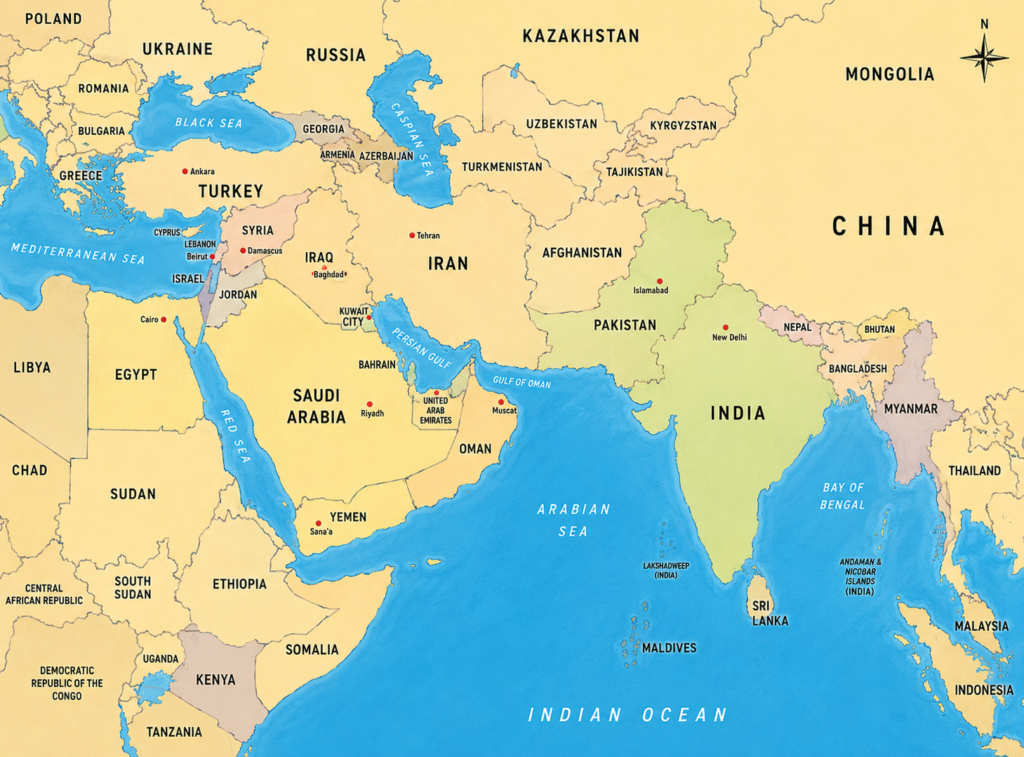
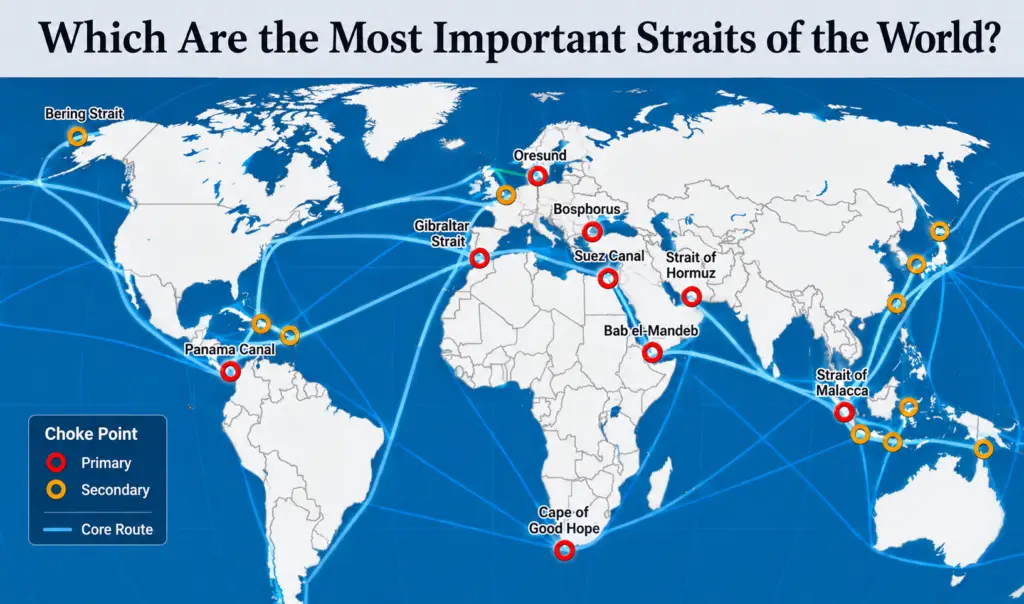
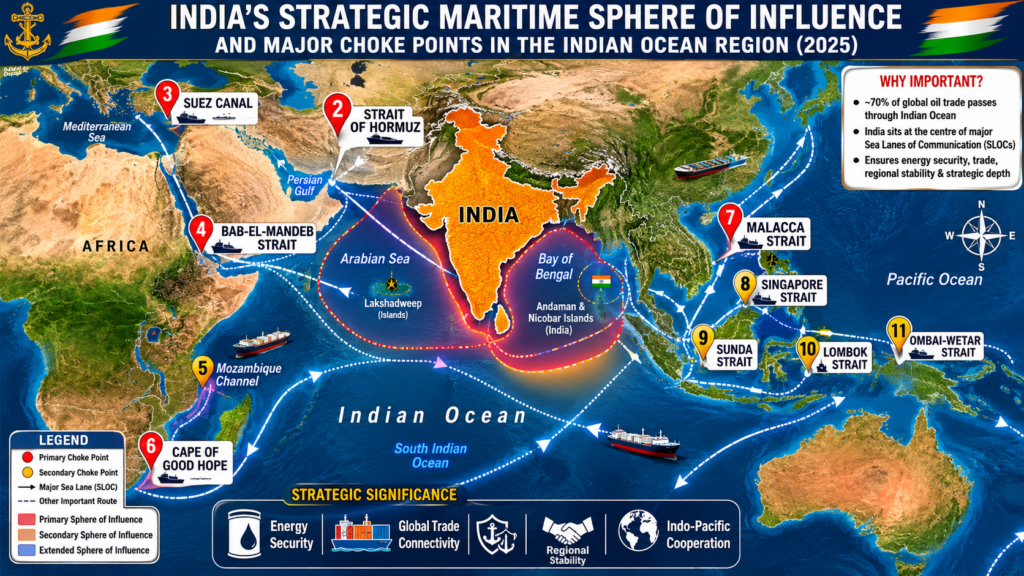
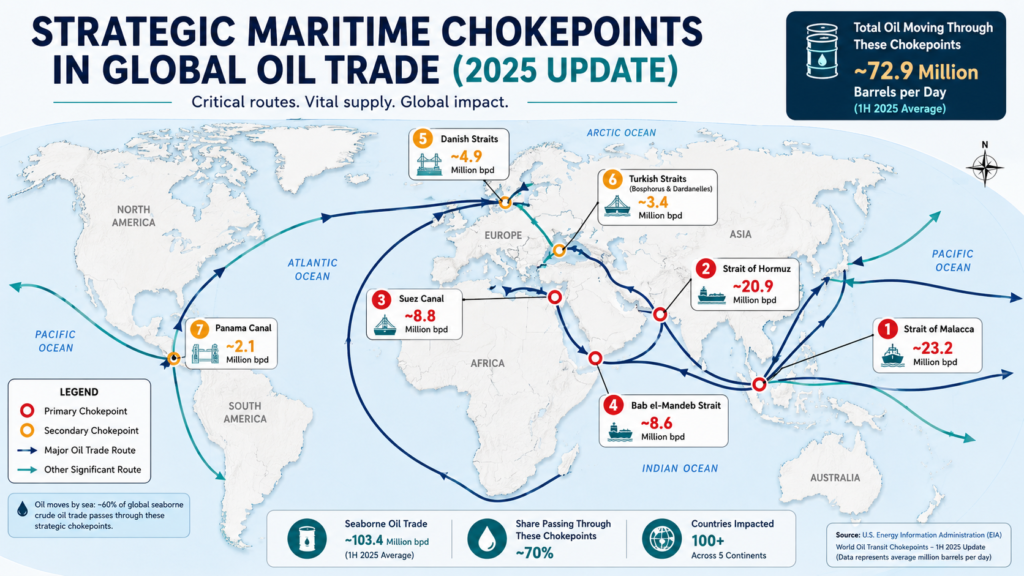
India’s location provides natural strategic depth and dominance over key maritime chokepoints:
| Strait | Location | Importance for India |
|---|---|---|
| Strait of Malacca | Between Malaysia & Indonesia | Controls access to East Asia & Pacific; ~25% of global trade; China’s energy lifeline |
| Strait of Hormuz | Between Iran & Oman | 20%+ of global oil; India imports ~85% of its oil through this route |
| Bab-el-Mandeb | Between Yemen & Djibouti | Links Red Sea & Suez Canal; vital for Europe-Asia trade |
- Andaman & Nicobar Islands: Act as “unsinkable aircraft carriers” near Malacca Strait, enabling surveillance and power projection.
- Lakshadweep: Strategic depth in the Arabian Sea.
- Controls critical Sea Lanes of Communication (SLOCs) carrying two-thirds of global oil shipments.
Defence Perspective:
- Northern barrier (Himalayas) limits land threats.
- Southern maritime frontier allows naval dominance.
- Central position supports Indo-Pacific strategy, QUAD, and SAGAR policy.
3. Economic Significance
- Trade: 95% of India’s trade by volume and nearly all oil imports move through sea routes.
- Blue Economy: Vast EEZ (2.37 million sq km) for fisheries, hydrocarbons, minerals, and renewable energy.
- Energy Security: Heavy dependence on Persian Gulf oil makes stability in Hormuz and Bab-el-Mandeb critical.
- Connectivity: Potential transshipment hubs (Great Nicobar Project) reduce dependence on Singapore/Colombo.
- Ports & Sagarmala: 12 major + 200+ minor ports benefit from central location.
4. Historical and Cultural Significance
- Ancient maritime links with East Africa, Arabia, Southeast Asia (Spice Route, Silk Route extensions).
- Spread of Buddhism, Hinduism, Indian culture, languages, and textiles.
- Attracted traders, invaders, and settlers — shaping India’s composite culture.
- Named the Indian Ocean after India, reflecting historical influence.
5. Geopolitical Significance (Contemporary)
- Indo-Pacific Pivot: India is a net security provider in the IOR.
- Counters China’s String of Pearls and Belt & Road Initiative through SAGAR, QUAD, IORA, and BIMSTEC.
- Bridge between Global South and developed world.
- Climate and disaster diplomacy leverage (e.g., Indian Ocean tsunami response).
6. Challenges Arising from Location
- Maritime Vulnerabilities: Piracy, IUU fishing, and chokepoint disruptions (e.g., Red Sea crisis).
- Border Disputes: With China (LAC) and Pakistan.
- Resource Strain: Securing vast land + maritime frontiers.
- Climate Change: Rising sea levels threaten coastal areas and islands.
- Geopolitical Tightrope: Balancing relations with major powers (US, China, Russia).
7. Government Initiatives
- SAGAR Policy (2015): Security and Growth for All in the Region.
- Indo-Pacific Oceans Initiative (IPOI).
- Great Nicobar Project: Transshipment port and strategic hub.
- Andaman & Nicobar Command (India’s only tri-service command).
- Maritime India Vision 2030 & Amrit Kaal Vision 2047.
- Enhanced naval capabilities (INS Vikrant, P-8I aircraft) and coastal security schemes.
6. Indian Subcontinent
India is not just a country but the largest and most dominant part of the Indian Subcontinent. The term “subcontinent” denotes a large, distinct landmass that is geographically, culturally, and historically separate from the rest of the Asian continent. The Indian Subcontinent is a classic example of this phenomenon, primarily due to the formidable barrier of the Himalayas, which isolates it from Central and East Asia. This unique geographical setting has profoundly shaped the region’s climate, culture, history, politics, and economy.
1. Meaning and Definition of a Subcontinent
A subcontinent is a large, relatively self-contained landmass that forms a subdivision of a continent, separated by significant physical barriers such as mountains, deserts, or seas.
Key Characteristics:
- Large size and distinct physiography.
- Separation from the main continent by formidable barriers.
- Unique climatic, cultural, and historical identity.
- Often exhibits “Unity in Diversity”.
2. Composition of the Indian Subcontinent
| Core Countries | Status | Remarks |
|---|---|---|
| India | Largest & Central | Dominates demographically, economically & culturally |
| Pakistan | Core | Shares Indus Valley civilisation |
| Bangladesh | Core | Shares Ganga-Brahmaputra delta |
| Nepal | Core | Himalayan buffer state |
| Bhutan | Core | Himalayan buffer state |
Culturally Associated:
- Sri Lanka and Maldives — Linked through Indian Ocean maritime history, Buddhism, and Tamil cultural ties.
Sometimes Included (Broader Definition):
- Afghanistan (due to historical and cultural links with northwest India).
3. Why is India (and the Region) Called a Subcontinent?
A. Geographical Factors
- Himalayan Barrier: The world’s highest mountain range acts as a massive wall separating the subcontinent from the rest of Asia.
- Distinct Physiography: Himalayas → Northern Plains → Peninsular Plateau → Coastal Plains → Islands.
- Peninsular Protrusion: India juts deep into the Indian Ocean, giving the region a unique maritime identity.
- Size: The subcontinent covers nearly 4.4 million sq km — larger than Europe (excluding Russia).
B. Climatic Unity
- The Himalayas block cold Central Asian winds and trap the southwest monsoon, creating a distinct tropical monsoon climate across the region.
- This shared climate influences agriculture, festivals, and lifestyles.
C. Historical and Cultural Unity
- Common Indus Valley Civilisation and Vedic roots.
- Spread of Buddhism, Hinduism, Jainism, and Islam across the region.
- Shared colonial experience under British rule (except Nepal & Bhutan).
- Unity in Diversity: Despite linguistic, religious, and ethnic diversity, a common civilisational thread exists.
- Cultural exports: Yoga, Ayurveda, Indian epics, spices, and textiles.
D. Geological Unity
- The Indian Plate broke from Gondwanaland and collided with the Eurasian Plate, forming the Himalayas. This shared geological history binds the region.
4. Role of the Himalayas in Defining the Subcontinent
- Physical Barrier: Prevents easy movement from North Asia.
- Climatic Barrier: Creates tropical climate south of the range.
- Cultural Barrier: Helped preserve a distinct Indian civilisation.
- Water Tower of Asia: Source of major rivers (Indus, Ganga, Brahmaputra) — lifeline for the entire subcontinent.
- Biodiversity Hotspot: Rich ecosystems shared across countries.
- Strategic Barrier: Limits large-scale invasions but also creates border disputes.
5. Strategic and Geopolitical Significance
- The subcontinent occupies a pivotal position between West Asia, Central Asia, and Southeast Asia.
- Controls key access to the Indian Ocean.
- India’s central location makes it a natural leader in regional groupings like SAARC, BIMSTEC, and BBIN.
- Persistent challenges: Border disputes (India-China, India-Pakistan), water sharing (Indus, Teesta), and cross-border terrorism.
- Potential for regional cooperation in trade, energy, and disaster management.
6. Challenges Facing the Indian Subcontinent
- Political Fragmentation: Partition of 1947 and subsequent conflicts.
- Boundary Disputes: Kashmir, Siachen, Doklam, Kalapani.
- Resource Conflicts: River water sharing (Indus Waters Treaty, Teesta).
- Climate Change Vulnerability: Himalayan glacier melt, sea-level rise (affecting Bangladesh and Maldives).
- Terrorism and Instability: Impacts regional development.
- Economic Disparities: India’s dominance creates both opportunities and resentment.
7. Significance for India
- Reinforces India’s civilisational identity and soft power.
- Gives India natural leadership in the region.
- Provides strategic depth and buffer states (Nepal, Bhutan).
- Shared cultural heritage strengthens people-to-people ties despite political differences.
- Forms the basis of India’s Neighbourhood First Policy.
The Indian Subcontinent is a distinct geographical, cultural, and civilisational entity, largely defined by the Himalayas and the Indian Ocean. For India, this subcontinental identity is both an asset and a responsibility. While geographical unity offers enormous potential for regional cooperation, historical divisions and strategic rivalries continue to pose challenges. In the 21st century, India must leverage its central position to promote peace, economic integration, and shared prosperity in the subcontinent — a prerequisite for its emergence as a global power.
7. Role of the Himalayas
The Himalayas are the youngest and highest mountain system in the world, stretching about 2,400 km from the Indus Gorge in the west to the Brahmaputra Gorge in the east. Formed by the collision of the Indian Plate with the Eurasian Plate, they act as the crown of India and the defining feature of the Indian Subcontinent. Often called the “Third Pole” due to their vast glacial reserves, the Himalayas play a multi-dimensional role — physical, climatic, hydrological, cultural, ecological, strategic, and economic — profoundly shaping India’s geography, climate, civilisation, and security.
1. Physical Barrier
- The Himalayas form a formidable natural wall between the Indian Subcontinent and the rest of Asia (Tibet, Central Asia, and China).
- Average height: 6,000 metres; width: 150–400 km.
- They isolate India geographically, giving it the character of a subcontinent.
- Major passes (Zoji La, Shipki La, Nathu La) are few and difficult, limiting large-scale movement.
2. Climatic Barrier (Most Important Role)
- Block Cold Winds: Prevent cold Siberian/Central Asian winds from entering the subcontinent, keeping northern India warmer than other regions at the same latitude.
- Monsoon Trap: Force the southwest monsoon winds to ascend, causing orographic rainfall. This is the primary reason for India’s tropical monsoon climate.
- Without the Himalayas, India would have been a desert like Central Asia or experienced extreme continental climate.
- They create rain shadow areas (e.g., Ladakh plateau) and influence micro-climates across the region.
3. Drainage Divide / Water Tower of Asia
- The Himalayas are the source of major perennial river systems:
- Indus System (Jhelum, Chenab, Ravi, Beas, Sutlej)
- Ganga System (Yamuna, Ghaghara, Gandak, Kosi)
- Brahmaputra System
- They feed over 50% of India’s river water, supporting irrigation for millions of hectares and sustaining the Indo-Gangetic Plains — the granary of India.
- Glaciers (Siachen, Gangotri, Yamunotri) act as natural reservoirs, ensuring year-round water supply.
- Hydropower Potential: Massive scope for hydroelectric projects (e.g., Tehri, Bhakra Nangal).
4. Cultural and Historical Barrier
- Acted as a cultural filter, limiting large-scale invasions from the north while allowing selective cultural exchange through passes.
- Helped preserve India’s distinct civilisational identity (Vedic, Buddhist, Hindu traditions).
- Influenced architecture, religion, and lifestyle — e.g., Himalayan temples, monasteries, and trans-Himalayan trade (silk, wool, herbs).
- Symbol of spiritual and cultural unity (considered sacred in Hinduism, Buddhism, and Jainism).
5. Ecological and Environmental Role
- Biodiversity Hotspot: Home to unique flora and fauna (snow leopard, red panda, Himalayan musk deer, rhododendrons).
- Carbon Sink and Climate Regulator: Forests regulate regional climate and sequester carbon.
- Soil Conservation: Prevent soil erosion in the northern plains.
- Disaster Regulation: Influence cloud formation and rainfall patterns.
6. Strategic and Defence Importance
- Act as a natural frontier against China and provide strategic depth.
- High passes and ridges are vital for military positioning (Siachen, Ladakh).
- Control of Himalayan heights is critical in India-China border disputes (LAC).
- Buffer states: Nepal and Bhutan provide additional strategic cushion.
7. Economic Importance
- Tourism: Major revenue source (Himachal, Uttarakhand, Sikkim, Kashmir).
- Agriculture & Horticulture: Apples, saffron, medicinal plants.
- Hydropower: Major contributor to India’s renewable energy.
- Minerals: Limestone, gypsum, copper, and precious stones.
8. Contemporary Challenges
- Climate Change: Rapid glacial melting (Gangotri retreating), GLOF (Glacial Lake Outburst Flood) risks (e.g., 2023 Sikkim disaster).
- Seismic Vulnerability: Earthquake-prone (Zone V) due to tectonic activity.
- Ecological Degradation: Deforestation, landslides, and hydropower-induced displacement.
- Border Infrastructure vs Environment: China’s infrastructure push forces India to balance development and conservation.
- Water Disputes: Sharing of Himalayan rivers with Pakistan, Nepal, and China.
9. Government Initiatives
- National Mission for Sustaining the Himalayan Ecosystem (NMSHE) under NAPCC.
- Biodiversity Conservation: Project Snow Leopard, Himalayan Biosphere Reserves.
- Border Infrastructure: BRO’s road projects, Vibrant Villages Programme.
- Disaster Management: GLOF monitoring, early warning systems.
- Sustainable Development: Eco-tourism and green energy projects.
The Himalayas are far more than a mountain range — they are the geographical, climatic, and cultural guardian of the Indian Subcontinent. They have shaped India’s identity as a distinct civilisation, provided water and ecological security, and continue to play a decisive role in its strategic outlook. In the era of climate change and geopolitical competition, the sustainable management and protection of the Himalayas is not just an environmental necessity but a strategic and civilisational imperative for India. As rightly said, “Himalayas are the soul of India.”
Expected Questions:
- “Why is India called a subcontinent?” Discuss. (15 Marks)
- Examine the role of the Himalayas in shaping the identity of the Indian Subcontinent.
- “Geographical unity of the Indian Subcontinent is stronger than its political divisions.” Comment.
- “The Himalayas are more than a physical barrier.” Examine. (15 Marks)
- Discuss the role of the Himalayas in shaping the climate and economy of India.
- Examine the strategic and ecological significance of the Himalayas for India.
8. India: Tropical or Temperate?
India is often described as a tropical country despite a significant portion lying north of the Tropic of Cancer. This classification is not based merely on latitudinal position but on a combination of climatic characteristics, physical barriers, agricultural patterns, and cultural-economic features. The Tropic of Cancer (23°30′ N) passes almost through the middle of India, dividing the country into two broad climatic zones. However, the dominance of tropical features makes India overwhelmingly tropical in character.
1. Latitudinal Division of India
- Tropic of Cancer (23°30′ N) passes through the central part of India.
- States Traversed by Tropic of Cancer (8 States): Gujarat → Rajasthan → Madhya Pradesh → Chhattisgarh → Jharkhand → West Bengal → Tripura → Mizoram.
- Climatic Zones:
- Southern Part (South of Tropic of Cancer): Truly Tropical Zone.
- Northern Part (North of Tropic of Cancer): Sub-tropical / Temperate Zone.
Even though the temperate/sub-tropical zone is larger in area, India is predominantly treated as a tropical country.
2. Why is India Treated as a Tropical Country?
A. Physical and Climatic Reasons
- Himalayan Barrier
- The Himalayas act as a formidable climatic barrier, blocking cold continental winds from Central Asia and Siberia.
- This prevents India from experiencing severe winters typical of temperate countries at similar latitudes (e.g., compared to China or USA).
- Result: Most parts of India remain relatively warm throughout the year.
- Dominance of Tropical Monsoon Climate
- India experiences a classic tropical monsoon climate (Köppen classification: Am, Aw).
- Features: High temperature throughout the year, seasonal reversal of winds, and concentrated rainfall during June–September.
- Even northern India receives heavy monsoon rainfall and high summer temperatures.
- High Insolation and Temperature Regime
- India receives abundant solar radiation due to its tropical location.
- Winter temperatures rarely fall below 10–15°C in the plains.
- Most parts experience hot summers (above 30°C) and mild winters.
- Absence of True Temperate Features
- No prolonged freezing winters, no snowfall in plains, and no deciduous forests of the temperate type in most regions.
B. Economic and Cultural Reasons
- Agriculture: Predominantly tropical crops — rice, sugarcane, cotton, jute, tea, coffee, spices, and tropical fruits. Cropping patterns are monsoon-dependent.
- Natural Vegetation: Tropical rainforests, deciduous forests, and thorn forests dominate.
- Diseases and Health: Tropical diseases like malaria, dengue, and cholera are more prevalent.
- Lifestyle and Economy: Traditional occupations, housing patterns, clothing, and food habits reflect tropical conditions.
- Biodiversity: Richness of tropical flora and fauna.
3. Comparative Analysis
| Feature | Tropical South | Sub-tropical/Temperate North | Overall Character |
|---|---|---|---|
| Temperature | High year-round | Cooler winters | Tropical dominant |
| Rainfall | Monsoon dominant | Monsoon + Western Disturbances | Tropical monsoon |
| Vegetation | Evergreen/Deciduous | Mixed | Tropical |
| Agriculture | Rice, Plantation crops | Wheat, Maize | Tropical bias |
| Influence of Himalayas | Indirect | Direct protection | Key factor |
4. Significance of Treating India as Tropical
Positive Aspects:
- Supports rich biodiversity and multiple cropping.
- High agricultural potential.
- Advantage in tropical medicine and biotechnology.
Challenges:
- High vulnerability to climate change, cyclones, and erratic monsoons.
- Spread of vector-borne diseases.
- Heat waves and urban heat islands in tropical zones.
5. Contemporary Relevance
- Climate Change: Rising temperatures and changing monsoon patterns are affecting both zones, but the tropical character makes India more vulnerable to extreme weather events.
- Agriculture Policy: Focus on climate-resilient tropical crops.
- International Grouping: India aligns with tropical developing countries in forums like G77 and BASIC on climate negotiations.
Although the Tropic of Cancer divides India into tropical and sub-tropical zones, the country is rightly regarded as tropical due to the overwhelming influence of the Himalayas, the monsoon system, and associated tropical features in agriculture, vegetation, and lifestyle. The Himalayas play the decisive role by blocking cold winds and creating a warm, humid environment across most of the country. This tropical character is fundamental to understanding India’s climate, economy, biodiversity, and vulnerability to climate change. For India’s development planning and disaster management, recognising its predominantly tropical nature remains crucial.
Expected Questions:
- “Why is India considered a tropical country even though a large part lies in the temperate zone?” Discuss. (15 Marks)
- Examine the role of the Himalayas in making India a tropical country.
- Discuss the implications of India’s tropical location on its agriculture and economy.
9. Time Difference and Indian Standard Time (IST)
India’s vast longitudinal extent creates a significant local time difference across the country. Despite this, India follows a single standard time — the Indian Standard Time (IST) — for administrative convenience and national integration. This topic highlights the interplay between geography (longitude) and governance (uniform time policy) and is frequently asked in UPSC Prelims (mapping) and Mains (analytical questions on unity, administration, and federalism).
1. Cause of Time Difference in India
- Earth rotates 360° in 24 hours → 1° longitude = 4 minutes time difference.
- India’s longitudinal extent: 68°7′ E (Guhar Moti, Gujarat) to 97°25′ E (Kibithu, Arunachal Pradesh) ≈ 30° span.
- Time difference = 30° × 4 minutes = 120 minutes = 2 hours.
Practical Impact:
- Sunrise in Arunachal Pradesh (easternmost) occurs nearly 2 hours earlier than in Gujarat (westernmost).
- Example: When it is 6:00 AM in Kibithu (Arunachal), it is only around 4:00 AM in Guhar Moti (Gujarat).
2. Indian Standard Time (IST)
- Standard Meridian: 82°30′ East longitude.
- This meridian passes through Mirzapur (near Allahabad) in Uttar Pradesh.
- IST = UTC + 5:30 hours (5 hours 30 minutes ahead of Greenwich Mean Time).
- IST is the official time used across the country for all purposes — railways, aviation, broadcasting, banking, defence, and government functions.
3. Why Does India Follow a Single Time Zone?
Despite a 2-hour difference, India adopted one time zone after independence. Reasons include:
Administrative and Political Unity:
- A single time promotes national integration in a diverse country.
- Avoids confusion in scheduling and coordination.
Economic and Functional Efficiency:
- Uniform time is essential for Indian Railways (world’s 4th largest network), air traffic control, stock markets, and banking.
- Simplifies broadcasting (Doordarshan, All India Radio) and emergency services.
Historical Decision:
- Before independence, several local times existed (Bombay Time, Calcutta Time, Madras Time).
- In 1906, Indian Standard Time was introduced based on 82°30′ E. It was retained after 1947 for unity.
Comparison:
- Large countries like Russia (11 time zones), USA (11), Canada (6) use multiple zones due to greater longitudinal span and federal structure.
- India consciously chose unity over local solar time.
4. Implications of Single Time Zone
Advantages:
- Strengthens the idea of “One India”.
- Improves coordination in defence and disaster management.
- Enhances economic efficiency.
Disadvantages / Challenges:
- Northeastern states experience very early sunrise and late sunset relative to official time.
- Affects daily life, school timings, and productivity in eastern states (e.g., people wake up earlier but offices open as per IST).
- Some experts suggest dual time zones (IST + Northeast Time), but the government has rejected this to preserve national unity.
India’s longitudinal span of nearly 30° creates a natural time difference of two hours between its eastern and western extremities. However, the adoption of Indian Standard Time (82°30′ E) reflects India’s commitment to administrative unity, national integration, and economic efficiency. While this decision sacrifices local solar time in some regions, it strengthens the idea of “One Nation, One Time”. In a diverse and vast country like India, such uniformity is not just a geographical convenience but a political and administrative necessity that reinforces the spirit of unity in diversity.
10. Significance of India’s Geographical Extent
India’s geographical extent — spanning approximately 3,214 km north-south and 2,933 km east-west, with an area of 3.287 million sq km — is one of the most significant factors shaping its identity as a subcontinent. This vast extent is not merely a statistical fact; it creates immense diversity while simultaneously offering strategic advantages and posing serious developmental challenges. The location and size of India form the very foundation of its physical, economic, cultural, and strategic personality.
1. Diversity Created by Geographical Extent
A. Climatic Diversity
- Ranges from tropical (Kerala, Tamil Nadu) to alpine (Ladakh, Himalayas) and arid (Rajasthan).
- The Tropic of Cancer divides the country into tropical and sub-tropical zones.
- Leads to varied rainfall patterns — from >2,000 mm in Cherrapunji to <100 mm in western Rajasthan.
B. Soil and Agricultural Diversity
- Different soil types: Alluvial (Northern Plains), Black (Deccan), Red & Laterite (Peninsula), Desert (Rajasthan).
- Supports diverse crops: Rice & Jute (east), Wheat & Sugarcane (north), Cotton (west), Spices & Plantation crops (south), Millets (dry areas).
C. Cultural and Linguistic Diversity
- Vast size has fostered 22 scheduled languages, hundreds of dialects, and varied food habits, festivals, dress, and architecture.
- Promotes the philosophy of “Unity in Diversity”.
D. Biodiversity
- From coral reefs in Lakshadweep to alpine meadows in Himalayas and mangroves in Sundarbans — India is one of the 17 megadiverse countries.
2. Advantages of Large Geographical Extent
A. Resource Base
- Rich and varied mineral resources (iron ore, coal, bauxite, manganese, mica).
- Diverse forest resources and marine resources in a large EEZ (2.37 million sq km).
- Multiple river systems originating from Himalayas provide water security.
B. Agricultural Variety and Food Security
- Ability to grow almost every crop due to varied agro-climatic zones.
- Supports multiple cropping seasons (Kharif, Rabi, Zaid).
- Acts as a buffer against regional crop failures.
C. Strategic Depth and Geopolitical Advantage
- Large size provides defence in depth against invasions or conflicts.
- Northern Himalayan barrier + southern Indian Ocean protrusion gives natural strategic advantage.
- Enables India to play a leading role in South Asia and the Indo-Pacific.
D. Economic Potential
- Huge domestic market due to population and size.
- Diverse tourism potential (hill stations, beaches, deserts, heritage sites).
3. Challenges Arising from Large Geographical Extent
A. Administrative and Governance Issues
- Difficult to implement uniform policies across such a vast and diverse territory.
- Coordination challenges between Centre and States.
B. Regional Disparities
- Sharp development gaps between states (e.g., Maharashtra vs Bihar, Kerala vs Jharkhand).
- Uneven industrial growth and infrastructure development.
C. Disaster Management Challenges
- Exposed to multiple hazards: Earthquakes (Himalayas), Cyclones (east & west coast), Floods (Northern Plains), Droughts (Deccan & Rajasthan), Landslides (Western Ghats & Himalayas).
- Vast coastline (7,516 km) and mountainous terrain make disaster response logistically complex.
D. Other Challenges
- High cost of infrastructure development (roads, railways, communication).
- Environmental pressure due to large population on limited resources.
- Internal security issues (Naxalism in central India, insurgency in Northeast).
India’s geographical extent has made it a land of contrasts — rich in resources and diversity, yet complex to govern. It explains why India is called a subcontinent. The Himalayas in the north and the Indian Ocean in the south have shaped its climate, security, and civilisation for centuries. This unique setting underpins its role in global affairs, monsoon dynamics, biodiversity, and geopolitics.
While the vast extent gives India strategic depth, resource diversity, and cultural richness, it also demands strong federalism, inclusive development policies, and disaster-resilient infrastructure. For India to realise its goal of becoming a developed nation by 2047, balanced regional development that harnesses this geographical diversity while minimising its challenges is essential.
Expected Questions:
- “The large geographical extent of India is both a strength and a challenge.” Discuss. (15 Marks)
- Examine how India’s geographical extent influences its climate, economy, and polity.