
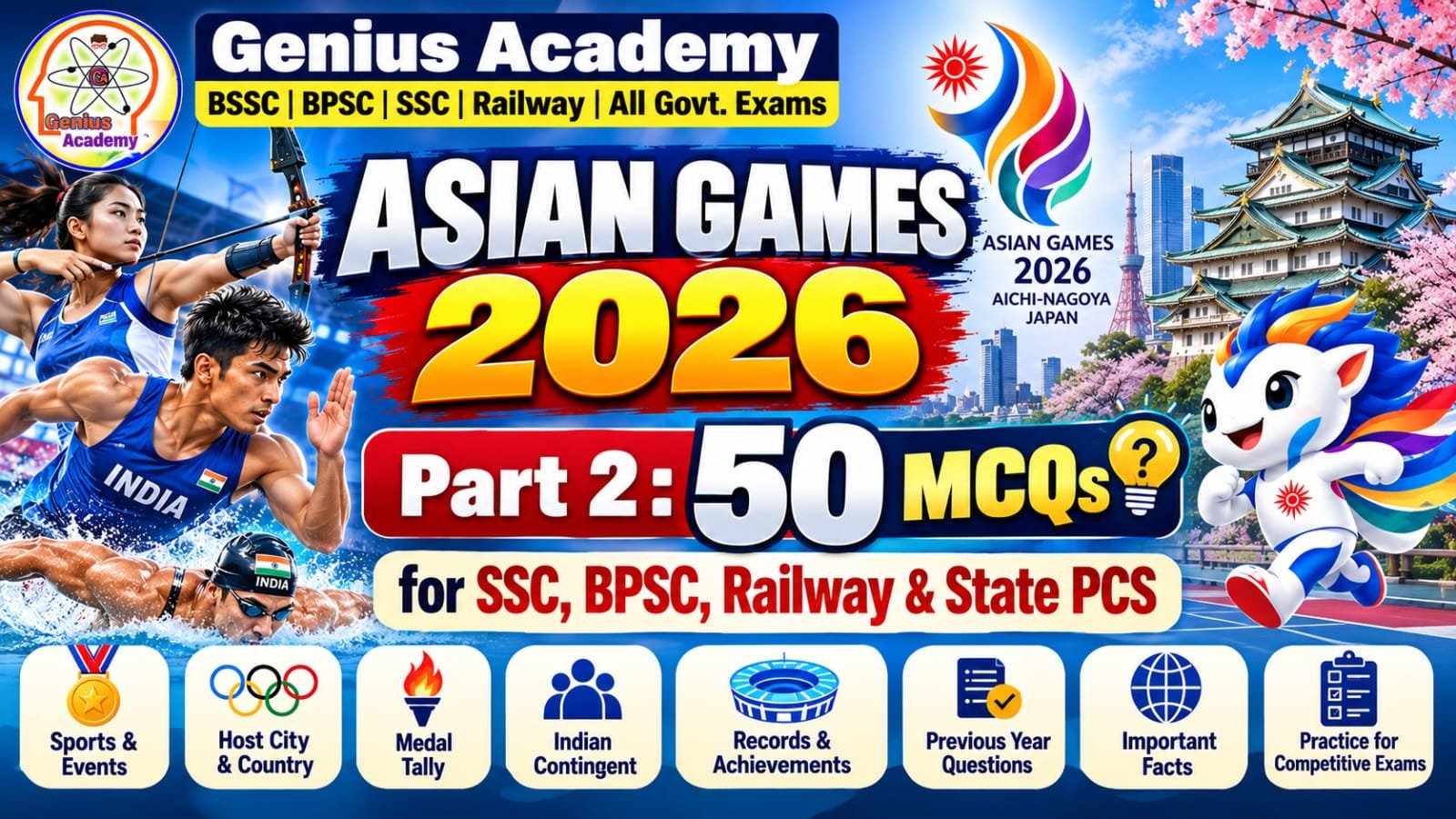
50 MCQs of Asian Games 2026 Part 2
26
In which year was kabaddi officially included in the Asian Games for the first time?
एशियाई खेलों में पहली बार कबड्डी को किस वर्ष आधिकारिक तौर पर शामिल किया गया था?
| Milestone | Year / Edition |
|---|---|
| Kabaddi demonstration appearance | 1982 — New Delhi |
| Regular Asian Games sport | 1990 — Beijing |
| First men’s Asian Games gold | India — Beijing 1990 |
| Women’s kabaddi introduced | 2010 — Guangzhou |
| Important later editions | 1994 Hiroshima, 1998 Bangkok, 2002 Busan, 2006 Doha |
27
India won the gold medal by defeating South Korea 2–1 in the football final at the Asian Games held in Jakarta. In which year did this take place?
जकार्ता में आयोजित एशियाई खेलों में भारत ने फुटबॉल फाइनल में दक्षिण कोरिया को
2–1 से हराकर स्वर्ण पदक जीता। यह किस वर्ष हुआ था?
| Fact | Details |
|---|---|
| Asian Games | 4th Asian Games — Jakarta 1962 |
| Final date | 4 September 1962 |
| Venue | Gelora Bung Karno Stadium, Jakarta |
| Final result | India 2–1 South Korea |
| Indian scorers | P. K. Banerjee (17′), J. Singh (20′) |
| Indian coach | Syed Abdul Rahim |
28
In which city were the second Asian Games held?
दूसरे एशियाई खेलों का आयोजन किस शहर में हुआ था?
| Fact | Details |
|---|---|
| Edition | 2nd Asian Games / II Asiad |
| Host city | Manila, Philippines |
| Dates | 1–9 May 1954 |
| Opened by | President Ramon Magsaysay |
| Athletes | 970 |
| Sports / Events | 8 sports / 76 events |
| India’s medal tally | 4 Gold, 4 Silver, 5 Bronze — 13 total |
29
Which country won the highest number of medals (first place) at the 1951 Asian Games?
1951 के पहले एशियाई खेलों में सर्वाधिक पदक (प्रथम स्थान) किस देश ने जीते?
| Rank | Country | Gold | Silver | Bronze | Total |
|---|---|---|---|---|---|
| 1 | Japan | 24 | 21 | 15 | 60 |
| 2 | India | 15 | 16 | 20 | 51 |
| 3 | Iran | 8 | 6 | 2 | 16 |
| 4 | Singapore | 5 | 7 | 2 | 14 |
30
Who was the first Indian boxer to win a gold medal at the Asian Games?
एशियाई खेलों में स्वर्ण पदक जीतने वाले पहले भारतीय मुक्केबाज (Boxer) कौन थे?
| Boxer | Important Achievement |
|---|---|
| Padam Bahadur Mal | First Indian Asian Games boxing gold medallist — 1962 |
| Hawa Singh | Two-time Asian Games heavyweight champion |
| Dingko Singh | Asian Games gold medallist — 1998 |
| Vijender Singh | India’s first Olympic boxing medallist — bronze, Beijing 2008 |
| Padam Bahadur Mal’s award | Arjuna Award — 1962 |
31
Who was among the first Indian wrestlers to win a gold medal at the Asian Games?
एशियाई खेलों में स्वर्ण पदक जीतने वाले पहले भारतीय पहलवानों में से एक कौन थे?
| Wrestler | 1962 Asian Games Achievement |
|---|---|
| Maruti Mane | Gold — Men’s 97 kg Freestyle |
| Malwa | Gold — Men’s 52 kg Greco-Roman |
| Ganpat Andhalkar | Gold — Men’s 97+ kg Greco-Roman |
| K. D. Jadhav | India’s first individual Olympic medallist — Wrestling bronze, Helsinki 1952 |
| Sushil Kumar | Two-time Olympic medallist in wrestling |
32
Who was the first Indian to win a gold medal in golf at the Asian Games?
एशियाई खेलों में गोल्फ में स्वर्ण पदक जीतने वाले पहले भारतीय कौन हैं?
| Fact | Details |
|---|---|
| Golf’s Asian Games debut | 1982 — New Delhi |
| Individual Gold | Lakshman Singh — India |
| Individual Silver | Rajiv Mohta — India |
| Team Gold | India |
| Indian team | Lakshman Singh, Rajiv Mohta, Rishi Narain, Amit Luthra |
| Team result | India ahead of South Korea and Japan |
33
Which edition of the Asian Games was held in India in 1982?
1982 में भारत में आयोजित एशियाई खेल कौन-से क्रम के एशियाई खेल थे?
| Fact | Details |
|---|---|
| Edition | 9th Asian Games — IX Asiad |
| Host | New Delhi, India |
| Dates | 19 November – 4 December 1982 |
| Athletes | 3,411 |
| NOCs | 33 |
| Sports / Events | 21 sports / 147 events |
| Mascot | Appu — a young elephant |
| India’s rank | 5th — 13 Gold, 19 Silver, 25 Bronze = 57 medals |
34
In which country is the 22nd Asian Games (originally scheduled for 2034) to be held?
22वें एशियाई खेल (मूल रूप से 2034 के लिए निर्धारित) किस देश में आयोजित होने हैं?
| Edition | Host City | Country | Current Scheduling Note |
|---|---|---|---|
| 20th | Aichi-Nagoya | Japan | 2026 |
| 21st | Doha | Qatar | Currently listed as 2030; OCA Board proposed 2031 |
| 22nd | Riyadh | Saudi Arabia | Currently listed as 2034; OCA Board proposed 2035 |
35
How many new sports and sporting disciplines are making their Asian Games debut at Aichi-Nagoya 2026?
जापान के आइची-नागोया 2026 एशियाई खेलों में कितने नए खेल और खेल-विधाएँ पहली बार शामिल की जा रही हैं?
| New sport / discipline | Category / Note |
|---|---|
| Teqball | New sport; officially added as a medal sport |
| Padel | New sport; officially added as a medal sport |
| Surfing | Asian Games debut |
| Cycling BMX Freestyle | New discipline under cycling |
| Mixed Martial Arts (MMA) | New discipline / sport category making its debut |
| Virtual Taekwondo | New virtual discipline / format under taekwondo |
| Total debut additions | 6 |
| Aichi-Nagoya programme | 43 sports, 71 disciplines, 469 medal events |
36
What was the first mascot introduced for the Asian Games?
एशियाई खेलों के लिए पेश किया गया पहला शुभंकर (Mascot) क्या था?
| Fact | Details |
|---|---|
| First Asian Games mascot | Appu |
| Character | A young Indian elephant |
| Games | 9th Asian Games |
| Host | New Delhi, India |
| Year | 1982 |
| Historical significance | First mascot used for the Asian Games |
37
In which year was a mascot first introduced at the Asian Games?
एक शुभंकर (Mascot) पहली बार एशियाई खेलों में किस वर्ष पेश किया गया था?
| Milestone | Details |
|---|---|
| First mascot | Appu |
| First mascot year | 1982 |
| Host city | New Delhi, India |
| Asian Games edition | 9th |
| Sports / Events | 21 sports / 147 events |
38
Which athlete won India’s first Asian Games gold medal in 1951?
1951 में भारत का पहला एशियाई खेलों का स्वर्ण पदक किस खिलाड़ी ने हासिल किया था?
| Fact | Details |
|---|---|
| Athlete | Sachin Nag |
| Event | Men’s 100 m Freestyle |
| Year | 1951 |
| Host | New Delhi, India |
| Historical achievement | India’s first Asian Games gold medal |
| Other medals at 1951 Games | Bronze — 4×100 m freestyle relay and 3×100 m medley relay |
| India’s overall tally | 15 Gold, 16 Silver, 20 Bronze = 51 |
39
Where was the proposal to host the Asian Games first made?
एशियाई खेलों के आयोजन का सुझाव सबसे पहले कहाँ दिया गया था?
| Year | Important Development |
|---|---|
| 1947 | Asian Relations Conference, New Delhi; Sondhi promoted the Asian Games idea |
| 1947 | The term “Asian Games” was adopted instead of “Asiatic Games” |
| 1949 | Asian Games Federation established in New Delhi |
| 1951 | First Asian Games held in New Delhi |
| Founder figure | Prof. Guru Dutt Sondhi |
40
In which sport did India win its first gold medal at the 1951 Asian Games?
1951 के एशियाई खेलों में भारत ने अपना पहला स्वर्ण पदक किस खेल में जीता था?
| Fact | Details |
|---|---|
| First Indian Asian Games gold | Sachin Nag |
| Sport | Swimming |
| Event | Men’s 100 m Freestyle |
| Year | 1951 |
| Host | New Delhi, India |
| India’s final tally | 15 Gold, 16 Silver, 20 Bronze = 51 |
| India’s medal-table position | 2nd, behind Japan |
41 Who won India’s first individual gold medal in archery at the Asian Games? एशियाई खेलों में तीरंदाजी की व्यक्तिगत स्पर्धा में भारत के लिए पहला स्वर्ण पदक किसने जीता था?
✓ सही उत्तर: (C) ओजस प्रवीण देवताले
✗ गलत उत्तर। सही उत्तर (C) ओजस प्रवीण देवताले है।
Ojas Pravin Deotale became India’s first male individual gold medallist in archery at the Asian Games. He achieved this historic distinction in the men’s individual compound archery event at the 19th Asian Games, officially called Hangzhou 2022, which were held in China in September–October 2023.
On 7 October 2023, Deotale defeated fellow Indian archer Abhishek Verma by 149–147 in the men’s individual compound final. Verma received the silver medal, giving India the top two positions in this event.
On the same day, Jyothi Surekha Vennam became India’s first female individual Asian Games archery gold medallist. She defeated So Chaewon of South Korea by 149–145 in the women’s individual compound final.
Both Deotale and Vennam finished the Hangzhou Asian Games with three gold medals each. Their achievements helped India win all five compound archery gold medals available at these Games.
- Men’s individual compound gold: Ojas Pravin Deotale.
- Women’s individual compound gold: Jyothi Surekha Vennam.
- Men’s individual compound silver: Abhishek Verma.
- Men’s individual compound final: Deotale defeated Verma 149–147.
- Women’s individual compound final: Vennam defeated So Chaewon 149–145.
| Important Fact | Details |
|---|---|
| Asian Games edition | 19th Asian Games, Hangzhou 2022 |
| Actual year of competition | 2023 |
| First Indian men’s individual archery gold | Ojas Pravin Deotale |
| Men’s event | Compound individual |
| Men’s final score | 149–147 against Abhishek Verma |
| First Indian women’s individual archery gold | Jyothi Surekha Vennam |
| Women’s final score | 149–145 against So Chaewon |
| Compound archery gold medals won by India | 5 out of 5 |
ओजस प्रवीण देवताले एशियाई खेलों में तीरंदाजी की व्यक्तिगत स्पर्धा में स्वर्ण पदक जीतने वाले भारत के पहले पुरुष खिलाड़ी बने। उन्होंने यह ऐतिहासिक उपलब्धि पुरुषों की व्यक्तिगत कंपाउंड तीरंदाजी स्पर्धा में 19वें एशियाई खेलों के दौरान हासिल की। इन खेलों का आधिकारिक नाम हांगझोऊ 2022 था, लेकिन इनका आयोजन चीन में सितंबर–अक्टूबर 2023 में हुआ था।
7 अक्टूबर 2023 को देवताले ने पुरुषों की व्यक्तिगत कंपाउंड स्पर्धा के फाइनल में अपने ही देश के तीरंदाज अभिषेक वर्मा को 149–147 से हराया। वर्मा ने रजत पदक प्राप्त किया, जिससे इस स्पर्धा में भारत ने पहले दो स्थानों पर कब्जा किया।
इसी दिन ज्योति सुरेखा वेन्नम एशियाई खेलों की तीरंदाजी में व्यक्तिगत स्वर्ण पदक जीतने वाली भारत की पहली महिला खिलाड़ी बनीं। उन्होंने महिलाओं की व्यक्तिगत कंपाउंड स्पर्धा के फाइनल में दक्षिण कोरिया की सो चेवोन को 149–145 से पराजित किया।
देवताले और वेन्नम, दोनों ने हांगझोऊ एशियाई खेलों में तीन-तीन स्वर्ण पदक जीतकर अपना अभियान समाप्त किया। उनकी उपलब्धियों ने भारत को इन खेलों में कंपाउंड तीरंदाजी के सभी पाँच स्वर्ण पदक जीतने में सहायता की।
- पुरुष व्यक्तिगत कंपाउंड स्वर्ण: ओजस प्रवीण देवताले।
- महिला व्यक्तिगत कंपाउंड स्वर्ण: ज्योति सुरेखा वेन्नम।
- पुरुष व्यक्तिगत कंपाउंड रजत: अभिषेक वर्मा।
- पुरुष व्यक्तिगत कंपाउंड फाइनल: देवताले ने वर्मा को 149–147 से हराया।
- महिला व्यक्तिगत कंपाउंड फाइनल: वेन्नम ने सो चेवोन को 149–145 से हराया।
| महत्त्वपूर्ण तथ्य | विवरण |
|---|---|
| एशियाई खेलों का संस्करण | 19वें एशियाई खेल, हांगझोऊ 2022 |
| प्रतियोगिता का वास्तविक वर्ष | 2023 |
| भारत का पहला पुरुष व्यक्तिगत तीरंदाजी स्वर्ण | ओजस प्रवीण देवताले |
| पुरुषों की स्पर्धा | व्यक्तिगत कंपाउंड |
| पुरुष फाइनल का स्कोर | अभिषेक वर्मा के विरुद्ध 149–147 |
| भारत का पहला महिला व्यक्तिगत तीरंदाजी स्वर्ण | ज्योति सुरेखा वेन्नम |
| महिला फाइनल का स्कोर | सो चेवोन के विरुद्ध 149–145 |
| भारत द्वारा जीते गए कंपाउंड तीरंदाजी स्वर्ण पदक | 5 में से 5 |
42 Which country has hosted the Summer Asian Games the most times up to 2026? वर्ष 2026 तक किस देश ने ग्रीष्मकालीन एशियाई खेलों की सबसे अधिक बार मेजबानी की है?
✓ सही उत्तर: (A) थाईलैंड
✗ गलत उत्तर। सही उत्तर (A) थाईलैंड है।
Thailand has hosted the Summer Asian Games four times, the highest number of editions hosted by any country up to and including 2026. All four editions were organised in Bangkok, the capital of Thailand.
Bangkok hosted the Asian Games in 1966, 1970, 1978 and 1998. Consequently, Bangkok also holds the distinction of being the city that has hosted the Summer Asian Games the greatest number of times.
By the completion of the 2026 edition, China, Japan and South Korea had each hosted the Summer Asian Games three times. Japan reached its third hosting with the Aichi-Nagoya Asian Games in 2026.
India has hosted the Asian Games twice, both times in New Delhi, in 1951 and 1982. New Delhi also hosted the inaugural edition of the Asian Games in March 1951.
| Country | Host City / Cities | Years | Times |
|---|---|---|---|
| Thailand | Bangkok | 1966, 1970, 1978, 1998 | 4 |
| China | Beijing, Guangzhou, Hangzhou | 1990, 2010, 2022* | 3 |
| Japan | Tokyo, Hiroshima, Aichi-Nagoya | 1958, 1994, 2026 | 3 |
| South Korea | Seoul, Busan, Incheon | 1986, 2002, 2014 | 3 |
| India | New Delhi | 1951, 1982 | 2 |
*Hangzhou 2022 was postponed and actually held in 2023.
- Most frequent host country: Thailand — four times.
- Most frequent host city: Bangkok — four times.
- First Asian Games: New Delhi, India — 1951.
- 20th Asian Games: Aichi-Nagoya, Japan — 2026.
थाईलैंड ने ग्रीष्मकालीन एशियाई खेलों की चार बार मेजबानी की है, जो वर्ष 2026 तक, उसे शामिल करते हुए, किसी भी देश द्वारा आयोजित संस्करणों की सर्वाधिक संख्या है। ये चारों संस्करण थाईलैंड की राजधानी बैंकॉक में आयोजित किए गए थे।
बैंकॉक ने 1966, 1970, 1978 और 1998 में एशियाई खेलों की मेजबानी की थी। इसलिए बैंकॉक को ग्रीष्मकालीन एशियाई खेलों की सबसे अधिक बार मेजबानी करने वाला शहर होने का गौरव भी प्राप्त है।
वर्ष 2026 के संस्करण की समाप्ति तक चीन, जापान और दक्षिण कोरिया प्रत्येक ने ग्रीष्मकालीन एशियाई खेलों की तीन-तीन बार मेजबानी की थी। जापान ने 2026 के आइची-नागोया एशियाई खेलों के आयोजन के साथ तीसरी बार मेजबानी की उपलब्धि प्राप्त की।
भारत ने एशियाई खेलों की दो बार मेजबानी की है। दोनों संस्करण नई दिल्ली में 1951 और 1982 में आयोजित किए गए थे। नई दिल्ली ने मार्च 1951 में एशियाई खेलों के प्रथम संस्करण की मेजबानी भी की थी।
| देश | मेजबान शहर | वर्ष | संख्या |
|---|---|---|---|
| थाईलैंड | बैंकॉक | 1966, 1970, 1978, 1998 | 4 |
| चीन | बीजिंग, ग्वांगझोऊ, हांगझोऊ | 1990, 2010, 2022* | 3 |
| जापान | टोक्यो, हिरोशिमा, आइची-नागोया | 1958, 1994, 2026 | 3 |
| दक्षिण कोरिया | सियोल, बुसान, इंचियोन | 1986, 2002, 2014 | 3 |
| भारत | नई दिल्ली | 1951, 1982 | 2 |
*हांगझोऊ 2022 को स्थगित कर दिया गया था और इसका वास्तविक आयोजन 2023 में हुआ।
- सर्वाधिक बार मेजबानी करने वाला देश: थाईलैंड — चार बार।
- सर्वाधिक बार मेजबानी करने वाला शहर: बैंकॉक — चार बार।
- प्रथम एशियाई खेल: नई दिल्ली, भारत — 1951।
- 20वें एशियाई खेल: आइची-नागोया, जापान — 2026।
43 Which athletics event at the Asian Games is a combined competition consisting of ten track-and-field events? एशियाई खेलों में एथलेटिक्स की कौन-सी संयुक्त प्रतियोगिता दस ट्रैक एवं फील्ड स्पर्धाओं से मिलकर बनी होती है?
✓ सही उत्तर: (D) डेकाथलॉन
✗ गलत उत्तर। सही उत्तर (D) डेकाथलॉन है।
The Decathlon is a combined athletics competition consisting of ten track-and-field events conducted over two consecutive days. It is contested in major international athletics competitions, including the Asian Games and the Olympic Games.
The word Decathlon is derived from Greek roots: deka, meaning ten, and athlon, meaning contest. An athlete who participates in this competition is called a decathlete.
Each athlete receives points according to performance in every event, using established athletics scoring tables. The athlete with the highest combined points total after all ten events is declared the winner. Therefore, the winner is not necessarily the athlete who finishes first in the greatest number of individual events.
The ten events are divided into five events on the first day and five events on the second day. They test sprinting, jumping, throwing, hurdling, endurance and overall athletic ability.
| Day | Order | Event | Category |
|---|---|---|---|
| Day 1 | 1 | 100 metres | Sprint |
| Day 1 | 2 | Long jump | Jump |
| Day 1 | 3 | Shot put | Throw |
| Day 1 | 4 | High jump | Jump |
| Day 1 | 5 | 400 metres | Sprint |
| Day 2 | 6 | 110 metres hurdles | Hurdles |
| Day 2 | 7 | Discus throw | Throw |
| Day 2 | 8 | Pole vault | Jump |
| Day 2 | 9 | Javelin throw | Throw |
| Day 2 | 10 | 1500 metres | Middle-distance run |
- Decathlon: Ten athletics events over two days.
- Heptathlon: Seven athletics events.
- Triathlon: Swimming, cycling and running.
- Modern pentathlon: A separate multi-discipline sport, traditionally involving five disciplines.
- Marathon: A long-distance running event covering 42.195 kilometres.
डेकाथलॉन एथलेटिक्स की एक संयुक्त प्रतियोगिता है, जिसमें दस ट्रैक एवं फील्ड स्पर्धाएँ शामिल होती हैं और इन्हें लगातार दो दिनों में आयोजित किया जाता है। यह एशियाई खेलों और ओलंपिक खेलों सहित प्रमुख अंतरराष्ट्रीय एथलेटिक्स प्रतियोगिताओं में आयोजित होती है।
डेकाथलॉन शब्द की उत्पत्ति यूनानी भाषा के दो मूल शब्दों से हुई है: डेका, जिसका अर्थ दस है, और एथलॉन, जिसका अर्थ प्रतियोगिता है। इस प्रतियोगिता में भाग लेने वाले खिलाड़ी को डेकाथलीट कहा जाता है।
प्रत्येक खिलाड़ी को हर स्पर्धा में उसके प्रदर्शन के अनुसार निर्धारित एथलेटिक्स अंक तालिकाओं के आधार पर अंक दिए जाते हैं। सभी दस स्पर्धाओं की समाप्ति के बाद सर्वाधिक कुल अंक प्राप्त करने वाले खिलाड़ी को विजेता घोषित किया जाता है। इसलिए यह आवश्यक नहीं है कि सबसे अधिक व्यक्तिगत स्पर्धाएँ जीतने वाला खिलाड़ी ही समग्र विजेता बने।
दस स्पर्धाओं को पहले दिन की पाँच और दूसरे दिन की पाँच स्पर्धाओं में विभाजित किया जाता है। ये तेज दौड़, कूद, फेंक, बाधा दौड़, सहनशक्ति और समग्र एथलेटिक क्षमता का परीक्षण करती हैं।
| दिन | क्रम | स्पर्धा | श्रेणी |
|---|---|---|---|
| पहला दिन | 1 | 100 मीटर दौड़ | तेज दौड़ |
| पहला दिन | 2 | लंबी कूद | कूद |
| पहला दिन | 3 | गोला फेंक | फेंक |
| पहला दिन | 4 | ऊँची कूद | कूद |
| पहला दिन | 5 | 400 मीटर दौड़ | तेज दौड़ |
| दूसरा दिन | 6 | 110 मीटर बाधा दौड़ | बाधा दौड़ |
| दूसरा दिन | 7 | चक्का फेंक | फेंक |
| दूसरा दिन | 8 | बाँस कूद | कूद |
| दूसरा दिन | 9 | भाला फेंक | फेंक |
| दूसरा दिन | 10 | 1500 मीटर दौड़ | मध्यम दूरी की दौड़ |
- डेकाथलॉन: दो दिनों में एथलेटिक्स की दस स्पर्धाएँ।
- हेप्टाथलॉन: एथलेटिक्स की सात स्पर्धाएँ।
- ट्रायथलॉन: तैराकी, साइकिल चलाना और दौड़ना।
- आधुनिक पेंटाथलॉन: एक अलग बहु-विधा खेल, जिसमें परंपरागत रूप से पाँच विधाएँ शामिल होती हैं।
- मैराथन: 42.195 किलोमीटर की लंबी दूरी की दौड़।
44 Who was the female flag-bearer of the Indian contingent at the opening ceremony of the 2026 Asian Games? वर्ष 2026 के एशियाई खेलों के उद्घाटन समारोह में भारतीय दल की महिला ध्वजवाहक कौन थीं?
✓ सही उत्तर: (C) मनु भाकर
✗ गलत उत्तर। सही उत्तर (C) मनु भाकर है।
Manu Bhaker, the Indian pistol shooter and double Olympic medallist, was the female flag-bearer of the Indian contingent at the opening ceremony of the 20th Asian Games in Aichi-Nagoya, Japan, on 19 September 2026.
She carried the Indian national flag alongside Pawan Sehrawat, a prominent Indian kabaddi player. Together, they led India’s athletes during the Parade of Nations at the Paloma Mizuho Stadium in Nagoya.
Tajinderpal Singh Toor, an Indian shot-put athlete and two-time Asian Games gold medallist, had initially been announced as the male flag-bearer. However, he was replaced by Pawan Sehrawat before the opening ceremony because of technical issues. Manu Bhaker remained the female flag-bearer.
Manu Bhaker had earlier achieved a historic performance at the Paris 2024 Olympic Games, where she won two bronze medals. She secured bronze in the women’s 10-metre air pistol event and another bronze in the 10-metre air pistol mixed-team event with Sarabjot Singh.
The 2026 Asian Games were organised from 19 September to 4 October 2026 in Japan’s Aichi Prefecture and Nagoya region. Japan hosted the Summer Asian Games for the third time, following Tokyo 1958 and Hiroshima 1994.
| Important Fact | Details |
|---|---|
| Asian Games edition | 20th Asian Games |
| Host | Aichi-Nagoya, Japan |
| Opening ceremony date | 19 September 2026 |
| Opening ceremony venue | Paloma Mizuho Stadium, Nagoya |
| Indian female flag-bearer | Manu Bhaker — Shooting |
| Indian male flag-bearer | Pawan Sehrawat — Kabaddi |
| Initially announced male flag-bearer | Tajinderpal Singh Toor — Shot put |
| Manu Bhaker’s Paris 2024 medals | Two bronze medals |
| Games dates | 19 September–4 October 2026 |
मनु भाकर, भारतीय पिस्टल निशानेबाज और दो ओलंपिक पदक विजेता, 19 सितंबर 2026 को जापान के आइची-नागोया में आयोजित 20वें एशियाई खेलों के उद्घाटन समारोह में भारतीय दल की महिला ध्वजवाहक थीं।
उन्होंने भारत के प्रमुख कबड्डी खिलाड़ी पवन सहरावत के साथ भारतीय राष्ट्रीय ध्वज लेकर परेड में भाग लिया। दोनों ने नागोया के पालोमा मिजुहो स्टेडियम में आयोजित राष्ट्रों की परेड के दौरान भारतीय खिलाड़ियों के दल का नेतृत्व किया।
भारतीय गोला फेंक खिलाड़ी और एशियाई खेलों के दो बार के स्वर्ण पदक विजेता तजिंदरपाल सिंह तूर को प्रारंभ में पुरुष ध्वजवाहक घोषित किया गया था। हालाँकि, तकनीकी समस्याओं के कारण उद्घाटन समारोह से पहले उनकी जगह पवन सहरावत को चुना गया। मनु भाकर महिला ध्वजवाहक बनी रहीं।
मनु भाकर ने इससे पहले पेरिस 2024 ओलंपिक खेलों में ऐतिहासिक प्रदर्शन करते हुए दो कांस्य पदक जीते थे। उन्होंने महिलाओं की 10 मीटर एयर पिस्टल स्पर्धा में कांस्य पदक और सरबजोत सिंह के साथ 10 मीटर एयर पिस्टल मिश्रित टीम स्पर्धा में एक अन्य कांस्य पदक प्राप्त किया।
वर्ष 2026 के एशियाई खेलों का आयोजन 19 सितंबर से 4 अक्टूबर 2026 तक जापान के आइची प्रांत और नागोया क्षेत्र में किया गया। जापान ने टोक्यो 1958 और हिरोशिमा 1994 के बाद तीसरी बार ग्रीष्मकालीन एशियाई खेलों की मेजबानी की।
| महत्त्वपूर्ण तथ्य | विवरण |
|---|---|
| एशियाई खेलों का संस्करण | 20वें एशियाई खेल |
| मेजबान | आइची-नागोया, जापान |
| उद्घाटन समारोह की तिथि | 19 सितंबर 2026 |
| उद्घाटन समारोह का स्थल | पालोमा मिजुहो स्टेडियम, नागोया |
| भारत की महिला ध्वजवाहक | मनु भाकर — निशानेबाजी |
| भारत के पुरुष ध्वजवाहक | पवन सहरावत — कबड्डी |
| प्रारंभ में घोषित पुरुष ध्वजवाहक | तजिंदरपाल सिंह तूर — गोला फेंक |
| पेरिस 2024 में मनु भाकर के पदक | दो कांस्य पदक |
| खेलों की तिथियाँ | 19 सितंबर–4 अक्टूबर 2026 |
45 Where is the headquarters of the Olympic Council of Asia (OCA) located? एशियाई ओलंपिक परिषद (OCA) का मुख्यालय कहाँ स्थित है?
✓ सही उत्तर: (B) कुवैत सिटी
✗ गलत उत्तर। सही उत्तर (B) कुवैत सिटी है।
The headquarters of the Olympic Council of Asia (OCA) is located in Kuwait City, Kuwait. The OCA is an international, non-governmental, non-profit sports organisation responsible for representing the Olympic movement and coordinating major multi-sport competitions in Asia.
The organisation represents 45 Asian National Olympic Committees. It is recognised by the International Olympic Committee (IOC) and works with Asian Olympic committees to develop sport and organise continental sporting competitions, including the Asian Games.
The predecessor of the OCA was the Asian Games Federation (AGF), established in New Delhi in 1949. The AGF initially maintained its headquarters in New Delhi, India.
In 1981, Asian sports leaders decided to replace the Asian Games Federation with the Olympic Council of Asia. The OCA was formally established in 1982, and its headquarters were transferred from India to Kuwait during that year.
The 1982 New Delhi Asian Games were the first Asian Games organised under the newly established OCA. The organisation’s permanent headquarters remain in Kuwait City.
| Important Fact | Details |
|---|---|
| Full name | Olympic Council of Asia |
| Abbreviation | OCA |
| Headquarters | Kuwait City, Kuwait |
| Predecessor organisation | Asian Games Federation (AGF) |
| AGF established | 1949, New Delhi |
| Decision to replace AGF | 1981 |
| Formal establishment of OCA | 1982 |
| Headquarters shifted to Kuwait | 1982 |
| Member National Olympic Committees | 45 |
| First Asian Games under OCA | New Delhi, 1982 |
Historical Note: Israel participated in the Asian Games during the period of the Asian Games Federation, but it was not included among the members of the newly constituted OCA. Israel subsequently became part of the European Olympic sporting structure. This historical development should be distinguished from the present membership of the OCA.
एशियाई ओलंपिक परिषद (OCA) का मुख्यालय कुवैत सिटी, कुवैत में स्थित है। OCA एक अंतरराष्ट्रीय, गैर-सरकारी और गैर-लाभकारी खेल संगठन है, जो एशिया में ओलंपिक आंदोलन का प्रतिनिधित्व करने तथा प्रमुख बहु-खेल प्रतियोगिताओं के समन्वय के लिए उत्तरदायी है।
यह संगठन एशिया की 45 राष्ट्रीय ओलंपिक समितियों का प्रतिनिधित्व करता है। इसे अंतरराष्ट्रीय ओलंपिक समिति (IOC) से मान्यता प्राप्त है और यह खेलों के विकास तथा एशियाई खेलों सहित महाद्वीपीय खेल प्रतियोगिताओं के आयोजन के लिए एशियाई ओलंपिक समितियों के साथ कार्य करता है।
OCA का पूर्ववर्ती संगठन एशियाई खेल महासंघ (AGF) था, जिसकी स्थापना 1949 में नई दिल्ली में हुई थी। प्रारंभ में एशियाई खेल महासंघ का मुख्यालय भारत की राजधानी नई दिल्ली में स्थित था।
1981 में एशियाई खेल नेतृत्व ने एशियाई खेल महासंघ के स्थान पर एशियाई ओलंपिक परिषद बनाने का निर्णय लिया। OCA की औपचारिक स्थापना 1982 में हुई और उसी वर्ष इसका मुख्यालय भारत से कुवैत स्थानांतरित कर दिया गया।
1982 के नई दिल्ली एशियाई खेल नवस्थापित OCA के अंतर्गत आयोजित होने वाले पहले एशियाई खेल थे। इस संगठन का स्थायी मुख्यालय आज भी कुवैत सिटी में स्थित है।
| महत्त्वपूर्ण तथ्य | विवरण |
|---|---|
| पूरा नाम | एशियाई ओलंपिक परिषद |
| संक्षिप्त नाम | OCA |
| मुख्यालय | कुवैत सिटी, कुवैत |
| पूर्ववर्ती संगठन | एशियाई खेल महासंघ (AGF) |
| AGF की स्थापना | 1949, नई दिल्ली |
| AGF के स्थान पर नया संगठन बनाने का निर्णय | 1981 |
| OCA की औपचारिक स्थापना | 1982 |
| मुख्यालय कुवैत स्थानांतरित | 1982 |
| सदस्य राष्ट्रीय ओलंपिक समितियाँ | 45 |
| OCA के अंतर्गत प्रथम एशियाई खेल | नई दिल्ली, 1982 |
ऐतिहासिक टिप्पणी: एशियाई खेल महासंघ के समय इजराइल एशियाई खेलों में भाग लेता था, लेकिन नवगठित OCA के सदस्यों में उसे शामिल नहीं किया गया। बाद में इजराइल यूरोपीय ओलंपिक खेल संरचना का हिस्सा बन गया। इस ऐतिहासिक घटनाक्रम को OCA की वर्तमान सदस्यता से अलग समझना चाहिए।
46 How many gold medals did India win in total at the first Asian Games in 1951? 1951 के पहले एशियाई खेलों में भारत ने कुल कितने स्वर्ण पदक जीते थे?
✓ सही उत्तर: (C) 15
✗ गलत उत्तर। सही उत्तर (C) 15 है।
India won a total of 15 gold medals at the first Asian Games, held in New Delhi from 4 to 11 March 1951. As the host nation, India finished second in the overall medal table behind Japan.
India’s complete medal tally was 51 medals, consisting of 15 gold, 16 silver and 20 bronze medals. Therefore, 51 represents India’s total number of medals, not its number of gold medals.
India’s 15 gold medals came from several sports and events, including athletics, diving, football, swimming and water polo. Notable gold medallists included Lavy Pinto, who won the men’s 100m and 200m titles, and Sachin Nag, who won the men’s 100m freestyle swimming gold.
India also won two diving gold medals through K. P. Thakkar, while the Indian men’s football team and men’s water polo team also won gold. The first Asian Games therefore marked an important beginning for India’s continental sporting achievements.
| Country | Gold | Silver | Bronze | Total | Rank |
|---|---|---|---|---|---|
| Japan | 24 | 21 | 15 | 60 | 1 |
| India | 15 | 16 | 20 | 51 | 2 |
| Iran | 8 | 6 | 2 | 16 | 3 |
| Singapore | 5 | 7 | 2 | 14 | 4 |
- First Asian Games: New Delhi, India, 1951.
- Dates: 4–11 March 1951.
- India’s gold medals: 15.
- India’s total medals: 51.
- India’s position: Second.
- Top country: Japan with 60 medals.
- Participating NOCs: 11.
- Athletes: 489.
भारत ने 4 से 11 मार्च 1951 तक नई दिल्ली में आयोजित पहले एशियाई खेलों में कुल 15 स्वर्ण पदक जीते थे। मेजबान देश भारत समग्र पदक तालिका में जापान के बाद दूसरे स्थान पर रहा।
भारत की पूरी पदक तालिका में 15 स्वर्ण, 16 रजत और 20 कांस्य पदक शामिल थे, अर्थात कुल 51 पदक। इसलिए 51 भारत के कुल पदकों की संख्या है, न कि उसके स्वर्ण पदकों की संख्या।
भारत के 15 स्वर्ण पदक कई खेलों और स्पर्धाओं से आए, जिनमें एथलेटिक्स, डाइविंग, फुटबॉल, तैराकी और वाटर पोलो शामिल थे। उल्लेखनीय स्वर्ण पदक विजेताओं में लवी पिंटो शामिल थे, जिन्होंने पुरुषों की 100 मीटर और 200 मीटर स्पर्धाएँ जीतीं, जबकि सचिन नाग ने पुरुषों की 100 मीटर फ्रीस्टाइल तैराकी में स्वर्ण पदक जीता।
भारत ने के. पी. ठाक्कर के माध्यम से डाइविंग में दो स्वर्ण पदक भी जीते, जबकि भारतीय पुरुष फुटबॉल टीम और पुरुष वाटर पोलो टीम ने भी स्वर्ण पदक हासिल किया। इस प्रकार पहले एशियाई खेलों ने महाद्वीपीय खेल प्रतियोगिताओं में भारत की उपलब्धियों के लिए एक महत्त्वपूर्ण शुरुआत की।
| देश | स्वर्ण | रजत | कांस्य | कुल | स्थान |
|---|---|---|---|---|---|
| जापान | 24 | 21 | 15 | 60 | 1 |
| भारत | 15 | 16 | 20 | 51 | 2 |
| ईरान | 8 | 6 | 2 | 16 | 3 |
| सिंगापुर | 5 | 7 | 2 | 14 | 4 |
- प्रथम एशियाई खेल: नई दिल्ली, भारत, 1951।
- तिथियाँ: 4–11 मार्च 1951।
- भारत के स्वर्ण पदक: 15।
- भारत के कुल पदक: 51।
- भारत का स्थान: दूसरा।
- शीर्ष देश: 60 पदकों के साथ जापान।
- भाग लेने वाली NOCs: 11।
- खिलाड़ी: 489।
47 How many medals did Japan win in total during the 1951 Asian Games? 1951 के एशियाई खेलों के दौरान जापान ने कुल कितने पदक जीते थे?
✓ सही उत्तर: (C) 60
✗ गलत उत्तर। सही उत्तर (C) 60 है।
Japan won 60 medals at the first Asian Games held in New Delhi in 1951, making it the top-ranked country in the medal table. Japan won 24 gold, 21 silver and 15 bronze medals.
The total can be calculated as: 24 + 21 + 15 = 60. India finished second with 51 medals, while Iran finished third with 16 medals. Japan’s victory was particularly significant because Japan had been barred from the 1948 London Olympics and had not been invited to the founding meeting of the Asian Games Federation, but it was allowed to compete in the inaugural Asian Games.
The 1951 Games were held from 4 to 11 March 1951 in New Delhi. They featured athletes from 11 National Olympic Committees and included 57 events across six sports categories listed by the OCA.
| Rank | Country | Gold | Silver | Bronze | Total |
|---|---|---|---|---|---|
| 1 | Japan | 24 | 21 | 15 | 60 |
| 2 | India | 15 | 16 | 20 | 51 |
| 3 | Iran | 8 | 6 | 2 | 16 |
| 4 | Singapore | 5 | 7 | 2 | 14 |
| 5 | Philippines | 5 | 6 | 8 | 19 |
- Japan’s gold medals: 24.
- Japan’s silver medals: 21.
- Japan’s bronze medals: 15.
- Total medals: 60.
- Medal-table position: First.
- India’s position: Second.
जापान ने 1951 में नई दिल्ली में आयोजित पहले एशियाई खेलों में कुल 60 पदक जीते और पदक तालिका में प्रथम स्थान प्राप्त किया। जापान ने 24 स्वर्ण, 21 रजत और 15 कांस्य पदक जीते।
कुल संख्या की गणना इस प्रकार की जा सकती है: 24 + 21 + 15 = 60। भारत 51 पदकों के साथ दूसरे स्थान पर, जबकि ईरान 16 पदकों के साथ तीसरे स्थान पर रहा। जापान की उपलब्धि विशेष रूप से महत्त्वपूर्ण थी क्योंकि जापान को 1948 के लंदन ओलंपिक खेलों से प्रतिबंधित किया गया था और एशियाई खेल महासंघ की संस्थापक बैठक में भी आमंत्रित नहीं किया गया था, लेकिन उसे प्रथम एशियाई खेलों में भाग लेने की अनुमति दी गई।
वर्ष 1951 के खेल 4 से 11 मार्च 1951 तक नई दिल्ली में आयोजित हुए। इनमें 11 राष्ट्रीय ओलंपिक समितियों के खिलाड़ियों ने भाग लिया और OCA के विवरण के अनुसार छह खेल श्रेणियों में 57 स्पर्धाएँ आयोजित की गईं।
| स्थान | देश | स्वर्ण | रजत | कांस्य | कुल |
|---|---|---|---|---|---|
| 1 | जापान | 24 | 21 | 15 | 60 |
| 2 | भारत | 15 | 16 | 20 | 51 |
| 3 | ईरान | 8 | 6 | 2 | 16 |
| 4 | सिंगापुर | 5 | 7 | 2 | 14 |
| 5 | फिलीपींस | 5 | 6 | 8 | 19 |
- जापान के स्वर्ण पदक: 24।
- जापान के रजत पदक: 21।
- जापान के कांस्य पदक: 15।
- कुल पदक: 60।
- पदक तालिका में स्थान: पहला।
- भारत का स्थान: दूसरा।
48 What were the names of the three robots comprising the “Smart Triplets”, the mascots of the 19th Asian Games held in Hangzhou, China? चीन के हांगझोऊ में आयोजित 19वें एशियाई खेलों के शुभंकर “स्मार्ट ट्रिपलेट्स” में शामिल तीन रोबोटों के नाम क्या थे?
✓ सही उत्तर: (A) कंगकोंग, लियानलियान और चेनचेन
✗ गलत उत्तर। सही उत्तर (A) कंगकोंग, लियानलियान और चेनचेन है।
The three robot mascots of the 19th Asian Games in Hangzhou were Congcong, Lianlian and Chenchen. Together, they were known as the mascot combination “Memories of Jiangnan”, inspired by a famous line associated with the Tang-dynasty poet Bai Juyi.
The three mascots represented important cultural and heritage symbols of Hangzhou. Congcong represented the Archaeological Ruins of Liangzhu City, Chenchen represented the Beijing-Hangzhou Grand Canal, and Lianlian represented the West Lake.
The mascots were designed as a group of robots to combine Hangzhou’s ancient heritage with its modern technological identity. They served as ambassadors of the Olympic spirit, peace and friendship.
The 19th Asian Games were officially known as Hangzhou 2022, but they were actually held from 23 September to 8 October 2023. The Games had originally been scheduled for 2022 but were postponed because of the COVID-19 pandemic.
| Mascot | Represents | Name / Design Inspiration |
|---|---|---|
| Congcong | Archaeological Ruins of Liangzhu City | Cong jade pendant |
| Chenchen | Beijing-Hangzhou Grand Canal | Gongchen Bridge |
| Lianlian | West Lake | Lotus leaves of West Lake |
- 19th Asian Games: Hangzhou 2022.
- Actual dates: 23 September–8 October 2023.
- Host: Hangzhou, Zhejiang, China.
- Mascot group: Memories of Jiangnan.
- Mascots: Congcong, Chenchen and Lianlian.
- Sports: 40.
- Disciplines: 61.
- Events: 482.
19वें हांगझोऊ एशियाई खेलों के तीन रोबोट शुभंकर कंगकोंग, लियानलियान और चेनचेन थे। तीनों को मिलाकर शुभंकर समूह का नाम “Memories of Jiangnan” अर्थात “जियांगनान की स्मृतियाँ” रखा गया था, जो तांग वंश के कवि बाई जुई से जुड़ी एक प्रसिद्ध पंक्ति से प्रेरित था।
तीनों शुभंकर हांगझोऊ के महत्त्वपूर्ण सांस्कृतिक और विरासत प्रतीकों का प्रतिनिधित्व करते थे। कंगकोंग ने लियांगझू नगर के पुरातात्त्विक अवशेषों, चेनचेन ने बीजिंग-हांगझोऊ ग्रैंड कैनाल और लियानलियान ने पश्चिमी झील अर्थात वेस्ट लेक का प्रतिनिधित्व किया।
शुभंकरों को रोबोट के रूप में इस उद्देश्य से डिजाइन किया गया था कि हांगझोऊ की प्राचीन विरासत को उसकी आधुनिक तकनीकी पहचान के साथ जोड़ा जा सके। उन्होंने ओलंपिक भावना, शांति और मित्रता के दूतों के रूप में कार्य किया।
19वें एशियाई खेलों का आधिकारिक नाम हांगझोऊ 2022 था, लेकिन इनका वास्तविक आयोजन 23 सितंबर से 8 अक्टूबर 2023 तक हुआ। इन खेलों को मूल रूप से 2022 में आयोजित किया जाना था, लेकिन COVID-19 महामारी के कारण इन्हें स्थगित कर दिया गया था।
| शुभंकर | प्रतिनिधित्व | नाम / डिजाइन की प्रेरणा |
|---|---|---|
| कंगकोंग | लियांगझू नगर के पुरातात्त्विक अवशेष | कांग जेड पेंडेंट |
| चेनचेन | बीजिंग-हांगझोऊ ग्रैंड कैनाल | गोंगचेन ब्रिज |
| लियानलियान | वेस्ट लेक | वेस्ट लेक के कमल के पत्ते |
- 19वें एशियाई खेल: हांगझोऊ 2022।
- वास्तविक तिथियाँ: 23 सितंबर–8 अक्टूबर 2023।
- मेजबान: हांगझोऊ, झेजियांग, चीन।
- शुभंकर समूह: Memories of Jiangnan।
- शुभंकर: कंगकोंग, चेनचेन और लियानलियान।
- खेल: 40।
- डिसिप्लिन: 61।
- स्पर्धाएँ: 482।
49 What is the meaning of “HONOHON”, the mascot of the 2026 Asian Games? 2026 एशियाई खेलों के शुभंकर “HONOHON” का अर्थ क्या है?
✓ सही उत्तर: (D) ज्वाला
✗ गलत उत्तर। सही उत्तर (D) ज्वाला है।
HONOHON is the mascot of the 20th Asian Games, Aichi-Nagoya 2026. Its name comes from the Japanese word “Honoho”, an old-style expression associated with the meaning “flame”.
According to the Olympic Council of Asia, the name evokes the image of fire rising high and burning brightly. The imagery also resembles the shape of a rice ear, with “ho” referring to the rice ear in Japanese. The name was made more friendly and memorable by repeating the sound to form “HONOHON”.
HONOHON was also designed in connection with Shachihoko, the guardian deity associated with Aichi-Nagoya. The fiery character represents the passion and enthusiasm that live in the hearts of athletes participating in the Asian Games.
The 20th Asian Games were held in Aichi-Nagoya, Japan, from 19 September to 4 October 2026. Japan hosted the Summer Asian Games for the third time, after Tokyo 1958 and Hiroshima 1994.
| Fact | Details |
|---|---|
| Asian Games | 20th Asian Games |
| Edition | Aichi-Nagoya 2026 |
| Mascot | HONOHON |
| Name derived from | Japanese “Honoho” |
| Meaning | Flame |
| Symbolism | Fiery passion and enthusiasm of athletes |
| Cultural connection | Shachihoko, guardian deity of Aichi-Nagoya |
| Games dates | 19 September–4 October 2026 |
HONOHON जापान के आइची-नागोया 2026 के 20वें एशियाई खेलों का शुभंकर है। इसका नाम जापानी शब्द “Honoho” से लिया गया है, जो एक पुरानी शैली का जापानी शब्द है और जिसका संबंध “ज्वाला” के अर्थ से है।
एशियाई ओलंपिक परिषद के अनुसार, यह नाम ऊपर उठती और तेज चमकती हुई आग की छवि को दर्शाता है। इसकी कल्पना जापानी भाषा में चावल की बाली के आकार से भी जुड़ी है, जहाँ “ho” चावल की बाली के लिए प्रयुक्त होता है। नाम को अधिक मैत्रीपूर्ण और याद रखने योग्य बनाने के लिए ध्वनि को दोहराकर “HONOHON” बनाया गया।
HONOHON का डिजाइन Shachihoko से भी जुड़ा है, जिसे आइची-नागोया से संबंधित एक संरक्षक देवता माना जाता है। ज्वालामय चरित्र उन खिलाड़ियों के जुनून और उत्साह का प्रतिनिधित्व करता है, जो एशियाई खेलों में भाग लेते हैं।
20वें एशियाई खेलों का आयोजन 19 सितंबर से 4 अक्टूबर 2026 तक आइची-नागोया, जापान में किया गया। जापान ने टोक्यो 1958 और हिरोशिमा 1994 के बाद तीसरी बार ग्रीष्मकालीन एशियाई खेलों की मेजबानी की।
| तथ्य | विवरण |
|---|---|
| एशियाई खेल | 20वें एशियाई खेल |
| संस्करण | आइची-नागोया 2026 |
| शुभंकर | HONOHON |
| नाम किससे लिया गया | जापानी “Honoho” |
| अर्थ | ज्वाला |
| प्रतीकात्मक अर्थ | खिलाड़ियों का ज्वलंत जुनून और उत्साह |
| सांस्कृतिक संबंध | आइची-नागोया से संबंधित संरक्षक देवता Shachihoko |
| खेलों की तिथियाँ | 19 सितंबर–4 अक्टूबर 2026 |
50 In which sport did India not participate in the 2010 and 2014 Asian Games, but won a gold medal upon participating in 2023? भारत ने 2010 और 2014 के एशियाई खेलों में किस खेल में भाग नहीं लिया था, लेकिन 2023 में भाग लेकर स्वर्ण पदक जीता?
✓ सही उत्तर: (B) क्रिकेट
✗ गलत उत्तर। सही उत्तर (B) क्रिकेट है।
The correct answer is Cricket. India did not send teams to the cricket competitions at the 2010 Guangzhou and 2014 Incheon Asian Games, even though cricket was included in those editions. India made its Asian Games cricket debut at Hangzhou in 2023.
At the 19th Asian Games, officially known as Hangzhou 2022 but held in 2023, India’s women’s cricket team won the gold medal after defeating Sri Lanka by 19 runs in the final. This was India’s first participation in Asian Games cricket.
India’s men’s cricket team also made its Asian Games debut at Hangzhou and won gold. The men’s final against Afghanistan was interrupted by rain, and India was awarded the match because of its superior seeding.
Cricket had previously featured in the Asian Games in 2010 and 2014. Pakistan won women’s gold on both occasions. India therefore did not participate in the cricket competition during either of those editions.
| Asian Games | Year | Women’s Gold | India’s Participation |
|---|---|---|---|
| Guangzhou | 2010 | Pakistan | India did not participate |
| Incheon | 2014 | Pakistan | India did not participate |
| Hangzhou | 2023 | India | India’s debut; Gold |
| India at Hangzhou Asian Games | Result |
|---|---|
| Women’s cricket | Gold — defeated Sri Lanka |
| Men’s cricket | Gold — awarded against Afghanistan after rain interruption |
| India’s overall medal tally | 107 medals |
| Gold medals | 28 |
| Silver medals | 38 |
| Bronze medals | 41 |
India’s overall performance at Hangzhou was historic. India won a record 107 medals — 28 gold, 38 silver and 41 bronze — and finished fourth in the overall medal standings.
सही उत्तर क्रिकेट है। भारत ने 2010 ग्वांगझोऊ और 2014 इंचियोन एशियाई खेलों की क्रिकेट प्रतियोगिताओं में अपनी टीमें नहीं भेजी थीं, जबकि इन दोनों संस्करणों में क्रिकेट शामिल था। भारत ने 2023 में हांगझोऊ में पहली बार एशियाई खेलों की क्रिकेट प्रतियोगिता में भाग लिया।
19वें एशियाई खेलों में, जिन्हें आधिकारिक रूप से हांगझोऊ 2022 कहा गया, लेकिन जिनका आयोजन 2023 में हुआ, भारत की महिला क्रिकेट टीम ने फाइनल में श्रीलंका को 19 रन से हराकर स्वर्ण पदक जीता। यह एशियाई खेलों की क्रिकेट प्रतियोगिता में भारत की पहली भागीदारी थी।
भारत की पुरुष क्रिकेट टीम ने भी हांगझोऊ में एशियाई खेलों में अपना पदार्पण किया और स्वर्ण पदक जीता। अफगानिस्तान के विरुद्ध पुरुष फाइनल बारिश के कारण बाधित हुआ और बेहतर सीडिंग के आधार पर भारत को मैच विजेता घोषित किया गया।
क्रिकेट इससे पहले 2010 और 2014 के एशियाई खेलों में शामिल था। दोनों अवसरों पर पाकिस्तान ने महिला क्रिकेट का स्वर्ण पदक जीता था। इसलिए भारत ने इन दोनों संस्करणों में क्रिकेट प्रतियोगिता में भाग नहीं लिया था।
| एशियाई खेल | वर्ष | महिला स्वर्ण | भारत की भागीदारी |
|---|---|---|---|
| ग्वांगझोऊ | 2010 | पाकिस्तान | भारत ने भाग नहीं लिया |
| इंचियोन | 2014 | पाकिस्तान | भारत ने भाग नहीं लिया |
| हांगझोऊ | 2023 | भारत | भारत का पदार्पण; स्वर्ण |
| हांगझोऊ एशियाई खेलों में भारत | परिणाम |
|---|---|
| महिला क्रिकेट | स्वर्ण — श्रीलंका को हराया |
| पुरुष क्रिकेट | स्वर्ण — बारिश के बाद अफगानिस्तान के विरुद्ध मैच प्रदान किया गया |
| भारत की कुल पदक संख्या | 107 पदक |
| स्वर्ण पदक | 28 |
| रजत पदक | 38 |
| कांस्य पदक | 41 |
हांगझोऊ में भारत का समग्र प्रदर्शन ऐतिहासिक रहा। भारत ने 107 पदक — 28 स्वर्ण, 38 रजत और 41 कांस्य जीते और समग्र पदक तालिका में चौथा स्थान प्राप्त किया।
Asian Games 2026 – 50 Important MCQs with Answers and Explanations
This comprehensive Asian Games 2026 MCQ Practice Set contains 50 important multiple-choice questions designed for UPSC, BPSC, BSSC, SSC CGL, SSC CHSL, Railway, State PCS and other competitive examinations.
The questions cover important aspects of the Asian Games, including the history of the first Asian Games in New Delhi in 1951, India’s performance, medal records, host countries and cities, Asian Games mascots, important athletes, sports and disciplines, the Olympic Council of Asia (OCA), Hangzhou 2022, and the 20th Asian Games Aichi-Nagoya 2026.
Each question includes four options, the correct answer, and detailed explanations in both English and Hindi, making the practice set useful for both English- and Hindi-medium aspirants.
Major Topics Covered
- Asian Games 1951 – New Delhi
- First Asian Games and India’s performance
- Asian Games history and important milestones
- Asian Games host countries and cities
- India’s Asian Games medal records
- Japan, China, Thailand and South Korea
- Hangzhou 2022 Asian Games
- Aichi-Nagoya 2026 Asian Games
- Asian Games 2026 mascot HONOHON
- Hangzhou 2022 mascots
- Important Indian athletes and medal winners
- Archery, cricket, athletics and other sports
- Asian Games flag-bearers
- Olympic Council of Asia (OCA)
- OCA headquarters and history
- Asian Games slogans, symbols and mascots
- Important facts for UPSC, BPSC, SSC and Railway examinations