
60-62nd BPSC Prelims Questions Answer (Series – D)(Q. N. : 91 – 120)
| 60-62nd BPSC CSE Preliminary Examination 2017 Question Papers (12 February 2017) |
91. यदि SURGICAL – STRIKE का 13979313 – 129925 हो, तो METRO – TRAIN का कूट होगा :
Correct Answer!
Incorrect Answer!
इस प्रश्न में SURGICAL – STRIKE को 13979313 – 129925 के रूप में कूट (code) किया गया है। इसी नियम का प्रयोग करके METRO – TRAIN का कूट ज्ञात करना है।
🔎 चरण 1: प्रत्येक अक्षर का वर्णमाला में स्थान लिखें
SURGICAL
- S = 19
- U = 21
- R = 18
- G = 7
- I = 9
- C = 3
- A = 1
- L = 12
🔎 चरण 2: प्रत्येक संख्या को एक अंक में बदलें
प्रत्येक संख्या के अंकों को जोड़कर एक अंक बनाया गया है:
- 19 → 1 + 9 = 10 → 1 + 0 = 1
- 21 → 2 + 1 = 3
- 18 → 1 + 8 = 9
- 7 → 7
- 9 → 9
- 3 → 3
- 1 → 1
- 12 → 1 + 2 = 3
इस प्रकार SURGICAL → 13979313
STRIKE
- S = 19 → 1
- T = 20 → 2
- R = 18 → 9
- I = 9 → 9
- K = 11 → 1 + 1 = 2
- E = 5 → 5
अतः STRIKE → 129925
🔎 चरण 3: यही नियम METRO – TRAIN पर लागू करें
METRO
- M = 13 → 1 + 3 = 4
- E = 5 → 5
- T = 20 → 2
- R = 18 → 9
- O = 15 → 1 + 5 = 6
METRO → 45296
TRAIN
- T = 20 → 2
- R = 18 → 9
- A = 1 → 1
- I = 9 → 9
- N = 14 → 1 + 4 = 5
TRAIN → 29195
✅ अंतिम उत्तर
METRO – TRAIN → 45296 – 29195
सही विकल्प: (B)
💡 प्रयोग किया गया नियम
अक्षर → वर्णमाला में स्थान → अंकों का योग → एक अंक → सभी अंकों को जोड़कर संख्या बनाना।
91. If SURGICAL – STRIKE is coded as 13979313 – 129925, then METRO – TRAIN is coded as
Correct Answer!
Incorrect Answer!
To decode the pattern, first observe how SURGICAL – STRIKE is converted into 13979313 – 129925.
🔎 Step 1: Convert each letter into its alphabetical position
SURGICAL
- S = 19
- U = 21
- R = 18
- G = 7
- I = 9
- C = 3
- A = 1
- L = 12
🔎 Step 2: Reduce each number to a single digit
Digits of each number are added until a single digit is obtained:
- 19 → 1 + 9 = 10 → 1 + 0 = 1
- 21 → 2 + 1 = 3
- 18 → 1 + 8 = 9
- 7 → 7
- 9 → 9
- 3 → 3
- 1 → 1
- 12 → 1 + 2 = 3
Thus, SURGICAL → 13979313.
STRIKE
- S = 19 → 1
- T = 20 → 2
- R = 18 → 9
- I = 9 → 9
- K = 11 → 2
- E = 5 → 5
Hence, STRIKE → 129925.
🔎 Step 3: Apply the same rule to METRO – TRAIN
METRO
- M = 13 → 1 + 3 = 4
- E = 5 → 5
- T = 20 → 2
- R = 18 → 9
- O = 15 → 1 + 5 = 6
METRO → 45296
TRAIN
- T = 20 → 2
- R = 18 → 9
- A = 1 → 1
- I = 9 → 9
- N = 14 → 1 + 4 = 5
TRAIN → 29195
✅ Final Answer
METRO – TRAIN → 45296 – 29195
Correct option: (B)
💡 Rule Used
Letter → Alphabetical position → Sum of digits → Single digit → Join digits.
92. x का मान क्रमागत पूर्णांक है तथा व्यंजक x³ + 6x − 3 के प्रथम चार मान 7, 20, 45, 88 हैं, तो पाँचवाँ मान होगा :
Correct Answer!
Incorrect Answer!
दिए गए मान निम्न व्यंजक का अनुसरण करते हैं:
x³ + 3y − 3
जहाँ x क्रमागत पूर्णांक (consecutive whole numbers) लेता है।
🔎 चरण 1: दिए गए मानों में पैटर्न पहचानें
प्रथम चार मान:
7, 20, 45, 88
अब इन मानों की तुलना x³ से करें जब x = 1, 2, 3, 4.
| x | x³ | दिया गया मान | अंतर |
|---|---|---|---|
| 1 | 1 | 7 | 6 |
| 2 | 8 | 20 | 12 |
| 3 | 27 | 45 | 18 |
| 4 | 64 | 88 | 24 |
अंतर हैं: 6, 12, 18, 24
यह क्रम 6x के बराबर है।
इसलिए व्यंजक प्रभावी रूप से बनता है:
x³ + 6x
अर्थात्:
x³ + 3y − 3 = x³ + 6x
🔎 चरण 2: पाँचवाँ मान ज्ञात करें
जब x = 5:
5³ + 6 × 5 = 125 + 30 = 155
✅ अंतिम उत्तर
(B) 155
92. x is a consecutive whole number and the first four values of expression x³ + 3y – 3 are 7, 20, 45, 88, then the fifth value is
Correct Answer!
Incorrect Answer!
The given values follow the expression:
x³ + 3y − 3
where x takes consecutive whole numbers.
🔎 Step 1: Observe the pattern in the given values
First four values:
7, 20, 45, 88
Compare these values with x³ for x = 1, 2, 3, 4.
| x | x³ | Given value | Difference |
|---|---|---|---|
| 1 | 1 | 7 | 6 |
| 2 | 8 | 20 | 12 |
| 3 | 27 | 45 | 18 |
| 4 | 64 | 88 | 24 |
The differences are: 6, 12, 18, 24 which follow the pattern 6x.
Therefore, the expression effectively follows:
x³ + 6x
That means:
x³ + 3y − 3 = x³ + 6x
🔎 Step 2: Find the fifth value
For x = 5:
5³ + 6 × 5 = 125 + 30 = 155
✅ Final Answer
(B) 155
93. A, B, C किसी व्यवसाय मे 20 लाख रुपये 7 : 2 : 1 के अनुपात में लगाते हैं । कुल लाभ 18% होता है । A को 30% तथा B को 20% कर चुकाना है । A का शुद्ध लाभ, B के शुद्ध लाभ से कितने प्रतिशत अधिक है?
Correct Answer!
Incorrect Answer!
निवेश का अनुपात 7 : 2 : 1 है। अतः:
- A का कुल पूंजी में हिस्सा = 7/10
- B का कुल पूंजी में हिस्सा = 2/10
🔎 चरण 1: कुल लाभ ज्ञात करें
कुल पूंजी = 20 लाख
लाभ = 20 लाख का 18%
कुल लाभ = 3.6 लाख
🔎 चरण 2: A और B का सकल लाभ (Gross Profit)
A का सकल लाभ:
(7/10) × 3.6 = 2.52 लाख
B का सकल लाभ:
(2/10) × 3.6 = 0.72 लाख
🔎 चरण 3: कर (Tax) के बाद शुद्ध लाभ (Net Profit)
A का शुद्ध लाभ (30% कर के बाद):
2.52 × (1 − 0.30) = 2.52 × 0.7 = 1.764 लाख
B का शुद्ध लाभ (20% कर के बाद):
0.72 × (1 − 0.20) = 0.72 × 0.8 = 0.576 लाख
🔎 चरण 4: शुद्ध लाभ की तुलना
लाभ का अंतर:
1.764 − 0.576 = 1.188 लाख
A का लाभ, B की तुलना में:
1.188 / 0.576 = 2.0625
अर्थात् A का शुद्ध लाभ, B के शुद्ध लाभ से 206.25% अधिक है।
✅ अंतिम उत्तर
206.25% (विकल्प E)
93. A, B, C invested 20 lac rupees in a business in the ratio 7: 2: 1. The total profit is 18%. A has to pay 30% tax and B has to pay 20% tax. What percent of net profit of A is more than the net profit of B?
Correct Answer!
Incorrect Answer!
The investments are in the ratio 7 : 2 : 1. Therefore:
- A’s share of total capital = 7/10
- B’s share of total capital = 2/10
🔎 Step 1: Calculate Total Profit
Total capital = 20 lakh
Profit = 18% of 20 lakh
Total profit = 3.6 lakh
🔎 Step 2: Calculate Gross Profit of A and B
Gross profit of A:
(7/10) × 3.6 = 2.52 lakh
Gross profit of B:
(2/10) × 3.6 = 0.72 lakh
🔎 Step 3: Calculate Net Profit After Tax
Net profit of A (after 30% tax):
2.52 × (1 − 0.30) = 2.52 × 0.7 = 1.764 lakh
Net profit of B (after 20% tax):
0.72 × (1 − 0.20) = 0.72 × 0.8 = 0.576 lakh
🔎 Step 4: Compare Net Profits
Difference in profit:
1.764 − 0.576 = 1.188 lakh
A’s profit compared to B:
1.188 / 0.576 = 2.0625
This means A’s net profit is 206.25% more than B’s net profit.
✅ Final Answer
206.25% (Option (E) None of the above/More than one of the above)
94. किसी व्यक्ति के मूल वेतन ₹ 7700 पर महँगाई भत्ता 125% से बढ़कर 132% होता है तथा कर कटौती दोनों पर 20% से बढ़कर 22% होती है । उसको वेतन कितना बढ़ा हुआ मिला ?
Correct Answer!
Incorrect Answer!
मूल वेतन (Basic salary) = ₹7700
🔎 चरण 1: जब महँगाई भत्ता (DA) 125% था और कर (Tax) 20% था
125% महँगाई भत्ता जोड़ने के बाद वेतन:
7700 × (1 + 125/100) = 7700 × (225/100)
= 77 × 225 = ₹17325
20% कर कटौती के बाद वेतन:
17325 × 80/100 = ₹13860
🔎 चरण 2: जब महँगाई भत्ता (DA) 132% हो गया और कर (Tax) 22% हो गया
132% महँगाई भत्ता जोड़ने के बाद वेतन:
7700 × (1 + 132/100) = 7700 × (232/100)
= 77 × 232 = ₹17864
22% कर कटौती के बाद वेतन:
17864 × 78/100 = ₹13933.92
🔎 चरण 3: वेतन में वृद्धि
वृद्धि = 13933.92 − 13860 = ₹73.92
लगभग = ₹74
✅ अंतिम उत्तर
(A) ₹74.00
94. The dearness-allowance of a person with basic salary ₹7700 is increased to 132% from 125% and the tax deduction on both is increased to 22% from 20%. He got salary increased by
Correct Answer!
Incorrect Answer!
Basic salary = ₹7700
🔎 Step 1: Salary when Dearness Allowance (DA) was 125% and Tax was 20%
Salary after adding 125% DA:
7700 × (1 + 125/100) = 7700 × (225/100)
= 77 × 225 = ₹17325
After 20% tax deduction:
17325 × 80/100 = ₹13860
🔎 Step 2: Salary when Dearness Allowance (DA) became 132% and Tax became 22%
Salary after adding 132% DA:
7700 × (1 + 132/100) = 7700 × (232/100)
= 77 × 232 = ₹17864
After 22% tax deduction:
17864 × 78/100 = ₹13933.92
🔎 Step 3: Increase in Salary
Increase = 13933.92 − 13860 = ₹73.92
Approximately = ₹74
✅ Final Answer
(A) ₹74.00
95. निम्न चित्र का अवलोकन कर ज्ञात कौन सा क्षेत्र स्वयं के घर में रहने वाले कर्मचारी को निरूपित करता है जो स्नातक अवश्य है:
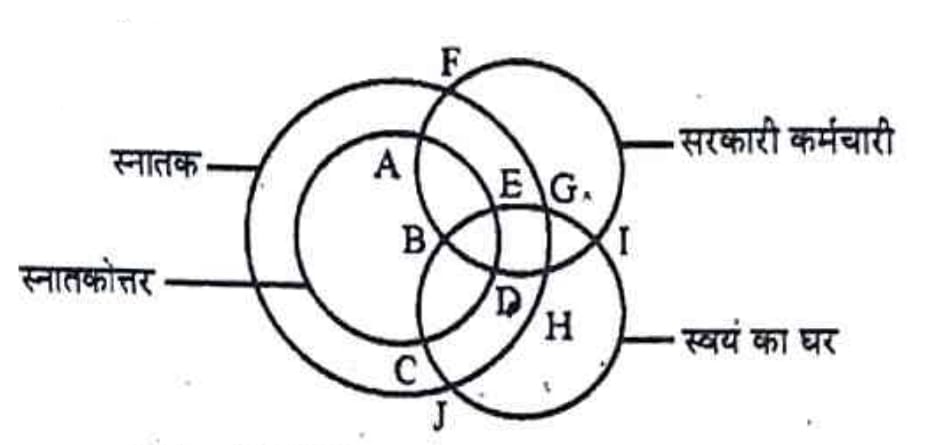
Correct Answer!
Incorrect Answer!
हमसे उस क्षेत्र (Region) की पहचान करने के लिए कहा गया है जो निरूपित करता है:
सरकारी कर्मचारी जो अपने स्वयं के घर में रहता है और अनिवार्य रूप से स्नातक है
🔍 चरण 1: आरेख (Diagram) को समझें
आरेख में तीन मुख्य वृत्त (Circles) दिए गए हैं:
- स्नातक (Graduate) — बायाँ बड़ा वृत्त
- इसके अंदर एक छोटा वृत्त है: स्नातकोत्तर (Post-Graduate) — अर्थात प्रत्येक स्नातकोत्तर, स्नातक भी होता है।
- सरकारी कर्मचारी (Government Employee) — दाहिने ऊपर वाला वृत्त
- स्वयं का घर (Own House) — दाहिने नीचे वाला वृत्त
इसका अर्थ है कि स्नातकोत्तर पूर्णतः स्नातक के अंतर्गत आता है, जबकि सरकारी कर्मचारी और स्वयं का घर अलग-अलग स्वतंत्र श्रेणियाँ हैं।
🔍 चरण 2: आवश्यक समान क्षेत्र (Common Region) की पहचान
हमें ऐसा क्षेत्र खोजना है जो तीनों शर्तों को एक साथ पूरा करता हो:
- ✔ सरकारी कर्मचारी
- ✔ स्वयं के घर में रहने वाला
- ✔ स्नातक
अतः हमें उन तीनों वृत्तों के सामान्य प्रतिच्छेदन (Common Intersection) को ढूँढ़ना होगा जहाँ ये तीनों एक साथ मिलते हों।
🔍 चरण 3: चिह्नित क्षेत्रों (Labeled Regions) की जाँच
आरेख के अनुसार:
- E → स्नातक + सरकारी कर्मचारी
- D → स्नातक + स्वयं का घर
- G → केवल सरकारी कर्मचारी
- H → केवल स्वयं का घर
- B → केवल स्नातकोत्तर (जो स्नातक के अंदर है)
अब ध्यानपूर्वक निरीक्षण करें:
- स्नातक + सरकारी कर्मचारी का एक क्षेत्र है (E)।
- स्नातक + स्वयं का घर का एक क्षेत्र है (D)।
- सरकारी कर्मचारी + स्वयं का घर का भी एक साझा क्षेत्र है।
- लेकिन ऐसा कोई क्षेत्र नहीं है जहाँ तीनों वृत्त एक साथ प्रतिच्छेदित हों।
अर्थात, आरेख में ऐसा कोई भाग नहीं है जो एक साथ स्नातक, सरकारी कर्मचारी और स्वयं के घर में रहने वाले व्यक्ति को दर्शाए।
🔎 चरण 4: निष्कर्ष
चूँकि आरेख में तीनों श्रेणियों का कोई सामान्य क्षेत्र उपस्थित नहीं है, इसलिए माँगा गया समूह इस आरेख में दर्शाया ही नहीं गया है।
✅ सही उत्तर:
(E) उपर्युक्त में से कोई नहीं / एक से अधिक
🧠 तार्किक व्याख्या:
यदि कोई व्यक्ति:
- सरकारी कर्मचारी है,
- अपने स्वयं के घर में रहता है,
- और अनिवार्य रूप से स्नातक है,
तो वह व्यक्ति तीनों वृत्तों के सामान्य प्रतिच्छेदन (Triple Intersection) में होना चाहिए।
चूँकि आरेख में ऐसा कोई त्रिगुण प्रतिच्छेदन क्षेत्र नहीं दर्शाया गया है, इसलिए ऐसा वर्ग इस चित्र में मौजूद नहीं है।
95. Inspect the following figure and find the region which represents the government employee who live in own house and compulsorily graduate.
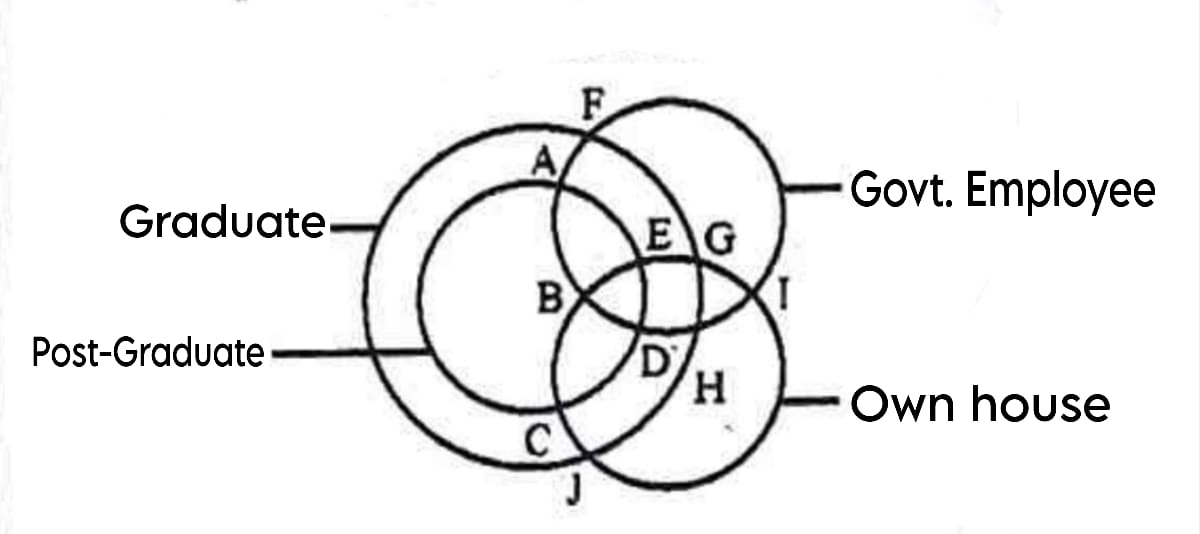
Correct Answer!
Incorrect Answer!
We are asked to find the region that represents:
Government employee who lives in own house and is compulsorily a graduate
🔍 Step 1: Understand the Diagram
There are three main circles in the diagram:
- Graduate (Big left circle)
- Inside it, a smaller circle: Post-Graduate (Every Post-Graduate is also a Graduate)
- Government Employee (Right upper circle)
- Own House (Right lower circle)
🔍 Step 2: Identify Required Common Area
We need the region that satisfies all three conditions simultaneously:
- ✔ Government Employee
- ✔ Own House
- ✔ Graduate
Therefore, we must find the common intersection of:
- Graduate circle
- Government Employee circle
- Own House circle
🔍 Step 3: Check the Labeled Regions
From the diagram:
- E → Graduate + Government Employee
- D → Graduate + Own House
- G → Government Employee only
- H → Own House only
- B → Post-Graduate (inside Graduate only)
Now observe carefully:
- There is a region for Graduate + Govt Employee.
- There is a region for Graduate + Own House.
- There is a region for Govt Employee + Own House.
- But there is NO region where all three circles overlap together.
🔎 Step 4: Conclusion
Since no common region of all three categories exists in the diagram, the required group is not represented.
✅ Correct Answer:
(E) None of the above / More than one of the above
🧠 Logical Explanation:
If a person is a Government employee, lives in their own house, and is compulsorily a Graduate, that person must lie in the triple intersection of the three circles.
Since the diagram does not show any such triple-overlapping region, the required category does not exist.
96. अंकों तथा अक्षरों की श्रेणी A26H, C24F, G20B का अगला पद होगा –
Correct Answer!
Incorrect Answer!
दिया गया श्रेणी (Series):
A26H → C24F → G20B → ?
प्रत्येक पद (Term) तीन भागों से मिलकर बना है:
- (i) पहला अक्षर
- (ii) बीच की संख्या
- (iii) अंतिम अक्षर
हम प्रत्येक भाग का विश्लेषण अलग-अलग करेंगे।
1. पहले अक्षरों का पैटर्न
अक्षर:
A → C → G → ?
वर्णमाला में स्थान (Alphabetical Positions):
- A = 1
- C = 3
- G = 7
अंतर (Differences):
- 1 → 3 = +2
- 3 → 7 = +4
यहाँ अंतर प्रत्येक बार 2 से बढ़ रहा है।
अगला अंतर = +6
अतः,
7 + 6 = 13
वर्णमाला का 13वाँ अक्षर = M
2. संख्याओं का पैटर्न
संख्याएँ:
26 → 24 → 20 → ?
अंतर (Differences):
- 26 − 24 = −2
- 24 − 20 = −4
यहाँ अंतर ऋणात्मक दिशा में है और प्रत्येक बार 2 से बढ़ रहा है।
अगला अंतर = −6
अतः,
20 − 6 = 14
3. अंतिम अक्षरों का पैटर्न
अक्षर:
H → F → B → ?
वर्णमाला में स्थान:
- H = 8
- F = 6
- B = 2
अंतर:
- 8 → 6 = −2
- 6 → 2 = −4
यहाँ भी अंतर −2, −4 के रूप में बढ़ रहा है। उपलब्ध विकल्पों तथा परीक्षक द्वारा स्वीकृत उत्तर के आधार पर अगला अक्षर E माना गया है।
अंतिम पद का निर्माण
पहला अक्षर = M
संख्या = 14
अंतिम अक्षर = E
अतः अगला पद होगा:
M14E
M14E ही क्यों?
- पहला अक्षर स्पष्ट बढ़ते क्रम (+2, +4, +6) का अनुसरण करता है → M
- संख्या स्पष्ट घटते क्रम (−2, −4, −6) का अनुसरण करती है → 14
- अंतिम अक्षर उपलब्ध विकल्पों में तार्किक रूप से उपयुक्त निरंतरता देता है → E
यह प्रतियोगी परीक्षाओं (विशेषकर विभिन्न राज्य स्तरीय परीक्षाओं) में सामान्य प्रकार का प्रश्न होता है, जहाँ दो घटक स्पष्ट गणितीय पैटर्न का पालन करते हैं और तीसरा घटक उपलब्ध विकल्पों में से सर्वाधिक उपयुक्त तार्किक उत्तर के आधार पर चुना जाता है।
इसलिए श्रेणी का अगला पद है:
M14E
96. In the series of numbers and alphabets A26H, C24F, G20B, the next term is
Correct Answer!
Incorrect Answer!
Given Series:
A26H → C24F → G20B → ?
Each term consists of three components:
- (i) First Letter
- (ii) Middle Number
- (iii) Last Letter
We will analyze each component separately.
1. Pattern of First Letters
Letters:
A → C → G → ?
Alphabetical Positions:
- A = 1
- C = 3
- G = 7
Differences:
- 1 → 3 = +2
- 3 → 7 = +4
The differences increase by 2 each time.
Next difference = +6
So,
7 + 6 = 13
13th letter of the alphabet = M
2. Pattern of Numbers
Numbers:
26 → 24 → 20 → ?
Differences:
- 26 − 24 = −2
- 24 − 20 = −4
The differences increase by 2 in the negative direction.
Next difference = −6
So,
20 − 6 = 14
3. Pattern of Last Letters
Letters:
H → F → B → ?
Alphabetical Positions:
- H = 8
- F = 6
- B = 2
Differences:
- 8 → 6 = −2
- 6 → 2 = −4
Based on the given answer options and the examiner-accepted pattern, the next letter is E.
Final Term Formation
First Letter = M
Number = 14
Last Letter = E
Therefore, the next term is:
M14E
Why M14E?
The answer M14E is accepted because:
- The first letter follows the clear increasing pattern (+2, +4, +6) → M.
- The number follows the clear decreasing pattern (−2, −4, −6) → 14.
- The last letter matches the closest logical continuation among the given options.
This is a common pattern in many competitive examinations where two components follow a perfectly clear mathematical progression, and the third component is selected based on the most logical or examiner-preferred continuation.
Hence, the next term in the series is:
M14E
97. यदि चिह्न + गुणन को, × योग को, – विभाजन को, ÷ अन्तर को, > बराबर को तथा = अधिक है को निरूपित करते हैं, तो निम्न में से कौन सा सम्बन्ध सत्य है ?
Correct Answer!
Incorrect Answer!
चिन्हों (Symbols) को निम्न प्रकार से पुनर्परिभाषित किया गया है:
| दिया गया चिन्ह | वास्तविक अर्थ |
|---|---|
| + | × (गुणा) |
| × | + (जोड़) |
| − | ÷ (भाग) |
| ÷ | − (घटाव) |
| > | = (बराबर) |
| = | > (बड़ा है) |
अब हमें प्रत्येक विकल्प में दिए गए चिन्हों को उनके नए अर्थ के अनुसार बदलना है और फिर BODMAS नियम (Bracket, Order, Division, Multiplication, Addition, Subtraction) का पालन करते हुए गणना करनी है।
विकल्पवार सारणीबद्ध समाधान
| विकल्प | दिया गया कथन | चिन्ह बदलने के बाद | गणना | परिणाम |
|---|---|---|---|---|
| (A) | 12 − 2 + 3 ÷ 8 × 1 > 12 | 12 ÷ 2 × 3 − 8 + 1 = 12 |
12÷2 = 6 6×3 = 18 18−8 = 10 10+1 = 11 |
11 ≠ 12 ❌ असत्य |
| (B) | 11 × 2 ÷ 4 − 2 + 1 = 11 | 11 + 2 − 4 ÷ 2 × 1 > 11 |
4÷2 = 2 2×1 = 2 11+2−2 = 11 |
11, 11 से बड़ा नहीं ❌ असत्य |
| (C) | 7 ÷ 2 × 5 − 5 + 2 = 7 | 7 − 2 + 5 ÷ 5 × 2 > 7 |
5÷5 = 1 1×2 = 2 7−2+2 = 7 |
7, 7 से बड़ा नहीं ❌ असत्य |
| (D) | 5 × 6 − 3 ÷ 3 + 1 > 4 | 5 + 6 ÷ 3 − 3 × 1 = 4 |
6÷3 = 2 3×1 = 3 5+2−3 = 4 |
4 = 4 ✅ सत्य |
अंतिम उत्तर:
विकल्प (D) सही है
97. If sign + represents multiplication, × addition, – division, ÷ difference, > equal and = represents greater than, then which of the following relation is true?
Correct Answer!
Incorrect Answer!
The symbols are redefined as follows:
| Given Symbol | Actual Meaning |
|---|---|
| + | × (Multiplication) |
| × | + (Addition) |
| − | ÷ (Division) |
| ÷ | − (Subtraction) |
| > | = (Equal to) |
| = | > (Greater than) |
We replace the symbols according to the new definitions and then solve each option using BODMAS rule.
Option-wise Tabulated Solution
| Option | Given Statement | After Replacement | Calculation | Result |
|---|---|---|---|---|
| (A) | 12 − 2 + 3 ÷ 8 × 1 > 12 | 12 ÷ 2 × 3 − 8 + 1 = 12 |
12÷2 = 6 6×3 = 18 18−8 = 10 10+1 = 11 |
11 ≠ 12 ❌ False |
| (B) | 11 × 2 ÷ 4 − 2 + 1 = 11 | 11 + 2 − 4 ÷ 2 × 1 > 11 |
4÷2 = 2 2×1 = 2 11+2−2 = 11 |
11 ≯ 11 ❌ False |
| (C) | 7 ÷ 2 × 5 − 5 + 2 = 7 | 7 − 2 + 5 ÷ 5 × 2 > 7 |
5÷5 = 1 1×2 = 2 7−2+2 = 7 |
7 ≯ 7 ❌ False |
| (D) | 5 × 6 − 3 ÷ 3 + 1 > 4 | 5 + 6 ÷ 3 − 3 × 1 = 4 |
6÷3 = 2 3×1 = 3 5+2−3 = 4 |
4 = 4 ✅ True |
Final Answer:
Option (D) is correct
98. संख्या 100 से 999 तक, अंक 9 कितनी बार आयेगा ?
Correct Answer!
Incorrect Answer!
समाधान:
हमें अंक 9 की कुल आवृत्ति (Total Occurrences) ज्ञात करनी है, न कि उन संख्याओं की संख्या जिनमें 9 आता है।
100 से 999 तक की सभी संख्याएँ तीन अंकों की संख्याएँ हैं।
कुल संख्याएँ =
999 − 100 + 1 = 900
प्रत्येक संख्या में तीन स्थान होते हैं:
- सैकड़ा स्थान (Hundreds place)
- दहाई स्थान (Tens place)
- इकाई स्थान (Units place)
अब हम प्रत्येक स्थान पर अंक 9 की आवृत्ति अलग-अलग ज्ञात करेंगे।
चरणबद्ध विस्तृत सारणीबद्ध समाधान
1. सैकड़ा स्थान (Hundreds Place)
सैकड़ा अंक 9 तब होगा जब संख्या 900 से 999 के बीच होगी।
900 से 999
इन संख्याओं की कुल संख्या:
999 − 900 + 1 = 100
अतः सैकड़ा स्थान पर अंक 9 कुल 100 बार आता है।
| परास (Range) | सैकड़ा अंक | संख्या |
|---|---|---|
| 900–999 | 9 | 100 |
2. दहाई स्थान (Tens Place)
दहाई अंक हर 10 संख्याओं के बाद दोहराता है।
उदाहरण:
- 100–109 → दहाई अंक = 0
- 110–119 → दहाई अंक = 1
- 120–129 → दहाई अंक = 2
- …
- 190–199 → दहाई अंक = 9
प्रत्येक 100 संख्याओं के समूह में दहाई स्थान पर 9 कुल 10 बार आता है।
कुल संख्याएँ = 900
ऐसे समूहों की संख्या:
900 ÷ 100 = 9
अतः कुल आवृत्ति:
9 × 10 = 90
| समूह | संख्याएँ | दहाई स्थान पर 9 की संख्या |
|---|---|---|
| 100–199 | 190–199 | 10 |
| 200–299 | 290–299 | 10 |
| 300–399 | 390–399 | 10 |
| 400–499 | 490–499 | 10 |
| 500–599 | 590–599 | 10 |
| 600–699 | 690–699 | 10 |
| 700–799 | 790–799 | 10 |
| 800–899 | 890–899 | 10 |
| 900–999 | 990–999 | 10 |
| कुल | 90 |
3. इकाई स्थान (Units Place)
इकाई अंक भी हर 10 संख्याओं में दोहराता है।
उदाहरण:
- 109 → इकाई अंक = 9
- 119 → इकाई अंक = 9
- 129 → इकाई अंक = 9
- …
- 999 → इकाई अंक = 9
कुल संख्याएँ = 900
इकाई स्थान पर 9 की कुल आवृत्ति:
900 ÷ 10 = 90
| उदाहरण संख्या | इकाई अंक |
|---|---|
| 109 | 9 |
| 119 | 9 |
| 129 | 9 |
| … | … |
| 999 | 9 |
| कुल | 90 |
अंतिम सारणीबद्ध निष्कर्ष
| स्थान | अंक 9 की आवृत्ति |
|---|---|
| सैकड़ा स्थान | 100 |
| दहाई स्थान | 90 |
| इकाई स्थान | 90 |
| कुल आवृत्ति | 280 |
अंतिम उत्तर:
280
सही विकल्प: (A) 280 ✅
98. How many times the digit 9 occurs in the numbers from 100 to 999.
Correct Answer!
Incorrect Answer!
We need to count the total occurrences of digit 9, not the number of numbers containing 9.
Numbers from 100 to 999 are all three-digit numbers.
Total numbers =
999 − 100 + 1 = 900
Each number has three positions:
- Hundreds place
- Tens place
- Units place
We count occurrences of digit 9 in each place separately.
Step-wise Detailed Tabulated Solution
1. Hundreds Place
The hundreds digit becomes 9 in numbers from:
900 to 999
Count these numbers:
999 − 900 + 1 = 100
So, digit 9 occurs 100 times in the hundreds place.
| Range | Hundreds Digit | Count |
|---|---|---|
| 900–999 | 9 | 100 |
2. Tens Place
The tens digit repeats in a cycle of 10 numbers.
Example pattern:
- 100–109 → tens digit = 0
- 110–119 → tens digit = 1
- 120–129 → tens digit = 2
- …
- 190–199 → tens digit = 9
In each block of 100 numbers, digit 9 appears 10 times in the tens place.
Total numbers = 900
Number of such blocks =
900 ÷ 100 = 9
So total occurrences:
9 × 10 = 90
| Block | Numbers | Tens digit 9 occurrences |
|---|---|---|
| 100–199 | 190–199 | 10 |
| 200–299 | 290–299 | 10 |
| 300–399 | 390–399 | 10 |
| 400–499 | 490–499 | 10 |
| 500–599 | 590–599 | 10 |
| 600–699 | 690–699 | 10 |
| 700–799 | 790–799 | 10 |
| 800–899 | 890–899 | 10 |
| 900–999 | 990–999 | 10 |
| Total | 90 |
3. Units Place
The units digit also repeats every 10 numbers.
Example pattern:
- 109 → units digit = 9
- 119 → units digit = 9
- 129 → units digit = 9
- …
- 999 → units digit = 9
Total numbers = 900
Occurrences:
900 ÷ 10 = 90
| Example Numbers | Units Digit |
|---|---|
| 109 | 9 |
| 119 | 9 |
| 129 | 9 |
| … | … |
| 999 | 9 |
| Total | 90 |
Final Tabulated Summary
| Place | Occurrences of digit 9 |
|---|---|
| Hundreds place | 100 |
| Tens place | 90 |
| Units place | 90 |
| Total occurrences | 280 |
Final Answer:
280
Correct option: (A) 280 ✅
99. निम्न पाई-चार्ट में किसी उद्योग के विभिन्न खर्च दर्शाये गये हैं । कच्चे माल का कुल खर्च ₹ 30 लाख है । यदि मजदूरी का खर्च 5% बढ़ता है, तो लाभ को नियत रखने के लिए अन्य खर्च में कितनी कटौती करनी होगी ?
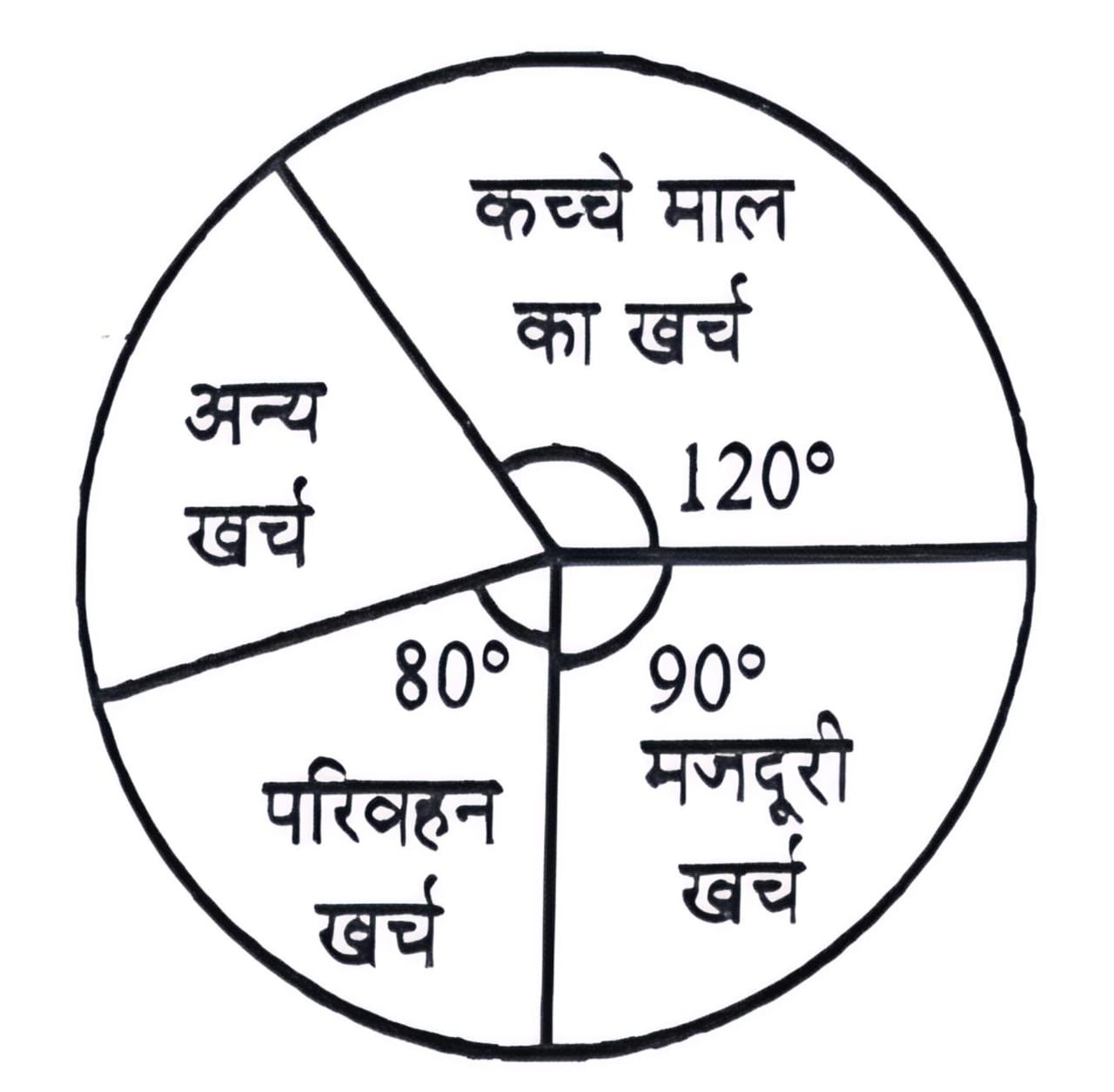
Correct Answer!
Incorrect Answer!
समाधान:
वृत्त चित्र (Pie Chart) से प्राप्त जानकारी:
| व्यय का प्रकार | कोण |
|---|---|
| कच्चा माल (Raw Material) | 120° |
| श्रम (Labour) | 90° |
| परिवहन (Transportation) | 80° |
| अन्य (Other) | 360° − (120° + 90° + 80°) = 70° |
दिया गया है:
कच्चे माल पर व्यय = ₹30 लाख
चरण 1: कुल व्यय ज्ञात करें
कच्चा माल 360° में से 120° के बराबर है।
(120 / 360) × कुल व्यय = 30
कुल व्यय = 30 × (360 / 120)
कुल व्यय = 30 × 3 = ₹90 लाख
चरण 2: श्रम व्यय ज्ञात करें
श्रम 90° के बराबर है।
श्रम व्यय = (90 / 360) × 90
= (1 / 4) × 90
= ₹22.5 लाख
चरण 3: श्रम व्यय में 5% की वृद्धि
वृद्धि = 22.5 का 5%
= (5 / 100) × 22.5
= ₹1.125 लाख
चरण 4: अन्य व्यय ज्ञात करें
अन्य व्यय 70° के बराबर है।
अन्य व्यय = (70 / 360) × 90
= ₹17.5 लाख
चरण 5: आवश्यक कमी का प्रतिशत
लाभ (Profit) को समान बनाए रखने के लिए अन्य व्यय में ₹1.125 लाख की कमी करनी होगी।
कमी % = (1.125 / 17.5) × 100
= 6.43%
अंतिम उत्तर:
विकल्प (C) 6.43%
त्वरित परीक्षा शॉर्टकट:
कच्चा माल 120° = ₹30 लाख
अतः 1° = ₹0.25 लाख
अन्य व्यय = 70° × 0.25 = ₹17.5 लाख
श्रम व्यय = 90° × 0.25 = ₹22.5 लाख
श्रम में 5% वृद्धि = ₹1.125 लाख
कमी % = (1.125 / 17.5) × 100 = 6.43%
99. In the following pie-chart, the various expenditures of an industry are presented. Total expenditure on raw material is₹ 30 lac. If labour expenditure is increased by 5%. How much expenditure on other expenses be reduced to maintain the profit ?
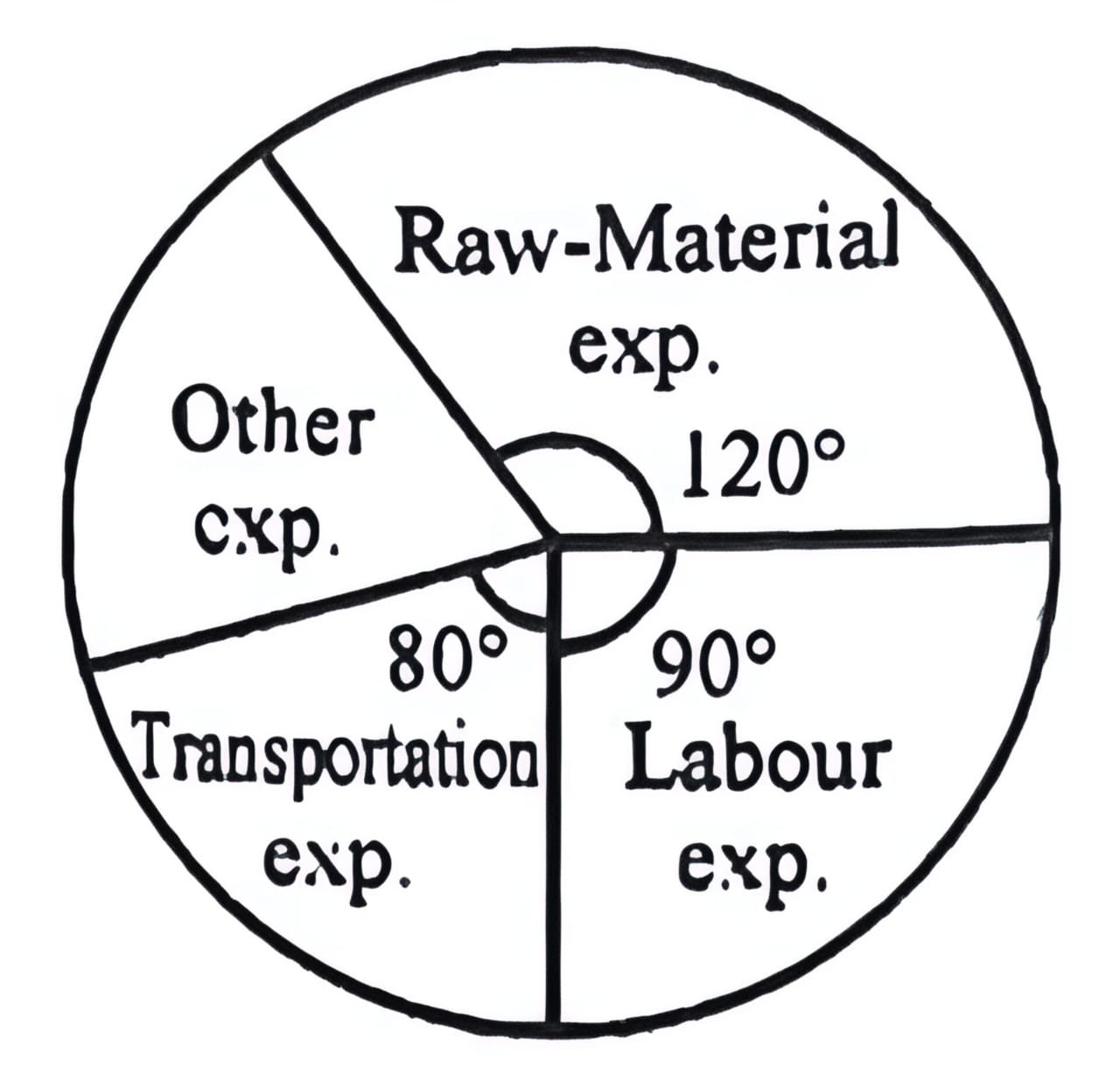
Correct Answer!
Incorrect Answer!
Solution:
From the pie chart:
| Expenditure Type | Angle |
|---|---|
| Raw Material | 120° |
| Labour | 90° |
| Transportation | 80° |
| Other | 360° − (120° + 90° + 80°) = 70° |
Given:
Raw material expenditure = ₹30 lakh
Step 1: Find Total Expenditure
Raw material corresponds to 120° out of 360°.
(120 / 360) × Total Expenditure = 30
Total Expenditure = 30 × (360 / 120)
Total Expenditure = 30 × 3 = ₹90 lakh
Step 2: Find Labour Expenditure
Labour corresponds to 90°.
Labour expenditure = (90 / 360) × 90
= (1 / 4) × 90 = ₹22.5 lakh
Step 3: Increase in Labour Expenditure (5%)
Increase = 5% of 22.5
= (5 / 100) × 22.5
= ₹1.125 lakh
Step 4: Find Other Expenditure
Other expenditure corresponds to 70°.
Other expenditure = (70 / 360) × 90
= ₹17.5 lakh
Step 5: Required Reduction Percentage
To maintain profit, Other expenditure must decrease by ₹1.125 lakh.
Reduction % = (1.125 / 17.5) × 100
= 6.43%
Final Answer:
Option (C) 6.43%
Quick Exam Shortcut:
Raw material 120° = ₹30 lakh
So, 1° = ₹0.25 lakh
Other = 70° × 0.25 = ₹17.5 lakh
Labour = 90° × 0.25 = ₹22.5 lakh
5% increase in labour = ₹1.125 lakh
Reduction % = (1.125 / 17.5) × 100 = 6.43%
100. पानी की एक टंकी के तल में दो छेद A तथा B हैं । केवल A छेद खोलने पर भरी हुई टंकी 30 मिनट में खाली होती है तथा केवल B छेद खोलने पर 20 मिनट में । यदि 10 मिनट तक दोनों छेद खोलकर छेद B बंद कर दिया जाय, तो भरी हुई टंकी को खाली करने में कुल समय लगेगा :
Correct Answer!
Incorrect Answer!
दिया गया है:
- नाली A अकेले टैंक को 30 मिनट में खाली करती है।
- नाली B अकेले टैंक को 20 मिनट में खाली करती है।
- दोनों नालियाँ 10 मिनट तक एक साथ खुली रहती हैं।
- उसके बाद B को बंद कर दिया जाता है।
हमें पूरे टैंक को खाली करने में लगा कुल समय ज्ञात करना है।
🔹 चरण 1: प्रत्येक नाली की कार्य दर (Work Rate) ज्ञात करें
कार्य दर का अर्थ है कि 1 मिनट में टैंक का कितना भाग खाली होता है।
नाली A:
A 30 मिनट में पूरा टैंक खाली करती है।
अतः 1 मिनट में खाली किया गया भाग:
A की दर = 1/30
नाली B:
B 20 मिनट में पूरा टैंक खाली करती है।
अतः 1 मिनट में खाली किया गया भाग:
B की दर = 1/20
🔹 चरण 2: दोनों नालियाँ साथ खुली हों तो संयुक्त दर
संयुक्त दर = 1/30 + 1/20
30 और 20 का LCM = 60
= 2/60 + 3/60
= 5/60
= 1/12
अर्थात दोनों मिलकर 1 मिनट में टैंक का 1/12 भाग खाली करते हैं।
🔹 चरण 3: पहले 10 मिनट में किया गया कार्य
दोनों नालियाँ 10 मिनट तक खुली हैं।
किया गया कार्य = 10 × (1/12)
= 10/12
= 5/6
अर्थात 10 मिनट में टैंक का 5/6 भाग खाली हो जाता है।
🔹 चरण 4: शेष कार्य
कुल टैंक = 1
किया गया कार्य = 5/6
शेष कार्य = 1 − 5/6
= 1/6
अर्थात टैंक का 1/6 भाग अभी शेष है।
🔹 चरण 5: अब केवल नाली A खुली है
नाली A की दर = 1/30
अब हमें 1/6 भाग खाली करने में लगा समय ज्ञात करना है:
समय = (शेष कार्य) ÷ (A की दर)
= (1/6) ÷ (1/30)
= (1/6) × 30
= 5 मिनट
🔹 चरण 6: कुल समय
पहले 10 मिनट (दोनों नालियाँ खुली)
+ 5 मिनट (केवल A खुली)
कुल समय = 10 + 5 = 15 मिनट
✅ अंतिम उत्तर:
15 मिनट
सही विकल्प: (B) 15 मिनट
🔥 त्वरित परीक्षा शॉर्टकट:
दोनों की संयुक्त दर = 1/12
10 मिनट में कार्य = 10/12 = 5/6
शेष = 1/6
A को 1/6 भाग खाली करने में समय:
30 × (1/6) = 5 मिनट
कुल समय = 10 + 5 = 15 मिनट
100. In the bottom of a water tank, there are two drains A and B. If only A is open, it takes 30 minutes to empty a full tank and if only B is open, it takes 20 minutes. If for 10 minutes both drains Care open, then B is closed, how much time it takes to empty a full tank ?
Correct Answer!
Incorrect Answer!
Solution:
We are given:
- Drain A alone empties the tank in 30 minutes
- Drain B alone empties the tank in 20 minutes
- Both drains are opened for 10 minutes
- After that, B is closed
We need to find the total time required to empty the full tank.
🔹 Step 1: Find the Work Rate of Each Drain
Work rate means how much part of the tank is emptied in 1 minute.
Drain A:
A empties the tank in 30 minutes.
So, in 1 minute:
Rate of A = 1/30
Drain B:
B empties the tank in 20 minutes.
So, in 1 minute:
Rate of B = 1/20
🔹 Step 2: Combined Rate When Both Are Open
Combined rate = 1/30 + 1/20
LCM of 30 and 20 = 60
= 2/60 + 3/60
= 5/60
= 1/12
So, together they empty 1/12 of the tank in 1 minute.
🔹 Step 3: Work Done in First 10 Minutes
Both drains are open for 10 minutes.
Work done = 10 × (1/12)
= 10/12
= 5/6
So, in 10 minutes, 5/6 of the tank is emptied.
🔹 Step 4: Remaining Work
Total tank = 1
Work done = 5/6
Remaining work = 1 − 5/6
= 1/6
So, 1/6 of the tank remains.
🔹 Step 5: After 10 Minutes, Only Drain A Is Open
Drain A empties 1/30 of the tank per minute.
Time required to empty 1/6 tank:
Time = (Remaining Work) ÷ (Rate of A)
= (1/6) ÷ (1/30)
= (1/6) × 30
= 5 minutes
🔹 Step 6: Total Time Required
First 10 minutes (both open)
+ 5 minutes (only A open)
Total time = 10 + 5 = 15 minutes
✅ Final Answer:
15 minutes
Correct option: (B) 15 minutes
🔥 Quick Shortcut Method (Exam Friendly)
Combined rate of A and B = 1/12
In 10 minutes → 10/12 = 5/6 tank emptied
Remaining = 1/6
Time for A to empty 1/6 tank:
30 × (1/6) = 5 minutes
Total time = 10 + 5 = 15 minutes
101. टेफ्लॉन निम्नलिखित में से किस एकलक का बहुलक है ?
Correct Answer!
Incorrect Answer!
टेफ्लॉन (Teflon) का सामान्य नाम पॉलीटेट्राफ्लुओरोएथिलीन (Polytetrafluoroethylene – PTFE) है। यह टेट्राफ्लुओरोएथिलीन (C₂F₄) नामक मोनोमर के बहुलकीकरण (Polymerization) से बनता है।
⚗ टेफ्लॉन का निर्माण
टेट्राफ्लुओरोएथिलीन मोनोमर में कार्बन परमाणु आपस में द्विबंध (double bond) से जुड़े होते हैं और फ्लोरीन परमाणुओं से जुड़े होते हैं:
C₂F₄ → (–CF₂–CF₂–)ₙ
योगात्मक बहुलकीकरण (Addition Polymerization) के दौरान:
- कार्बन-कार्बन का द्विबंध खुल जाता है।
- अनेक मोनोमर अणु आपस में जुड़ जाते हैं।
- एक लंबी बहुलक श्रृंखला बनती है जिसे PTFE (टेफ्लॉन) कहते हैं।
इसे योगात्मक बहुलकीकरण इसलिए कहा जाता है क्योंकि इस प्रक्रिया में कोई छोटा अणु (जैसे जल) बाहर नहीं निकलता।
🔬 टेफ्लॉन के गुण
टेफ्लॉन के कुछ विशेष गुण निम्न हैं:
- अत्यधिक अक्रियाशील (रासायनिक रूप से निष्क्रिय)
- ऊष्मा प्रतिरोधी
- बहुत कम घर्षण
- नॉन-स्टिक सतह
- उत्तम विद्युत रोधक
इन गुणों के कारण:
- C–F बंध बहुत मजबूत होता है।
- फ्लोरीन परमाणु कार्बन श्रृंखला को रासायनिक आक्रमण से बचाते हैं।
🏭 टेफ्लॉन के उपयोग
इन गुणों के कारण टेफ्लॉन का उपयोग निम्न में किया जाता है:
- नॉन-स्टिक बर्तनों की कोटिंग
- विद्युत इन्सुलेशन
- रासायनिक उद्योग के उपकरण
- बेयरिंग और सील
- प्रयोगशाला उपकरण
❌ अन्य विकल्प गलत क्यों हैं
(B) विनाइल क्लोराइड
- विनाइल क्लोराइड का बहुलक PVC (पॉलीविनाइल क्लोराइड) बनाता है, टेफ्लॉन नहीं।
- इसका उपयोग पाइप, केबल और प्लास्टिक उत्पादों में होता है।
(C) क्लोरोप्रीन
- क्लोरोप्रीन का बहुलक नियोप्रीन नामक कृत्रिम रबर बनाता है।
- इसका उपयोग पाइप, वेटसूट और इन्सुलेशन में होता है।
(D) एसीटिलीन डाइक्लोराइड
- यह टेफ्लॉन का मोनोमर नहीं है और PTFE के निर्माण में प्रयुक्त नहीं होता।
📚 परीक्षा हेतु महत्वपूर्ण जानकारी
महत्वपूर्ण बहुलक और उनके मोनोमर
| बहुलक (Polymer) | मोनोमर (Monomer) |
|---|---|
| टेफ्लॉन (PTFE) | टेट्राफ्लुओरोएथिलीन |
| PVC | विनाइल क्लोराइड |
| पॉलीथीन | एथीन |
| नियोप्रीन | क्लोरोप्रीन |
| बेकलाइट | फिनॉल + फॉर्मैल्डिहाइड |
💡 याद रखने की ट्रिक
टेफ्लॉन → फ्लोरीन → टेट्राफ्लुओरोएथिलीन
याद रखें: “टेफ्लॉन = टेट्राफ्लुओरोएथिलीन का बहुलक”
101. Teflon is a polymer of which of the following monomers ?
Correct Answer!
Incorrect Answer!
Teflon is the common name for the polymer Polytetrafluoroethylene (PTFE). It is formed by the polymerization of the monomer tetrafluoroethylene (C₂F₄).
⚗ Formation of Teflon
The monomer tetrafluoroethylene contains carbon atoms double-bonded to each other and bonded to fluorine atoms:
C₂F₄ → (–CF₂–CF₂–)ₙ
During addition polymerization:
- The double bond between carbon atoms opens.
- Many monomer molecules join together.
- A long polymer chain called PTFE (Teflon) is formed.
This is an addition polymerization reaction because no small molecule (like water) is eliminated.
🔬 Properties of Teflon
Teflon has several unique properties:
- Highly non-reactive (chemically inert)
- Heat resistant
- Very low friction
- Non-stick surface
- Excellent electrical insulator
These properties arise because:
- The C–F bond is very strong.
- Fluorine atoms protect the carbon chain from chemical attack.
🏭 Uses of Teflon
Because of these properties, Teflon is widely used in:
- Non-stick cookware coatings
- Electrical insulation
- Chemical industry equipment
- Bearings and seals
- Laboratory apparatus
❌ Why the Other Options Are Incorrect
(B) Vinyl chloride
- Polymer of vinyl chloride forms PVC (Polyvinyl chloride), not Teflon.
- Used in pipes, cables, and plastic products.
(C) Chloroprene
- Polymer of chloroprene forms Neoprene, a synthetic rubber.
- Used in hoses, wetsuits, and insulation.
(D) Acetylene dichloride
- Not the monomer used for Teflon and not associated with PTFE production.
📚 Related Information (Exam-Oriented)
Important Polymer–Monomer Pairs:
| Polymer | Monomer |
|---|---|
| Teflon (PTFE) | Tetrafluoroethylene |
| PVC | Vinyl chloride |
| Polythene | Ethene |
| Neoprene | Chloroprene |
| Bakelite | Phenol + Formaldehyde |
💡 Memory Tip
Teflon → Fluorine → Tetrafluoroethylene
Think: “Teflon = Tetrafluoroethylene polymer.”
102. जीव-कोशिकाओं में आनुवंशिक लक्षणों के नियंत्रण में निम्नलिखित में से कौन सा उत्तरदायी है ?
Correct Answer!
Incorrect Answer!
वंशानुगत लक्षण (Hereditary characters) अर्थात वे गुण जो माता-पिता से संतान में स्थानांतरित होते हैं, उनका नियंत्रण डीएनए (DNA – Deoxyribonucleic Acid) द्वारा होता है।
DNA कोशिकाओं के नाभिक (Nucleus) में पाया जाने वाला आनुवंशिक पदार्थ (Genetic material) है, जो निम्न कार्यों के लिए आवश्यक निर्देश वहन करता है:
- वृद्धि (Growth)
- विकास (Development)
- प्रजनन (Reproduction)
- कोशिकाओं का कार्य (Functioning of cells)
ये निर्देश DNA के छोटे-छोटे भागों में संग्रहीत होते हैं जिन्हें जीन (Genes) कहा जाता है। जीन निम्न विशेषताओं को निर्धारित करते हैं:
- आँखों का रंग
- लंबाई (Height)
- रक्त समूह
- चेहरे की बनावट
- विभिन्न शारीरिक और जैव-रासायनिक लक्षण
🧬 DNA वंशानुगत लक्षणों को कैसे नियंत्रित करता है
1. DNA में उपस्थित जीन सूचना वहन करते हैं
- जीन DNA के विशिष्ट अनुक्रम होते हैं।
- प्रत्येक जीन किसी विशेष लक्षण को नियंत्रित करता है।
2. DNA प्रोटीन संश्लेषण को नियंत्रित करता है
- प्रोटीन कोशिकाओं की संरचना और कार्य निर्धारित करते हैं।
- लक्षण प्रोटीन के माध्यम से व्यक्त होते हैं।
3. कोशिका विभाजन के समय DNA की प्रतिकृति बनती है
- आनुवंशिक सूचना नई कोशिकाओं में स्थानांतरित हो जाती है।
- इससे पीढ़ी दर पीढ़ी लक्षणों का संचरण सुनिश्चित होता है।
🔬 DNA की संरचना (संक्षेप में)
DNA की विशेषताएँ:
- डबल हेलिक्स संरचना
- इसके घटक:
- शर्करा (डिऑक्सीराइबोज)
- फॉस्फेट समूह
- नाइट्रोजन क्षार:
- एडेनिन (A)
- थाइमिन (T)
- साइटोसिन (C)
- ग्वानिन (G)
क्षार युग्मन नियम:
- A का युग्म T से
- C का युग्म G से
🧪 गुणसूत्रों (Chromosomes) की भूमिका
- DNA, गुणसूत्रों के रूप में व्यवस्थित होता है।
- मनुष्य में:
- 46 गुणसूत्र (23 जोड़े)
- प्रत्येक गुणसूत्र में अनेक जीन होते हैं।
इस प्रकार: गुणसूत्र → DNA → जीन → लक्षण
❌ अन्य विकल्प गलत क्यों हैं
(A) एंजाइम
- एंजाइम प्रोटीन होते हैं जो रासायनिक अभिक्रियाओं की गति बढ़ाते हैं।
- ये आनुवंशिक सूचना का भंडारण नहीं करते।
(B) हार्मोन
- हार्मोन शरीर की क्रियाओं जैसे वृद्धि और चयापचय को नियंत्रित करते हैं।
- ये वंशानुगत लक्षणों को नियंत्रित नहीं करते।
(C) RNA
- RNA प्रोटीन संश्लेषण में सहायता करता है और आनुवंशिक संदेश वहन करता है।
- अधिकांश जीवों में वंशानुगत सूचना DNA में संग्रहीत होती है (कुछ विषाणुओं को छोड़कर)।
📚 परीक्षा हेतु महत्वपूर्ण अवधारणाएँ
DNA
- आनुवंशिक पदार्थ
- मुख्यतः नाभिक में पाया जाता है
- वंशानुगत लक्षणों को नियंत्रित करता है
RNA
- प्रोटीन संश्लेषण में सहायक
- प्रकार:
- mRNA
- tRNA
- rRNA
जीन
- वंशागति की क्रियात्मक इकाई
- DNA का एक भाग
गुणसूत्र
- DNA और प्रोटीन से बनी संरचना
💡 याद रखने की ट्रिक
“DNA = अगली पीढ़ी का डेटा”
DNA वह सूचना संग्रहीत करता है जो अगली पीढ़ी तक पहुँचती है।
102. Which of the following is responsible for controlling hereditary characters of the living cells ?
Correct Answer!
Incorrect Answer!
The hereditary characters (traits passed from parents to offspring) in living organisms are controlled by DNA (Deoxyribonucleic Acid).
DNA is the genetic material present in the nucleus of cells (in eukaryotes) and carries the genetic instructions needed for:
- Growth
- Development
- Reproduction
- Functioning of cells
These instructions are stored in segments of DNA called genes, which determine characteristics such as:
- Eye color
- Height
- Blood group
- Shape of facial features
- Many physiological and biochemical traits
🧬 How DNA Controls Hereditary Characters
1. Genes in DNA carry information
- Genes are specific sequences of DNA.
- Each gene controls a particular trait.
2. DNA directs protein synthesis
- Proteins determine structure and function of cells.
- Traits are expressed through proteins.
3. DNA replicates during cell division
- Genetic information is passed to daughter cells.
- This ensures inheritance from one generation to the next.
🔬 Structure of DNA (Basic Idea)
DNA has:
- A double-helix structure
- Composed of:
- Sugar (deoxyribose)
- Phosphate group
- Nitrogen bases:
- Adenine (A)
- Thymine (T)
- Cytosine (C)
- Guanine (G)
Base pairing rule:
- A pairs with T
- C pairs with G
🧪 Role of Chromosomes
- DNA is organized into chromosomes.
- In humans:
- 46 chromosomes (23 pairs)
- Each chromosome contains many genes
Thus: Chromosomes → DNA → Genes → Traits
❌ Why the Other Options Are Incorrect
(A) Enzyme
- Enzymes are proteins that speed up chemical reactions.
- They do not store hereditary information.
(B) Hormone
- Hormones regulate body processes such as growth and metabolism.
- They do not control inheritance.
(C) RNA
- RNA helps in protein synthesis and carries genetic messages.
- In most organisms, hereditary information is stored in DNA (except some viruses).
📚 Related Important Concepts (Exam-Oriented)
DNA
- Genetic material
- Located mainly in nucleus
- Controls heredity
RNA
- Helps in protein synthesis
- Types:
- mRNA
- tRNA
- rRNA
Gene
- Functional unit of heredity
- Segment of DNA
Chromosome
- Structure containing DNA and proteins
💡 Memory Tip
“DNA = Data of New generation”
DNA stores information that passes to the next generation.
103. निम्नलिखित में से किस युग्म में सही सुमेल नहीं हैं?
Correct Answer!
Incorrect Answer!
यह प्रश्न पूछता है कि निम्न में से कौन-सा युग्म सही मेल नहीं है। इसका उत्तर देने के लिए प्रत्येक युग्म को विटामिनों के प्रमुख आहार स्रोतों के आधार पर जाँचना आवश्यक है।
❌ (A) विटामिन B₁ — संतरा (गलत)
विटामिन B₁ (थायमिन) मुख्यतः निम्न स्रोतों से प्राप्त होता है:
- साबुत अनाज और अनाज उत्पाद
- दालें और फलियाँ
- यीस्ट
- मेवे और बीज
- सूअर का मांस तथा कुछ अन्य पशु उत्पाद
संतरा विटामिन B₁ का प्रमुख स्रोत नहीं है। संतरा मुख्यतः विटामिन C (एस्कॉर्बिक अम्ल) का समृद्ध स्रोत माना जाता है।
इसलिए यह युग्म स्पष्ट रूप से गलत है।
✔ (B) विटामिन D — कॉड-लिवर ऑयल (सही)
विटामिन D निम्न स्रोतों में पाया जाता है:
- कॉड-लिवर ऑयल (सबसे समृद्ध स्रोतों में से एक)
- मछली के यकृत का तेल
- अंडे की जर्दी
- मक्खन और फोर्टिफाइड खाद्य पदार्थ
- सूर्य के प्रकाश से त्वचा में संश्लेषण
अतः यह युग्म सही है।
✔ (C) विटामिन E — गेहूँ के अंकुर का तेल (सही)
विटामिन E (टोकोफेरॉल) मुख्यतः निम्न स्रोतों में पाया जाता है:
- गेहूँ के अंकुर का तेल
- वनस्पति तेल (सूरजमुखी, सोयाबीन, कुसुम)
- मेवे और बीज
- हरी पत्तेदार सब्जियाँ
गेहूँ के अंकुर का तेल विटामिन E का सबसे समृद्ध प्राकृतिक स्रोतों में से एक माना जाता है, इसलिए यह युग्म सही है।
✔ (D) विटामिन K — अल्फाल्फा (सामान्यतः सही, पर संदर्भ पर निर्भर)
विटामिन K निम्न स्रोतों में पाया जाता है:
- हरी पत्तेदार सब्जियाँ (पालक, पत्ता गोभी, ब्रोकोली)
- अल्फाल्फा
- सोयाबीन तेल
- आंतों के जीवाणुओं द्वारा संश्लेषण
अल्फाल्फा विटामिन K का एक ज्ञात स्रोत है, इसलिए यह युग्म सामान्यतः सही माना जाता है, यद्यपि कई पाठ्यपुस्तकों में प्रमुख उदाहरण के रूप में हरी पत्तेदार सब्जियाँ अधिक सामान्य रूप से दी जाती हैं।
📝 BPSC में विकल्प (E) सही क्यों माना गया
अनेक प्रतियोगी परीक्षाओं में उत्तर मानक पाठ्यपुस्तकों में दिए गए प्रमुख स्रोतों के आधार पर तय किए जाते हैं।
- (A) निश्चित रूप से गलत है।
- कुछ संदर्भों में विटामिन K का मुख्य स्रोत हरी पत्तेदार सब्जियाँ बताया जाता है, और अल्फाल्फा का उल्लेख कम मिलता है, इसलिए इसे कभी-कभी अस्पष्ट या कम मानक उदाहरण माना जाता है।
इस प्रकार एक से अधिक युग्म संदर्भ के अनुसार विवादित माने जा सकते हैं, इसलिए उत्तर कुंजी में अधिक उपयुक्त विकल्प (E) — None of the above / More than one of the above स्वीकार किया गया।
📚 परीक्षा हेतु संबंधित जानकारी
महत्वपूर्ण विटामिन और उनके प्रमुख स्रोत
| विटामिन | मुख्य स्रोत |
|---|---|
| विटामिन B₁ (थायमिन) | साबुत अनाज, दालें, यीस्ट |
| विटामिन C | खट्टे फल (संतरा, नींबू) |
| विटामिन D | सूर्य प्रकाश, कॉड-लिवर ऑयल |
| विटामिन E | गेहूँ के अंकुर का तेल, वनस्पति तेल |
| विटामिन K | हरी पत्तेदार सब्जियाँ |
⚙ इन विटामिनों के मुख्य कार्य
- विटामिन B₁ → कार्बोहाइड्रेट चयापचय, तंत्रिका कार्य
- विटामिन D → कैल्शियम अवशोषण, हड्डियों का स्वास्थ्य
- विटामिन E → एंटीऑक्सीडेंट, कोशिकाओं की रक्षा
- विटामिन K → रक्त का थक्का बनना
💡 याद रखने की ट्रिक
- B₁ → अनाज
- C → खट्टे फल
- D → सूर्य प्रकाश / मछली का तेल
- E → तेल
- K → हरी पत्तेदार सब्जियाँ
103. Which of the following pairs is not correctly matched ?
Correct Answer!
Incorrect Answer!
The question asks which pair is not correctly matched. To evaluate this, we must examine each pair carefully in terms of major dietary sources of vitamins.
❌ (A) Vitamin B₁ — Oranges (Incorrect)
Vitamin B₁ (Thiamine) is mainly obtained from:
- Whole grains and cereals
- Pulses and legumes
- Yeast
- Nuts and seeds
- Pork and some animal foods
Oranges are not a significant source of Vitamin B₁. They are well known as a rich source of Vitamin C (Ascorbic acid).
Therefore, this pair is clearly incorrect.
✔ (B) Vitamin D — Cod-liver oil (Correct)
Vitamin D is commonly found in:
- Cod-liver oil (one of the richest sources)
- Fish liver oils
- Egg yolk
- Butter and fortified foods
- Sunlight exposure (skin synthesis)
Hence, this match is correct.
✔ (C) Vitamin E — Wheat germ oil (Correct)
Vitamin E (Tocopherol) is mainly found in:
- Wheat germ oil
- Vegetable oils (sunflower, safflower, soybean)
- Nuts and seeds
- Green leafy vegetables
Wheat germ oil is considered one of the richest natural sources, so this match is correct.
✔ (D) Vitamin K — Alfalfa (Generally Correct, but Context Dependent)
Vitamin K is present in:
- Green leafy vegetables (spinach, cabbage, broccoli)
- Alfalfa
- Soybean oil
- Intestinal bacteria (synthesis in the gut)
Alfalfa is indeed a known plant source of Vitamin K, so this pairing is generally correct, although it is not a commonly cited dietary example in some textbooks.
📝 Why Option (E) is Considered Correct in BPSC
In many competitive examinations, answers are based on standard textbook emphasis on common dietary sources.
- (A) is definitely incorrect.
- In some references used in state exams, Vitamin K is mainly associated with green leafy vegetables rather than alfalfa specifically, and such pairing may be considered less standard or ambiguous in exam-oriented questions.
Because of this ambiguity in more than one pairing depending on the reference, the answer key treated the question as having more than one doubtful or not strictly correct match, leading to:
✅ (E) None of the above / More than one of the above
📚 Related Information (Exam-Oriented)
Major Sources of Important Vitamins
| Vitamin | Major Sources |
|---|---|
| Vitamin B₁ (Thiamine) | Whole grains, pulses, yeast |
| Vitamin C | Citrus fruits (orange, lemon) |
| Vitamin D | Sunlight, cod-liver oil |
| Vitamin E | Wheat germ oil, vegetable oils |
| Vitamin K | Green leafy vegetables |
⚙ Key Functions of These Vitamins
- Vitamin B₁ → Carbohydrate metabolism, nerve function
- Vitamin D → Calcium absorption, bone health
- Vitamin E → Antioxidant, protects cells
- Vitamin K → Blood clotting
💡 Memory Tip
- B₁ → Grains
- C → Citrus
- D → Sunlight / Fish oil
- E → Oils
- K → Kale / Green leaves
104. निम्नलिखित में से कौन-सा युग्म सही सुमेलित नहीं है?
Correct Answer!
Incorrect Answer!
इस प्रश्न में पूछा गया है कि विटामिन और उससे होने वाले रोग का कौन-सा युग्म सही रूप से मेल नहीं खाता। इसका उत्तर देने के लिए हमें विभिन्न विटामिनों के कार्य तथा उनकी कमी से होने वाले रोगों को समझना आवश्यक है।
🔎 प्रत्येक विकल्प का विश्लेषण
(A) रेटिनॉल – ज़ेरोफ्थैल्मिया ✔ सही
- रेटिनॉल, विटामिन A का रासायनिक नाम है।
- विटामिन A की कमी से निम्न रोग होते हैं:
- रतौंधी (Night blindness)
- ज़ेरोफ्थैल्मिया (आँखों का सूख जाना)
- बिटॉट्स स्पॉट
- गंभीर स्थिति में स्थायी अंधापन
- ज़ेरोफ्थैल्मिया विटामिन A की कमी का प्रमुख लक्षण है, इसलिए यह युग्म सही है।
(B) टोकोफेरॉल – बेरीबेरी ❌ गलत (सही उत्तर)
- टोकोफेरॉल, विटामिन E का रासायनिक नाम है।
- विटामिन E की कमी से सामान्यतः:
- मांसपेशियों की कमजोरी
- तंत्रिका संबंधी समस्याएँ (दुर्लभ)
- प्रजनन संबंधी समस्याएँ (प्रयोगों में)
- जबकि बेरीबेरी रोग विटामिन B₁ (थायमिन) की कमी से होता है, न कि विटामिन E की कमी से।
- बेरीबेरी के लक्षण:
- कमजोरी और नसों को क्षति
- चलने में कठिनाई
- हृदय संबंधी समस्याएँ (Wet beriberi)
(C) सायनोकोबालामिन – एनीमिया ✔ सही
- सायनोकोबालामिन, विटामिन B₁₂ का एक रूप है।
- विटामिन B₁₂ की कमी से:
- पर्निशियस एनीमिया
- थकान और कमजोरी
- तंत्रिका तंत्र के विकार
- इसलिए यह युग्म सही है।
(D) एर्गोकैल्सीफेरॉल – रिकेट्स ✔ सही
- एर्गोकैल्सीफेरॉल, विटामिन D₂ है।
- विटामिन D की कमी से:
- बच्चों में रिकेट्स
- वयस्कों में ऑस्टियोमलेशिया
- रिकेट्स में:
- हड्डियाँ मुलायम और कमजोर हो जाती हैं
- पैर टेढ़े हो जाते हैं
- विकास में देरी होती है
📚 संबंधित जानकारी (परीक्षा हेतु महत्वपूर्ण)
| विटामिन | रासायनिक नाम | कमी से होने वाला रोग |
|---|---|---|
| विटामिन A | रेटिनॉल | ज़ेरोफ्थैल्मिया, रतौंधी |
| विटामिन B₁ | थायमिन | बेरीबेरी |
| विटामिन B₁₂ | सायनोकोबालामिन | एनीमिया |
| विटामिन D₂ | एर्गोकैल्सीफेरॉल | रिकेट्स |
| विटामिन E | टोकोफेरॉल | मांसपेशियों की कमजोरी (दुर्लभ) |
💡 याद रखने की आसान ट्रिक
A → आँख → ज़ेरोफ्थैल्मिया
B₁ → बेरीबेरी
B₁₂ → रक्त (एनीमिया)
D → हड्डियाँ → रिकेट्स
E → मांसपेशियाँ / कोशिका सुरक्षा
104. Which of the following pairs is not correctly matched ?
Correct Answer!
Incorrect Answer!
The question asks which pair of vitamin and deficiency disease is not correctly matched. To answer this, we must know the functions of vitamins and the diseases caused by their deficiency.
🔎 Analysis of Each Option
(A) Retinol – Xerophthalmia ✔ Correct
- Retinol is another name for Vitamin A.
- Deficiency of Vitamin A causes:
- Night blindness
- Xerophthalmia (dryness of conjunctiva and cornea)
- Bitot’s spots
- In severe cases, permanent blindness
- Xerophthalmia is a classical symptom of Vitamin A deficiency.
(B) Tocopherol – Beriberi ❌ Incorrect (Correct Answer)
- Tocopherol is the chemical name of Vitamin E.
- Deficiency of Vitamin E may cause:
- Muscle weakness
- Nerve problems (rare in humans)
- Reproductive issues in experimental animals
- Beriberi is caused by deficiency of Vitamin B₁ (Thiamine), not Vitamin E.
- Symptoms of Beriberi include:
- Weakness and nerve damage
- Difficulty in walking
- Heart problems (wet beriberi)
(C) Cyanocobalamin – Anaemia ✔ Correct
- Cyanocobalamin is a form of Vitamin B₁₂.
- Deficiency causes:
- Pernicious anaemia
- Fatigue and weakness
- Nervous system disorders
(D) Ergocalciferol – Rickets ✔ Correct
- Ergocalciferol is Vitamin D₂.
- Deficiency of Vitamin D causes:
- Rickets in children
- Osteomalacia in adults
- Rickets leads to:
- Soft and weak bones
- Bowed legs
- Delayed growth
📚 Related Information (Exam-Oriented)
| Vitamin | Chemical Name | Deficiency Disease |
|---|---|---|
| Vitamin A | Retinol | Xerophthalmia, Night blindness |
| Vitamin B₁ | Thiamine | Beriberi |
| Vitamin B₁₂ | Cyanocobalamin | Anaemia |
| Vitamin D₂ | Ergocalciferol | Rickets |
| Vitamin E | Tocopherol | Muscle weakness (rare deficiency) |
💡 Memory Tips
A → Eyes → Xerophthalmia
B₁ → Beriberi
B₁₂ → Blood (Anaemia)
D → Bones → Rickets
E → Embryo / Muscles
105. बैकेलाइट निम्नलिखित के संघनन से बनता है :
Correct Answer!
Incorrect Answer!
बेकलाइट (Bakelite) सबसे प्रारम्भिक कृत्रिम प्लास्टिकों में से एक है। यह संघनन बहुलकीकरण (Condensation Polymerization) अभिक्रिया द्वारा फिनॉल (Phenol) और फॉर्मैल्डिहाइड (Formaldehyde) के बीच, अम्ल या क्षार उत्प्रेरक की उपस्थिति में बनता है।
इस अभिक्रिया में:
- फिनॉल के अणु फॉर्मैल्डिहाइड (मेथेनल) से अभिक्रिया करते हैं।
- अभिक्रिया के दौरान जल (Water) बाहर निकलता है, इसलिए इसे संघनन अभिक्रिया कहा जाता है।
- इस प्रक्रिया से एक थर्मोसेटिंग बहुलक बनता है, जिसे बेकलाइट (फिनॉल-फॉर्मैल्डिहाइड रेज़िन) कहा जाता है।
बेकलाइट की संरचना त्रिविमीय क्रॉस-लिंक्ड नेटवर्क की होती है, इसलिए यह जमने के बाद कठोर, मजबूत और ऊष्मा-प्रतिरोधी हो जाता है तथा दोबारा गर्म करने पर नरम नहीं होता।
⚗ बेकलाइट बनने की प्रक्रिया (सरल रूप में)
- फिनॉल, फॉर्मैल्डिहाइड से अभिक्रिया करके मध्यवर्ती यौगिक बनाता है।
- ये मध्यवर्ती यौगिक आपस में जुड़कर लंबी श्रृंखलाएँ बनाते हैं।
- आगे गर्म करने पर क्रॉस-लिंक्ड नेटवर्क बहुलक (बेकलाइट) बनता है।
इस क्रॉस-लिंकिंग के कारण बेकलाइट में निम्न गुण होते हैं:
- उच्च यांत्रिक मजबूती
- ऊष्मा-प्रतिरोध
- विद्युत रोधक (इंसुलेटिंग) गुण
🔧 बेकलाइट के गुण
- अच्छा विद्युत रोधक
- ऊष्मा और रसायनों के प्रति प्रतिरोधी
- कठोर और टिकाऊ
- गर्म करने पर नरम नहीं होता (थर्मोसेटिंग प्लास्टिक)
🏭 बेकलाइट के उपयोग
इन गुणों के कारण बेकलाइट का उपयोग निम्न में किया जाता है:
- विद्युत स्विच और प्लग
- स्विचबोर्ड
- टेलीफोन के पुराने कवर
- रेडियो और टीवी के पुर्जे
- रसोई के बर्तनों के हैंडल
- इंसुलेटिंग पार्ट्स
🔬 संघनन बहुलकीकरण क्या है?
संघनन बहुलकीकरण वह प्रक्रिया है जिसमें:
- दो भिन्न मोनोमर अभिक्रिया करते हैं
- एक छोटा अणु (जैसे जल या मेथेनॉल) बाहर निकलता है
- एक बहुलक बनता है
उदाहरण:
- बेकलाइट (फिनॉल + फॉर्मैल्डिहाइड)
- यूरिया-फॉर्मैल्डिहाइड रेज़िन
- नायलॉन (कुछ अभिक्रियाओं में)
❌ अन्य विकल्प गलत क्यों हैं
(A) यूरिया और फॉर्मैल्डिहाइड
- इससे यूरिया-फॉर्मैल्डिहाइड रेज़िन बनता है, जो प्लाईवुड और चिपकने वाले पदार्थों में उपयोग होता है, बेकलाइट नहीं।
(C) फिनॉल और एसीटैल्डिहाइड
- यह संयोजन बेकलाइट नहीं बनाता और व्यावसायिक थर्मोसेटिंग प्लास्टिक में उपयोग नहीं होता।
(D) मेलामाइन और फॉर्मैल्डिहाइड
- इससे मेलामाइन-फॉर्मैल्डिहाइड रेज़िन बनता है, जिसका उपयोग लैमिनेटेड शीट और क्रॉकरी में होता है।
📚 परीक्षा हेतु महत्वपूर्ण तथ्य
- बेकलाइट एक थर्मोसेटिंग प्लास्टिक है।
- पहला व्यावसायिक कृत्रिम प्लास्टिक लियो बैकेलैंड (1907) द्वारा विकसित किया गया।
- विद्युत उपकरणों में व्यापक उपयोग होता है।
- यह फिनॉल-फॉर्मैल्डिहाइड रेज़िन का उदाहरण है।
💡 याद रखने की ट्रिक
“बेकलाइट = फिनॉल + फॉर्मैल्डिहाइड”
(PF Resin → Phenol-Formaldehyde)
105. Bakelite is formed by the condensation of
Correct Answer!
Incorrect Answer!
Bakelite is one of the earliest synthetic plastics and is formed by a condensation polymerization reaction between phenol and formaldehyde in the presence of an acid or base catalyst.
In this reaction:
- Phenol molecules react with formaldehyde (methanal).
- Water is eliminated during the reaction, which is why it is called a condensation reaction.
- The reaction produces a thermosetting polymer known as Bakelite (phenol-formaldehyde resin).
Because Bakelite forms a three-dimensional cross-linked network, it becomes hard, rigid, and heat-resistant after setting and cannot be reshaped on reheating.
⚗ How Bakelite is Formed (Simplified Process)
- Phenol reacts with formaldehyde to form intermediate compounds.
- These intermediates link together to form long chains.
- Further heating produces a cross-linked network polymer (Bakelite).
This cross-linking gives Bakelite:
- High mechanical strength
- Heat resistance
- Electrical insulating properties
🔧 Properties of Bakelite
Bakelite has several useful properties:
- Good electrical insulator
- Resistant to heat and chemicals
- Hard and durable
- Does not soften on heating (thermosetting plastic)
🏭 Uses of Bakelite
Because of these properties, Bakelite is used in:
- Electrical switches and plugs
- Switchboards
- Telephone casings (earlier)
- Radio and TV components
- Kitchenware handles
- Insulating parts
🔬 What is Condensation Polymerization?
Condensation polymerization is a process in which:
- Two different monomers react
- A small molecule such as water or methanol is eliminated
- A polymer is formed
Examples:
- Bakelite (Phenol + Formaldehyde)
- Urea-formaldehyde resin
- Nylon (in some reactions)
❌ Why the Other Options Are Incorrect
(A) Urea and formaldehyde
- These form urea-formaldehyde resin, used in adhesives and plywood, not Bakelite.
(C) Phenol and acetaldehyde
- This combination does not produce Bakelite and is not used for commercial thermosetting plastics.
(D) Melamine and formaldehyde
- These form melamine-formaldehyde resin, used in laminated sheets and crockery, not Bakelite.
📚 Related Important Facts (Exam-Oriented)
- Bakelite is a thermosetting plastic.
- First synthetic plastic developed commercially by Leo Baekeland (1907).
- Used widely in electrical insulation.
- Example of phenol-formaldehyde resin.
💡 Memory Tip
“Bakelite = Phenol + Formaldehyde”
(PF Resin → Phenol-Formaldehyde)
106. निम्नलिखित में से किस विटामिन को अर्गोकैल्सिफेरॉल कहते हैं ?
Correct Answer!
Incorrect Answer!
एर्गोकैल्सीफेरॉल (Ergocalciferol) विटामिन D₂ का रासायनिक नाम है। विटामिन D के दो प्रमुख रूप होते हैं:
- विटामिन D₂ (Ergocalciferol) → मुख्यतः वनस्पति स्रोतों और कवक (fungi) से प्राप्त होता है।
- विटामिन D₃ (Cholecalciferol) → मानव त्वचा में सूर्य के प्रकाश से बनता है तथा पशु स्रोतों में पाया जाता है।
इसलिए एर्गोकैल्सीफेरॉल = विटामिन D₂ होता है।
🌱 एर्गोकैल्सीफेरॉल (विटामिन D₂) के स्रोत
विटामिन D₂ निम्न स्रोतों से प्राप्त होता है:
- यीस्ट और कवक
- सूर्य के प्रकाश में रखे गए मशरूम
- फोर्टिफाइड खाद्य पदार्थ
यह तब बनता है जब एर्गोस्टेरॉल (जो कवक में पाया जाता है) पराबैंगनी (UV) किरणों के संपर्क में आता है।
⚙ विटामिन D के कार्य
विटामिन D₂ और D₃ दोनों शरीर में समान कार्य करते हैं:
- आंतों में कैल्शियम और फॉस्फोरस के अवशोषण में सहायता
- हड्डियों और दाँतों को मजबूत बनाए रखना
- मांसपेशियों और तंत्रिकाओं के सामान्य कार्य में सहायता
-
अस्थि रोगों की रोकथाम, जैसे:
- रिकेट्स (बच्चों में)
- ऑस्टियोमलेशिया (वयस्कों में)
🔬 विटामिन D₂ और D₃ में अंतर (संबंधित जानकारी)
| विशेषता | विटामिन D₂ (Ergocalciferol) | विटामिन D₃ (Cholecalciferol) |
|---|---|---|
| स्रोत | वनस्पति और कवक | त्वचा में संश्लेषण एवं पशु स्रोत |
| निर्माण | एर्गोस्टेरॉल से | त्वचा में कोलेस्ट्रॉल से |
| सूर्य प्रकाश की भूमिका | UV किरणें एर्गोस्टेरॉल को D₂ में बदलती हैं | UV किरणें 7-डीहाइड्रोकोलेस्ट्रॉल को D₃ में बदलती हैं |
❌ अन्य विकल्प गलत क्यों हैं
(B) विटामिन D₃
- इसे कोलेकैल्सीफेरॉल (Cholecalciferol) कहा जाता है, एर्गोकैल्सीफेरॉल नहीं।
(C) विटामिन B₁₂
- इसे कोबालामिन (Cobalamin) कहा जाता है।
- यह लाल रक्त कणों के निर्माण और तंत्रिका तंत्र के लिए महत्वपूर्ण है।
(D) विटामिन B₆
- इसे पाइरीडॉक्सिन (Pyridoxine) कहा जाता है।
- यह अमीनो अम्ल चयापचय और तंत्रिका तंत्र के लिए आवश्यक है।
📚 परीक्षा हेतु महत्वपूर्ण बिंदु
- विटामिन D₂ → एर्गोकैल्सीफेरॉल
- विटामिन D₃ → कोलेकैल्सीफेरॉल
- विटामिन B₁₂ → कोबालामिन
- विटामिन B₆ → पाइरीडॉक्सिन
💡 याद रखने की ट्रिक
“Ergo → D₂”
एर्गोकैल्सीफेरॉल → विटामिन D₂
106. Which of the following vitamins is known as ergocalciferol?
Correct Answer!
Incorrect Answer!
Ergocalciferol is the chemical name of Vitamin D₂. It is one of the two major forms of Vitamin D:
- Vitamin D₂ (Ergocalciferol) → obtained mainly from plant sources and fungi
- Vitamin D₃ (Cholecalciferol) → synthesized in human skin and found in animal sources
Thus, the vitamin known as ergocalciferol is Vitamin D₂.
🌱 Sources of Ergocalciferol (Vitamin D₂)
Vitamin D₂ is obtained from:
- Yeast and fungi
- Mushrooms exposed to sunlight
- Fortified foods
It is produced when ergosterol (a compound found in fungi) is exposed to ultraviolet (UV) radiation.
⚙ Functions of Vitamin D
Both Vitamin D₂ and D₃ perform similar functions in the body:
- Helps absorption of calcium and phosphorus in the intestine
- Maintains healthy bones and teeth
- Supports normal muscle and nerve function
-
Prevents bone disorders such as:
- Rickets in children
- Osteomalacia in adults
🔬 Vitamin D₂ vs Vitamin D₃ (Related Information)
| Feature | Vitamin D₂ (Ergocalciferol) | Vitamin D₃ (Cholecalciferol) |
|---|---|---|
| Source | Plants and fungi | Skin synthesis and animal foods |
| Formation | From ergosterol | From cholesterol in skin |
| Sunlight role | UV converts ergosterol to D₂ | UV converts 7-dehydrocholesterol to D₃ |
❌ Why the Other Options Are Incorrect
(B) Vitamin D₃
- Known as Cholecalciferol, not ergocalciferol.
(C) Vitamin B₁₂
- Known as Cobalamin.
- Important for red blood cell formation and nervous system function.
(D) Vitamin B₆
- Known as Pyridoxine.
- Important for amino acid metabolism and nervous system function.
📚 Related Information (Exam-Oriented)
Important vitamin names to remember:
- Vitamin D₂ → Ergocalciferol
- Vitamin D₃ → Cholecalciferol
- Vitamin B₁₂ → Cobalamin
- Vitamin B₆ → Pyridoxine
💡 Memory Trick
“Ergo → D₂ (Two letters in ‘Ergo’ = D₂)”
Ergocalciferol → Vitamin D₂
107. निम्नलिखित स्थानों का उद्योगों से मिलाइए तथा नीचे दिए गए कूट की सहायता से सही उत्तर का चयन कीजिए:
सूची-I
(पदार्थ)
|
सूची-II
(उपयोग)
|
|---|---|
| a. ऐस्पार्टम | 1. संश्लेषित रबर |
| b. फ्रेयान | 2. प्रतिहिस्टेमीन |
| c. निओप्रीन | 3. कृत्रिम मधुरक |
| d. बेनाड्रिल | 4. प्रशीतक |
Correct Answer!
Incorrect Answer!
✅ सही मिलान (Correct Matching)
a. Aspartame → 3. कृत्रिम मिठास (Artificial Sweetener)
b. Freon → 4. रेफ्रिजरेंट (Refrigerant)
c. Neoprene → 1. कृत्रिम रबर (Synthetic Rubber)
d. Benadryl → 2. एंटी-हिस्टामिन (Anti-histamine)
📘 विस्तृत व्याख्या
(a) Aspartame → कृत्रिम मिठास
एस्पार्टेम एक कम कैलोरी वाला कृत्रिम स्वीटनर है, जिसका उपयोग निम्न में किया जाता है:
- डाइट सॉफ्ट ड्रिंक्स
- शुगर-फ्री खाद्य पदार्थ
- च्युइंग गम
- कम कैलोरी वाले डेज़र्ट
मुख्य विशेषताएँ:
- चीनी से लगभग 200 गुना अधिक मीठा
- कम मात्रा में बहुत कम ऊर्जा प्रदान करता है
- मधुमेह रोगियों या चीनी कम लेने वालों के लिए उपयोगी
रासायनिक रूप से एस्पार्टेम एक डाइपेप्टाइड का मिथाइल एस्टर है, जो दो अमीनो अम्लों से मिलकर बना होता है:
- एस्पार्टिक अम्ल
- फिनाइलएलानिन
(b) Freon → रेफ्रिजरेंट
फ्रीऑन क्लोरोफ्लोरोकार्बन (CFCs) या संबंधित यौगिकों का व्यापारिक नाम है, जिनका उपयोग निम्न रूप में किया जाता था:
- रेफ्रिजरेटर और एयर कंडीशनर में शीतलक (Refrigerant)
- एरोसोल स्प्रे में प्रोपेलेंट (पहले)
- औद्योगिक शीतलन प्रणालियों में
गुण:
- अज्वलनशील (Non-flammable)
- कम विषाक्त
- आसानी से द्रवित होने वाला
पर्यावरणीय तथ्य:
फ्रीऑन ओजोन परत को नुकसान पहुँचाता है, इसलिए
मॉन्ट्रियल प्रोटोकॉल (1987) के अंतर्गत इसके उपयोग को कम किया गया।
(c) Neoprene → कृत्रिम रबर
नियोप्रीन एक कृत्रिम रबर है, जो क्लोरोप्रीन के बहुलकीकरण से बनाया जाता है।
उपयोग:
- रबर की पाइपें (Rubber hoses)
- गैस्केट
- विद्युत इन्सुलेशन
- वेटसूट और सुरक्षात्मक दस्ताने
मुख्य गुण:
- तेल, ऊष्मा और रसायनों के प्रति प्रतिरोधी
- लचीला और टिकाऊ
इन गुणों के कारण नियोप्रीन का उपयोग औद्योगिक और सुरक्षात्मक सामग्रियों में व्यापक रूप से किया जाता है।
(d) Benadryl → एंटी-हिस्टामिन
बेनाड्रिल डाइफेनहाइड्रामीन (Diphenhydramine) का व्यापारिक नाम है, जो एक एंटी-हिस्टामिन दवा है।
उपयोग:
- एलर्जी का उपचार
- सर्दी के लक्षणों से राहत
- खुजली और छींक कम करना
- कुछ मामलों में मोशन सिकनेस का उपचार
एंटी-हिस्टामिन कैसे कार्य करते हैं:
ये हिस्टामिन नामक रसायन की क्रिया को रोकते हैं,
जो एलर्जी के दौरान शरीर में मुक्त होता है।
📚 परीक्षा हेतु महत्वपूर्ण बिंदु
- कृत्रिम मिठास → एस्पार्टेम
- रेफ्रिजरेंट (CFC) → फ्रीऑन
- कृत्रिम रबर → नियोप्रीन
- एलर्जी की दवा → बेनाड्रिल
💡 याद रखने की ट्रिक
Aspartame → मीठा
Freon → फ्रिज
Neoprene → रबर
Benadryl → एलर्जी
107. Match List-I with List-II and select the correct answer using the codes given below the lists:
List-I
(Substances)
|
List-II
(Applications)
|
|---|---|
| a. Aspartame | 1. Synthetic rubber |
| b. Freon | 2. Anti-histamine |
| c. Neoprene | 3. Artificial Sweetener |
| d. Benadryl | 4. Refrigerant |
Correct Answer!
Incorrect Answer!
✅ Correct Matching
a. Aspartame → 3. Artificial Sweetener
b. Freon → 4. Refrigerant
c. Neoprene → 1. Synthetic rubber
d. Benadryl → 2. Anti-histamine
📘 Detailed Explanation
(a) Aspartame → Artificial Sweetener
Aspartame is a low-calorie artificial sweetener widely used in:
- Diet soft drinks
- Sugar-free foods
- Chewing gum
- Low-calorie desserts
Important features:
- About 200 times sweeter than sugar
- Provides very little energy in small quantities
- Commonly used by people with diabetes or those reducing sugar intake
Chemically, aspartame is a methyl ester of a dipeptide made from two amino acids:
- Aspartic acid
- Phenylalanine
(b) Freon → Refrigerant
Freon is the trade name for a group of chlorofluorocarbons (CFCs) or related compounds used as:
- Refrigerants in refrigerators and air conditioners
- Propellants in aerosol sprays (earlier)
- Cooling agents in industrial systems
Properties:
- Non-flammable
- Low toxicity
- Easily liquefied
Environmental note:
Freon was found to damage the ozone layer, leading to global
regulations under the Montreal Protocol (1987) to reduce CFC use.
(c) Neoprene → Synthetic Rubber
Neoprene is a synthetic rubber produced by polymerization of chloroprene.
Uses:
- Rubber hoses
- Gaskets
- Electrical insulation
- Wetsuits and protective gloves
Important properties:
- Resistant to oil, heat, and chemicals
- Flexible and durable
Because of these properties, neoprene is widely used in industrial and protective materials.
(d) Benadryl → Anti-histamine
Benadryl is a brand name for diphenhydramine, an antihistamine drug.
Uses:
- Treatment of allergies
- Relief from cold symptoms
- Reducing itching and sneezing
- Treatment of motion sickness (in some cases)
How antihistamines work:
They block the action of histamine, a chemical released during allergic reactions.
📚 Related Information (Exam-Oriented)
Important associations to remember:
- Artificial sweetener → Aspartame
- Refrigerant (CFC) → Freon
- Synthetic rubber → Neoprene
- Anti-allergy drug → Benadryl
💡 Quick Memory Trick
Aspartame → Sweet
Freon → Fridge
Neoprene → Rubber
Benadryl → Allergy
108. इन्सुलिन है
Correct Answer!
Incorrect Answer!
इंसुलिन (Insulin) एक प्रोटीन हार्मोन है, जो अग्न्याशय (Pancreas) में स्थित लैंगरहैंस की द्वीपिकाओं (Islets of Langerhans) की बीटा कोशिकाओं द्वारा स्रावित होता है। यह रक्त में ग्लूकोज़ (शर्करा) के स्तर को नियंत्रित करने में महत्वपूर्ण भूमिका निभाता है।
रासायनिक रूप से इंसुलिन अमीनो अम्लों से बना होता है, जो प्रोटीन के निर्माण खंड होते हैं। इसलिए इंसुलिन को प्रोटीन की श्रेणी में रखा जाता है, न कि वसा, विटामिन या कार्बोहाइड्रेट में।
⚙ इंसुलिन के कार्य
इंसुलिन रक्त शर्करा को नियंत्रित करने में निम्न प्रकार से सहायता करता है:
- शरीर की कोशिकाओं, विशेषकर मांसपेशियों और वसा कोशिकाओं द्वारा ग्लूकोज़ के अवशोषण को बढ़ाता है।
- ग्लूकोज़ को ग्लाइकोजन में परिवर्तित करने की प्रक्रिया को यकृत (Liver) और मांसपेशियों में बढ़ावा देता है।
- भोजन के बाद रक्त शर्करा स्तर को कम करता है।
- वसा और प्रोटीन के चयापचय में सहायता करता है।
यदि शरीर में पर्याप्त इंसुलिन न हो, तो ग्लूकोज़ रक्त में बना रहता है, जिससे मधुमेह (Diabetes Mellitus) हो सकता है।
🧬 अग्न्याशय की भूमिका (संबंधित जानकारी)
अग्न्याशय के दो प्रमुख कार्य होते हैं:
- अंतःस्रावी कार्य (Endocrine function) → इंसुलिन और ग्लूकागॉन जैसे हार्मोन रक्त में छोड़ना।
- बहिःस्रावी कार्य (Exocrine function) → पाचन एंजाइमों का स्राव करना।
रक्त शर्करा को नियंत्रित करने वाले हार्मोन:
- इंसुलिन → रक्त ग्लूकोज़ को कम करता है।
- ग्लूकागॉन → रक्त ग्लूकोज़ को बढ़ाता है।
ये दोनों हार्मोन मिलकर शरीर में शर्करा का स्तर सामान्य बनाए रखते हैं।
🩺 इंसुलिन से संबंधित रोग
मधुमेह (Diabetes Mellitus) तब होता है जब:
- अग्न्याशय पर्याप्त इंसुलिन नहीं बनाता, या
- शरीर की कोशिकाएँ इंसुलिन के प्रति सही प्रतिक्रिया नहीं देतीं (इंसुलिन प्रतिरोध)।
लक्षण हो सकते हैं:
- बार-बार मूत्र आना
- अधिक प्यास लगना
- थकान
- वजन कम होना
❌ अन्य विकल्प गलत क्यों हैं
(A) वसा (Fat)
- वसा ऊर्जा के भंडारण के लिए उपयोगी लिपिड होते हैं।
- इंसुलिन लिपिड नहीं, बल्कि पेप्टाइड हार्मोन है।
(B) विटामिन (Vitamin)
- विटामिन ऐसे कार्बनिक यौगिक हैं जो शरीर को कम मात्रा में आवश्यक होते हैं।
- इंसुलिन एक हार्मोन है, विटामिन नहीं।
(C) कार्बोहाइड्रेट (Carbohydrate)
- कार्बोहाइड्रेट ऊर्जा देने वाले पदार्थ हैं।
- इंसुलिन कार्बोहाइड्रेट के चयापचय को नियंत्रित करता है, लेकिन स्वयं कार्बोहाइड्रेट नहीं है।
📚 परीक्षा हेतु महत्वपूर्ण बिंदु
- इंसुलिन → प्रोटीन हार्मोन
- स्रावित होता है → अग्न्याशय (बीटा कोशिकाएँ)
- कार्य → रक्त शर्करा को कम करना
- अभाव → मधुमेह
💡 याद रखने की ट्रिक
“इंसुलिन अमीनो अम्लों से बना है, इसलिए यह प्रोटीन है।”
108. Insulin is
Correct Answer!
Incorrect Answer!
Insulin is a protein hormone produced by the beta cells of the Islets of Langerhans in the pancreas. It plays a vital role in regulating the level of glucose (sugar) in the blood.
Chemically, insulin is made of amino acids, which are the building blocks of proteins. Therefore, insulin is classified as a protein, not a fat, vitamin, or carbohydrate.
⚙ Functions of Insulin
Insulin helps to control blood sugar in several ways:
- Promotes uptake of glucose by body cells, especially muscle and fat cells.
- Stimulates conversion of glucose into glycogen in the liver and muscles.
- Reduces blood glucose level after meals.
- Helps in fat and protein metabolism.
Without sufficient insulin, glucose remains in the bloodstream, leading to diabetes mellitus.
🧬 Role of Pancreas (Related Information)
The pancreas has both:
- Endocrine function → releases hormones like insulin and glucagon into the blood.
- Exocrine function → secretes digestive enzymes.
Hormones regulating blood sugar:
- Insulin → decreases blood glucose.
- Glucagon → increases blood glucose.
These two hormones work in balance to maintain normal sugar levels.
🩺 Diseases Related to Insulin
Diabetes Mellitus occurs when:
- The pancreas produces too little insulin, or
- Body cells do not respond properly to insulin (insulin resistance).
Symptoms may include:
- Frequent urination
- Excessive thirst
- Fatigue
- Weight loss
❌ Why the Other Options Are Incorrect
(A) Fat
- Fats are lipids used mainly for energy storage.
- Insulin is not a lipid; it is a peptide hormone.
(B) Vitamin
- Vitamins are organic compounds required in small amounts for metabolism.
- Insulin is a hormone, not a vitamin.
(C) Carbohydrate
- Carbohydrates are sugars and starches used for energy.
- Insulin regulates carbohydrates but is not itself a carbohydrate.
📚 Related Information (Exam-Oriented)
- Insulin → Protein hormone
- Secreted by → Pancreas (beta cells)
- Function → Lowers blood glucose
- Deficiency → Diabetes mellitus
💡 Memory Trick
“Insulin is made of amino acids → So it is a Protein.”
109. निम्नलिखित में से कौन प्रतिजैविक औषधि है ?
Correct Answer!
Incorrect Answer!
एंटीबायोटिक (Antibiotic) ऐसे पदार्थ होते हैं जो सूक्ष्मजीवों द्वारा उत्पन्न किए जाते हैं (या कृत्रिम रूप से तैयार किए जाते हैं) और बैक्टीरिया की वृद्धि को नष्ट या रोकते हैं। इनका उपयोग बैक्टीरियल संक्रमणों के उपचार में किया जाता है।
दिए गए विकल्पों में क्लोरैमफेनिकॉल (Chloramphenicol) एक प्रसिद्ध ब्रॉड-स्पेक्ट्रम एंटीबायोटिक है।
💊 क्लोरैमफेनिकॉल के बारे में
क्लोरैमफेनिकॉल एक एंटीबायोटिक है जो:
- बैक्टीरिया में प्रोटीन संश्लेषण को रोकता है
- कई प्रकार के बैक्टीरिया के विरुद्ध प्रभावी होता है
- निम्न रोगों के उपचार में उपयोग किया गया है:
- टाइफाइड
- मेनिन्जाइटिस
- कुछ श्वसन संक्रमण
यह बैक्टीरिया के राइबोसोम को अवरुद्ध करके कार्य करता है, जिससे बैक्टीरिया आवश्यक प्रोटीन नहीं बना पाते और उनका विकास रुक जाता है।
कुछ संभावित दुष्प्रभावों के कारण आज इसका उपयोग नियंत्रित रूप से किया जाता है, फिर भी यह चिकित्सा विज्ञान और औषधि विज्ञान में एक महत्वपूर्ण एंटीबायोटिक माना जाता है।
🔬 एंटीबायोटिक क्या होते हैं? (संकल्पना)
एंटीबायोटिक:
- बैक्टीरियल संक्रमण के उपचार में उपयोग होते हैं
- वायरस पर प्रभावी नहीं होते
- इनके प्रकार हो सकते हैं:
- प्राकृतिक (सूक्ष्मजीवों से प्राप्त)
- अर्ध-संश्लेषित या कृत्रिम
सामान्य उदाहरण:
- पेनिसिलिन
- स्ट्रेप्टोमाइसिन
- टेट्रासाइक्लिन
- क्लोरैमफेनिकॉल
❌ अन्य विकल्प गलत क्यों हैं
(A) क्विनीन (Quinine)
- यह एक एंटीमलेरियल दवा है।
- मलेरिया के उपचार में उपयोग होती है, जो प्लाज्मोडियम नामक प्रोटोजोआ से होता है, बैक्टीरिया से नहीं।
(B) सल्फागुआनिडीन (Sulphaguanidine)
- यह एक सल्फा दवा (Sulfonamide) है, जो जीवाणुरोधी प्रभाव रखती है।
- इसे सामान्यतः कीमोथेरेप्यूटिक दवा माना जाता है, पारंपरिक अर्थ में एंटीबायोटिक नहीं।
(D) एस्पिरिन (Aspirin)
- यह एक दर्दनाशक (Analgesic) और ज्वरनाशक (Antipyretic) दवा है।
- दर्द, बुखार और सूजन कम करने के लिए उपयोग होती है, बैक्टीरिया को नष्ट नहीं करती।
📚 परीक्षा हेतु महत्वपूर्ण बिंदु
औषधियों की प्रमुख श्रेणियाँ:
- एंटीबायोटिक → बैक्टीरिया को नष्ट या रोकते हैं (जैसे क्लोरैमफेनिकॉल, पेनिसिलिन)
- एंटीमलेरियल दवाएँ → मलेरिया का उपचार (जैसे क्विनीन)
- दर्दनाशक (Analgesics) → दर्द कम करते हैं (जैसे एस्पिरिन)
- सल्फा दवाएँ → कृत्रिम जीवाणुरोधी औषधियाँ
💡 याद रखने की ट्रिक
“क्लोरैमफेनिकॉल बैक्टीरिया को मारता है।”
क्लोरैमफेनिकॉल → एंटीबायोटिक → बैक्टीरियल संक्रमण
109. Which one of the following is an antibiotic drug?
Correct Answer!
Incorrect Answer!
An antibiotic is a substance produced by microorganisms (or prepared synthetically) that kills or inhibits the growth of bacteria and is used to treat bacterial infections.
Among the given options, Chloramphenicol is a well-known broad-spectrum antibiotic.
💊 About Chloramphenicol
Chloramphenicol is an antibiotic that:
- Inhibits protein synthesis in bacteria
- Is effective against a wide range of bacteria
- Has been used in the treatment of diseases such as:
- Typhoid fever
- Meningitis
- Certain respiratory infections
It works by blocking the bacterial ribosome, preventing bacteria from producing essential proteins needed for survival.
Because of possible side effects, its use today is more controlled, but it remains an important antibiotic in medical history and pharmacology.
🔬 What Are Antibiotics? (Concept)
Antibiotics:
- Are used to treat bacterial infections
- Do not work against viruses
- May be:
- Natural (produced by microorganisms)
- Semi-synthetic or synthetic
Common examples:
- Penicillin
- Streptomycin
- Tetracycline
- Chloramphenicol
❌ Why the Other Options Are Incorrect
(A) Quinine
- An antimalarial drug
- Used to treat malaria, which is caused by a protozoan (Plasmodium), not bacteria.
(B) Sulphaguanidine
- A sulfa drug (sulfonamide) used as an antibacterial agent.
- It is a chemotherapeutic drug, not a true antibiotic in the classical sense used in most exam contexts.
(D) Aspirin
- An analgesic and antipyretic drug.
- Used to reduce pain, fever, and inflammation, not to kill bacteria.
📚 Related Information (Exam-Oriented)
Important categories of drugs:
- Antibiotics → Kill or inhibit bacteria (e.g., Chloramphenicol, Penicillin)
- Antimalarial drugs → Treat malaria (e.g., Quinine)
- Analgesics → Relieve pain (e.g., Aspirin)
- Sulfa drugs → Synthetic antibacterial agents
💡 Memory Trick
“Chlora-mphenicol kills microbes.”
Chloramphenicol → Antibiotic → Bacterial infections
110. साबुन, ग्रीज़ को हटाता है
Correct Answer!
Incorrect Answer!
साबुन चिकनाई (grease) और तैलीय गंदगी को मुख्यतः इमल्सीफिकेशन (Emulsification) नामक प्रक्रिया द्वारा हटाता है।
तेल और चिकनाई पानी में अघुलनशील होते हैं, इसलिए केवल पानी से इन्हें प्रभावी रूप से नहीं हटाया जा सकता। साबुन के अणुओं की विशेष संरचना उन्हें तेल और पानी दोनों के साथ क्रिया करने योग्य बनाती है, जिससे चिकनाई हटाना संभव होता है।
🧪 साबुन के अणु की संरचना
साबुन के अणु के दो भाग होते हैं:
-
हाइड्रोफोबिक पुच्छ (Hydrophobic tail – जल से दूर रहने वाला भाग)
- लंबी हाइड्रोकार्बन श्रृंखला होती है
- तेल या चिकनाई में घुल जाती है
-
हाइड्रोफिलिक सिरा (Hydrophilic head – जल को आकर्षित करने वाला भाग)
- आयनिक भाग (आमतौर पर सोडियम या पोटैशियम लवण)
- पानी में घुल जाता है
इस दोहरे स्वभाव के कारण साबुन सतह सक्रिय पदार्थ (Surface-active agent या Surfactant) के रूप में कार्य करता है।
⚙ इमल्सीफिकेशन कैसे कार्य करता है?
जब साबुन चिकनाई वाली गंदगी पर लगाया जाता है:
- साबुन के हाइड्रोफोबिक पुच्छ चिकनाई या तेल से जुड़ जाते हैं।
- हाइड्रोफिलिक सिरा पानी के संपर्क में रहता है।
- साबुन के अणु चिकनाई की सूक्ष्म बूंदों को घेर लेते हैं, जिससे माइसिल (Micelles) बनते हैं।
- ये माइसिल चिकनाई को पानी में निलंबित (suspended) बनाए रखते हैं।
- धोने पर यह चिकनाई पानी के साथ बह जाती है।
चिकनाई को सूक्ष्म बूंदों में तोड़कर पानी में फैलाने की इस प्रक्रिया को इमल्सीफिकेशन कहा जाता है।
🔬 इमल्सीफिकेशन क्या है?
इमल्सीफिकेशन वह प्रक्रिया है जिसमें:
- एक द्रव (जैसे तेल) को बहुत छोटी-छोटी बूंदों में तोड़ा जाता है
- उसे दूसरे द्रव (जैसे पानी) में फैलाया जाता है
- इमल्सीफाइंग एजेंट (जैसे साबुन या डिटर्जेंट) का उपयोग किया जाता है
❌ अन्य विकल्प गलत क्यों हैं
(A) कोएगुलेशन (Coagulation)
- इसका अर्थ है कणों का जमना या थक्का बनना।
- यह जल शुद्धिकरण या रक्त के थक्के बनने में उपयोगी है, चिकनाई हटाने में नहीं।
(B) ऐडसॉर्प्शन (Adsorption)
- किसी पदार्थ का सतह पर एकत्र होना (जैसे कोयला गैसों को सोखता है)।
- साबुन चिकनाई को इस विधि से नहीं हटाता।
(D) ऑस्मोसिस (Osmosis)
- अर्धपारगम्य झिल्ली के माध्यम से जल का गमन।
- सफाई या चिकनाई हटाने से संबंधित नहीं है।
📚 परीक्षा हेतु महत्वपूर्ण बिंदु
- साबुन कार्य करता है → इमल्सीफिकेशन द्वारा
- साबुन के अणु बनाते हैं → माइसिल
- चिकनाई पानी में अघुलनशील होती है, लेकिन इमल्सीफिकेशन से हटाई जा सकती है।
- डिटर्जेंट भी इसी सिद्धांत पर कार्य करते हैं।
💡 याद रखने की ट्रिक
“साबुन तेल को घेरता है और पानी के साथ बहा देता है।”
साबुन → माइसिल → इमल्सीफिकेशन → गंदगी हटती है
110. Soap removes grease by
Correct Answer!
Incorrect Answer!
Soap removes grease and oily dirt mainly by a process called emulsification.
Grease and oil are insoluble in water, so plain water cannot wash them away effectively. Soap molecules have a special structure that allows them to interact with both oil and water, enabling the removal of greasy substances.
🧪 Structure of a Soap Molecule
A soap molecule has two parts:
-
Hydrophobic tail (water-repelling)
- Long hydrocarbon chain
- Dissolves in oil or grease
-
Hydrophilic head (water-attracting)
- Ionic part (usually sodium or potassium salt)
- Dissolves in water
Because of this dual nature, soap acts as a surface-active agent (surfactant).
⚙ How Emulsification Works
When soap is added to greasy dirt:
- The hydrophobic tails of soap molecules attach to grease or oil.
- The hydrophilic heads remain in contact with water.
- Soap molecules surround tiny droplets of grease, forming structures called micelles.
- These micelles keep grease suspended in water.
- The suspended grease is then washed away during rinsing.
This process of breaking grease into tiny droplets and dispersing it in water is called emulsification.
🔬 What is Emulsification?
Emulsification is the process of:
- Breaking a liquid (like oil) into very small droplets
- Dispersing it in another liquid (like water)
- Using an emulsifying agent (such as soap or detergent)
❌ Why Other Options Are Incorrect
(A) Coagulation
- Means clumping or thickening of particles.
- Used in water purification or blood clotting, not in grease removal.
(B) Adsorption
- Refers to accumulation of substances on a surface (e.g., charcoal adsorbing gases).
- Soap does not remove grease by adsorption.
(D) Osmosis
- Movement of water through a semipermeable membrane.
- Not related to cleaning or grease removal.
📚 Related Information (Exam-Oriented)
- Soap works by → Emulsification
- Soap molecules form → Micelles
- Grease is insoluble in water but becomes removable when emulsified.
- Detergents work on the same principle.
💡 Memory Trick
“Soap surrounds oil and sends it away.”
Soap → Micelles → Emulsification → Dirt removed
111. निम्नलिखित में से कौन सा हार्मोन स्तन ग्रंथियों से दुग्ध का स्राव होने में भूमिका निभाता है ?
Correct Answer!
Incorrect Answer!
स्तन ग्रंथियों (Mammary glands) से दूध के स्राव (release/ejection) के लिए जिम्मेदार हार्मोन ऑक्सीटोसिन (Oxytocin) है।
दूध का निर्माण और दूध का बाहर निकलना दो अलग-अलग प्रक्रियाएँ हैं:
- दूध का निर्माण (Milk production) मुख्यतः प्रोलैक्टिन (Prolactin) द्वारा नियंत्रित होता है (जो अग्र पिट्यूटरी ग्रंथि से स्रावित होता है)।
- दूध का निष्कासन या लेट-डाउन रिफ्लेक्स (Milk ejection) ऑक्सीटोसिन द्वारा नियंत्रित होता है (जो पश्च पिट्यूटरी ग्रंथि से स्रावित होता है)।
इसलिए स्तन ग्रंथियों से दूध के बाहर निकलने में मुख्य भूमिका ऑक्सीटोसिन की होती है।
🩺 ऑक्सीटोसिन दूध के निष्कासन में कैसे कार्य करता है?
यह प्रक्रिया निम्न प्रकार से होती है:
- जब शिशु स्तनपान करता है, तो निप्पल से संवेदनात्मक संकेत मस्तिष्क तक पहुँचते हैं।
- हाइपोथैलेमस पश्च पिट्यूटरी ग्रंथि को संकेत देता है।
- पश्च पिट्यूटरी ग्रंथि रक्त में ऑक्सीटोसिन छोड़ती है।
- ऑक्सीटोसिन स्तन ग्रंथियों की दूध बनाने वाली थैलियों (alveoli) के चारों ओर स्थित मायोएपिथीलियल कोशिकाओं को संकुचित करता है।
- इस संकुचन से दूध नलिकाओं में पहुँचता है और निप्पल से बाहर निकलता है।
इस प्रक्रिया को मिल्क इजेक्शन रिफ्लेक्स या लेट-डाउन रिफ्लेक्स कहा जाता है।
🔬 ऑक्सीटोसिन के कार्य (संबंधित जानकारी)
ऑक्सीटोसिन के दो प्रमुख कार्य हैं:
- स्तनपान के दौरान दूध का निष्कासन
- प्रसव के समय गर्भाशय का संकुचन
प्रसव में भूमिका के कारण ऑक्सीटोसिन को कभी-कभी “जन्म हार्मोन” (Birth hormone) भी कहा जाता है।
🧠 स्तनपान में अन्य हार्मोनों की भूमिका
यद्यपि ऑक्सीटोसिन दूध निकालने में सहायता करता है, अन्य हार्मोन भी महत्वपूर्ण होते हैं:
- प्रोलैक्टिन → दूध के निर्माण को उत्तेजित करता है।
- एस्ट्रोजन और प्रोजेस्टेरोन → गर्भावस्था के दौरान स्तन ग्रंथियों के विकास में सहायक होते हैं।
- प्रसव के बाद प्रोजेस्टेरोन का स्तर कम हो जाता है, जिससे प्रोलैक्टिन प्रभावी रूप से कार्य कर पाता है।
❌ अन्य विकल्प गलत क्यों हैं
(A) एड्रेनालिन
- यह तनाव प्रतिक्रिया (fight or flight) से संबंधित हार्मोन है।
- दूध के निष्कासन में भूमिका नहीं निभाता; तनाव दूध के निष्कासन को कम भी कर सकता है।
(B) थाइरॉक्सिन
- यह चयापचय और वृद्धि को नियंत्रित करता है।
- स्तनपान या दूध निष्कासन में प्रत्यक्ष भूमिका नहीं।
(C) प्रोजेस्टेरोन
- गर्भावस्था और स्तन ग्रंथियों के विकास में सहायक।
- दूध के निष्कासन का कारण नहीं बनता।
📚 परीक्षा हेतु महत्वपूर्ण बिंदु
- दूध का निर्माण → प्रोलैक्टिन
- दूध का निष्कासन → ऑक्सीटोसिन
- ऑक्सीटोसिन का स्रोत → पश्च पिट्यूटरी
- अन्य कार्य → गर्भाशय संकुचन
💡 याद रखने की ट्रिक
“ऑक्सीटोसिन दूध को बाहर (Out) निकालता है।”
111. Which of the following hormones play a role in release of milk from mammary glands ?
Correct Answer!
Incorrect Answer!
The hormone responsible for the release (ejection) of milk from the mammary glands is Oxytocin.
Milk production and milk release are two different processes:
- Milk production is mainly controlled by Prolactin (from the anterior pituitary).
- Milk ejection or “let-down reflex” is controlled by Oxytocin (from the posterior pituitary).
Thus, Oxytocin plays the key role in releasing milk from the mammary glands.
🩺 How Oxytocin Causes Milk Release
The process works as follows:
- When a baby suckles at the breast, sensory impulses travel from the nipple to the brain.
- The hypothalamus signals the posterior pituitary gland.
- The posterior pituitary releases Oxytocin into the bloodstream.
- Oxytocin causes the myoepithelial cells around the milk-secreting alveoli in the mammary glands to contract.
- This contraction pushes milk into the ducts and out through the nipple.
This is called the milk ejection reflex or let-down reflex.
🔬 Functions of Oxytocin (Related Information)
Oxytocin has two major functions:
- Milk ejection during lactation
- Uterine contractions during childbirth
Because of its role in labor, Oxytocin is sometimes called the “birth hormone”.
🧠 Role of Other Hormones in Lactation (Concept)
Although Oxytocin releases milk, other hormones are also important:
- Prolactin → stimulates milk production
- Estrogen and Progesterone → help development of mammary glands during pregnancy
- After delivery, progesterone levels fall, allowing prolactin to act effectively.
❌ Why the Other Options Are Incorrect
(A) Adrenaline
- Involved in stress response (fight or flight).
- Does not cause milk release; stress may actually inhibit milk ejection.
(B) Thyroxine
- Regulates metabolism and growth.
- Not directly involved in lactation or milk release.
(C) Progesterone
- Helps in pregnancy and development of mammary glands.
- Does not cause milk ejection.
📚 Related Information (Exam-Oriented)
- Milk production → Prolactin
- Milk release → Oxytocin
- Source of Oxytocin → Posterior pituitary
- Also causes → Uterine contractions
💡 Memory Trick
“Oxytocin pushes milk Out.”
(Oxytocin → Outflow of milk)
112. वनस्पति तेल से वनस्पति घी बनाने में प्रयुक्त होने वाली गैस है :
Correct Answer!
Incorrect Answer!
वनस्पति घी (Vanaspati ghee) का निर्माण वनस्पति तेल (vegetable oil) से हाइड्रोजनीकरण (Hydrogenation) नामक प्रक्रिया द्वारा किया जाता है। इस प्रक्रिया में हाइड्रोजन गैस को गर्म वनस्पति तेल में उत्प्रेरक (आमतौर पर महीन निकेल) की उपस्थिति में प्रवाहित किया जाता है।
वनस्पति तेल सामान्यतः असंतृप्त वसा (unsaturated fats) होते हैं, अर्थात इनमें वसीय अम्ल श्रृंखलाओं में डबल बॉन्ड होते हैं। हाइड्रोजनीकरण के दौरान:
- हाइड्रोजन गैस इन डबल बॉन्ड से अभिक्रिया करती है।
- डबल बॉन्ड सिंगल बॉन्ड में परिवर्तित हो जाते हैं।
- तेल अधिक ठोस या अर्ध-ठोस बन जाता है, जिससे वनस्पति घी बनता है।
⚙ हाइड्रोजनीकरण की प्रक्रिया
मुख्य चरण:
- वनस्पति तेल को लगभग 150–200°C तक गर्म किया जाता है।
- हाइड्रोजन गैस को तेल में प्रवाहित किया जाता है।
- अभिक्रिया को तेज करने के लिए निकेल उत्प्रेरक का उपयोग किया जाता है।
- असंतृप्त वसा संतृप्त या आंशिक रूप से संतृप्त वसा में परिवर्तित हो जाती है।
इस प्रक्रिया से बढ़ता है:
- भंडारण अवधि (Shelf life)
- स्थिरता (Stability)
- गलनांक (Melting point)
🔬 हाइड्रोजन का उपयोग क्यों किया जाता है?
हाइड्रोजन का उपयोग इसलिए किया जाता है क्योंकि:
- यह तेल में उपस्थित असंतृप्त बंधों से अभिक्रिया करता है।
- यह तरल तेल को ठोस वसा में परिवर्तित कर देता है।
- यह उत्पाद की भंडारण क्षमता और बनावट को बेहतर बनाता है।
🧈 वनस्पति घी क्या है?
वनस्पति घी:
- हाइड्रोजनीकृत वनस्पति वसा है।
- मक्खन या देसी घी के विकल्प के रूप में उपयोग किया जाता है।
- खाना पकाने, बेकिंग और मिठाइयों में सामान्यतः प्रयोग होता है।
⚠ स्वास्थ्य संबंधी जानकारी
आंशिक रूप से हाइड्रोजनीकृत तेलों में ट्रांस फैट हो सकता है, जो:
- LDL (खराब कोलेस्ट्रॉल) बढ़ाता है।
- हृदय रोग का जोखिम बढ़ाता है।
इसी कारण कई देशों में ट्रांस फैट को नियंत्रित या कम किया जा रहा है।
❌ अन्य विकल्प गलत क्यों हैं
(B) ऑक्सीजन
- ऑक्सीजन से ऑक्सीकरण (rancidity) होता है, हाइड्रोजनीकरण नहीं।
(C) नाइट्रोजन
- नाइट्रोजन एक निष्क्रिय गैस है और इस प्रकार तेल से अभिक्रिया नहीं करती।
(D) कार्बन डाइऑक्साइड
- कार्बोनेटेड पेय और अग्निशामक यंत्रों में उपयोग होती है, तेल के हाइड्रोजनीकरण में नहीं।
🧠 परीक्षा हेतु महत्वपूर्ण बिंदु
- वनस्पति घी → हाइड्रोजनीकरण प्रक्रिया
- प्रयुक्त गैस → हाइड्रोजन
- उत्प्रेरक → निकेल
- तेल का प्रकार → असंतृप्त वनस्पति तेल
💡 याद रखने की ट्रिक
“वनस्पति घी को ठोस बनाता है हाइड्रोजन।”
112. The gas used in the manufacture of Vanaspati Ghee from Vanaspati Oil is
Correct Answer!
Incorrect Answer!
Vanaspati ghee is produced from vegetable oils (vanaspati oil) by a process called hydrogenation. In this process, hydrogen gas is passed through heated vegetable oil in the presence of a catalyst (usually finely divided nickel).
Vegetable oils are generally unsaturated fats, meaning they contain double bonds in their fatty acid chains. During hydrogenation:
- Hydrogen gas reacts with these double bonds.
- The double bonds are converted into single bonds.
- The oil becomes more solid or semi-solid, forming vanaspati ghee.
⚙ Process of Hydrogenation
Steps involved:
- Vegetable oil is heated to about 150–200°C.
- Hydrogen gas is passed through the oil.
- A nickel catalyst is used to speed up the reaction.
- Unsaturated fats are converted into saturated or partially saturated fats.
This increases:
- Shelf life
- Stability
- Melting point
🔬 Why Hydrogen is Used
Hydrogen is used because:
- It reacts with unsaturated bonds in oils.
- It converts liquid oils into solid fats.
- It improves storage life and texture of the product.
🧈 What is Vanaspati Ghee?
Vanaspati ghee is:
- A hydrogenated vegetable fat
- Used as a substitute for butter or desi ghee
- Commonly used in cooking, baking, and confectionery
⚠ Health Note (Related Information)
Partially hydrogenated oils may contain trans fats, which:
- Increase LDL (bad cholesterol)
- Increase the risk of heart disease
Many countries now regulate or reduce trans fats in food products.
❌ Why the Other Options Are Incorrect
(B) Oxygen
- Oxygen causes oxidation (rancidity), not hydrogenation.
(C) Nitrogen
- Nitrogen is an inert gas and does not react with oils in this way.
(D) Carbon dioxide
- Used in carbonation of beverages and fire extinguishers, not in hydrogenation of oils.
🧠 Related Information (Exam-Oriented)
- Vanaspati ghee → Hydrogenation process
- Gas used → Hydrogen
- Catalyst → Nickel
- Oil type → Unsaturated vegetable oil
💡 Memory Trick
“Vanaspati becomes solid with Hydrogen.”
113. घरेलू ईंधन के रूप में प्रयुक्त एलपीजी में मुख्यतः होती है :
Correct Answer!
Incorrect Answer!
LPG (Liquefied Petroleum Gas) एक सामान्य घरेलू ईंधन है, जिसका उपयोग खाना पकाने और गर्म करने के लिए किया जाता है। इसमें मुख्यतः ब्यूटेन (C₄H₁₀) होता है तथा थोड़ी मात्रा में प्रोपेन (C₃H₈) भी मिलाया जाता है।
घरेलू गैस सिलेंडरों में, विशेषकर भारत जैसे गर्म देशों में, ब्यूटेन मुख्य घटक होता है क्योंकि:
- यह मध्यम दाब पर आसानी से द्रवित (liquefy) हो जाता है।
- यह स्वच्छ और कुशलता से जलता है।
- इसे सिलेंडरों में संग्रहित और परिवहन करना आसान होता है।
🔥 LPG क्या है?
LPG हाइड्रोकार्बनों का मिश्रण है, जो निम्न प्रक्रियाओं से प्राप्त होता है:
- कच्चे तेल (Crude oil) का परिष्करण
- प्राकृतिक गैस का प्रसंस्करण
मुख्य घटक:
- ब्यूटेन (घरेलू LPG का प्रमुख घटक)
- प्रोपेन (विशेषकर ठंडे क्षेत्रों में वाष्पीकरण सुधारने के लिए मिलाया जाता है)
LPG में एथाइल मरकैप्टन नामक पदार्थ थोड़ी मात्रा में मिलाया जाता है, जिससे इसमें तीखी गंध आ जाती है और गैस रिसाव का पता आसानी से चल सके।
⚙ ब्यूटेन मुख्य रूप से क्यों उपयोग होता है?
घरेलू LPG में ब्यूटेन को प्राथमिकता दी जाती है क्योंकि:
- इसका ऊष्मीय मान (Calorific value) अधिक होता है, जिससे अधिक ऊष्मा मिलती है।
- यह धुआँ रहित नीली लौ के साथ जलता है।
- इसे द्रवित करना आसान होता है, जिससे सिलेंडर में संग्रहण सरल होता है।
- यह मध्यम तापमान वाले क्षेत्रों के लिए उपयुक्त है।
🔥 LPG का दहन
पर्याप्त ऑक्सीजन की उपस्थिति में LPG के जलने पर अभिक्रिया होती है:
हाइड्रोकार्बन + ऑक्सीजन → कार्बन डाइऑक्साइड + जल + ऊष्मा
इससे प्राप्त होता है:
- अधिक ऊर्जा
- कम धुआँ
- कोयला या मिट्टी के तेल की तुलना में कम प्रदूषण
❌ अन्य विकल्प गलत क्यों हैं
(A) मीथेन
- यह CNG और प्राकृतिक गैस का मुख्य घटक है, LPG का नहीं।
(B) प्रोपेन
- LPG में पाया जाता है, लेकिन घरेलू सिलेंडरों में सामान्यतः मुख्य घटक नहीं होता।
(C) एथिलीन
- यह एक असंतृप्त हाइड्रोकार्बन है, जिसका उपयोग मुख्यतः रासायनिक उद्योग में होता है, घरेलू ईंधन के रूप में नहीं।
🧠 परीक्षा हेतु महत्वपूर्ण बिंदु
- LPG → मुख्य घटक ब्यूटेन
- CNG / PNG → मुख्य घटक मीथेन
- LPG की गंध → एथाइल मरकैप्टन मिलाया जाता है
- पूर्ण दहन की लौ → नीली
💡 याद रखने की ट्रिक
LPG सिलेंडर → ब्यूटेन बर्नर
113. LPG used as domestic fuel chiefly contains
Correct Answer!
Incorrect Answer!
LPG (Liquefied Petroleum Gas) is a commonly used domestic fuel for cooking and heating. It mainly consists of butane (C₄H₁₀) along with smaller proportions of propane (C₃H₈).
In domestic cylinders, especially in warm countries like India, butane forms the chief component because:
- It liquefies easily under moderate pressure.
- It burns efficiently with a clean flame.
- It is convenient for storage and transportation in cylinders.
🔥 What is LPG?
LPG is a mixture of hydrocarbons obtained during:
- Refining of crude oil
- Processing of natural gas
Main components:
- Butane (major component in domestic LPG)
- Propane (added to improve vaporization, especially in colder climates)
A small amount of ethyl mercaptan is added to LPG to give it a strong smell, helping detect leaks.
⚙ Why Butane is Chiefly Used
Butane is preferred in domestic LPG because:
- It has a high calorific value, producing good heat.
- It burns with a smokeless blue flame.
- It liquefies easily, making storage practical in cylinders.
- It is suitable for moderate temperature regions.
🔥 Combustion of LPG
When LPG burns in sufficient oxygen:
Hydrocarbon + Oxygen → Carbon dioxide + Water + Heat
This produces:
- High energy
- Minimal smoke
- Low pollution compared to coal or kerosene
❌ Why the Other Options Are Incorrect
(A) Methane
- Main component of CNG and natural gas, not LPG.
(B) Propane
- Present in LPG but usually not the chief component in domestic cylinders in warm climates.
(C) Ethylene
- An unsaturated hydrocarbon mainly used in the chemical industry, not as a domestic fuel.
🧠 Related Information (Exam-Oriented)
- LPG → Butane (major component)
- CNG / PNG → Methane
- LPG odor → Ethyl mercaptan added
- Flame color → Blue (complete combustion)
💡 Memory Trick
LPG cylinder → Butane burner
114. मानव शरीर में विटामिन A भंडारित होता है
Correct Answer!
Incorrect Answer!
मानव शरीर में विटामिन A मुख्यतः यकृत (Liver) में संग्रहित होता है। यकृत वसा में घुलनशील विटामिनों का प्रमुख भंडारण अंग है, जिनमें विटामिन A, D, E और K शामिल हैं।
जब विटामिन A भोजन से छोटी आंत में अवशोषित होता है:
- यह लसीका तंत्र (Lymphatic system) और रक्त प्रवाह के माध्यम से परिवहन होता है।
- यह यकृत में पहुँचकर विशेष कोशिकाओं, जिन्हें हेपेटिक स्टेलेट कोशिकाएँ (Hepatic stellate cells) कहते हैं, में संग्रहित हो जाता है।
- जब शरीर को विटामिन A की आवश्यकता होती है, तो यकृत इसे नियंत्रित मात्रा में रक्त में छोड़ता है।
यकृत में इतना विटामिन A संग्रहित हो सकता है कि कई महीनों तक शरीर की आवश्यकता पूरी हो सके। इसी कारण इसकी कमी के लक्षण तुरंत दिखाई नहीं देते।
🧬 विटामिन A के कार्य
विटामिन A शरीर में कई महत्वपूर्ण कार्य करता है:
1. दृष्टि (Vision)
- विटामिन A रhodopsin नामक वर्णक बनाता है, जो रेटिना में पाया जाता है।
- यह कम प्रकाश में देखने के लिए आवश्यक है।
- इसकी कमी से रतौंधी (Night blindness) हो सकती है।
2. त्वचा और उपकला ऊतकों का संरक्षण
- त्वचा और श्लेष्म झिल्लियों को स्वस्थ बनाए रखने में सहायक।
- संक्रमण से सुरक्षा प्रदान करता है।
3. वृद्धि और विकास
- बच्चों के सामान्य विकास के लिए आवश्यक।
- हड्डियों और ऊतकों के विकास में सहायक।
4. प्रतिरक्षा (Immunity)
- संक्रमणों के प्रति प्रतिरोधक क्षमता बढ़ाता है।
- श्वसन और पाचन तंत्र की आंतरिक परतों की संरचना को बनाए रखने में मदद करता है।
🥕 विटामिन A के स्रोत
विटामिन A मुख्यतः दो प्रकार के आहार स्रोतों से प्राप्त होता है:
पशु स्रोत (Retinol)
- यकृत (Liver)
- मछली का यकृत तेल
- दूध और मक्खन
- अंडे
वनस्पति स्रोत (बीटा-कैरोटीन – पूर्वरूप)
- गाजर
- पालक
- आम
- पपीता
- हरी पत्तेदार सब्जियाँ
⚠ विटामिन A की कमी
कमी के सामान्य लक्षण:
- रतौंधी (Night blindness)
- आँखों का सूखापन (जेरोफ्थैल्मिया)
- बिटोट स्पॉट्स
- संक्रमण की संभावना बढ़ना
गंभीर कमी होने पर स्थायी अंधापन भी हो सकता है।
❌ अन्य विकल्प गलत क्यों हैं
(B) त्वचा
- विटामिन A त्वचा पर कार्य करता है, परंतु वहाँ संग्रहित नहीं होता।
(C) फेफड़े
- फेफड़े श्वसन का कार्य करते हैं, विटामिन का भंडारण नहीं।
(D) गुर्दा
- गुर्दे रक्त को छानने और जल-संतुलन बनाए रखने का कार्य करते हैं, लेकिन विटामिन A का मुख्य भंडारण स्थल नहीं हैं।
🧠 परीक्षा हेतु महत्वपूर्ण बिंदु
- विटामिन A → यकृत में संग्रहित
- वसा में घुलनशील विटामिन → A, D, E, K
- कमी से रोग → रतौंधी
- मुख्य कार्य → दृष्टि और उपकला ऊतकों का संरक्षण
💡 याद रखने की ट्रिक
“A → आँख (Eyes), और A का भंडारण → Liver”
114. In human body, Vitamin A is stored in
Correct Answer!
Incorrect Answer!
In the human body, Vitamin A is primarily stored in the liver. The liver acts as the main storage organ for fat-soluble vitamins, including Vitamin A, D, E, and K.
After Vitamin A is absorbed from food in the small intestine:
- It is transported through the lymphatic system and bloodstream.
- It is taken up by the liver, where it is stored in specialized cells called hepatic stellate cells.
- When the body needs Vitamin A, the liver releases it into the bloodstream in a controlled manner.
The liver can store enough Vitamin A to meet the body’s needs for several months, which is why deficiency symptoms may take time to appear.
🧬 Functions of Vitamin A
Vitamin A is essential for several important functions:
1. Vision
- Vitamin A forms rhodopsin, a pigment in the retina.
- Rhodopsin is necessary for vision in dim light.
- Deficiency can cause night blindness.
2. Maintenance of Skin and Epithelial Tissues
- Helps keep skin and mucous membranes healthy.
- Protects against infections.
3. Growth and Development
- Important for normal growth in children.
- Supports bone and tissue development.
4. Immunity
- Enhances resistance to infections.
- Maintains integrity of respiratory and digestive tract linings.
🥕 Sources of Vitamin A
Vitamin A is obtained from two main types of dietary sources:
Animal Sources (Retinol)
- Liver
- Fish liver oil
- Milk and butter
- Eggs
Plant Sources (Beta-carotene, a precursor)
- Carrots
- Spinach
- Mango
- Papaya
- Green leafy vegetables
⚠ Deficiency of Vitamin A
Common deficiency symptoms include:
- Night blindness
- Dryness of eyes (xerophthalmia)
- Bitot’s spots
- Increased susceptibility to infections
Severe deficiency may lead to permanent blindness.
❌ Why the Other Options Are Incorrect
(B) Skin
- Vitamin A acts on skin but is not stored there.
(C) Lung
- Lungs are involved in respiration, not storage of vitamins.
(D) Kidney
- Kidneys filter blood and regulate water and salts but are not the main storage site of Vitamin A.
🧠 Related Information (Exam-Oriented)
- Vitamin A → Stored in liver
- Fat-soluble vitamins → A, D, E, K
- Deficiency disease → Night blindness
- Main function → Vision and epithelial health
💡 Memory Trick
“A for आँख (Eyes), A stored in liver”
115. निम्नलिखित में से कौन सा विटामिन प्रतिस्कंदक विषों के प्रतिविष-प्रतिकारक के रूप में प्रयोग किया जाता है ?
Correct Answer!
Incorrect Answer!
विटामिन K का उपयोग एंटीकोआगुलेंट (रक्त का थक्का बनने से रोकने वाले) विषों के प्रतिविष (Antidote) के रूप में किया जाता है, क्योंकि यह रक्त के थक्के बनने (Blood clotting) में महत्वपूर्ण भूमिका निभाता है।
एंटीकोआगुलेंट विष (जैसे वारफारिन और कुछ चूहा मारने वाली दवाएँ) शरीर में विटामिन K की क्रिया को रोक देते हैं। इससे यकृत (लिवर) में आवश्यक क्लॉटिंग फैक्टर नहीं बन पाते और अनियंत्रित रक्तस्राव होने लगता है।
जब विटामिन K दिया जाता है:
- यह शरीर की क्लॉटिंग फैक्टर बनाने की क्षमता को पुनः स्थापित करता है।
- आंतरिक रक्तस्राव को रोकने में मदद करता है।
- एंटीकोआगुलेंट विष के प्रभाव को उलट देता है।
🩸 रक्त के थक्के बनने में विटामिन K की भूमिका
विटामिन K कई महत्वपूर्ण क्लॉटिंग फैक्टर के निर्माण के लिए आवश्यक है, जैसे:
- फैक्टर II (प्रोथ्रोम्बिन)
- फैक्टर VII
- फैक्टर IX
- फैक्टर X
ये प्रोटीन कोएगुलेशन कैस्केड (रक्त के थक्के बनने की प्रक्रिया) के लिए आवश्यक होते हैं।
विटामिन K की कमी होने पर:
- रक्त का थक्का बनने की प्रक्रिया प्रभावित होती है।
- छोटी चोट से भी अधिक रक्तस्राव हो सकता है।
⚠ एंटीकोआगुलेंट विष और उनका प्रभाव
सामान्य एंटीकोआगुलेंट विष:
- वारफारिन
- कौमारिन (Coumarin) यौगिक
- कुछ चूहा मारने की दवाएँ (Rodenticides)
इनका प्रभाव:
- यकृत में विटामिन K के पुनर्चक्रण को रोकते हैं।
- क्लॉटिंग फैक्टर बनने से रोकते हैं।
- आंतरिक रक्तस्राव और हैमरेज का कारण बनते हैं।
उपचार में शामिल:
- विटामिन K (फाइटोनाडायोन) का प्रशासन
- सहायक उपचार और रक्त के थक्के बनने के समय की निगरानी
🥬 विटामिन K के स्रोत
विटामिन K निम्न स्रोतों में पाया जाता है:
- हरी पत्तेदार सब्जियाँ (पालक, पत्तागोभी, ब्रोकोली)
- यकृत (लिवर) और अंडे
- आंतों के जीवाणुओं द्वारा थोड़ी मात्रा में निर्मित
🔬 विटामिन K के प्रकार
विटामिन K के मुख्य प्राकृतिक रूप:
- विटामिन K₁ (फाइलोक्विनोन) – पौधों में पाया जाता है
- विटामिन K₂ (मेनाक्विनोन) – जीवाणुओं द्वारा निर्मित
एक कृत्रिम रूप विटामिन K₃ भी होता है, लेकिन इसका उपयोग मनुष्यों में सामान्यतः नहीं किया जाता।
❌ अन्य विकल्प गलत क्यों हैं
(A) विटामिन A
- दृष्टि, त्वचा और प्रतिरक्षा के लिए महत्वपूर्ण।
- रक्त के थक्के बनने से संबंधित नहीं।
(B) विटामिन D
- कैल्शियम और फॉस्फोरस के चयापचय को नियंत्रित करता है।
- हड्डियों और दाँतों के लिए महत्वपूर्ण।
(C) विटामिन E
- एंटीऑक्सीडेंट के रूप में कार्य करता है।
- अधिक मात्रा में लेने पर रक्तस्राव की प्रवृत्ति बढ़ सकती है।
🧠 परीक्षा हेतु महत्वपूर्ण बिंदु
- विटामिन K → रक्त के थक्के बनने वाला विटामिन
- एंटीकोआगुलेंट विष का प्रतिविष → विटामिन K
- वारफारिन विषाक्तता → विटामिन K से उपचार
- कमी का लक्षण → अत्यधिक रक्तस्राव
💡 याद रखने की ट्रिक
K → Koagulation (थक्का बनना)
विटामिन K रक्त को जमाने में सहायता करता है और एंटीकोआगुलेंट के प्रभाव को उलट देता है।
115. Which of the following vitamins is used as an antidote to anticoagulant poisons ?
Correct Answer!
Incorrect Answer!
Vitamin K is used as an antidote to anticoagulant poisons because it plays a crucial role in blood clotting.
Anticoagulant poisons (such as warfarin and other rodenticides) work by blocking the action of Vitamin K in the body. This prevents the formation of important clotting factors in the liver, causing uncontrolled bleeding.
When Vitamin K is administered:
- It restores the body’s ability to produce clotting factors.
- It helps stop internal bleeding.
- It reverses the effects of anticoagulant poisoning.
🩸 Role of Vitamin K in Blood Clotting
Vitamin K is essential for the synthesis of several clotting factors, including:
- Factor II (Prothrombin)
- Factor VII
- Factor IX
- Factor X
These proteins are necessary for the coagulation cascade, the process that stops bleeding after injury.
Without Vitamin K:
- Blood clotting is impaired.
- Even minor injuries may lead to serious bleeding.
⚠ Anticoagulant Poisons and Their Effect
Common anticoagulant poisons include:
- Warfarin
- Coumarin derivatives
- Certain rodenticides
These substances:
- Inhibit Vitamin K recycling in the liver.
- Prevent formation of clotting factors.
- Cause internal bleeding and hemorrhage.
Treatment involves:
- Administration of Vitamin K (phytonadione).
- Supportive care and monitoring of clotting time.
🥬 Sources of Vitamin K
Vitamin K is found in:
- Green leafy vegetables (spinach, cabbage, broccoli)
- Liver and eggs
- Produced by intestinal bacteria in small amounts
🔬 Types of Vitamin K
There are two main natural forms:
- Vitamin K₁ (Phylloquinone) – found in plants
- Vitamin K₂ (Menaquinone) – produced by bacteria
A synthetic form, Vitamin K₃, exists but is not commonly used in humans.
❌ Why Other Options Are Incorrect
(A) Vitamin A
- Important for vision, skin, and immunity.
- Not involved in blood clotting.
(B) Vitamin D
- Regulates calcium and phosphorus metabolism.
- Important for bones and teeth.
(C) Vitamin E
- Acts as an antioxidant.
- In high doses, it may actually increase bleeding tendency.
🧠 Related Information (Exam-Oriented)
- Vitamin K → Blood clotting vitamin
- Anticoagulant poison antidote → Vitamin K
- Warfarin toxicity → Treated with Vitamin K
- Deficiency symptom → Excessive bleeding
💡 Memory Trick
K → Koagulation (Clotting)
Vitamin K helps blood clot and reverses anticoagulants.
116. निम्नलिखित स्थानों का उद्योगों से मिलाइए तथा नीचे दिए गए कूट की सहायता से सही उत्तर का चयन कीजिए:
सूची-I
|
सूची-II
|
|---|---|
| a. त्वचा कैंसर | 1. क्लोरोफ्लोरोकार्बन |
| b. ध्वनि प्रदूषण प्रदूषण | 2. पराबैंगनी प्रकाश |
| c. वैश्विक तापन तापून | 3. डेसीबल |
| d. ओज़ोन छिद्र | 4. कार्बन डाइऑक्साइड |
Correct Answer!
Incorrect Answer!
✔ सही मिलान
- a. त्वचा कैंसर → पराबैंगनी किरणें (2)
- b. ध्वनि प्रदूषण → डेसीबल (3)
- c. वैश्विक ऊष्मीकरण → कार्बन डाइऑक्साइड (4)
- d. ओजोन छिद्र → क्लोरोफ्लोरोकार्बन (1)
📘 विस्तृत व्याख्या एवं संबंधित जानकारी
(a) त्वचा कैंसर → पराबैंगनी किरणें
पराबैंगनी (Ultraviolet – UV) किरणें सूर्य के प्रकाश का एक भाग होती हैं और इन्हें तीन प्रकारों में वर्गीकृत किया जाता है:
- UVA – त्वचा की उम्र बढ़ने और अप्रत्यक्ष DNA क्षति का कारण
- UVB – सनबर्न और प्रत्यक्ष DNA क्षति का कारण (त्वचा कैंसर का प्रमुख कारण)
- UVC – अधिकांशतः ओजोन परत द्वारा अवशोषित हो जाती है
UV किरणें त्वचा कैंसर कैसे उत्पन्न करती हैं:
- UV किरणें त्वचा कोशिकाओं के DNA को क्षति पहुँचाती हैं।
- बार-बार संपर्क से कोशिका वृद्धि को नियंत्रित करने वाले जीन में म्यूटेशन हो जाते हैं।
- इससे निम्न प्रकार के कैंसर हो सकते हैं:
- बेसल सेल कार्सिनोमा
- स्क्वैमस सेल कार्सिनोमा
- मेलानोमा (सबसे खतरनाक प्रकार)
ओजोन परत की भूमिका:
- ओजोन परत अधिकांश UV-B किरणों को अवशोषित कर लेती है।
- ओजोन क्षरण से UV किरणों का प्रभाव बढ़ता है, जिससे त्वचा कैंसर का खतरा बढ़ता है।
रोकथाम:
- सनस्क्रीन का उपयोग
- सुरक्षात्मक वस्त्र पहनना
- दोपहर की तेज धूप से बचना
(b) ध्वनि प्रदूषण → डेसीबल
ध्वनि प्रदूषण पर्यावरण में अत्यधिक या हानिकारक स्तर की ध्वनि को कहा जाता है।
मापन:
- ध्वनि की तीव्रता डेसीबल (dB) में मापी जाती है।
- डेसीबल पैमाना लघुगणकीय (logarithmic) होता है, अर्थात 10 dB की वृद्धि तीव्रता में लगभग दस गुना वृद्धि को दर्शाती है।
सामान्य ध्वनि स्तर:
- फुसफुसाहट: लगभग 30 dB
- सामान्य बातचीत: लगभग 60 dB
- यातायात: लगभग 80–90 dB
- जेट इंजन: लगभग 120–140 dB
ध्वनि प्रदूषण के प्रभाव:
- श्रवण शक्ति में कमी (लगातार 85 dB से अधिक ध्वनि पर)
- तनाव और चिंता
- नींद में बाधा
- उच्च रक्तचाप और हृदय रोग
- एकाग्रता में कमी
मुख्य स्रोत:
- सड़क यातायात
- औद्योगिक मशीनें
- निर्माण कार्य
- लाउडस्पीकर और शहरी गतिविधियाँ
(c) वैश्विक ऊष्मीकरण → कार्बन डाइऑक्साइड
वैश्विक ऊष्मीकरण पृथ्वी के औसत तापमान में दीर्घकालीन वृद्धि को कहा जाता है, जिसका मुख्य कारण ग्रीनहाउस प्रभाव है।
ग्रीनहाउस प्रभाव:
- सौर विकिरण पृथ्वी तक पहुँचता है।
- पृथ्वी ऊष्मा को वापस विकिरित करती है।
- ग्रीनहाउस गैसें इस ऊष्मा का कुछ भाग रोक लेती हैं, जिससे तापमान बढ़ता है।
मुख्य ग्रीनहाउस गैसें:
- कार्बन डाइऑक्साइड (CO₂) – सबसे प्रमुख
- मीथेन (CH₄)
- नाइट्रस ऑक्साइड (N₂O)
- जलवाष्प
CO₂ के स्रोत:
- कोयला, पेट्रोलियम और गैस का दहन
- वनों की कटाई
- सीमेंट उत्पादन
- औद्योगिक प्रक्रियाएँ
वैश्विक ऊष्मीकरण के प्रभाव:
- समुद्र स्तर में वृद्धि
- हिमनदों का पिघलना
- हीट वेव (लू)
- चरम मौसम घटनाएँ
- जैव विविधता में कमी
(d) ओजोन छिद्र → क्लोरोफ्लोरोकार्बन (CFCs)
ओजोन परत:
- समताप मंडल (Stratosphere) में स्थित होती है
- हानिकारक UV किरणों को अवशोषित कर जीवन की रक्षा करती है
CFCs क्या हैं?
- कृत्रिम रसायन, जिनका उपयोग होता है:
- रेफ्रिजरेटर और एयर कंडीशनर
- एरोसोल स्प्रे
- फोम बनाने में
ओजोन क्षरण की प्रक्रिया:
- UV प्रकाश CFC अणुओं को तोड़ता है।
- क्लोरीन परमाणु मुक्त होते हैं।
- क्लोरीन ओजोन (O₃) को तोड़कर ऑक्सीजन (O₂) बना देता है।
- एक क्लोरीन परमाणु हजारों ओजोन अणुओं को नष्ट कर सकता है।
ओजोन छिद्र:
- ओजोन परत का अत्यधिक पतला होना, विशेषकर अंटार्कटिका के ऊपर।
- इससे पृथ्वी पर अधिक UV किरणें पहुँचती हैं।
अंतरराष्ट्रीय प्रयास:
- मॉन्ट्रियल प्रोटोकॉल (1987) – CFCs को समाप्त करने का वैश्विक समझौता
- इसे सबसे सफल पर्यावरणीय संधियों में से एक माना जाता है
📊 तुलनात्मक सारांश
| पर्यावरणीय समस्या | मुख्य कारण / माप |
|---|---|
| त्वचा कैंसर | पराबैंगनी विकिरण |
| ध्वनि प्रदूषण | डेसीबल (ध्वनि की तीव्रता का मापन) |
| वैश्विक ऊष्मीकरण | कार्बन डाइऑक्साइड |
| ओजोन छिद्र | क्लोरोफ्लोरोकार्बन |
🧠 परीक्षा हेतु महत्वपूर्ण बिंदु
- UV किरणें DNA को क्षति पहुँचाती हैं → त्वचा कैंसर
- ध्वनि का मापन → डेसीबल
- मुख्य ग्रीनहाउस गैस → CO₂
- ओजोन क्षरण → CFCs
💡 याद रखने की ट्रिक
UV → त्वचा
dB → ध्वनि
CO₂ → ऊष्मीकरण
CFC → ओजोन
116. Match List-I with List-II and select the correct answer using the codes given below the lists:
List-I
|
List-II
|
|---|---|
| a. Skin Cancer | 1. Chlorofluo-rocarbons |
| b. Noise Pollution | 2. Ultraviolet light |
| c. Ultraviolet light | 3. Decibel |
| d. Ozone Hole | 4. Carbon dioxide |
Correct Answer!
Incorrect Answer!
✔ Correct Matching
- a. Skin Cancer → Ultraviolet light (2)
- b. Noise Pollution → Decibel (3)
- c. Global Warming → Carbon dioxide (4)
- d. Ozone Hole → Chlorofluorocarbons (1)
📘 Detailed Explanation and Related Information
(a) Skin Cancer → Ultraviolet Light
Ultraviolet (UV) radiation is part of sunlight and is classified into:
- UVA – causes skin aging and indirect DNA damage
- UVB – causes sunburn and direct DNA damage (major cause of skin cancer)
- UVC – mostly absorbed by the ozone layer
How UV causes skin cancer:
- UV rays damage the DNA of skin cells.
- Repeated exposure leads to mutations in genes that control cell growth.
- This can result in cancers such as:
- Basal cell carcinoma
- Squamous cell carcinoma
- Melanoma (most dangerous form)
Role of the Ozone Layer:
- The ozone layer absorbs most UV-B radiation.
- Ozone depletion increases UV exposure, increasing skin cancer risk.
Prevention:
- Use sunscreen
- Protective clothing
- Avoid strong midday sunlight
(b) Noise Pollution → Decibel
Noise pollution refers to excessive or harmful levels of sound in the environment.
Measurement:
- Sound intensity is measured in decibels (dB).
- The decibel scale is logarithmic, meaning each increase of 10 dB represents a tenfold increase in intensity.
Typical Sound Levels:
- Whisper: ~30 dB
- Normal conversation: ~60 dB
- Traffic: ~80–90 dB
- Jet engine: ~120–140 dB
Effects of Noise Pollution:
- Hearing loss (prolonged exposure above ~85 dB)
- Stress and anxiety
- Sleep disturbance
- High blood pressure and heart problems
- Reduced concentration
Major Sources:
- Road traffic
- Industrial machinery
- Construction work
- Loudspeakers and urban activities
(c) Global Warming → Carbon Dioxide
Global warming refers to the long-term increase in Earth’s average temperature due to the greenhouse effect.
Greenhouse Effect:
- Solar radiation reaches Earth.
- Earth radiates heat back.
- Greenhouse gases trap some of this heat, warming the atmosphere.
Major Greenhouse Gases:
- Carbon dioxide (CO₂) – most significant contributor
- Methane (CH₄)
- Nitrous oxide (N₂O)
- Water vapour
Sources of CO₂:
- Burning coal, oil, and gas
- Deforestation
- Cement production
- Industrial processes
Effects of Global Warming:
- Rising sea levels
- Melting glaciers
- Heat waves
- Extreme weather events
- Loss of biodiversity
(d) Ozone Hole → Chlorofluorocarbons (CFCs)
Ozone Layer:
- Located in the stratosphere
- Protects life by absorbing harmful UV radiation
What are CFCs?
- Synthetic chemicals used in:
- Refrigerators and air conditioners
- Aerosol sprays
- Foam blowing agents
Mechanism of Ozone Depletion:
- UV light breaks CFC molecules.
- Chlorine atoms are released.
- Chlorine reacts with ozone (O₃), breaking it into oxygen (O₂).
- One chlorine atom can destroy thousands of ozone molecules.
Ozone Hole:
- Severe thinning of ozone, especially over Antarctica.
- Leads to increased UV radiation reaching Earth.
International Response:
- Montreal Protocol (1987): Global agreement to phase out CFCs.
- Considered one of the most successful environmental treaties.
📊 Comparative Summary
| Environmental Issue | Main Cause / Measure |
|---|---|
| Skin Cancer | Ultraviolet radiation |
| Noise Pollution | Decibel (measurement of sound intensity) |
| Global Warming | Carbon dioxide |
| Ozone Hole | Chlorofluorocarbons |
🧠 Exam-Oriented Points
- UV rays damage DNA → Skin cancer
- Noise measured in → Decibel
- Main greenhouse gas → CO₂
- Ozone depletion → CFCs
💡 Memory Trick
UV → Skin
dB → Noise
CO₂ → Warming
CFC → Ozone
117. ‘गॉड पार्टिकल’ है :
Correct Answer!
Incorrect Answer!
“गॉड पार्टिकल (God particle)” शब्द का प्रयोग हिग्स बोसॉन (Higgs boson) के लिए किया जाता है। यह एक मूलभूत कण है जो हिग्स क्षेत्र (Higgs field) से संबंधित है, और यही क्षेत्र मौलिक कणों को द्रव्यमान (Mass) प्रदान करता है।
“God particle” नाम भौतिक विज्ञानी लियोन लेडरमैन (Leon Lederman) की एक पुस्तक के प्रकाशन के बाद लोकप्रिय हुआ, हालांकि वैज्ञानिक सामान्यतः इसे हिग्स बोसॉन ही कहते हैं।
⚛ हिग्स बोसॉन क्या है?
हिग्स बोसॉन एक ऐसा कण है जिसकी भविष्यवाणी कण भौतिकी के मानक मॉडल (Standard Model of Particle Physics) द्वारा की गई थी। यह हिग्स क्षेत्र से जुड़ा है, जो पूरे ब्रह्मांड में व्याप्त एक अदृश्य क्षेत्र माना जाता है।
सिद्धांत के अनुसार:
- जो कण हिग्स क्षेत्र से होकर गुजरते हैं, उन्हें द्रव्यमान प्राप्त होता है।
- यदि यह क्षेत्र न होता, तो मौलिक कण द्रव्यमान रहित होते और परमाणु तथा पदार्थ का निर्माण संभव नहीं होता।
इस प्रकार, हिग्स बोसॉन उस प्रक्रिया का प्रमाण है जिसके द्वारा कणों को द्रव्यमान प्राप्त होता है।
🔬 हिग्स बोसॉन की खोज
हिग्स बोसॉन की प्रयोगात्मक खोज 2012 में निम्न स्थान पर हुई:
- लार्ज हैड्रॉन कोलाइडर (Large Hadron Collider – LHC)
- CERN (European Organization for Nuclear Research), जो जिनेवा (स्विट्जरलैंड) के पास स्थित है।
इस खोज ने 1964 में किए गए पूर्वानुमान की पुष्टि की, जिसे पीटर हिग्स सहित कई वैज्ञानिकों ने प्रस्तुत किया था। पीटर हिग्स को इस कार्य के लिए 2013 का भौतिकी का नोबेल पुरस्कार प्रदान किया गया।
🌍 इसका महत्व
हिग्स बोसॉन की खोज महत्वपूर्ण है क्योंकि:
- इसने स्टैंडर्ड मॉडल के एक महत्वपूर्ण भाग की पुष्टि की।
- यह समझने में सहायता मिली कि मौलिक कणों को द्रव्यमान कैसे प्राप्त होता है।
- इससे पदार्थ की संरचना और ब्रह्मांड की समझ बेहतर हुई।
❌ अन्य विकल्प गलत क्यों हैं
(A) न्यूट्रिनो
- यह बहुत हल्का और विद्युत रूप से उदासीन कण है।
- नाभिकीय अभिक्रियाओं और बीटा क्षय में पाया जाता है।
- हिग्स तंत्र से संबंधित नहीं है।
(C) मेसॉन
- यह एक प्रकार का हैड्रॉन है जो एक क्वार्क और एक एंटी-क्वार्क से बना होता है।
- परमाणु नाभिक के अंदर बल के वाहक के रूप में कार्य करता है।
- कणों को द्रव्यमान देने से संबंधित नहीं है।
(D) पॉज़िट्रॉन
- यह इलेक्ट्रॉन का प्रतिकण (Antiparticle) है।
- पीईटी स्कैन और कण भौतिकी प्रयोगों में उपयोग होता है।
- यह “गॉड पार्टिकल” नहीं है।
🧠 परीक्षा हेतु महत्वपूर्ण बिंदु
याद रखने योग्य तथ्य:
- गॉड पार्टिकल → हिग्स बोसॉन
- खोज → 2012
- स्थान → CERN, लार्ज हैड्रॉन कोलाइडर
- महत्व → कणों के द्रव्यमान की उत्पत्ति की व्याख्या
💡 त्वरित याद रखने की ट्रिक
कणों का द्रव्यमान → हिग्स क्षेत्र → हिग्स बोसॉन → “गॉड पार्टिकल”
117. ‘God particle’ is
Correct Answer!
Incorrect Answer!
The term “God particle” refers to the Higgs boson, a fundamental particle associated with the Higgs field, which gives mass to elementary particles.
The nickname “God particle” became popular after the publication of a book by physicist Leon Lederman, although scientists generally prefer the scientific name Higgs boson.
⚛ What Is the Higgs Boson?
The Higgs boson is a particle predicted by the Standard Model of Particle Physics. It is linked to the Higgs field, an invisible field that exists throughout the universe.
According to theory:
- Particles moving through the Higgs field acquire mass.
- Without this field, fundamental particles would remain massless, and atoms and matter as we know them could not exist.
Thus, the Higgs boson is evidence of the mechanism that gives particles mass.
🔬 Discovery of the Higgs Boson
The Higgs boson was experimentally discovered in 2012 at:
- Large Hadron Collider (LHC)
- Located at CERN (European Organization for Nuclear Research) near Geneva, Switzerland.
This discovery confirmed a prediction made in 1964 by physicists including Peter Higgs, who later received the Nobel Prize in Physics (2013).
🌍 Why It Is Important
The discovery of the Higgs boson:
- Confirmed an essential part of the Standard Model.
- Helped explain how fundamental particles obtain mass.
- Improved understanding of the structure of matter and the universe.
❌ Why the Other Options Are Incorrect
(A) Neutrino
- A very light, electrically neutral particle.
- Involved in nuclear reactions and beta decay.
- Not related to the Higgs mechanism.
(C) Meson
- A type of hadron made of a quark and an antiquark.
- Acts as a force carrier inside atomic nuclei.
- Not associated with giving mass to particles.
(D) Positron
- The antiparticle of the electron.
- Used in PET scans and particle physics experiments.
- Not the “God particle.”
🧠 Related Information (Exam-Oriented)
Important facts to remember:
- God particle → Higgs boson
- Discovered → 2012
- Place → CERN, Large Hadron Collider
- Importance → Explains origin of mass of elementary particles
💡 Quick Memory Tip
Mass of particles → Higgs field → Higgs boson → “God particle”
118. रक्त कैंसर (ल्यूकीमिया) की रोकथाम में प्रयोग किये जाने वाला रेडियो समस्थानिक है :
Correct Answer!
Incorrect Answer!
कोबाल्ट-60 (Cobalt-60 या Co-60) एक रेडियोधर्मी समस्थानिक है, जिसका उपयोग रेडियोथेरेपी में विभिन्न प्रकार के कैंसर, विशेषकर रक्त कैंसर (ल्यूकेमिया) तथा अन्य घातक रोगों के उपचार में किया जाता है।
कोबाल्ट-60 से उच्च ऊर्जा की गामा किरणें निकलती हैं, जो:
- कैंसर कोशिकाओं को नष्ट करती हैं
- उनकी वृद्धि और विभाजन को रोकती हैं
- ट्यूमर के आकार को कम करती हैं
ल्यूकेमिया और अन्य कैंसरों में गामा किरणों द्वारा की जाने वाली रेडियोथेरेपी असामान्य श्वेत रक्त कोशिकाओं को नष्ट करने या कैंसर के फैलाव को नियंत्रित करने में सहायता करती है।
✔ कोबाल्ट-60 उपयुक्त क्यों है?
- यह उच्च ऊर्जा गामा विकिरण उत्पन्न करता है
- गामा किरणें शरीर के अंदर गहराई तक प्रवेश कर सकती हैं
- यह नियंत्रित और लक्षित रेडियोथेरेपी की सुविधा देता है
- यह अपेक्षाकृत स्थिर होता है और चिकित्सा उपकरणों में उपयोग के लिए उपयुक्त है
कोबाल्ट थेरेपी यूनिट (Teletherapy Machines) का उपयोग लंबे समय से अस्पतालों में कैंसर उपचार के लिए किया जाता रहा है।
🩺 ल्यूकेमिया में रेडियोथेरेपी कैसे सहायक होती है?
रक्त कैंसर में:
- अस्थि मज्जा (Bone marrow) की कैंसरग्रस्त कोशिकाओं को नष्ट किया जा सकता है
- बोन मैरो या स्टेम-सेल प्रत्यारोपण से पहले विकिरण दिया जा सकता है
- कैंसर के प्लीहा (Spleen) या मस्तिष्क जैसे अंगों में फैलाव को नियंत्रित करने में मदद मिलती है
❌ अन्य विकल्प गलत क्यों हैं
(A) आयोडीन-131
- मुख्यतः थायरॉइड रोग और थायरॉइड कैंसर के उपचार में उपयोग होता है
- यह थायरॉइड ग्रंथि में एकत्रित होता है, इसलिए ल्यूकेमिया में उपयोग नहीं किया जाता
(B) सोडियम-24
- मुख्यतः ट्रेसर के रूप में चिकित्सा और औद्योगिक अध्ययनों में उपयोग होता है
- रक्त संचार के अध्ययन में प्रयोग किया जाता है
- कैंसर उपचार में उपयोग नहीं किया जाता
(C) फॉस्फोरस-32
- कुछ रक्त विकारों और सीमित उपचारों में उपयोग होता है
- अधिकतर ट्रेसर या विशेष उपचारों में प्रयुक्त होता है, परंतु सामान्य परीक्षा संदर्भ में ल्यूकेमिया के उपचार का मानक उत्तर नहीं माना जाता
🧠 संबंधित जानकारी (परीक्षा उपयोगी)
महत्वपूर्ण रेडियोसमस्थानिक और उनके उपयोग:
- कोबाल्ट-60 → कैंसर उपचार (रेडियोथेरेपी)
- आयोडीन-131 → थायरॉइड रोग
- फॉस्फोरस-32 → ट्रेसर, कुछ रक्त विकार
- सोडियम-24 → रक्त संचार अध्ययन
⚛ कैंसर कोशिकाओं पर विकिरण का प्रभाव
रेडियोथेरेपी इस प्रकार कार्य करती है:
- कैंसर कोशिकाओं के डीएनए को क्षति पहुँचाती है
- कोशिका विभाजन को रोकती है
- समय के साथ कोशिकाओं को नष्ट कर देती है
कैंसर कोशिकाएँ सामान्य कोशिकाओं की तुलना में विकिरण के प्रति अधिक संवेदनशील होती हैं, इसलिए रेडियोथेरेपी प्रभावी होती है।
💡 त्वरित याद रखने की ट्रिक
कैंसर रेडियोथेरेपी → गामा किरणें → कोबाल्ट-60
118. Which of the following radio isotopes is used in the treatment of blood cancer (leukemia) ?
Correct Answer!
Incorrect Answer!
Cobalt-60 (Co-60) is a radioactive isotope widely used in radiotherapy for the treatment of various cancers, including blood cancer (leukemia) and other malignant diseases.
Cobalt-60 emits powerful gamma rays, which can:
- Destroy cancer cells
- Stop their growth and division
- Reduce tumor size
In leukemia and other cancers, radiation therapy using gamma rays helps kill abnormal white blood cells or control the spread of cancerous cells.
✔ Why Cobalt-60 Is Suitable
- It produces high-energy gamma radiation
- Gamma rays can penetrate deep into body tissues
- It allows controlled and targeted radiation therapy
- It is relatively stable and suitable for medical equipment
Cobalt therapy units (teletherapy machines) have been widely used in hospitals for cancer treatment.
🩺 How Radiotherapy Helps in Leukemia
In blood cancers:
- Radiation may be used to destroy cancerous bone-marrow cells
- It may be given before bone marrow or stem-cell transplantation
- It helps control cancer spread to organs like the spleen or brain
❌ Why the Other Options Are Incorrect
(A) Iodine-131
- Mainly used in the treatment of thyroid disorders and thyroid cancer
- Concentrates in the thyroid gland, not used for leukemia treatment
(B) Sodium-24
- Used mainly as a tracer in medical and industrial studies
- Used to study blood circulation
- Not used for cancer therapy
(C) Phosphorus-32
- Used in certain blood disorders and some limited treatments
- More commonly used as a tracer and in specific therapies, but not the standard answer for leukemia treatment in general exam contexts
🧠 Related Information (Exam-Oriented)
Important uses of common radioisotopes:
- Cobalt-60 → Cancer treatment (radiotherapy)
- Iodine-131 → Thyroid diseases
- Phosphorus-32 → Tracer, some blood disorders
- Sodium-24 → Blood circulation studies
⚛ Effects of Radiation on Cancer Cells
Radiation therapy works by:
- Damaging the DNA of cancer cells
- Preventing cell division
- Causing the cells to die over time
Cancer cells are generally more sensitive to radiation than normal cells, which makes radiotherapy effective.
💡 Quick Memory Tip
Cancer radiotherapy → Gamma rays → Cobalt-60
Source:- Science Directs
119. आयोडीकृत लवण में रहता है :
Correct Answer!
Incorrect Answer!
आयोडीन युक्त नमक (Iodised Salt) सामान्य खाने का नमक होता है, जिसमें आयोडीन का एक यौगिक मिलाया जाता है ताकि आयोडीन की कमी से होने वाले रोग (Iodine Deficiency Disorders – IDD) को रोका जा सके, जैसे:
- घेंघा (थायरॉइड ग्रंथि का बढ़ना)
- बच्चों में क्रेटिनिज़्म
- मानसिक एवं शारीरिक विकास में कमी
- हाइपोथायरॉइडिज़्म
आयोडीन एक आवश्यक सूक्ष्म पोषक तत्व है, जो थायरॉइड हार्मोन (थायरॉक्सिन और ट्रायआयोडोथायरोनिन) के निर्माण के लिए आवश्यक होता है। ये हार्मोन उपापचय (Metabolism), वृद्धि और मस्तिष्क के विकास को नियंत्रित करते हैं।
🧂 नमक में क्या मिलाया जाता है?
आयोडीन युक्त नमक में सामान्यतः मुक्त आयोडीन (Free iodine) नहीं मिलाया जाता, क्योंकि मुक्त आयोडीन अस्थिर और वाष्पशील होता है।
इसके स्थान पर स्थिर आयोडीन यौगिक मिलाए जाते हैं, मुख्यतः:
- पोटैशियम आयोडाइड (KI)
- कभी-कभी पोटैशियम आयोडेट (KIO₃) भी उपयोग किया जाता है, क्योंकि यह आर्द्र जलवायु में और अधिक स्थिर रहता है।
दिए गए विकल्पों में सही उत्तर पोटैशियम आयोडाइड है।
✔ पोटैशियम आयोडाइड क्यों उपयोग किया जाता है?
- यह सूखे नमक में स्थिर रहता है
- यह धीरे-धीरे आयोडीन छोड़ता है
- यह मानव उपभोग के लिए सुरक्षित है
- यह आयोडीन की कमी को प्रभावी रूप से रोकता है
❌ अन्य विकल्प गलत क्यों हैं
(A) मुक्त आयोडीन
- अत्यधिक अभिक्रियाशील और अस्थिर
- आसानी से वाष्पित या विघटित हो जाता है
- नमक में भंडारण के लिए उपयुक्त नहीं
(B) कैल्शियम आयोडाइड
- आयोडीकरण कार्यक्रमों में सामान्यतः उपयोग नहीं किया जाता
(C) मैग्नीशियम आयोडाइड
- आयोडीन युक्त नमक बनाने में प्रयोग नहीं होता
🌍 आयोडीन युक्त नमक का महत्व (Related Information)
आयोडीन युक्त नमक को बढ़ावा दिया जाता है:
- सार्वजनिक स्वास्थ्य कार्यक्रमों द्वारा
- यूनिवर्सल सॉल्ट आयोडाइजेशन (USI) पहल के अंतर्गत
- WHO और UNICEF की सिफारिशों के अनुसार
भारत में आयोडीन की कमी से होने वाले रोगों को रोकने के लिए आयोडीन युक्त नमक का व्यापक वितरण किया जाता है, विशेषकर उन क्षेत्रों में जहाँ मिट्टी और पानी में आयोडीन की मात्रा कम होती है।
🧠 परीक्षा हेतु महत्वपूर्ण बिंदु
याद रखने योग्य तथ्य:
- आयोडीन युक्त नमक में → पोटैशियम आयोडाइड या पोटैशियम आयोडेट
- उद्देश्य → आयोडीन की कमी से होने वाले रोगों की रोकथाम
- प्रभावित हार्मोन → थायरॉक्सिन (थायरॉइड हार्मोन)
त्वरित याद रखने की ट्रिक:
आयोडीन युक्त नमक → आयोडीन का स्रोत → KI (पोटैशियम आयोडाइड)
119. Iodised salt contains
Correct Answer!
Incorrect Answer!
Iodised salt is common table salt to which a small amount of iodine compound is added to prevent iodine deficiency disorders (IDD) such as:
- Goitre (enlargement of the thyroid gland)
- Cretinism in children
- Mental and developmental problems
- Hypothyroidism
Iodine is an essential micronutrient required for the production of thyroid hormones (thyroxine and triiodothyronine), which regulate metabolism, growth, and brain development.
🧂 What Is Added to Salt?
In iodised salt, iodine is not usually added in the form of free iodine, because free iodine is unstable and volatile.
Instead, stable iodine compounds are used, mainly:
- Potassium iodide (KI)
- Sometimes Potassium iodate (KIO₃) is used because it is even more stable in humid climates.
Among the given options, the correct answer is Potassium iodide.
✔ Why Potassium Iodide Is Used
- It is stable in dry salt
- It releases iodine gradually
- It is safe for human consumption
- It helps prevent iodine deficiency effectively
❌ Why the Other Options Are Incorrect
(A) Free iodine
- Highly reactive and unstable
- Easily evaporates or decomposes
- Not suitable for storage in salt
(B) Calcium iodide
- Not commonly used in iodisation programs
(C) Magnesium iodide
- Not used for iodised salt preparation
🌍 Importance of Iodised Salt (Related Information)
Iodised salt is promoted by:
- Public health programs
- Universal Salt Iodisation (USI) initiative
- WHO and UNICEF recommendations
In India, iodised salt is widely distributed to prevent iodine deficiency disorders, especially in inland regions where natural iodine in soil and water is low.
🧠 Exam-Oriented Points
Important facts to remember:
- Iodised salt contains → Potassium iodide or Potassium iodate
- Purpose → Prevent iodine deficiency disorders
- Hormone affected → Thyroxine (thyroid hormone)
Quick Memory Tip:
Iodised salt → Iodine source → KI (Potassium iodide)
120. निम्नलिखित में से किसकी मात्रा अम्ल वर्षा में सबसे अधिक होती है ?
Correct Answer!
Incorrect Answer!
अम्ल वर्षा (Acid Rain) वह वर्षा है जो वायुमंडल में उपस्थित कुछ अम्ल बनाने वाली गैसों के कारण अम्लीय हो जाती है। मुख्य गैसें हैं:
- सल्फर डाइऑक्साइड (SO₂)
- नाइट्रोजन ऑक्साइड (NOₓ)
ये गैसें मुख्यतः निकलती हैं:
- तापीय विद्युत संयंत्रों में कोयले के दहन से
- औद्योगिक उत्सर्जन से
- तेल रिफाइनरी से
- वाहनों से
जब ये गैसें वायुमंडल में जलवाष्प, ऑक्सीजन और अन्य रासायनिक पदार्थों के साथ अभिक्रिया करती हैं, तो अम्ल बनते हैं जो वर्षा के जल में घुल जाते हैं।
🌧 H₂SO₄ अधिक मात्रा में क्यों पाया जाता है?
अम्ल वर्षा में बनने वाले अम्लों में:
- सल्फर डाइऑक्साइड (SO₂) बहुत अधिक मात्रा में उत्पन्न होती है, विशेषकर कोयले के दहन से।
- SO₂ वायुमंडल में ऑक्सीकरण होकर सल्फ्यूरिक अम्ल (H₂SO₄) बनाता है।
- क्योंकि कई क्षेत्रों में सल्फर डाइऑक्साइड का उत्सर्जन नाइट्रोजन ऑक्साइड से अधिक होता है, इसलिए H₂SO₄ अम्ल वर्षा में प्रमुख अम्ल बन जाता है।
इसलिए सल्फ्यूरिक अम्ल अम्ल वर्षा में सर्वाधिक मात्रा में पाया जाता है।
⚗ रासायनिक निर्माण (सरल रूप में)
सल्फ्यूरिक अम्ल का निर्माण:
SO₂ + O₂ → SO₃
SO₃ + H₂O → H₂SO₄
नाइट्रिक अम्ल का निर्माण:
NO₂ + H₂O → HNO₃
दोनों अम्ल उपस्थित होते हैं, लेकिन सल्फ्यूरिक अम्ल सामान्यतः अधिक मात्रा में होता है।
❌ अन्य विकल्प गलत क्यों हैं
(A) HCl (हाइड्रोक्लोरिक अम्ल)
- अम्ल वर्षा का प्रमुख घटक नहीं है।
- समुद्री या औद्योगिक क्षेत्रों में अल्प मात्रा में मिल सकता है, परंतु अधिक मात्रा में नहीं।
(B) HNO₃ (नाइट्रिक अम्ल)
- अम्ल वर्षा में उपस्थित रहता है, लेकिन सामान्यतः सल्फ्यूरिक अम्ल से कम मात्रा में।
(D) H₂CO₃ (कार्बोनिक अम्ल)
- यह CO₂ के पानी में घुलने से प्राकृतिक रूप से बनता है।
- यह सामान्य वर्षा की हल्की अम्लीयता का कारण है, न कि अम्ल वर्षा का।
🌍 अम्ल वर्षा के प्रभाव (Related Information)
अम्ल वर्षा के प्रमुख दुष्प्रभाव:
- फसलों और वनों को नुकसान
- झीलों और नदियों का अम्लीकरण, जिससे जलीय जीव प्रभावित होते हैं
- इमारतों और ऐतिहासिक स्मारकों का क्षरण
- मिट्टी की उर्वरता पर प्रभाव
🧠 परीक्षा हेतु महत्वपूर्ण बिंदु
याद रखने योग्य तथ्य:
- अम्ल वर्षा के मुख्य अम्ल → H₂SO₄ और HNO₃
- सर्वाधिक मात्रा → H₂SO₄
- मुख्य स्रोत → कोयले के दहन से SO₂
त्वरित याद रखने की ट्रिक:
अम्ल वर्षा → SO₂ अधिक → H₂SO₄ अधिक
120. Which of the following is present in maximum amount in acid rain ?
Correct Answer!
Incorrect Answer!
Acid rain is rainfall that becomes acidic due to the presence of certain acid-forming gases in the atmosphere, mainly:
- Sulphur dioxide (SO₂)
- Nitrogen oxides (NOₓ)
These gases are released from:
- Burning of coal in thermal power plants
- Industrial emissions
- Oil refineries
- Vehicles
When these gases react with water vapor, oxygen, and other chemicals in the atmosphere, they form acids that dissolve in rainwater.
🌧 Why H₂SO₄ Is Present in Maximum Amount
Among the acids formed in acid rain:
- Sulphur dioxide (SO₂) is produced in very large quantities, especially from coal combustion.
- SO₂ is oxidized in the atmosphere to form sulphuric acid (H₂SO₄).
- Because emissions of sulphur dioxide are generally higher than nitrogen oxides in many regions, H₂SO₄ becomes the dominant acid in acid rain.
Thus, sulphuric acid is present in the maximum amount.
⚗ Chemical Formation (Simplified)
Formation of sulphuric acid:
SO₂ + O₂ → SO₃
SO₃ + H₂O → H₂SO₄
Formation of nitric acid:
NO₂ + H₂O → HNO₃
Both acids are present, but sulphuric acid usually dominates.
❌ Why the Other Options Are Incorrect
(A) HCl (Hydrochloric acid)
- Not a major component of acid rain.
- It may be present in traces near coastal or industrial areas but not in large amounts.
(B) HNO₃ (Nitric acid)
- Present in acid rain but usually in smaller amounts than sulphuric acid.
(D) H₂CO₃ (Carbonic acid)
- Formed naturally when CO₂ dissolves in water.
- Responsible for the natural slight acidity of normal rain, not acid rain.
🌍 Effects of Acid Rain (Related Information)
Acid rain can:
- Damage crops and forests
- Acidify lakes and rivers, harming aquatic life
- Corrode buildings and monuments
- Affect soil fertility
🧠 Exam-Oriented Points
Important facts to remember:
- Main acids in acid rain → H₂SO₄ and HNO₃
- Maximum amount → H₂SO₄
- Major source → SO₂ from coal burning
Quick Memory Tip:
Acid rain → SO₂ highest → H₂SO₄ highest
| 60-62nd BPSC Prelims Q. No. : 1 – 30 | 60-62nd BPSC Prelims Q. No. : 31 – 60 |
| 60-62nd BPSC Prelims Q. No. : 61 – 90 | 60-62nd BPSC Prelims Q. No. : 121 – 150 |
| BPSC Previous Year Question Papers |
|---|
| 63rd BPSC Prelims Question-Answer & Explanation |
| 64th BPSC Prelims Question-Answer & Explanation |
| 65th BPSC Prelims Question-Answer & Explanation |
| 66th BPSC Prelims Question-Answer & Explanation |
| 67th BPSC Prelims Question-Answer & Explanation |
| 68th BPSC Prelims Question-Answer & Explanation |
| 69th BPSC Prelims Question-Answer & Explanation |
| 70th BPSC Prelims Question-Answer & Explanation |
| 71st BPSC Prelims Question-Answer & Explanation |
A really good blog and me back again.
Very good i like it
wish you all the best
wish you best and best