

63rd BPSC Prelims 2018 Part 5 Question Paper with Answers
Prepare for the Bihar Public Service Commission (BPSC) examination with the 63rd BPSC CSE Preliminary Examination 2018 Question Paper on Genius Academy. This resource is designed to help aspirants practise previous-year multiple-choice questions (MCQs), revise General Studies topics, and understand the examination pattern. Use the question paper for self-assessment and focused revision for upcoming BPSC and other competitive examinations. Detailed answers and explanations should be included wherever available.
63rd BPSC CSE Preliminary Exam Question Paper (1 July 2018)
Practice Previous Year Questions Solved with Detailed Explanations and improve your BPSC exam preparation with Genius Academy.
121A number when divided by 342 gives a remainder 47. When the same number is divided by 19, what would be the remainder?
एक संख्या को 342 से भाग करने पर शेषफल 47 मिलता है। यदि उसी संख्या को 19 से भाग किया जाए, तो शेषफल क्या होगा?
🔢 Concept: Euclidean Division and Remainders
According to the question, when a number is divided by 342, the remainder is 47. We have to find the remainder when the same number is divided by 19.
Step-by-Step Solution
Let the required number be N.
According to the division algorithm:
Dividend = Divisor × Quotient + Remainder
Therefore,
\[ N=342q+47 \]
where \(q\) is the quotient.
Now, we have to divide this number by 19.
Since,
\[ 342=19\times18 \]
Substituting this value:
\[ N=(19\times18)q+47 \]
\[ N=19(18q)+47 \]
The term \(19(18q)\) is completely divisible by 19. Therefore, only 47 will determine the remainder.
Now divide 47 by 19:
\[ 47=19\times2+9 \]
Hence, the remainder is 9.
📊 Quick Calculation Table
| Calculation | Result |
|---|---|
| 342 ÷ 19 | 18, remainder 0 |
| 47 ÷ 19 | 2, remainder 9 |
| Required remainder | 9 |
🧠 Important Mathematical Facts
- Division algorithm: For any integer \(a\) and positive integer \(b\), we can write \(a=bq+r\), where \(0\leq r<b\).
- Remainder property: If a number is expressed as a multiple of the divisor plus another number, the remainder is the remainder obtained by dividing that other number by the divisor.
- Divisibility: Since 342 is exactly divisible by 19, the multiple \(342q\) contributes zero remainder when divided by 19.
- Remainder range: A remainder must always be smaller than the divisor and cannot be negative.
- Useful shortcut: If \(a\) is divisible by \(b\), then the remainder of \(aq+r\) upon division by \(b\) is the same as the remainder of \(r\) upon division by \(b\).
Quick Revision: \(N=342q+47\); \(342=19\times18\); \(47=19\times2+9\). Required remainder = 9.
✔️ Final Answer: (B) 9
🔢 अवधारणा: यूक्लिडीय विभाजन और शेषफल
प्रश्न के अनुसार, किसी संख्या को 342 से भाग देने पर शेषफल 47 प्राप्त होता है। हमें उसी संख्या को 19 से भाग देने पर प्राप्त होने वाला शेषफल ज्ञात करना है।
चरणबद्ध समाधान
माना कि अभीष्ट संख्या N है।
विभाजन एल्गोरिथ्म के अनुसार:
भाज्य = भाजक × भागफल + शेषफल
अतः,
\[ N=342q+47 \]
जहाँ \(q\) भागफल है।
अब हमें इस संख्या को 19 से भाग देना है।
चूँकि,
\[ 342=19\times18 \]
इस मान को रखने पर:
\[ N=(19\times18)q+47 \]
\[ N=19(18q)+47 \]
पद \(19(18q)\), 19 से पूर्णतः विभाज्य है। इसलिए शेषफल केवल 47 को 19 से भाग देने पर निर्भर करेगा।
अब 47 को 19 से भाग दें:
\[ 47=19\times2+9 \]
अतः शेषफल 9 होगा।
📊 त्वरित गणना तालिका
| गणना | परिणाम |
|---|---|
| 342 ÷ 19 | भागफल 18, शेषफल 0 |
| 47 ÷ 19 | भागफल 2, शेषफल 9 |
| अभीष्ट शेषफल | 9 |
🧠 महत्वपूर्ण गणितीय तथ्य
- विभाजन एल्गोरिथ्म: किसी भी पूर्णांक \(a\) और धनात्मक पूर्णांक \(b\) को \(a=bq+r\) के रूप में लिखा जा सकता है, जहाँ \(0\leq r<b\) होता है।
- शेषफल का गुण: यदि किसी संख्या को भाजक के गुणज और किसी अन्य संख्या के योग के रूप में व्यक्त किया जाए, तो उस संख्या को भाजक से भाग देने पर प्राप्त शेषफल वही होगा जो दूसरे पद को भाजक से भाग देने पर मिलता है।
- विभाज्यता: चूँकि 342, 19 से पूर्णतः विभाज्य है, इसलिए 342q का 19 से भाग देने पर शेषफल शून्य होगा।
- शेषफल की सीमा: शेषफल हमेशा भाजक से छोटा और ऋणात्मक नहीं हो सकता।
- उपयोगी शॉर्टकट: यदि \(a\), \(b\) से विभाज्य है, तो \(aq+r\) को \(b\) से भाग देने पर प्राप्त शेषफल वही होगा जो \(r\) को \(b\) से भाग देने पर प्राप्त होता है।
त्वरित पुनरावृत्ति: \(N=342q+47\); \(342=19\times18\); \(47=19\times2+9\)। अभीष्ट शेषफल = 9।
✔️ अंतिम उत्तर: (B) 9
122A person who spends 66⅔% of his income is able to save 1,200 per month. His monthly expenses (in) are
एक व्यक्ति अपनी आय का 66% खर्च करता है और ₹1,200 प्रति महीना बचा लेता है। उसका मासिक खर्च (₹ में) है
💰 Concept: Percentage of Income, Expenditure and Savings
According to the English question, a person spends 66⅔% of his income and saves ₹1,200 per month. We have to calculate his monthly expenditure.
Important: The Hindi question supplied here states 66%, whereas the English question states 66⅔%. The given answer options match the English figure of 66⅔%, so the calculation below uses 66⅔%.
Step-by-Step Solution
We know that:
\[ \text{Income}=\text{Expenditure}+\text{Savings} \]
Percentage of expenditure:
\[ 66\tfrac{2}{3}\%=\frac{200}{3}\% \]
Percentage of savings:
\[ 100\%-66\tfrac{2}{3}\%=33\tfrac{1}{3}\% \]
Therefore, savings represent one-third of the total income.
Given:
\[ \text{Savings}=1,200 \]
Let monthly income be \(I\).
\[ \frac{1}{3}I=1,200 \]
\[ I=1,200\times3=3,600 \]
Monthly expenditure:
\[ =\frac{2}{3}\times3,600 \]
\[ =2,400 \]
Hence, the monthly expenditure is ₹2,400.
📊 Income Distribution
| Particulars | Percentage | Amount |
|---|---|---|
| Total income | 100% | ₹3,600 |
| Monthly expenditure | 66⅔% | ₹2,400 |
| Monthly savings | 33⅓% | ₹1,200 |
🧠 Important Percentage Facts
- 66⅔%: Equivalent to the fraction \(\frac{2}{3}\).
- 33⅓%: Equivalent to the fraction \(\frac{1}{3}\).
- 50%: Equivalent to \(\frac{1}{2}\).
- 25%: Equivalent to \(\frac{1}{4}\).
- 20%: Equivalent to \(\frac{1}{5}\).
- Income relationship: Income is the sum of expenditure and savings. If two of these quantities are known, the third can be calculated.
⚡ Shortcut Method
If expenditure is 66⅔%, savings are 33⅓%. Therefore, the ratio of expenditure to savings is:
\[ \frac{2}{3}:\frac{1}{3}=2:1 \]
Savings = ₹1,200 = 1 part.
Expenditure = 2 parts:
\[ =2\times1,200=2,400 \]
⚠️ Hindi Wording Clarification
If the Hindi figure of 66% is taken literally, savings would be 34% of income. In that case:
\[ \text{Income}=\frac{1,200\times100}{34} =3,529.41\text{ (approximately)} \]
Expenditure would be approximately ₹2,329.41, which is not among the given options. Therefore, the intended percentage is clearly 66⅔%, consistent with the English question and option (A).
Quick Revision: Expenditure = 66⅔% = 2/3; Savings = 33⅓% = 1/3; Savings ₹1,200 → Income ₹3,600 → Expenditure ₹2,400.
✔️ Final Answer: (A) ₹2,400
💰 अवधारणा: आय, व्यय और बचत का प्रतिशत
अंग्रेजी प्रश्न के अनुसार, एक व्यक्ति अपनी आय का 66⅔% खर्च करता है और प्रति माह ₹1,200 बचाता है। हमें उसका मासिक व्यय ज्ञात करना है।
महत्वपूर्ण: यहाँ दिए गए हिन्दी प्रश्न में 66% लिखा है, जबकि अंग्रेजी प्रश्न में 66⅔% दिया गया है। दिए गए विकल्प अंग्रेजी प्रश्न के 66⅔% वाले आँकड़े से मेल खाते हैं, इसलिए नीचे की गणना में 66⅔% का प्रयोग किया गया है।
चरणबद्ध समाधान
हम जानते हैं कि:
\[ \text{आय}=\text{व्यय}+\text{बचत} \]
व्यय का प्रतिशत:
\[ 66\tfrac{2}{3}\%=\frac{200}{3}\% \]
बचत का प्रतिशत:
\[ 100\%-66\tfrac{2}{3}\%=33\tfrac{1}{3}\% \]
अतः बचत कुल आय का एक-तिहाई है।
दिया गया है:
\[ \text{बचत}=1,200 \]
माना मासिक आय \(I\) है।
\[ \frac{1}{3}I=1,200 \]
\[ I=1,200\times3=3,600 \]
मासिक व्यय:
\[ =\frac{2}{3}\times3,600 \]
\[ =2,400 \]
अतः मासिक व्यय ₹2,400 है।
📊 आय का वितरण
| विवरण | प्रतिशत | राशि |
|---|---|---|
| कुल आय | 100% | ₹3,600 |
| मासिक व्यय | 66⅔% | ₹2,400 |
| मासिक बचत | 33⅓% | ₹1,200 |
🧠 प्रतिशत से संबंधित महत्वपूर्ण तथ्य
- 66⅔%: भिन्न \(\frac{2}{3}\) के बराबर है।
- 33⅓%: भिन्न \(\frac{1}{3}\) के बराबर है।
- 50%: भिन्न \(\frac{1}{2}\) के बराबर है।
- 25%: भिन्न \(\frac{1}{4}\) के बराबर है।
- 20%: भिन्न \(\frac{1}{5}\) के बराबर है।
- आय का संबंध: आय, व्यय और बचत का योग होती है। यदि इनमें से दो राशियाँ ज्ञात हों, तो तीसरी राशि की गणना की जा सकती है।
⚡ शॉर्टकट विधि
यदि व्यय 66⅔% है, तो बचत 33⅓% होगी। अतः व्यय और बचत का अनुपात होगा:
\[ \frac{2}{3}:\frac{1}{3}=2:1 \]
बचत = ₹1,200 = 1 भाग।
व्यय = 2 भाग:
\[ =2\times1,200=2,400 \]
⚠️ हिन्दी प्रश्न के शब्दांकन का स्पष्टीकरण
यदि हिन्दी प्रश्न में दिए गए 66% को बिल्कुल सही मानकर गणना की जाए, तो बचत आय का 34% होगी। उस स्थिति में:
\[ \text{आय}=\frac{1,200\times100}{34} =3,529.41\text{ (लगभग)} \]
इस स्थिति में व्यय लगभग ₹2,329.41 होगा, जो दिए गए विकल्पों में नहीं है। इसलिए स्पष्ट है कि प्रश्न में अभिप्रेत प्रतिशत 66⅔% है, जो अंग्रेजी प्रश्न और विकल्प (A) से मेल खाता है।
त्वरित पुनरावृत्ति: व्यय = 66⅔% = 2/3; बचत = 33⅓% = 1/3; बचत ₹1,200 → आय ₹3,600 → व्यय ₹2,400।
✔️ अंतिम उत्तर: (A) ₹2,400
123A man gains 20% by selling an article for a certain price. If he sells it at double the price, the percentage of profit will be
एक व्यक्ति एक वस्तु को एक निश्चित दाम पर बेचकर 20% लाभ प्राप्त करता है। यदि वह उसे दुगने दाम पर बेचता है, तो उसका लाभप्रतिशत होगा
📈 Concept: Profit and Loss Percentage
A man earns a profit of 20% by selling an article at a certain selling price. If he sells the same article at double that selling price, we have to calculate the new profit percentage.
Step-by-Step Solution
Let the cost price (CP) of the article be ₹100.
Profit = 20% of ₹100 = ₹20.
Therefore, the original selling price (SP) is:
\[ SP=CP+\text{Profit} \]
\[ =100+20=120 \]
According to the question, the article is now sold at double the original selling price.
New selling price:
\[ =2\times120=240 \]
New profit:
\[ =240-100=140 \]
Profit percentage:
\[ =\frac{\text{Profit}}{\text{Cost Price}}\times100 \]
\[ =\frac{140}{100}\times100=140\% \]
Hence, the new profit percentage is 140%.
📊 Comparison of Original and New Selling Prices
| Particulars | Original sale | New sale |
|---|---|---|
| Cost Price | ₹100 | ₹100 |
| Selling Price | ₹120 | ₹240 |
| Profit | ₹20 | ₹140 |
| Profit Percentage | 20% | 140% |
⚡ Shortcut Formula
When the original profit is \(x\%\) and the selling price is doubled, the new profit percentage is:
\[ \text{New Profit \%}=100+2x \]
Here, \(x=20\).
\[ =100+2(20)=140\% \]
Why does this formula work? If CP is ₹100, the original SP is \(100+x\). Doubling SP gives \(2(100+x)\). The new profit is \(2(100+x)-100=100+2x\), which is also the profit percentage because CP is ₹100.
🧠 Important Profit and Loss Facts
- Cost Price (CP): The price at which an article is purchased or produced.
- Selling Price (SP): The price at which an article is sold.
- Profit: When SP is greater than CP, Profit = SP − CP.
- Loss: When CP is greater than SP, Loss = CP − SP.
- Profit percentage: \(\frac{\text{Profit}}{CP}\times100\).
- Loss percentage: \(\frac{\text{Loss}}{CP}\times100\).
- Important rule: Profit and loss percentages are normally calculated on the cost price, not the selling price.
🔎 Common Examination Trap
Doubling the selling price does not mean that the profit percentage simply doubles. The original selling price includes both the cost price and the original profit. Therefore, the new profit must be calculated after subtracting the unchanged cost price from the doubled selling price.
Quick Revision: CP = ₹100 → Original SP = ₹120 → New SP = ₹240 → New Profit = ₹140 → Profit percentage = 140%.
✔️ Final Answer: (A) 140
📈 अवधारणा: लाभ और हानि प्रतिशत
एक व्यक्ति किसी वस्तु को एक निश्चित विक्रय मूल्य पर बेचकर 20% लाभ कमाता है। यदि वह उसी वस्तु को मूल विक्रय मूल्य से दोगुने मूल्य पर बेचता है, तो हमें नया लाभ प्रतिशत ज्ञात करना है।
चरणबद्ध समाधान
माना कि वस्तु का क्रय मूल्य (CP) ₹100 है।
लाभ = ₹100 का 20% = ₹20।
अतः मूल विक्रय मूल्य (SP) होगा:
\[ SP=CP+\text{लाभ} \]
\[ =100+20=120 \]
प्रश्न के अनुसार, अब वस्तु को मूल विक्रय मूल्य से दोगुने मूल्य पर बेचा जाता है।
नया विक्रय मूल्य:
\[ =2\times120=240 \]
नया लाभ:
\[ =240-100=140 \]
लाभ प्रतिशत:
\[ =\frac{\text{लाभ}}{\text{क्रय मूल्य}}\times100 \]
\[ =\frac{140}{100}\times100=140\% \]
अतः नया लाभ प्रतिशत 140% होगा।
📊 मूल और नए विक्रय मूल्य की तुलना
| विवरण | मूल बिक्री | नई बिक्री |
|---|---|---|
| क्रय मूल्य | ₹100 | ₹100 |
| विक्रय मूल्य | ₹120 | ₹240 |
| लाभ | ₹20 | ₹140 |
| लाभ प्रतिशत | 20% | 140% |
⚡ शॉर्टकट सूत्र
जब मूल लाभ \(x\%\) हो और विक्रय मूल्य दोगुना कर दिया जाए, तो नया लाभ प्रतिशत होगा:
\[ \text{नया लाभ \%}=100+2x \]
यहाँ \(x=20\) है।
\[ =100+2(20)=140\% \]
यह सूत्र क्यों काम करता है? यदि क्रय मूल्य ₹100 है, तो मूल विक्रय मूल्य \(100+x\) होगा। विक्रय मूल्य को दोगुना करने पर नया विक्रय मूल्य \(2(100+x)\) होगा। नया लाभ \(2(100+x)-100=100+2x\) होगा, जो लाभ प्रतिशत भी है क्योंकि क्रय मूल्य ₹100 माना गया है।
🧠 लाभ और हानि के महत्वपूर्ण तथ्य
- क्रय मूल्य (CP): वह मूल्य जिस पर वस्तु खरीदी या उत्पादित की जाती है।
- विक्रय मूल्य (SP): वह मूल्य जिस पर वस्तु बेची जाती है।
- लाभ: जब SP, CP से अधिक हो, तो लाभ = SP − CP।
- हानि: जब CP, SP से अधिक हो, तो हानि = CP − SP।
- लाभ प्रतिशत: \(\frac{\text{लाभ}}{CP}\times100\)।
- हानि प्रतिशत: \(\frac{\text{हानि}}{CP}\times100\)।
- महत्वपूर्ण नियम: लाभ और हानि प्रतिशत की गणना सामान्यतः क्रय मूल्य पर की जाती है, विक्रय मूल्य पर नहीं।
🔎 परीक्षा में होने वाली सामान्य गलती
विक्रय मूल्य को दोगुना करने का अर्थ यह नहीं है कि लाभ प्रतिशत भी केवल दोगुना हो जाएगा। मूल विक्रय मूल्य में क्रय मूल्य और मूल लाभ दोनों शामिल होते हैं। इसलिए नए विक्रय मूल्य में से अपरिवर्तित क्रय मूल्य घटाने के बाद ही नया लाभ ज्ञात करना चाहिए।
त्वरित पुनरावृत्ति: CP = ₹100 → मूल SP = ₹120 → नया SP = ₹240 → नया लाभ = ₹140 → लाभ प्रतिशत = 140%।
✔️ अंतिम उत्तर: (A) 140
12410 women can complete a work in 7 days and 10 children take 14 days to complete the work. How many days will 5 women and 10 children take to complete the work?
10 महिलाएँ किसी काम को 7 दिन में पूरा करती हैं और उसी काम को 10 बच्चे 14 दिन में पूरा करते हैं। 5 महिलाएँ व 10 बच्चे उस काम को पूरा करने में कितने दिन लगाएँगे?
👷 Concept: Time and Work
10 women can complete a work in 7 days, while 10 children can complete the same work in 14 days. We have to find the time taken by 5 women and 10 children working together.
Step-by-Step Solution
Step 1: Assume the total work.
Take the total work as the LCM of 7 and 14:
\[ \text{Total Work}=14\text{ units} \]
Step 2: Calculate the work done by 10 women.
10 women complete 14 units in 7 days.
\[ \text{Work done by 10 women in 1 day} =\frac{14}{7}=2\text{ units} \]
Therefore, work done by 1 woman in 1 day:
\[ =\frac{2}{10}=\frac{1}{5}\text{ unit} \]
Step 3: Calculate the work done by 10 children.
10 children complete 14 units in 14 days.
\[ \text{Work done by 10 children in 1 day} =\frac{14}{14}=1\text{ unit} \]
Therefore, work done by 1 child in 1 day:
\[ =\frac{1}{10}\text{ unit} \]
Step 4: Calculate the combined daily work.
Work done by 5 women in one day:
\[ =5\times\frac{1}{5}=1\text{ unit} \]
Work done by 10 children in one day:
\[ =10\times\frac{1}{10}=1\text{ unit} \]
Total work done by 5 women and 10 children in one day:
\[ =1+1=2\text{ units} \]
Step 5: Calculate the required time.
\[ \text{Time}=\frac{\text{Total Work}}{\text{Daily Work}} \]
\[ =\frac{14}{2}=7\text{ days} \]
Hence, 5 women and 10 children will complete the work in 7 days.
📊 Work and Efficiency Table
| Workers | Time taken | Daily work |
|---|---|---|
| 10 women | 7 days | 2 units |
| 1 woman | — | 1/5 unit |
| 10 children | 14 days | 1 unit |
| 1 child | — | 1/10 unit |
| 5 women + 10 children | 7 days | 2 units |
🧠 Important Time and Work Facts
- Basic formula: Work = Efficiency × Time.
- Efficiency: Work completed by a person or group in one unit of time.
- Inverse relationship: For the same work and constant efficiency, more workers mean fewer days, and fewer workers mean more days.
- Combined work: When workers work together, their individual daily efficiencies are added.
- LCM method: Taking total work as the LCM of the given completion times often makes calculations easier.
- Worker comparison: One woman works twice as fast as one child in this question, because the same number of women completes the work in half the time taken by the same number of children.
⚡ Shortcut Method
10 women complete the work in 7 days, so their daily work rate is \(\frac{1}{7}\).
10 children complete the work in 14 days, so their daily work rate is \(\frac{1}{14}\).
5 women do half the work of 10 women per day:
\[ \frac{1}{2}\times\frac{1}{7}=\frac{1}{14} \]
Therefore, combined daily work:
\[ \frac{1}{14}+\frac{1}{14}=\frac{1}{7} \]
Time required:
\[ =\frac{1}{1/7}=7\text{ days} \]
Quick Revision: 10 women → 1/7 work per day; 10 children → 1/14 work per day; 5 women → 1/14 work per day; combined rate → 1/7 work per day; time → 7 days.
✔️ Final Answer: (D) 7
👷 अवधारणा: समय और कार्य
10 महिलाएँ किसी कार्य को 7 दिनों में पूरा करती हैं, जबकि 10 बच्चे उसी कार्य को 14 दिनों में पूरा करते हैं। हमें 5 महिलाओं और 10 बच्चों द्वारा मिलकर कार्य पूरा करने में लगने वाला समय ज्ञात करना है।
चरणबद्ध समाधान
चरण 1: कुल कार्य मान लें।
7 और 14 का लघुत्तम समापवर्त्य (LCM) लेते हैं:
\[ \text{कुल कार्य}=14\text{ इकाई} \]
चरण 2: 10 महिलाओं द्वारा किए गए कार्य की गणना करें।
10 महिलाएँ 7 दिनों में 14 इकाई कार्य पूरा करती हैं।
\[ \text{10 महिलाओं का 1 दिन का कार्य} =\frac{14}{7}=2\text{ इकाई} \]
अतः 1 महिला का 1 दिन का कार्य:
\[ =\frac{2}{10}=\frac{1}{5}\text{ इकाई} \]
चरण 3: 10 बच्चों द्वारा किए गए कार्य की गणना करें।
10 बच्चे 14 दिनों में 14 इकाई कार्य पूरा करते हैं।
\[ \text{10 बच्चों का 1 दिन का कार्य} =\frac{14}{14}=1\text{ इकाई} \]
अतः 1 बच्चे का 1 दिन का कार्य:
\[ =\frac{1}{10}\text{ इकाई} \]
चरण 4: संयुक्त दैनिक कार्य की गणना करें।
5 महिलाओं का एक दिन का कार्य:
\[ =5\times\frac{1}{5}=1\text{ इकाई} \]
10 बच्चों का एक दिन का कार्य:
\[ =10\times\frac{1}{10}=1\text{ इकाई} \]
5 महिलाओं और 10 बच्चों का एक दिन का कुल कार्य:
\[ =1+1=2\text{ इकाई} \]
चरण 5: अभीष्ट समय की गणना करें।
\[ \text{समय}=\frac{\text{कुल कार्य}}{\text{दैनिक कार्य}} \]
\[ =\frac{14}{2}=7\text{ दिन} \]
अतः 5 महिलाएँ और 10 बच्चे मिलकर इस कार्य को 7 दिनों में पूरा करेंगे।
📊 कार्य और दक्षता तालिका
| कर्मचारी | लगने वाला समय | दैनिक कार्य |
|---|---|---|
| 10 महिलाएँ | 7 दिन | 2 इकाई |
| 1 महिला | — | 1/5 इकाई |
| 10 बच्चे | 14 दिन | 1 इकाई |
| 1 बच्चा | — | 1/10 इकाई |
| 5 महिलाएँ + 10 बच्चे | 7 दिन | 2 इकाई |
🧠 समय और कार्य के महत्वपूर्ण तथ्य
- मूल सूत्र: कार्य = दक्षता × समय।
- दक्षता: किसी व्यक्ति या समूह द्वारा समय की एक इकाई में पूरा किया गया कार्य।
- व्युत्क्रम संबंध: समान कार्य और स्थिर दक्षता की स्थिति में अधिक कर्मचारी कम दिनों में कार्य पूरा करते हैं तथा कम कर्मचारी अधिक दिनों में कार्य पूरा करते हैं।
- संयुक्त कार्य: जब कर्मचारी एक साथ काम करते हैं, तो उनकी अलग-अलग दैनिक दक्षताओं को जोड़ दिया जाता है।
- LCM विधि: दिए गए कार्य-समापन समय का लघुत्तम समापवर्त्य कुल कार्य मानने से गणना प्रायः आसान हो जाती है।
- कर्मचारियों की तुलना: इस प्रश्न में एक महिला की कार्य-दक्षता एक बच्चे की तुलना में दोगुनी है, क्योंकि समान संख्या में महिलाएँ उतना ही कार्य आधे समय में पूरा करती हैं जितने समय में समान संख्या में बच्चे करती है।
⚡ शॉर्टकट विधि
10 महिलाएँ कार्य को 7 दिनों में पूरा करती हैं, इसलिए उनका दैनिक कार्य \(\frac{1}{7}\) है।
10 बच्चे कार्य को 14 दिनों में पूरा करते हैं, इसलिए उनका दैनिक कार्य \(\frac{1}{14}\) है।
5 महिलाएँ, 10 महिलाओं के दैनिक कार्य का आधा कार्य करती हैं:
\[ \frac{1}{2}\times\frac{1}{7}=\frac{1}{14} \]
अतः संयुक्त दैनिक कार्य:
\[ \frac{1}{14}+\frac{1}{14}=\frac{1}{7} \]
आवश्यक समय:
\[ =\frac{1}{1/7}=7\text{ दिन} \]
त्वरित पुनरावृत्ति: 10 महिलाएँ → प्रतिदिन 1/7 कार्य; 10 बच्चे → प्रतिदिन 1/14 कार्य; 5 महिलाएँ → प्रतिदिन 1/14 कार्य; संयुक्त दर → प्रतिदिन 1/7 कार्य; समय → 7 दिन।
✔️ अंतिम उत्तर: (D) 7
125How many numbers between 11 and 90 are divisible by 7?
11 और 90 के बीच में कितनी संख्याएँ हैं, जो 7 से भाग हो जाती है ?
🔢 Concept: Counting Multiples of a Number
We have to find how many integers strictly between 11 and 90 are divisible by 7. The first step is to identify the smallest and largest multiples of 7 within this range.
Step-by-Step Solution
Step 1: Find the first multiple of 7 greater than 11.
\[ 7\times1=7,\quad 7\times2=14 \]
Therefore, the first required multiple is 14.
Step 2: Find the last multiple of 7 less than 90.
\[ 7\times12=84,\quad 7\times13=91 \]
Therefore, the last required multiple is 84.
Step 3: List the multiples.
The required numbers are:
\[ 14,21,28,35,42,49,56,63,70,77,84 \]
There are 11 numbers.
⚡ Shortcut Method
The number of multiples of 7 from 1 to 90 is:
\[ \left\lfloor\frac{90}{7}\right\rfloor=12 \]
The number of multiples of 7 from 1 to 11 is:
\[ \left\lfloor\frac{11}{7}\right\rfloor=1 \]
Therefore, the number of multiples strictly between 11 and 90 is:
\[ 12-1=11 \]
Hence, the required count is 11.
📊 List of All Required Multiples
| Serial number | Multiple | Calculation |
|---|---|---|
| 1 | 14 | 7 × 2 |
| 2 | 21 | 7 × 3 |
| 3 | 28 | 7 × 4 |
| 4 | 35 | 7 × 5 |
| 5 | 42 | 7 × 6 |
| 6 | 49 | 7 × 7 |
| 7 | 56 | 7 × 8 |
| 8 | 63 | 7 × 9 |
| 9 | 70 | 7 × 10 |
| 10 | 77 | 7 × 11 |
| 11 | 84 | 7 × 12 |
🧠 Important Mathematical Facts
- Multiple: A number is a multiple of another number if it can be expressed as their product with an integer.
- Smallest multiple greater than a number: Identify the next integer multiple after the given lower limit.
- Largest multiple below a number: Identify the greatest integer multiple that does not exceed the upper limit.
- Counting formula: The number of multiples of a positive integer \(d\) from 1 to \(n\) is \(\lfloor n/d\rfloor\).
- Strictly between two limits: For positive integers \(a<b\), the number of multiples of \(d\) strictly between them is \(\lfloor(b-1)/d\rfloor-\lfloor a/d\rfloor\), when \(a\) and \(b\) are integers.
- Arithmetic progression: Consecutive multiples of 7 form an arithmetic progression with first term 14 and common difference 7.
🔎 Arithmetic Progression Method
The multiples form an arithmetic progression:
\[ 14,21,28,\ldots,84 \]
Here, first term \(a=14\), last term \(l=84\), and common difference \(d=7\).
Number of terms:
\[ n=\frac{l-a}{d}+1 \]
\[ =\frac{84-14}{7}+1 =\frac{70}{7}+1 =10+1=11 \]
Quick Revision: First multiple = 14; last multiple = 84; common difference = 7; number of multiples = \((84-14)/7+1=11\).
✔️ Final Answer: (E) 11
🔢 अवधारणा: किसी संख्या के गुणजों की गणना
हमें 11 और 90 के बीच ऐसी पूर्ण संख्याओं की संख्या ज्ञात करनी है, जो 7 से पूर्णतः विभाज्य हों। इसके लिए सबसे पहले इस सीमा के भीतर 7 का सबसे छोटा और सबसे बड़ा गुणज ज्ञात करना होगा।
चरणबद्ध समाधान
चरण 1: 11 से बड़ी 7 की पहली गुणज संख्या ज्ञात करें।
\[ 7\times1=7,\quad 7\times2=14 \]
अतः पहली अभीष्ट गुणज संख्या 14 है।
चरण 2: 90 से छोटी 7 की अंतिम गुणज संख्या ज्ञात करें।
\[ 7\times12=84,\quad 7\times13=91 \]
अतः अंतिम अभीष्ट गुणज संख्या 84 है।
चरण 3: सभी गुणज संख्याएँ लिखें।
अभीष्ट संख्याएँ हैं:
\[ 14,21,28,35,42,49,56,63,70,77,84 \]
इनकी कुल संख्या 11 है।
⚡ शॉर्टकट विधि
1 से 90 तक 7 के गुणजों की संख्या:
\[ \left\lfloor\frac{90}{7}\right\rfloor=12 \]
1 से 11 तक 7 के गुणजों की संख्या:
\[ \left\lfloor\frac{11}{7}\right\rfloor=1 \]
अतः 11 और 90 के बीच 7 के गुणजों की संख्या:
\[ 12-1=11 \]
इसलिए अभीष्ट संख्या 11 है।
📊 सभी अभीष्ट गुणजों की सूची
| क्रम संख्या | गुणज | गणना |
|---|---|---|
| 1 | 14 | 7 × 2 |
| 2 | 21 | 7 × 3 |
| 3 | 28 | 7 × 4 |
| 4 | 35 | 7 × 5 |
| 5 | 42 | 7 × 6 |
| 6 | 49 | 7 × 7 |
| 7 | 56 | 7 × 8 |
| 8 | 63 | 7 × 9 |
| 9 | 70 | 7 × 10 |
| 10 | 77 | 7 × 11 |
| 11 | 84 | 7 × 12 |
🧠 महत्वपूर्ण गणितीय तथ्य
- गुणज: कोई संख्या दूसरी संख्या का गुणज तब होती है, जब उसे किसी पूर्णांक के साथ गुणनफल के रूप में व्यक्त किया जा सके।
- किसी संख्या से बड़ी सबसे छोटी गुणज संख्या: दी गई निचली सीमा के बाद आने वाला अगला पूर्णांक गुणज ज्ञात करें।
- किसी संख्या से छोटी सबसे बड़ी गुणज संख्या: ऐसी सबसे बड़ी पूर्णांक गुणज संख्या ज्ञात करें जो ऊपरी सीमा से अधिक न हो।
- गणना का सूत्र: 1 से \(n\) तक किसी धनात्मक पूर्णांक \(d\) के गुणजों की संख्या \(\lfloor n/d\rfloor\) होती है।
- दो सीमाओं के बीच: धनात्मक पूर्णांकों \(a<b\) के लिए, यदि \(a\) और \(b\) पूर्णांक हों, तो उनके बीच \(d\) के गुणजों की संख्या \(\lfloor(b-1)/d\rfloor-\lfloor a/d\rfloor\) होती है।
- समांतर श्रेणी: 7 के क्रमागत गुणज एक समांतर श्रेणी बनाते हैं, जिसका प्रथम पद 14 और सार्व अंतर 7 है।
🔎 समांतर श्रेणी विधि
गुणज एक समांतर श्रेणी बनाते हैं:
\[ 14,21,28,\ldots,84 \]
यहाँ प्रथम पद \(a=14\), अंतिम पद \(l=84\) और सार्व अंतर \(d=7\) है।
पदों की संख्या:
\[ n=\frac{l-a}{d}+1 \]
\[ =\frac{84-14}{7}+1 =\frac{70}{7}+1 =10+1=11 \]
त्वरित पुनरावृत्ति: पहला गुणज = 14; अंतिम गुणज = 84; सार्व अंतर = 7; गुणजों की संख्या = \((84-14)/7+1=11\)।
✔️ अंतिम उत्तर: (E) 11
126A man can row 7½ km per hour in still water. If in a river running at 12 km an hour, it takes him 50 minutes to row to a place and back, how far off is the place?
एक व्यक्ति स्थिर पानी में 7½ कि० मी० प्रति घंटा से नौकायन कर सकता है। यदि 1½ कि० मी० प्रति घंटा की गति से बहती हुई नदी में किसी स्थान पर पहुँचने और वापिस आने के लिए उसे 50 मिनट लगते हों, तो उस स्थान की दूरी कितनी है?
🚣 Boats and Streams – Upstream and Downstream
The speed of the boat in still water is 7½ km/hour, and the speed of the river current given in the Hindi question is 1½ km/hour. The total time taken for the onward and return journeys is 50 minutes. We have to calculate the one-way distance.
📘 Important Formulae
- Downstream speed: Speed of boat in still water + Speed of stream.
- Upstream speed: Speed of boat in still water − Speed of stream.
- Time: Distance ÷ Speed.
- Distance: Speed × Time.
🧮 Step-by-Step Solution
Step 1: Calculate downstream speed.
Downstream speed = 7½ + 1½ = 9 km/hour.
Step 2: Calculate upstream speed.
Upstream speed = 7½ − 1½ = 6 km/hour.
Step 3: Convert the total time into hours.
50 minutes = 50/60 hour = 5/6 hour.
Step 4: Let the one-way distance be d km.
Time taken downstream = d/9 hour.
Time taken upstream = d/6 hour.
According to the question:
d/9 + d/6 = 5/6
Taking the LCM of 9 and 6, which is 18:
(2d + 3d)/18 = 5/6
5d/18 = 5/6
5d = 15
d = 3 km.
📊 Quick Calculation Table
| Particulars | Calculation | Result |
|---|---|---|
| Boat speed in still water | Given | 7½ km/hour |
| Stream speed | Given in Hindi question | 1½ km/hour |
| Downstream speed | 7½ + 1½ | 9 km/hour |
| Upstream speed | 7½ − 1½ | 6 km/hour |
| Total time | 50 ÷ 60 | 5/6 hour |
| One-way distance | Solving the time equation | 3 km |
⚠️ Important Note About the Question
The English version printed in the question states that the river is running at 12 km/hour, whereas the Hindi version states 1½ km/hour. A boat moving at 7½ km/hour in still water cannot travel upstream against a current of 12 km/hour. Therefore, the English figure appears to contain a printing or transcription error. The answer 3 km is obtained using the Hindi figure of 1½ km/hour.
🧠 Further Exam-Oriented Facts
- Still-water speed: The speed of a boat when the water is not flowing.
- Stream speed: The speed at which river water flows.
- Downstream: The boat moves in the direction of the current; its speed increases.
- Upstream: The boat moves against the current; its speed decreases.
- Average speed for equal distances: If a boat covers equal distances upstream and downstream, average speed is the harmonic mean of the two speeds: (2 × downstream speed × upstream speed) ÷ (downstream speed + upstream speed).
- Round-trip time: For a fixed distance, upstream and downstream times are different because their speeds are different.
Quick Revision: Downstream = Boat speed + Stream speed; Upstream = Boat speed − Stream speed; One-way distance in this question = 3 km.
✔️ Final Answer: (A) 3 km
🚣 नाव और धारा – अनुकूल धारा तथा प्रतिकूल धारा
स्थिर पानी में नाव की गति 7½ किमी/घंटा है तथा हिन्दी प्रश्न में नदी की धारा की गति 1½ किमी/घंटा दी गई है। आने और वापस जाने में कुल समय 50 मिनट लगता है। हमें एक तरफ की दूरी ज्ञात करनी है।
📘 महत्वपूर्ण सूत्र
- अनुकूल धारा में गति: स्थिर पानी में नाव की गति + धारा की गति।
- प्रतिकूल धारा में गति: स्थिर पानी में नाव की गति − धारा की गति।
- समय: दूरी ÷ गति।
- दूरी: गति × समय।
🧮 चरणबद्ध हल
चरण 1: अनुकूल धारा में गति ज्ञात करें।
अनुकूल धारा में गति = 7½ + 1½ = 9 किमी/घंटा।
चरण 2: प्रतिकूल धारा में गति ज्ञात करें।
प्रतिकूल धारा में गति = 7½ − 1½ = 6 किमी/घंटा।
चरण 3: कुल समय को घंटे में बदलें।
50 मिनट = 50/60 घंटा = 5/6 घंटा।
चरण 4: मान लें कि एक तरफ की दूरी d किमी है।
अनुकूल धारा में लगा समय = d/9 घंटा।
प्रतिकूल धारा में लगा समय = d/6 घंटा।
प्रश्नानुसार:
d/9 + d/6 = 5/6
9 और 6 का लघुत्तम समापवर्त्य 18 लेने पर:
(2d + 3d)/18 = 5/6
5d/18 = 5/6
5d = 15
d = 3 किमी।
📊 त्वरित गणना तालिका
| विवरण | गणना | परिणाम |
|---|---|---|
| स्थिर पानी में नाव की गति | प्रश्न में दी गई | 7½ किमी/घंटा |
| धारा की गति | हिन्दी प्रश्न में दी गई | 1½ किमी/घंटा |
| अनुकूल धारा में गति | 7½ + 1½ | 9 किमी/घंटा |
| प्रतिकूल धारा में गति | 7½ − 1½ | 6 किमी/घंटा |
| कुल समय | 50 ÷ 60 | 5/6 घंटा |
| एक तरफ की दूरी | समय का समीकरण हल करने पर | 3 किमी |
⚠️ प्रश्न के बारे में महत्वपूर्ण टिप्पणी
प्रश्न के अंग्रेजी संस्करण में नदी की धारा की गति 12 किमी/घंटा लिखी गई है, जबकि हिन्दी संस्करण में यह गति 1½ किमी/घंटा दी गई है। स्थिर पानी में 7½ किमी/घंटा की गति से चलने वाली नाव 12 किमी/घंटा की धारा के विरुद्ध आगे नहीं बढ़ सकती। इसलिए अंग्रेजी संस्करण में दिया गया 12 का आँकड़ा मुद्रण अथवा प्रतिलिपि संबंधी त्रुटि प्रतीत होता है। 3 किमी का उत्तर हिन्दी संस्करण में दी गई 1½ किमी/घंटा की गति से प्राप्त होता है।
🧠 अतिरिक्त परीक्षा-उपयोगी तथ्य
- स्थिर पानी में गति: पानी के प्रवाहहीन होने पर नाव की गति।
- धारा की गति: नदी के पानी के बहने की गति।
- अनुकूल धारा: नाव धारा की दिशा में चलती है; उसकी गति बढ़ जाती है।
- प्रतिकूल धारा: नाव धारा के विपरीत चलती है; उसकी गति घट जाती है।
- समान दूरियों के लिए औसत गति: यदि नाव अनुकूल और प्रतिकूल धारा में समान दूरी तय करती है, तो औसत गति दोनों गतियों का हरात्मक माध्य होती है: (2 × अनुकूल गति × प्रतिकूल गति) ÷ (अनुकूल गति + प्रतिकूल गति)।
- आने-जाने का समय: निश्चित दूरी के लिए अनुकूल और प्रतिकूल धारा में लगा समय अलग-अलग होता है, क्योंकि दोनों स्थितियों में गति अलग होती है।
त्वरित पुनरावृत्ति: अनुकूल धारा = नाव की गति + धारा की गति; प्रतिकूल धारा = नाव की गति − धारा की गति; इस प्रश्न में एक तरफ की दूरी = 3 किमी।
✔️ अंतिम उत्तर: (A) 3 किमी
127A sum of money invested at compound interest amounts to 4,624 in 2 years and to 4,913 in 3 years. The sum of money is
एक राशि चक्रवृद्धि ब्याज की दर से 2 वर्ष में ₹4,624 तथा 3 वर्ष में ₹4,913 हो जाती है। राशि है
💰 Compound Interest – Finding the Principal
Under compound interest, interest is added to the principal at the end of each compounding period. In this question, the amount after 2 years is ₹4,624 and the amount after 3 years is ₹4,913. We need to calculate the original principal.
📘 Important Formulae
Compound Amount:
A = P(1 + R/100)n
Where:
- A = Amount after n years.
- P = Principal or original sum.
- R = Annual rate of interest.
- n = Number of years.
When the amounts for two consecutive years are given, the interest rate can be found by dividing the later amount by the earlier amount.
🧮 Step-by-Step Solution
Step 1: Find the annual growth factor.
Amount after 2 years = ₹4,624.
Amount after 3 years = ₹4,913.
Therefore, the interest earned during the third year is:
₹4,913 − ₹4,624 = ₹289.
Step 2: Calculate the rate of compound interest.
Interest for the third year is calculated on the amount at the end of the second year.
Rate = (289 ÷ 4,624) × 100
= (289/4,624) × 100
= (1/16) × 100
= 6¼% per annum.
Step 3: Find the original principal.
Amount after 2 years = P × (1 + 6.25/100)2
4,624 = P × (17/16)2
4,624 = P × 289/256
P = 4,624 × 256/289
Since 4,624 ÷ 289 = 16:
P = 16 × 256
P = ₹4,096.
📊 Quick Calculation Table
| Particulars | Calculation | Result |
|---|---|---|
| Amount after 2 years | Given | ₹4,624 |
| Amount after 3 years | Given | ₹4,913 |
| Third-year interest | 4,913 − 4,624 | ₹289 |
| Annual interest rate | (289 ÷ 4,624) × 100 | 6¼% |
| Original principal | 4,624 × (16/17)² | ₹4,096 |
🧠 Further Exam-Oriented Facts
- Simple Interest (SI): Interest is calculated only on the original principal throughout the period.
- Compound Interest (CI): Interest is calculated on the principal as well as previously accumulated interest.
- Annual compound interest: Amount = P(1 + R/100)n.
- Two consecutive years: If the amount after two years is A₂ and after three years is A₃, then the annual multiplication factor is A₃/A₂.
- Interest for the third year: It is calculated on the amount accumulated at the end of the second year, not merely on the original principal.
- Difference between CI and SI: For two years at an annual rate R%, the difference is P × (R/100)².
Quick Revision: Third-year interest = ₹289; annual compound interest rate = 6¼%; principal = ₹4,096.
✔️ Final Answer: (C) ₹4,096
💰 चक्रवृद्धि ब्याज – मूलधन ज्ञात करना
चक्रवृद्धि ब्याज में प्रत्येक ब्याज अवधि के अंत में अर्जित ब्याज को मूलधन में जोड़ दिया जाता है। इस प्रश्न में 2 वर्ष बाद मिश्रधन ₹4,624 तथा 3 वर्ष बाद मिश्रधन ₹4,913 है। हमें प्रारंभिक मूलधन ज्ञात करना है।
📘 महत्वपूर्ण सूत्र
चक्रवृद्धि मिश्रधन:
A = P(1 + R/100)n
जहाँ:
- A = n वर्षों बाद का मिश्रधन।
- P = मूलधन अथवा प्रारंभिक राशि।
- R = ब्याज की वार्षिक दर।
- n = वर्षों की संख्या।
जब लगातार दो वर्षों के मिश्रधन दिए हों, तो बाद वाले मिश्रधन को पहले वाले मिश्रधन से भाग देकर ब्याज की वार्षिक वृद्धि का गुणक ज्ञात किया जा सकता है।
🧮 चरणबद्ध हल
चरण 1: वार्षिक वृद्धि का गुणक ज्ञात करें।
2 वर्ष बाद मिश्रधन = ₹4,624।
3 वर्ष बाद मिश्रधन = ₹4,913।
अतः तीसरे वर्ष में प्राप्त ब्याज होगा:
₹4,913 − ₹4,624 = ₹289।
चरण 2: चक्रवृद्धि ब्याज की दर ज्ञात करें।
तीसरे वर्ष का ब्याज दूसरे वर्ष के अंत में प्राप्त मिश्रधन पर लगाया जाता है।
दर = (289 ÷ 4,624) × 100
= (289/4,624) × 100
= (1/16) × 100
= 6¼% वार्षिक।
चरण 3: मूलधन ज्ञात करें।
2 वर्ष बाद मिश्रधन = P × (1 + 6.25/100)2
4,624 = P × (17/16)2
4,624 = P × 289/256
P = 4,624 × 256/289
चूँकि 4,624 ÷ 289 = 16:
P = 16 × 256
P = ₹4,096।
📊 त्वरित गणना तालिका
| विवरण | गणना | परिणाम |
|---|---|---|
| 2 वर्ष बाद मिश्रधन | प्रश्न में दिया गया | ₹4,624 |
| 3 वर्ष बाद मिश्रधन | प्रश्न में दिया गया | ₹4,913 |
| तीसरे वर्ष का ब्याज | 4,913 − 4,624 | ₹289 |
| वार्षिक ब्याज दर | (289 ÷ 4,624) × 100 | 6¼% |
| प्रारंभिक मूलधन | 4,624 × (16/17)² | ₹4,096 |
🧠 अतिरिक्त परीक्षा-उपयोगी तथ्य
- साधारण ब्याज (SI): पूरी अवधि में ब्याज की गणना केवल मूलधन पर की जाती है।
- चक्रवृद्धि ब्याज (CI): ब्याज की गणना मूलधन के साथ-साथ पहले से जमा हुए ब्याज पर भी की जाती है।
- वार्षिक चक्रवृद्धि ब्याज: मिश्रधन = P(1 + R/100)n।
- लगातार दो वर्ष: यदि 2 वर्ष बाद मिश्रधन A₂ और 3 वर्ष बाद A₃ हो, तो वार्षिक गुणन कारक A₃/A₂ होगा।
- तीसरे वर्ष का ब्याज: इसकी गणना दूसरे वर्ष के अंत में जमा हुए मिश्रधन पर होती है, केवल प्रारंभिक मूलधन पर नहीं।
- चक्रवृद्धि और साधारण ब्याज का अंतर: वार्षिक R% की दर से 2 वर्षों के लिए यह अंतर P × (R/100)² होता है।
त्वरित पुनरावृत्ति: तीसरे वर्ष का ब्याज = ₹289; वार्षिक चक्रवृद्धि ब्याज दर = 6¼%; मूलधन = ₹4,096।
✔️ अंतिम उत्तर: (C) ₹4,096
128A man buys 20 shares paying 9% dividend. The man wants to have an interest of 12% on his money. The market value of each share is
एक व्यक्ति 20 मूल्य के शेयर 9% लाभांश अदा करके खरीदता है। वह अपने धन पर 12% ब्याज चाहता है। प्रति शेयर का बाजार भाव है
📈 Shares and Dividends – Market Value of a Share
The question refers to shares with a face value of ₹20 each and a dividend rate of 9%. The investor wants an annual return of 12% on the amount invested. We have to calculate the market value of each share.
📘 Important Concepts and Formulae
- Face Value: The nominal value of a share mentioned by the issuing company.
- Dividend: The amount distributed by a company to shareholders, generally expressed as a percentage of face value.
- Market Value: The price at which a share is bought or sold in the market.
- Dividend per share: Face value × Dividend rate/100.
- Yield: (Annual dividend per share ÷ Market value per share) × 100.
🧮 Step-by-Step Solution
Step 1: Identify the face value and dividend rate.
Face value of each share = ₹20.
Dividend rate = 9%.
Step 2: Calculate the annual dividend per share.
Dividend = 20 × 9/100
= 180/100
= ₹1.80.
Step 3: Calculate the market value.
The investor wants a return of 12% on the amount invested.
Let the market value of each share be ₹x.
According to the yield formula:
(1.80/x) × 100 = 12
1.80 × 100 = 12x
x = 180/12
x = ₹15.
📊 Quick Calculation Table
| Particulars | Calculation | Result |
|---|---|---|
| Face value per share | Given | ₹20 |
| Dividend rate | Given | 9% |
| Annual dividend per share | 20 × 9/100 | ₹1.80 |
| Desired annual yield | Given | 12% |
| Market value per share | 1.80 × 100/12 | ₹15 |
🧠 Further Exam-Oriented Facts
- Face value and market value are different: Face value is the nominal value, whereas market value is determined by demand, supply and other market factors.
- Dividend is based on face value: A 9% dividend on a ₹20 share means ₹1.80 per share, not 9% of its market price.
- At par: When market value equals face value.
- At premium: When market value is greater than face value.
- At discount: When market value is lower than face value. Here, the share is purchased at a discount because ₹15 is less than its ₹20 face value.
- Yield increases when market price decreases: If the dividend remains fixed, a lower purchase price gives a higher percentage return.
- Total investment: For 20 shares at ₹15 each, total investment = 20 × 15 = ₹300; total annual dividend = 20 × 1.80 = ₹36; yield = (36/300) × 100 = 12%.
Quick Revision: Face value = ₹20; dividend = 9% = ₹1.80 per share; desired yield = 12%; market value = ₹15 per share.
✔️ Final Answer: (B) 15
📈 शेयर और लाभांश – शेयर का बाजार मूल्य
प्रश्न में प्रत्येक शेयर का अंकित मूल्य ₹20 तथा लाभांश की दर 9% है। निवेशक अपनी निवेशित राशि पर 12% वार्षिक प्रतिफल चाहता है। हमें प्रत्येक शेयर का बाजार मूल्य ज्ञात करना है।
📘 महत्वपूर्ण अवधारणाएँ एवं सूत्र
- अंकित मूल्य: कंपनी द्वारा शेयर पर निर्धारित किया गया नाममात्र मूल्य।
- लाभांश: कंपनी द्वारा शेयरधारकों को वितरित की जाने वाली राशि, जिसे सामान्यतः अंकित मूल्य के प्रतिशत के रूप में व्यक्त किया जाता है।
- बाजार मूल्य: वह कीमत जिस पर बाजार में शेयर खरीदा या बेचा जाता है।
- प्रति शेयर लाभांश: अंकित मूल्य × लाभांश दर/100।
- प्रतिफल: (प्रति शेयर वार्षिक लाभांश ÷ प्रति शेयर बाजार मूल्य) × 100।
🧮 चरणबद्ध हल
चरण 1: अंकित मूल्य और लाभांश दर पहचानें।
प्रति शेयर अंकित मूल्य = ₹20।
लाभांश दर = 9%।
चरण 2: प्रति शेयर वार्षिक लाभांश ज्ञात करें।
लाभांश = 20 × 9/100
= 180/100
= ₹1.80।
चरण 3: बाजार मूल्य ज्ञात करें।
निवेशक अपनी निवेशित राशि पर 12% प्रतिफल चाहता है।
मान लें कि प्रत्येक शेयर का बाजार मूल्य ₹x है।
प्रतिफल के सूत्र के अनुसार:
(1.80/x) × 100 = 12
1.80 × 100 = 12x
x = 180/12
x = ₹15।
📊 त्वरित गणना तालिका
| विवरण | गणना | परिणाम |
|---|---|---|
| प्रति शेयर अंकित मूल्य | प्रश्न में दिया गया | ₹20 |
| लाभांश दर | प्रश्न में दी गई | 9% |
| प्रति शेयर वार्षिक लाभांश | 20 × 9/100 | ₹1.80 |
| वांछित वार्षिक प्रतिफल | प्रश्न में दिया गया | 12% |
| प्रति शेयर बाजार मूल्य | 1.80 × 100/12 | ₹15 |
🧠 अतिरिक्त परीक्षा-उपयोगी तथ्य
- अंकित मूल्य और बाजार मूल्य अलग-अलग हैं: अंकित मूल्य नाममात्र मूल्य होता है, जबकि बाजार मूल्य माँग, आपूर्ति तथा अन्य बाजार कारकों से निर्धारित होता है।
- लाभांश अंकित मूल्य पर आधारित होता है: ₹20 के शेयर पर 9% लाभांश का अर्थ ₹1.80 प्रति शेयर है, न कि उसके बाजार मूल्य का 9%।
- सममूल्य पर: जब बाजार मूल्य और अंकित मूल्य बराबर हों।
- अधिमूल्य पर: जब बाजार मूल्य अंकित मूल्य से अधिक हो।
- बट्टे पर: जब बाजार मूल्य अंकित मूल्य से कम हो। यहाँ शेयर बट्टे पर खरीदा गया है, क्योंकि ₹15 का बाजार मूल्य ₹20 के अंकित मूल्य से कम है।
- बाजार मूल्य घटने पर प्रतिफल बढ़ता है: यदि लाभांश निश्चित रहे, तो कम खरीद मूल्य पर निवेश करने से प्रतिशत प्रतिफल अधिक होता है।
- कुल निवेश: ₹15 प्रति शेयर की दर से 20 शेयरों का कुल निवेश = 20 × 15 = ₹300; कुल वार्षिक लाभांश = 20 × 1.80 = ₹36; प्रतिफल = (36/300) × 100 = 12%।
त्वरित पुनरावृत्ति: अंकित मूल्य = ₹20; लाभांश = 9% = ₹1.80 प्रति शेयर; वांछित प्रतिफल = 12%; बाजार मूल्य = ₹15 प्रति शेयर।
✔️ अंतिम उत्तर: (B) 15
129
The following pie-chart shows sports the spendings of a country on various during a particular year. Study the chart carefully and answer the question :
निम्न पाई-चार्ट किसी राष्ट्र द्वारा किसी विशेष वर्ष में विभिन्न खेलों पर किए गए व्यय को दर्शाता है। चार्ट का ध्यान से अध्ययन करें और प्रश्न का उत्तर दें :
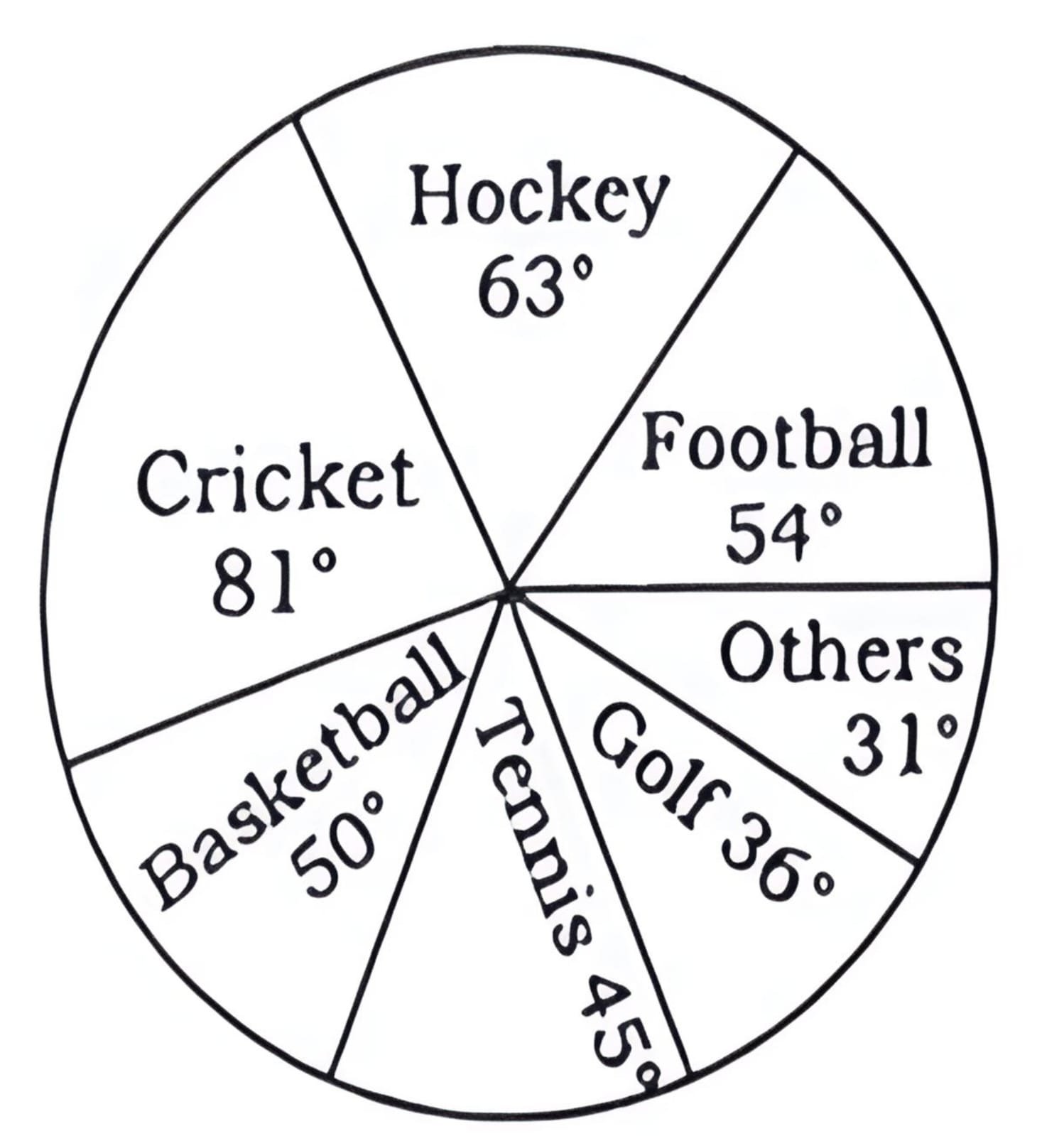
How much percent less is spent on football than that on cricket?
फुटबॉल पर क्रिकेट से कितना प्रतिशत कम व्यय किया गया?
📊 Data Interpretation – Pie Chart
The pie chart represents the expenditure of a country on different sports during a particular year. The central angle of each sector represents the proportion of total expenditure allocated to that sport. We have to calculate how much percent less is spent on football than on cricket.
📘 Important Concept and Formula
In a pie chart, the entire circle represents 100% of the total and measures 360°.
Therefore:
Percentage represented by a sector = (Central angle ÷ 360°) × 100.
When the question asks how much percent less one quantity is than another, the difference must be divided by the original comparison quantity.
Percentage decrease = [(Original value − New value) ÷ Original value] × 100.
📋 Information Given in the Pie Chart
| Sport | Central Angle | Share of Total Expenditure |
|---|---|---|
| Hockey | 63° | 17.5% |
| Football | 54° | 15% |
| Others | 31° | 8.61% approximately |
| Golf | 36° | 10% |
| Tennis | 45° | 12.5% |
| Basketball | 50° | 13.89% approximately |
| Cricket | 81° | 22.5% |
| Total | 360° | 100% |
🧮 Step-by-Step Solution
Step 1: Identify the angles for cricket and football.
Cricket = 81°.
Football = 54°.
Step 2: Calculate the difference between the two angles.
Difference = 81° − 54° = 27°.
Step 3: Calculate the percentage decrease with cricket as the base.
Percentage less = [(Cricket angle − Football angle) ÷ Cricket angle] × 100
= [(81 − 54) ÷ 81] × 100
= (27/81) × 100
= (1/3) × 100
= 33⅓%.
📊 Alternative Method Using Expenditure Percentages
Cricket’s share = (81/360) × 100 = 22.5%.
Football’s share = (54/360) × 100 = 15%.
Difference = 22.5 − 15 = 7.5 percentage points.
Percentage less than cricket = (7.5/22.5) × 100 = 33⅓%.
🧠 Further Exam-Oriented Facts
- Total angle of a pie chart: Always 360°.
- Percentage conversion: 1° represents 100/360 = 5/18% of the total.
- Cricket: 81° represents 22.5% of the total expenditure.
- Football: 54° represents 15% of the total expenditure.
- Difference: The difference is 27° or 7.5 percentage points of the total expenditure.
- Percentage less is not the same as percentage-point difference: The percentage-point difference is 7.5, but the percentage by which football expenditure is less than cricket expenditure is 33⅓%.
- Base value matters: To calculate how much football is less than cricket, cricket is the denominator. If the question asked how much cricket is more than football, football would be the denominator.
⚠️ Common Examination Trap
Do not calculate (81 − 54)/360 × 100 and select 7.5% as the answer. That gives the difference as a percentage of the entire country’s expenditure. The question asks the percentage by which football expenditure is less than cricket expenditure, so the difference must be divided by the cricket value, 81°.
Quick Revision: Cricket = 81°; Football = 54°; Difference = 27°; Percentage less = (27/81) × 100 = 33⅓%.
✔️ Final Answer: (E) 33⅓%
📊 आँकड़ों का विश्लेषण – पाई चार्ट
यह पाई चार्ट किसी विशेष वर्ष में विभिन्न खेलों पर एक राष्ट्र द्वारा किए गए व्यय को दर्शाता है। प्रत्येक खंड का केंद्रीय कोण उस खेल पर किए गए कुल व्यय के अनुपात को प्रदर्शित करता है। हमें ज्ञात करना है कि क्रिकेट की तुलना में फुटबॉल पर कितना प्रतिशत कम व्यय किया गया।
📘 महत्वपूर्ण अवधारणा एवं सूत्र
पाई चार्ट में पूरा वृत्त कुल व्यय का 100% तथा 360° दर्शाता है।
अतः:
किसी खंड द्वारा दर्शाया गया प्रतिशत = (केंद्रीय कोण ÷ 360°) × 100।
जब प्रश्न में पूछा जाए कि एक मात्रा दूसरी मात्रा से कितने प्रतिशत कम है, तो अंतर को तुलना के लिए दी गई मूल मात्रा से भाग देना आवश्यक है।
प्रतिशत कमी = [(मूल मान − नया मान) ÷ मूल मान] × 100।
📋 पाई चार्ट में दी गई जानकारी
| खेल | केंद्रीय कोण | कुल व्यय में हिस्सा |
|---|---|---|
| हॉकी | 63° | 17.5% |
| फुटबॉल | 54° | 15% |
| अन्य | 31° | लगभग 8.61% |
| गॉल्फ | 36° | 10% |
| टेनिस | 45° | 12.5% |
| बास्केटबॉल | 50° | लगभग 13.89% |
| क्रिकेट | 81° | 22.5% |
| कुल | 360° | 100% |
🧮 चरणबद्ध हल
चरण 1: क्रिकेट और फुटबॉल के कोण पहचानें।
क्रिकेट = 81°।
फुटबॉल = 54°।
चरण 2: दोनों कोणों का अंतर ज्ञात करें।
अंतर = 81° − 54° = 27°।
चरण 3: क्रिकेट को आधार मानकर प्रतिशत कमी ज्ञात करें।
प्रतिशत कमी = [(क्रिकेट का कोण − फुटबॉल का कोण) ÷ क्रिकेट का कोण] × 100
= [(81 − 54) ÷ 81] × 100
= (27/81) × 100
= (1/3) × 100
= 33⅓%।
📊 कुल व्यय के प्रतिशत से वैकल्पिक विधि
क्रिकेट का हिस्सा = (81/360) × 100 = 22.5%।
फुटबॉल का हिस्सा = (54/360) × 100 = 15%।
अंतर = 22.5 − 15 = कुल व्यय का 7.5 प्रतिशत अंक।
क्रिकेट की तुलना में प्रतिशत कमी = (7.5/22.5) × 100 = 33⅓%।
🧠 अतिरिक्त परीक्षा-उपयोगी तथ्य
- पाई चार्ट का कुल कोण: हमेशा 360° होता है।
- प्रतिशत में रूपांतरण: 1° कुल व्यय का 100/360 = 5/18% दर्शाता है।
- क्रिकेट: 81° कुल व्यय का 22.5% दर्शाता है।
- फुटबॉल: 54° कुल व्यय का 15% दर्शाता है।
- अंतर: दोनों के बीच अंतर 27° अथवा कुल व्यय का 7.5 प्रतिशत अंक है।
- प्रतिशत कमी और प्रतिशत अंक का अंतर: प्रतिशत अंकों का अंतर 7.5 है, लेकिन क्रिकेट की तुलना में फुटबॉल पर किया गया व्यय 33⅓% कम है।
- आधार मान महत्वपूर्ण है: फुटबॉल, क्रिकेट से कितना कम है, इसकी गणना में हर के रूप में क्रिकेट का मान लिया जाएगा। यदि प्रश्न पूछा जाए कि क्रिकेट, फुटबॉल से कितना अधिक है, तो हर में फुटबॉल का मान लिया जाएगा।
⚠️ परीक्षा में होने वाली सामान्य गलती
(81 − 54)/360 × 100 की गणना करके 7.5% को उत्तर नहीं चुनना चाहिए। इससे पूरे राष्ट्र के कुल व्यय की तुलना में अंतर प्राप्त होता है। प्रश्न पूछता है कि क्रिकेट की तुलना में फुटबॉल पर कितना प्रतिशत कम व्यय हुआ, इसलिए अंतर को क्रिकेट के मान 81° से भाग देना आवश्यक है।
त्वरित पुनरावृत्ति: क्रिकेट = 81°; फुटबॉल = 54°; अंतर = 27°; प्रतिशत कमी = (27/81) × 100 = 33⅓%।
✔️ अंतिम उत्तर: (E) 33⅓%
130A invested 76,000 in a business. After few months, B joined him with 57,000. At the end of the year, the total profit was divided between them in the ratio 2: 1. After how many months did B join?
एक व्यापार में A ₹76,000 का निवेश करता है। कुछ माह पश्चात् उससे N ₹57,000 के साथ जुड़ता है। वर्ष के अंत में कुल लाभ को 2:1 के अनुपात में उनमें बाँटा जाता है। B कितने माह के उपरान्त जुड़ा?
🤝 Partnership – Distribution of Profit
In a partnership, profit is generally distributed in proportion to the product of each partner’s capital invested and the time for which it remains invested. A invests ₹76,000 at the beginning of the year. B joins after some months with ₹57,000. At the end of the year, their profit-sharing ratio is 2:1. We have to calculate the number of months after which B joined.
📘 Important Formula
Profit-sharing ratio = (Capital of A × Time of A) : (Capital of B × Time of B).
In other words:
Profit share ∝ Capital × Time.
🧮 Step-by-Step Solution
Step 1: Write the given information.
- A’s capital = ₹76,000.
- B’s capital = ₹57,000.
- Total business period = 12 months.
- Profit-sharing ratio of A and B = 2:1.
Step 2: Let B invest for x months.
Since B joins after the beginning of the year, A’s investment period is 12 months and B’s investment period is x months.
Step 3: Apply the partnership formula.
(76,000 × 12) : (57,000 × x) = 2 : 1
Therefore:
(76,000 × 12)/(57,000 × x) = 2/1
912,000/(57,000x) = 2
912,000 = 114,000x
x = 912,000/114,000
x = 8 months.
Step 4: Calculate when B joined.
Total business period = 12 months.
B’s investment period = 8 months.
Therefore, B joined after = 12 − 8 = 4 months.
📊 Quick Calculation Table
| Particulars | A | B |
|---|---|---|
| Capital invested | ₹76,000 | ₹57,000 |
| Investment period | 12 months | 8 months |
| Capital × Time | 76,000 × 12 = 9,12,000 | 57,000 × 8 = 4,56,000 |
| Profit-sharing ratio | 9,12,000 : 4,56,000 = 2 : 1 | |
🧠 Further Exam-Oriented Facts
- Partnership: A business arrangement in which two or more persons agree to share profits and, as provided by their agreement and applicable law, business responsibilities.
- Capital and time: When partners invest different amounts for different periods, profit is divided according to capital multiplied by time, unless a different valid agreement applies.
- Equal capital: If two partners invest equal capital for different periods, their profit ratio depends on their investment periods.
- Equal time: If partners invest for the same period, their profit ratio depends on their respective capitals.
- Working partner: A partner who actively participates in the management of the business.
- Sleeping partner: A partner who contributes capital but does not actively participate in daily management.
- Important distinction: The question asks when B joined, not how long B invested. B invested for 8 months and therefore joined 4 months after the business began.
Quick Revision: A’s capital-time product = 76,000 × 12; B’s capital-time product = 57,000 × 8; profit ratio = 2:1; B invested for 8 months and joined after 4 months.
✔️ Final Answer: (B) 4 months
🤝 साझेदारी – लाभ का वितरण
साझेदारी में सामान्यतः लाभ का वितरण प्रत्येक साझेदार की निवेशित पूँजी और उस पूँजी के निवेश की अवधि के गुणनफल के अनुपात में किया जाता है। A वर्ष के प्रारंभ में ₹76,000 का निवेश करता है। B कुछ महीने बाद ₹57,000 के साथ व्यापार में शामिल होता है। वर्ष के अंत में उनके लाभ का अनुपात 2:1 है। हमें ज्ञात करना है कि B कितने महीने बाद व्यापार में शामिल हुआ।
📘 महत्वपूर्ण सूत्र
लाभ का अनुपात = (A की पूँजी × A का समय) : (B की पूँजी × B का समय)।
दूसरे शब्दों में:
लाभ का हिस्सा ∝ पूँजी × समय।
🧮 चरणबद्ध हल
चरण 1: दी गई जानकारी लिखें।
- A की पूँजी = ₹76,000।
- B की पूँजी = ₹57,000।
- व्यापार की कुल अवधि = 12 महीने।
- A और B के लाभ का अनुपात = 2:1।
चरण 2: मान लें कि B ने x महीने तक निवेश किया।
चूँकि B वर्ष के प्रारंभ में शामिल नहीं हुआ, इसलिए A की निवेश अवधि 12 महीने और B की निवेश अवधि x महीने होगी।
चरण 3: साझेदारी का सूत्र लागू करें।
(76,000 × 12) : (57,000 × x) = 2 : 1
अतः:
(76,000 × 12)/(57,000 × x) = 2/1
912,000/(57,000x) = 2
912,000 = 114,000x
x = 912,000/114,000
x = 8 महीने।
चरण 4: ज्ञात करें कि B कब शामिल हुआ।
व्यापार की कुल अवधि = 12 महीने।
B की निवेश अवधि = 8 महीने।
अतः B के शामिल होने का समय = 12 − 8 = 4 महीने बाद।
📊 त्वरित गणना तालिका
| विवरण | A | B |
|---|---|---|
| निवेशित पूँजी | ₹76,000 | ₹57,000 |
| निवेश की अवधि | 12 महीने | 8 महीने |
| पूँजी × समय | 76,000 × 12 = 9,12,000 | 57,000 × 8 = 4,56,000 |
| लाभ का अनुपात | 9,12,000 : 4,56,000 = 2 : 1 | |
🧠 अतिरिक्त परीक्षा-उपयोगी तथ्य
- साझेदारी: ऐसा व्यावसायिक समझौता जिसमें दो या दो से अधिक व्यक्ति लाभ बाँटने तथा अपने समझौते और लागू कानून के अनुसार व्यावसायिक जिम्मेदारियाँ साझा करने के लिए सहमत होते हैं।
- पूँजी और समय: जब साझेदार अलग-अलग धनराशि का निवेश अलग-अलग अवधियों के लिए करते हैं, तो किसी अन्य वैध समझौते के अभाव में लाभ का वितरण पूँजी और समय के गुणनफल के अनुपात में होता है।
- समान पूँजी: यदि दो साझेदार समान पूँजी अलग-अलग अवधियों के लिए लगाते हैं, तो उनका लाभ अनुपात निवेश की अवधियों पर निर्भर करेगा।
- समान समय: यदि साझेदार समान अवधि के लिए निवेश करते हैं, तो उनका लाभ अनुपात उनकी संबंधित पूँजी पर निर्भर करेगा।
- कार्यशील साझेदार: वह साझेदार जो व्यापार के प्रबंधन में सक्रिय रूप से भाग लेता है।
- निष्क्रिय साझेदार: वह साझेदार जो पूँजी का योगदान करता है, लेकिन दैनिक प्रबंधन में सक्रिय रूप से भाग नहीं लेता है।
- महत्वपूर्ण अंतर: प्रश्न में पूछा गया है कि B कब शामिल हुआ, न कि उसने कितने समय तक निवेश किया। B ने 8 महीने तक निवेश किया, इसलिए वह व्यापार शुरू होने के 4 महीने बाद शामिल हुआ।
त्वरित पुनरावृत्ति: A का पूँजी-समय गुणनफल = 76,000 × 12; B का पूँजी-समय गुणनफल = 57,000 × 8; लाभ अनुपात = 2:1; B ने 8 महीने निवेश किया और 4 महीने बाद शामिल हुआ।
✔️ अंतिम उत्तर: (B) 4 महीने
131Quartz crystals used in clocks are
घड़ी में प्रयोग होने वाले कार्ट्ज़ क्रिस्टल होते हैं
⏱️ Quartz Crystals and Their Use in Clocks
Quartz crystals used in clocks are made of silicon dioxide (SiO₂). Quartz is a naturally occurring crystalline form of silica. It is widely used in electronic clocks and watches because of its piezoelectric property, which means that it produces an electric charge when mechanical pressure is applied and can also vibrate mechanically when an electric field is applied.
In a quartz clock, an electronic circuit applies an alternating voltage to a small quartz crystal. The crystal vibrates at a highly stable natural frequency. These vibrations are converted into regular electrical pulses, which are counted by the clock’s electronic circuit to measure time accurately.
⚡ Piezoelectric Effect
The piezoelectric effect is the ability of certain materials to generate an electrical potential when mechanical stress is applied. The reverse piezoelectric effect occurs when such materials undergo mechanical deformation under an applied electric field. Quartz is an important natural piezoelectric material.
📊 Important Properties of Quartz
| Property | Description |
|---|---|
| Chemical name | Silicon dioxide |
| Chemical formula | SiO₂ |
| Major constituent | Silica |
| Crystal system | Trigonal |
| Hardness | 7 on the Mohs scale |
| Important property | Piezoelectricity |
| Common uses | Quartz clocks, watches, oscillators and electronic frequency-control devices |
🔬 Other Important Forms of Silicon Dioxide
- Quartz: A crystalline form of silicon dioxide commonly found in rocks and sand.
- Amethyst: A purple variety of quartz used as a gemstone.
- Agate: A banded variety of microcrystalline silica.
- Opal: A hydrated amorphous form of silica, unlike ordinary crystalline quartz.
🧠 Further Exam-Oriented Facts
- Silicon (Si): Atomic number 14; widely used as a semiconductor in electronic devices.
- Germanium (Ge): Atomic number 32; also used as a semiconductor.
- Titanium dioxide (TiO₂): Used in paints, pigments and sunscreens.
- Sodium silicate: Commonly known as water glass; used in adhesives, detergents and other industrial applications.
- Quartz clock: Its accuracy depends on the stable frequency of the quartz oscillator.
- Quartz versus silicon: Quartz is silicon dioxide (SiO₂), whereas elemental silicon has the chemical symbol Si.
Quick Revision: Quartz → SiO₂ → Piezoelectric effect → Stable vibrations → Accurate timekeeping.
✔️ Final Answer: (B) Silicon dioxide (SiO₂)
⏱️ क्वार्ट्ज क्रिस्टल और घड़ियों में उनका उपयोग
घड़ियों में प्रयोग किए जाने वाले क्वार्ट्ज क्रिस्टल सिलिकन डाइऑक्साइड (SiO₂) से बने होते हैं। क्वार्ट्ज, सिलिका का प्राकृतिक रूप से पाया जाने वाला क्रिस्टलीय रूप है। इसका उपयोग इलेक्ट्रॉनिक घड़ियों और कलाई घड़ियों में व्यापक रूप से किया जाता है, क्योंकि इसमें पीजोइलेक्ट्रिक गुण पाया जाता है। इसका अर्थ है कि यांत्रिक दबाव डालने पर यह विद्युत आवेश उत्पन्न कर सकता है तथा विद्युत क्षेत्र लगाने पर यांत्रिक रूप से कंपन भी कर सकता है।
क्वार्ट्ज घड़ी में एक इलेक्ट्रॉनिक परिपथ छोटे क्वार्ट्ज क्रिस्टल पर प्रत्यावर्ती वोल्टेज लागू करता है। यह क्रिस्टल अपनी अत्यधिक स्थिर प्राकृतिक आवृत्ति पर कंपन करता है। इन कंपनों को नियमित विद्युत स्पंदों में परिवर्तित किया जाता है, जिन्हें घड़ी का इलेक्ट्रॉनिक परिपथ गिनकर समय का सटीक मापन करता है।
⚡ पीजोइलेक्ट्रिक प्रभाव
पीजोइलेक्ट्रिक प्रभाव कुछ पदार्थों की वह क्षमता है, जिसके द्वारा उन पर यांत्रिक प्रतिबल लगाने पर वे विद्युत विभव उत्पन्न करते हैं। इसका विपरीत पीजोइलेक्ट्रिक प्रभाव तब होता है, जब विद्युत क्षेत्र लगाने पर ऐसे पदार्थों में यांत्रिक विकृति उत्पन्न होती है। क्वार्ट्ज एक महत्वपूर्ण प्राकृतिक पीजोइलेक्ट्रिक पदार्थ है।
📊 क्वार्ट्ज के महत्वपूर्ण गुण
| गुण | विवरण |
|---|---|
| रासायनिक नाम | सिलिकन डाइऑक्साइड |
| रासायनिक सूत्र | SiO₂ |
| प्रमुख घटक | सिलिका |
| क्रिस्टल तंत्र | त्रिकोणीय (Trigonal) |
| कठोरता | मोह्स पैमाने पर 7 |
| महत्वपूर्ण गुण | पीजोइलेक्ट्रिसिटी |
| सामान्य उपयोग | क्वार्ट्ज घड़ियाँ, कलाई घड़ियाँ, दोलित्र तथा इलेक्ट्रॉनिक आवृत्ति-नियंत्रण उपकरण |
🔬 सिलिकन डाइऑक्साइड के अन्य महत्वपूर्ण रूप
- क्वार्ट्ज: सिलिकन डाइऑक्साइड का क्रिस्टलीय रूप, जो चट्टानों और रेत में सामान्यतः पाया जाता है।
- एमेथिस्ट: क्वार्ट्ज की बैंगनी किस्म, जिसका उपयोग रत्न के रूप में किया जाता है।
- अगेट: सूक्ष्म क्रिस्टलीय सिलिका की पट्टियों वाली किस्म।
- ओपल: सिलिका का जलयोजित अक्रिस्टलीय रूप, जो सामान्य क्रिस्टलीय क्वार्ट्ज से भिन्न होता है।
🧠 अतिरिक्त परीक्षा-उपयोगी तथ्य
- सिलिकन (Si): परमाणु क्रमांक 14; इलेक्ट्रॉनिक उपकरणों में अर्धचालक के रूप में व्यापक उपयोग।
- जर्मेनियम (Ge): परमाणु क्रमांक 32; इसका उपयोग भी अर्धचालक के रूप में किया जाता है।
- टाइटेनियम डाइऑक्साइड (TiO₂): पेंट, रंगद्रव्य और सनस्क्रीन में उपयोग किया जाता है।
- सोडियम सिलिकेट: इसे सामान्यतः वाटर ग्लास कहा जाता है; इसका उपयोग चिपकाने वाले पदार्थों, डिटर्जेंट और अन्य औद्योगिक कार्यों में होता है।
- क्वार्ट्ज घड़ी: इसकी शुद्धता क्वार्ट्ज दोलित्र की स्थिर आवृत्ति पर निर्भर करती है।
- क्वार्ट्ज और सिलिकन में अंतर: क्वार्ट्ज सिलिकन डाइऑक्साइड (SiO₂) है, जबकि मौलिक सिलिकन का रासायनिक प्रतीक Si है।
त्वरित पुनरावृत्ति: क्वार्ट्ज → SiO₂ → पीजोइलेक्ट्रिक प्रभाव → स्थिर कंपन → सटीक समय मापन।
✔️ अंतिम उत्तर: (B) सिलिकन डाइऑक्साइड (SiO₂)
132Bromine is a
ब्रोमीन होती है
🧪 Bromine: A Reddish-Brown Liquid Halogen
Bromine (Br) is a non-metallic chemical element belonging to Group 17 of the periodic table. At ordinary room temperature, it exists as a reddish-brown, volatile liquid. It is one of the very few elements that are liquid at room temperature. Its molecules exist as diatomic molecules, represented by the formula Br₂.
The correct option is (D) red liquid, although the scientifically more precise description is reddish-brown liquid. Bromine gives off reddish-brown vapours and has a strong, unpleasant odour. It is corrosive and toxic, so it must be handled with appropriate laboratory safety precautions.
📊 Important Physical and Chemical Properties
| Property | Bromine |
|---|---|
| Symbol | Br |
| Atomic number | 35 |
| Atomic mass | Approximately 79.904 u |
| Group | 17 |
| Period | 4 |
| Family | Halogens |
| Molecular formula | Br₂ |
| Physical state at room temperature | Liquid |
| Colour | Reddish-brown |
| Melting point | Approximately −7.2°C |
| Boiling point | Approximately 58.8°C |
🧬 Physical States of Halogens
Halogens belong to Group 17 of the periodic table. Their physical states change as atomic size and intermolecular forces increase down the group.
| Element | Symbol | Physical State at Room Temperature | Colour |
|---|---|---|---|
| Fluorine | F₂ | Gas | Pale yellow |
| Chlorine | Cl₂ | Gas | Greenish-yellow |
| Bromine | Br₂ | Liquid | Reddish-brown |
| Iodine | I₂ | Solid | Greyish-black; gives violet vapour on heating |
| Astatine | At | Solid | Radioactive; visible colour is not well established |
🔬 Important Uses of Bromine
- Flame retardants: Certain brominated compounds are used in materials to reduce flammability, although several uses are restricted because of environmental and health concerns.
- Water treatment: Bromine-based compounds are used as disinfectants in some swimming pools and industrial water systems.
- Photography: Silver bromide (AgBr) was historically important in photographic films and papers because it is light-sensitive.
- Pharmaceuticals: Certain bromine-containing compounds are used in the manufacture of medicines.
- Chemical industry: Bromine compounds are used in various chemical synthesis processes.
🧠 Further Exam-Oriented Facts
- Liquid non-metals: Bromine is the only non-metallic element that is liquid at ordinary room temperature.
- Other liquid element: Mercury (Hg) is a metal that is liquid at ordinary room temperature.
- Halogens: The name means salt-forming elements. They have seven electrons in their outermost shell.
- Reactivity: Halogen reactivity generally decreases down Group 17: fluorine is the most reactive halogen.
- Bromine water: It is used in laboratory tests for unsaturation; alkenes can decolourise bromine water through an addition reaction.
- Safety: Bromine is toxic, corrosive and harmful by inhalation or skin contact. It should only be handled under suitable laboratory safety conditions.
Quick Revision: Bromine → Br → Atomic number 35 → Group 17 → Reddish-brown liquid → Br₂.
✔️ Final Answer: (D) Red liquid (more precisely, reddish-brown liquid)
🧪 ब्रोमीन: लाल-भूरे रंग का द्रव हैलोजन
ब्रोमीन (Br) एक अधात्विक रासायनिक तत्व है, जो आवर्त सारणी के समूह 17 में आता है। सामान्य कमरे के तापमान पर यह लाल-भूरे रंग के वाष्पशील द्रव के रूप में पाया जाता है। यह उन बहुत कम तत्वों में से एक है जो कमरे के तापमान पर द्रव अवस्था में होते हैं। इसके अणु द्विपरमाणुक होते हैं, जिन्हें Br₂ सूत्र से दर्शाया जाता है।
सही विकल्प (D) लाल द्रव है, हालाँकि वैज्ञानिक दृष्टि से इसका अधिक सटीक वर्णन लाल-भूरे रंग का द्रव है। ब्रोमीन से लाल-भूरे रंग के वाष्प निकलते हैं और इसकी गंध तीव्र तथा अप्रिय होती है। यह संक्षारक और विषैला है, इसलिए इसे उचित प्रयोगशाला सुरक्षा उपायों के साथ ही संभालना चाहिए।
📊 महत्वपूर्ण भौतिक एवं रासायनिक गुण
| गुण | ब्रोमीन |
|---|---|
| प्रतीक | Br |
| परमाणु क्रमांक | 35 |
| परमाणु द्रव्यमान | लगभग 79.904 u |
| समूह | 17 |
| आवर्त | 4 |
| परिवार | हैलोजन |
| अणुसूत्र | Br₂ |
| कमरे के तापमान पर भौतिक अवस्था | द्रव |
| रंग | लाल-भूरा |
| गलनांक | लगभग −7.2°C |
| क्वथनांक | लगभग 58.8°C |
🧬 हैलोजन की भौतिक अवस्थाएँ
हैलोजन आवर्त सारणी के समूह 17 में पाए जाते हैं। समूह में नीचे जाने पर परमाणु आकार और अंतराअणुक बल बढ़ने के कारण उनकी भौतिक अवस्थाओं में परिवर्तन होता है।
| तत्व | प्रतीक | कमरे के तापमान पर भौतिक अवस्था | रंग |
|---|---|---|---|
| फ्लोरीन | F₂ | गैस | हल्का पीला |
| क्लोरीन | Cl₂ | गैस | हरा-पीला |
| ब्रोमीन | Br₂ | द्रव | लाल-भूरा |
| आयोडीन | I₂ | ठोस | धूसर-काला; गर्म करने पर बैंगनी वाष्प देता है |
| एस्टेटीन | At | ठोस | रेडियोधर्मी; इसका दृश्य रंग अच्छी तरह स्थापित नहीं है |
🔬 ब्रोमीन के महत्वपूर्ण उपयोग
- अग्निरोधी पदार्थ: कुछ ब्रोमीनयुक्त यौगिकों का उपयोग पदार्थों की ज्वलनशीलता कम करने के लिए किया जाता है, हालाँकि पर्यावरण और स्वास्थ्य संबंधी चिंताओं के कारण इनके कई उपयोग प्रतिबंधित हैं।
- जल उपचार: कुछ स्विमिंग पूलों और औद्योगिक जल प्रणालियों में ब्रोमीन-आधारित यौगिकों का उपयोग कीटाणुनाशक के रूप में किया जाता है।
- फोटोग्राफी: सिल्वर ब्रोमाइड (AgBr) ऐतिहासिक रूप से फोटोग्राफिक फिल्मों और कागजों में महत्वपूर्ण था, क्योंकि यह प्रकाश-संवेदी होता है।
- औषधियाँ: ब्रोमीन युक्त कुछ यौगिकों का उपयोग दवाओं के निर्माण में किया जाता है।
- रासायनिक उद्योग: विभिन्न रासायनिक संश्लेषण प्रक्रियाओं में ब्रोमीन यौगिकों का उपयोग किया जाता है।
🧠 अतिरिक्त परीक्षा-उपयोगी तथ्य
- द्रव अधातु: ब्रोमीन एकमात्र अधात्विक तत्व है जो सामान्य कमरे के तापमान पर द्रव अवस्था में होता है।
- अन्य द्रव तत्व: पारा (Hg) एक धातु है जो सामान्य कमरे के तापमान पर द्रव अवस्था में होता है।
- हैलोजन: इस नाम का अर्थ लवण बनाने वाले तत्व है। इनके बाहरी कोश में सात इलेक्ट्रॉन होते हैं।
- अभिक्रियाशीलता: समूह 17 में नीचे जाने पर हैलोजन की अभिक्रियाशीलता सामान्यतः घटती है; फ्लोरीन सबसे अधिक अभिक्रियाशील हैलोजन है।
- ब्रोमीन जल: इसका उपयोग असंतृप्तता की प्रयोगशाला जाँच में किया जाता है; ऐल्कीन योगात्मक अभिक्रिया द्वारा ब्रोमीन जल का रंग समाप्त कर सकते हैं।
- सुरक्षा: ब्रोमीन विषैला, संक्षारक तथा साँस द्वारा अंदर जाने या त्वचा के संपर्क में आने पर हानिकारक है। इसे केवल उपयुक्त प्रयोगशाला सुरक्षा उपायों के अंतर्गत संभालना चाहिए।
त्वरित पुनरावृत्ति: ब्रोमीन → Br → परमाणु क्रमांक 35 → समूह 17 → लाल-भूरा द्रव → Br₂।
✔️ अंतिम उत्तर: (D) लाल द्रव (अधिक सटीक रूप से, लाल-भूरा द्रव)
133Gases used in welding are
वेल्डिंग में प्रयोग होने वाली गैसें हैं
🔥 Gases Used in Welding: Oxy-Acetylene Welding
The commonly used gases in oxy-acetylene welding are oxygen (O₂) and acetylene (C₂H₂). Acetylene is a highly combustible fuel gas, while oxygen supports combustion. When acetylene burns in oxygen, it produces a very high-temperature flame capable of melting and joining metals.
The temperature of an oxy-acetylene flame can reach approximately 3,100–3,200°C, depending on operating conditions. This makes it suitable for welding and cutting many metals. The process is widely used in metal fabrication, repair work and engineering workshops.
⚙️ How Does Oxy-Acetylene Welding Work?
- Fuel gas: Acetylene provides the combustible fuel.
- Oxidising gas: Oxygen supports the combustion of acetylene.
- Flame: The gases are mixed in a welding torch and ignited to produce a high-temperature flame.
- Joining: The heat melts the edges of the metal pieces; filler metal may be added when required.
- Welding versus cutting: Welding joins metal pieces, whereas oxy-fuel cutting uses a high-temperature flame and an oxygen jet to cut suitable metals.
🧪 Chemical Reaction
The complete combustion of acetylene in oxygen can be represented by the balanced equation:
2C₂H₂ + 5O₂ → 4CO₂ + 2H₂O + Heat
In practical oxy-acetylene welding, the flame is adjusted to obtain the required characteristics. A neutral flame is commonly used for general welding applications. Carburising and oxidising flames are also used for specific materials and purposes.
📊 Types of Oxy-Acetylene Flames
| Flame Type | Characteristics | Common Application |
|---|---|---|
| Neutral flame | Approximately balanced oxygen and acetylene supply | General welding of many steels and other metals |
| Oxidising flame | Excess oxygen | Used for certain copper alloys and specialised applications |
| Carburising flame | Excess acetylene | Used for selected materials and specialised operations |
🔧 Other Welding Processes and Their Gases
| Welding Process | Gas / Medium Used | Main Purpose |
|---|---|---|
| Oxy-acetylene welding | Oxygen + Acetylene | Produces a high-temperature flame |
| Oxy-hydrogen welding | Oxygen + Hydrogen | Uses a hydrogen-oxygen flame |
| MIG/MAG welding | Argon, carbon dioxide or gas mixtures | Shielding the molten weld pool |
| TIG welding | Argon or helium, sometimes mixtures | Protects the electrode and weld area |
| Shielded Metal Arc Welding | Flux coating produces shielding gases and slag | Protects the weld pool |
🧠 Further Exam-Oriented Facts
- Acetylene: Chemical formula C₂H₂; it is the simplest alkyne and is also called ethyne.
- Oxygen: Chemical formula O₂; it supports combustion but is not itself a fuel.
- Nitrogen: It is generally not used as the fuel gas in oxy-acetylene welding.
- Oxy-fuel cutting: Uses oxygen and a fuel gas; the oxygen jet oxidises and removes heated metal.
- Safety: Acetylene is highly flammable and can form explosive mixtures with air. Welding cylinders, regulators, hoses and flashback arrestors must be handled according to safety standards.
- Modern welding: Electric arc welding, MIG, MAG and TIG are widely used in industrial manufacturing alongside gas welding.
Quick Revision: Oxy-acetylene welding → Oxygen (O₂) + Acetylene (C₂H₂) → High-temperature flame → Metal joining.
✔️ Final Answer: (C) Oxygen and acetylene
🔥 वेल्डिंग में प्रयुक्त गैसें: ऑक्सी-ऐसीटिलीन वेल्डिंग
ऑक्सी-ऐसीटिलीन वेल्डिंग में सामान्यतः ऑक्सीजन (O₂) और ऐसीटिलीन (C₂H₂) गैसों का उपयोग किया जाता है। ऐसीटिलीन एक अत्यधिक ज्वलनशील ईंधन गैस है, जबकि ऑक्सीजन दहन में सहायता करती है। जब ऐसीटिलीन ऑक्सीजन में जलती है, तो बहुत अधिक तापमान वाली ज्वाला उत्पन्न होती है, जो धातुओं को पिघलाकर जोड़ने में सक्षम होती है।
ऑक्सी-ऐसीटिलीन ज्वाला का तापमान संचालन की परिस्थितियों के अनुसार लगभग 3,100–3,200°C तक पहुँच सकता है। इस कारण यह अनेक धातुओं की वेल्डिंग और कटाई के लिए उपयुक्त है। इस प्रक्रिया का उपयोग धातु निर्माण, मरम्मत कार्य और इंजीनियरिंग कार्यशालाओं में व्यापक रूप से किया जाता है।
⚙️ ऑक्सी-ऐसीटिलीन वेल्डिंग कैसे काम करती है?
- ईंधन गैस: ऐसीटिलीन ज्वलनशील ईंधन प्रदान करती है।
- दहन में सहायक गैस: ऑक्सीजन ऐसीटिलीन के दहन में सहायता करती है।
- ज्वाला: दोनों गैसों को वेल्डिंग टॉर्च में मिलाकर प्रज्वलित किया जाता है, जिससे उच्च तापमान वाली ज्वाला बनती है।
- जोड़ना: ऊष्मा धातु के टुकड़ों के किनारों को पिघला देती है; आवश्यकता पड़ने पर भराव धातु भी मिलाई जा सकती है।
- वेल्डिंग और कटाई में अंतर: वेल्डिंग में धातु के टुकड़ों को जोड़ा जाता है, जबकि ऑक्सी-ईंधन कटाई में उच्च तापमान वाली ज्वाला और ऑक्सीजन की धारा से उपयुक्त धातुओं को काटा जाता है।
🧪 रासायनिक अभिक्रिया
ऑक्सीजन में ऐसीटिलीन के पूर्ण दहन को निम्न संतुलित रासायनिक समीकरण से दर्शाया जा सकता है:
2C₂H₂ + 5O₂ → 4CO₂ + 2H₂O + ऊष्मा
वास्तविक ऑक्सी-ऐसीटिलीन वेल्डिंग में आवश्यक गुणों के अनुसार ज्वाला को समायोजित किया जाता है। सामान्य वेल्डिंग कार्यों में उदासीन ज्वाला का उपयोग किया जाता है। विशिष्ट पदार्थों और उद्देश्यों के लिए कार्बुराइजिंग तथा ऑक्सीकारक ज्वालाओं का भी उपयोग होता है।
📊 ऑक्सी-ऐसीटिलीन ज्वाला के प्रकार
| ज्वाला का प्रकार | विशेषताएँ | सामान्य उपयोग |
|---|---|---|
| उदासीन ज्वाला | ऑक्सीजन और ऐसीटिलीन की लगभग संतुलित आपूर्ति | अनेक प्रकार के इस्पात और अन्य धातुओं की सामान्य वेल्डिंग |
| ऑक्सीकारक ज्वाला | ऑक्सीजन की अधिकता | कुछ ताँबा मिश्रधातुओं तथा विशेष कार्यों में उपयोग |
| कार्बुराइजिंग ज्वाला | ऐसीटिलीन की अधिकता | चुनिंदा पदार्थों और विशेष प्रक्रियाओं में उपयोग |
🔧 अन्य वेल्डिंग प्रक्रियाएँ और उनकी गैसें
| वेल्डिंग प्रक्रिया | प्रयुक्त गैस / माध्यम | मुख्य उद्देश्य |
|---|---|---|
| ऑक्सी-ऐसीटिलीन वेल्डिंग | ऑक्सीजन + ऐसीटिलीन | उच्च तापमान वाली ज्वाला उत्पन्न करना |
| ऑक्सी-हाइड्रोजन वेल्डिंग | ऑक्सीजन + हाइड्रोजन | हाइड्रोजन-ऑक्सीजन ज्वाला का उपयोग |
| MIG/MAG वेल्डिंग | आर्गन, कार्बन डाइऑक्साइड या गैस मिश्रण | पिघले हुए वेल्ड क्षेत्र को परिरक्षित करना |
| TIG वेल्डिंग | आर्गन या हीलियम, कभी-कभी इनके मिश्रण | इलेक्ट्रोड और वेल्ड क्षेत्र की सुरक्षा करना |
| शील्डेड मेटल आर्क वेल्डिंग | फ्लक्स की परत से परिरक्षण गैसें और स्लैग बनते हैं | वेल्ड क्षेत्र की सुरक्षा करना |
🧠 अतिरिक्त परीक्षा-उपयोगी तथ्य
- ऐसीटिलीन: रासायनिक सूत्र C₂H₂; यह सबसे सरल ऐल्काइन है और इसे एथाइन भी कहा जाता है।
- ऑक्सीजन: रासायनिक सूत्र O₂; यह दहन में सहायता करती है, लेकिन स्वयं ईंधन नहीं है।
- नाइट्रोजन: ऑक्सी-ऐसीटिलीन वेल्डिंग में सामान्यतः ईंधन गैस के रूप में इसका उपयोग नहीं किया जाता है।
- ऑक्सी-ईंधन कटाई: इसमें ऑक्सीजन और ईंधन गैस का उपयोग होता है; ऑक्सीजन की धारा गर्म धातु का ऑक्सीकरण करके उसे हटाती है।
- सुरक्षा: ऐसीटिलीन अत्यधिक ज्वलनशील है और हवा के साथ विस्फोटक मिश्रण बना सकती है। वेल्डिंग सिलेंडरों, रेगुलेटरों, होज़ तथा फ्लैशबैक अरेस्टर को सुरक्षा मानकों के अनुसार संभालना चाहिए।
- आधुनिक वेल्डिंग: गैस वेल्डिंग के साथ-साथ इलेक्ट्रिक आर्क वेल्डिंग, MIG, MAG और TIG का औद्योगिक निर्माण में व्यापक उपयोग होता है।
त्वरित पुनरावृत्ति: ऑक्सी-ऐसीटिलीन वेल्डिंग → ऑक्सीजन (O₂) + ऐसीटिलीन (C₂H₂) → उच्च तापमान वाली ज्वाला → धातुओं को जोड़ना।
✔️ अंतिम उत्तर: (C) ऑक्सीजन तथा ऐसीटिलीन
134Galvanized iron pipes have a coating of
गैल्वेनाइज़्ड लोहे के पाइप पर परत होती है
🛡️ Galvanization: Zinc Coating on Iron and Steel
Galvanized iron (GI) pipes are iron or steel pipes coated with a thin protective layer of zinc (Zn). This coating protects the underlying metal from corrosion and rusting. The most common industrial method is hot-dip galvanization, in which cleaned iron or steel is immersed in molten zinc.
Zinc protects iron not only by acting as a physical barrier against air and moisture but also through sacrificial protection. Zinc is more reactive than iron and preferentially corrodes when the coating is damaged, thereby helping protect the exposed iron or steel.
⚙️ How Is Galvanization Done?
- Cleaning: Oil, grease and dirt are removed from the iron or steel surface.
- Pickling: The surface is treated with an appropriate acid solution to remove rust and scale.
- Fluxing: A flux treatment helps prepare the surface for zinc coating and reduces oxidation before immersion.
- Hot-dip coating: The cleaned material is immersed in molten zinc.
- Cooling and inspection: The coated material is cooled and inspected for coating quality and uniformity.
📊 Important Methods of Corrosion Protection
| Method | Principle / Material | Example |
|---|---|---|
| Galvanization | Coating with zinc | GI pipes, roofing sheets |
| Tinning | Coating with tin | Tin-plated steel food cans |
| Electroplating | Depositing a metal layer using electric current | Chrome-plated taps and fittings |
| Painting | Protective barrier against air and moisture | Metal gates and bridges |
| Cathodic protection | Making the protected metal act as a cathode | Underground pipelines and storage tanks |
| Alloying | Adding elements to improve corrosion resistance | Stainless steel |
🧪 Why Does Zinc Protect Iron?
Zinc is more electrochemically active than iron. When both metals are electrically connected in the presence of an electrolyte, zinc generally acts as the anode and corrodes preferentially. Iron acts as the cathode and is protected. This mechanism is called sacrificial anode protection.
Even if a small part of the zinc coating is scratched, the surrounding zinc can continue to provide sacrificial protection to the exposed iron, provided sufficient zinc remains and the electrochemical conditions allow it.
🧠 Further Exam-Oriented Facts
- Galvanization: Coating iron or steel with zinc to prevent corrosion.
- Zinc symbol: Zn; atomic number 30.
- Iron symbol: Fe; atomic number 26.
- Rust: Mainly hydrated iron(III) oxide, often represented as Fe₂O₃·xH₂O.
- Tinning versus galvanization: Tinning uses tin, whereas galvanization uses zinc.
- Stainless steel: Its corrosion resistance is mainly due to chromium, which forms a thin protective chromium oxide layer.
- Important distinction: Galvanized iron is zinc-coated iron or steel; it is not chromium-plated iron.
- Applications: GI pipes, fencing, roofing sheets, structural components and other outdoor steel products.
Quick Revision: Galvanization → Zinc coating → Sacrificial protection → Reduced rusting of iron and steel.
✔️ Final Answer: (A) Zinc
🛡️ गैल्वनीकरण: लोहे और इस्पात पर जस्ते की परत
गैल्वेनाइज्ड आयरन (GI) पाइप लोहे या इस्पात के ऐसे पाइप होते हैं जिन पर जस्ते (Zn) की एक पतली सुरक्षात्मक परत चढ़ाई जाती है। यह परत अंदर की धातु को संक्षारण और जंग लगने से बचाती है। इसकी सबसे सामान्य औद्योगिक विधि हॉट-डिप गैल्वनीकरण है, जिसमें साफ किए गए लोहे या इस्पात को पिघले हुए जस्ते में डुबोया जाता है।
जस्ता लोहे को केवल वायु और नमी से बचाने वाली भौतिक बाधा के रूप में ही नहीं, बल्कि बलिदानी संरक्षण द्वारा भी सुरक्षा देता है। जस्ता लोहे से अधिक अभिक्रियाशील होता है और परत क्षतिग्रस्त होने पर यह प्राथमिकता से संक्षारित होता है। इस प्रकार यह खुले हुए लोहे या इस्पात की रक्षा करने में सहायता करता है।
⚙️ गैल्वनीकरण कैसे किया जाता है?
- सफाई: लोहे या इस्पात की सतह से तेल, चिकनाई और गंदगी हटाई जाती है।
- पिकलिंग: जंग और ऑक्साइड की परत हटाने के लिए सतह को उपयुक्त अम्लीय विलयन से उपचारित किया जाता है।
- फ्लक्सिंग: फ्लक्स उपचार जस्ते की परत चढ़ाने के लिए सतह तैयार करता है तथा डुबोने से पहले ऑक्सीकरण कम करता है।
- हॉट-डिप कोटिंग: साफ की गई वस्तु को पिघले हुए जस्ते में डुबोया जाता है।
- ठंडा करना और निरीक्षण: परत चढ़ी वस्तु को ठंडा किया जाता है और परत की गुणवत्ता तथा एकरूपता की जाँच की जाती है।
📊 संक्षारण से सुरक्षा की महत्वपूर्ण विधियाँ
| विधि | सिद्धांत / पदार्थ | उदाहरण |
|---|---|---|
| गैल्वनीकरण | जस्ते की परत चढ़ाना | GI पाइप, छत की चादरें |
| टिनिंग | टिन की परत चढ़ाना | टिन-लेपित इस्पात के खाद्य डिब्बे |
| विद्युत-लेपन | विद्युत धारा द्वारा धातु की परत जमा करना | क्रोमियम-लेपित नल और फिटिंग |
| पेंटिंग | वायु और नमी के विरुद्ध सुरक्षात्मक बाधा | धातु के दरवाजे और पुल |
| कैथोडिक संरक्षण | संरक्षित धातु को कैथोड बनाना | भूमिगत पाइपलाइन और भंडारण टैंक |
| मिश्रधातु निर्माण | संक्षारण प्रतिरोध बढ़ाने के लिए तत्व मिलाना | स्टेनलेस स्टील |
🧪 जस्ता लोहे की रक्षा क्यों करता है?
जस्ता विद्युत-रासायनिक दृष्टि से लोहे से अधिक सक्रिय होता है। जब दोनों धातुएँ किसी विद्युत अपघट्य की उपस्थिति में विद्युत रूप से जुड़ी होती हैं, तो जस्ता सामान्यतः एनोड के रूप में कार्य करता है और प्राथमिकता से संक्षारित होता है। लोहा कैथोड के रूप में कार्य करता है और सुरक्षित रहता है। इस प्रक्रिया को बलिदानी एनोड संरक्षण कहा जाता है।
यदि जस्ते की परत का कोई छोटा भाग खरोंच से हट भी जाए, तो आसपास का जस्ता खुले हुए लोहे को बलिदानी संरक्षण देना जारी रख सकता है, बशर्ते पर्याप्त जस्ता शेष हो और विद्युत-रासायनिक परिस्थितियाँ इसके अनुकूल हों।
🧠 अतिरिक्त परीक्षा-उपयोगी तथ्य
- गैल्वनीकरण: संक्षारण रोकने के लिए लोहे या इस्पात पर जस्ते की परत चढ़ाना।
- जस्ते का प्रतीक: Zn; परमाणु क्रमांक 30।
- लोहे का प्रतीक: Fe; परमाणु क्रमांक 26।
- जंग: मुख्यतः जलयोजित आयरन (III) ऑक्साइड, जिसे प्रायः Fe₂O₃·xH₂O से दर्शाया जाता है।
- टिनिंग और गैल्वनीकरण में अंतर: टिनिंग में टिन की, जबकि गैल्वनीकरण में जस्ते की परत चढ़ाई जाती है।
- स्टेनलेस स्टील: इसका संक्षारण प्रतिरोध मुख्यतः क्रोमियम के कारण होता है, जो क्रोमियम ऑक्साइड की पतली सुरक्षात्मक परत बनाता है।
- महत्वपूर्ण अंतर: गैल्वेनाइज्ड आयरन जस्ते की परत चढ़ा हुआ लोहा या इस्पात है; यह क्रोमियम-लेपित लोहा नहीं है।
- उपयोग: GI पाइप, बाड़, छत की चादरें, संरचनात्मक घटक और अन्य बाहरी इस्पात उत्पाद।
त्वरित पुनरावृत्ति: गैल्वनीकरण → जस्ते की परत → बलिदानी संरक्षण → लोहे और इस्पात में जंग कम लगना।
✔️ अंतिम उत्तर: (A) जस्ता
135The wavelength of spectrum is in the range visible
दृश्य स्पेक्ट्रम के तरंगदैर्ध्य की सीमा है
🌈 Visible Spectrum and Wavelength of Light
The visible spectrum is the portion of the electromagnetic spectrum that can be detected by the human eye. Its approximate wavelength range is commonly given as 380–750 nanometres (nm), although the limits vary slightly depending on the observer and the reference used.
The given option (B) 3900 Å–7600 Å is the expected answer in this question. Since 1 nanometre = 10 ångströms, this range corresponds to 390–760 nm, which lies within the commonly accepted approximate visible-light range used in many traditional textbooks.
📏 Understanding the Units
- Nanometre (nm): One billionth of a metre, or 10⁻⁹ m.
- Ångström (Å): One ten-billionth of a metre, or 10⁻¹⁰ m.
- Conversion: 1 nm = 10 Å.
- Visible light: Approximately 380–750 nm, or 3800–7500 Å; some conventional textbook ranges extend approximately from 3900 Å to 7600 Å.
🌈 Colours of the Visible Spectrum
White light can be dispersed into different colours by a prism. In the conventional sequence, the colours are violet, indigo, blue, green, yellow, orange and red (VIBGYOR). Wavelength increases from violet towards red.
| Colour | Approximate Wavelength | Key Feature |
|---|---|---|
| Violet | 380–450 nm | Shortest visible wavelengths |
| Blue | 450–495 nm | Short wavelength |
| Green | 495–570 nm | Middle portion of the visible spectrum |
| Yellow | 570–590 nm | Intermediate wavelength |
| Orange | 590–620 nm | Longer wavelength |
| Red | 620–750 nm | Longest visible wavelengths |
📡 Electromagnetic Spectrum: Important Regions
The electromagnetic spectrum includes waves with different wavelengths and frequencies. The visible region is only a small part of this spectrum.
| Radiation | Approximate Wavelength Region | Common Use / Feature |
|---|---|---|
| Gamma rays | Less than about 0.01 nm | Nuclear processes and medical radiotherapy |
| X-rays | About 0.01–10 nm | Medical imaging |
| Ultraviolet | About 10–400 nm | Fluorescence and sterilisation applications |
| Visible light | About 380–750 nm | Human vision |
| Infrared | About 750 nm–1 mm | Thermal imaging and remote controls |
| Microwaves | About 1 mm–1 m | Radar and microwave communication |
| Radio waves | Longer than about 1 m | Radio and television communication |
⚡ Important Scientific Principles
- Wavelength and frequency: They are inversely proportional for electromagnetic waves travelling in the same medium. A shorter wavelength corresponds to a higher frequency.
- Speed of light: In vacuum, electromagnetic waves travel at approximately 3 × 10⁸ metres per second.
- Dispersion: Splitting white light into its constituent colours is called dispersion.
- Rainbow: It is formed mainly due to refraction, dispersion and internal reflection of sunlight in water droplets.
- Infrared radiation: It is commonly associated with thermal radiation and is used in thermal cameras.
- Ultraviolet radiation: It has a shorter wavelength than visible violet light and can cause skin damage with excessive exposure.
🧠 Further Exam-Oriented Facts
- VIBGYOR: Violet, Indigo, Blue, Green, Yellow, Orange and Red.
- Shortest wavelength in visible light: Violet.
- Longest wavelength in visible light: Red.
- Highest frequency in visible light: Violet.
- Lowest frequency in visible light: Red.
- Ultraviolet: Lies beyond the violet end of the visible spectrum.
- Infrared: Lies beyond the red end of the visible spectrum.
- Important distinction: The visible wavelength limits are approximate, not absolute boundaries; different scientific references may use slightly different values.
Quick Revision: Visible light → Approximately 380–750 nm → 3800–7500 Å; traditional textbook range in this question → 3900–7600 Å; violet → shortest wavelength; red → longest wavelength.
✔️ Final Answer: (B) 3900 Å–7600 Å
🌈 दृश्य स्पेक्ट्रम और प्रकाश की तरंगदैर्ध्य
दृश्य स्पेक्ट्रम विद्युतचुंबकीय स्पेक्ट्रम का वह भाग है जिसे मानव आँख देख सकती है। इसकी तरंगदैर्ध्य सीमा सामान्यतः लगभग 380–750 नैनोमीटर (nm) मानी जाती है, हालाँकि प्रेक्षक और प्रयुक्त संदर्भ के अनुसार इसकी सीमाओं में थोड़ा अंतर हो सकता है।
दिए गए विकल्पों में (B) 3900 Å–7600 Å इस प्रश्न का अपेक्षित उत्तर है। चूँकि 1 नैनोमीटर = 10 आंग्स्ट्रॉम होता है, इसलिए यह सीमा 390–760 nm के बराबर है, जो अनेक पारंपरिक पाठ्यपुस्तकों में प्रयुक्त दृश्य प्रकाश की सामान्य स्वीकृत अनुमानित सीमा के अंतर्गत आती है।
📏 मात्रकों को समझना
- नैनोमीटर (nm): मीटर का एक अरबवाँ भाग, अर्थात 10⁻⁹ m।
- आंग्स्ट्रॉम (Å): मीटर का दस अरबवाँ भाग, अर्थात 10⁻¹⁰ m।
- रूपांतरण: 1 nm = 10 Å।
- दृश्य प्रकाश: लगभग 380–750 nm अथवा 3800–7500 Å; कुछ पारंपरिक पाठ्यपुस्तकों में इसकी सीमा लगभग 3900 Å से 7600 Å तक दी जाती है।
🌈 दृश्य स्पेक्ट्रम के रंग
प्रिज्म द्वारा श्वेत प्रकाश को विभिन्न रंगों में विभाजित किया जा सकता है। पारंपरिक क्रम में रंग बैंगनी, जामुनी, नीला, हरा, पीला, नारंगी और लाल (VIBGYOR) होते हैं। बैंगनी से लाल की ओर जाने पर तरंगदैर्ध्य बढ़ती है।
| रंग | अनुमानित तरंगदैर्ध्य | प्रमुख विशेषता |
|---|---|---|
| बैंगनी | 380–450 nm | दृश्य प्रकाश में सबसे कम तरंगदैर्ध्य |
| नीला | 450–495 nm | कम तरंगदैर्ध्य |
| हरा | 495–570 nm | दृश्य स्पेक्ट्रम का मध्य भाग |
| पीला | 570–590 nm | मध्यम तरंगदैर्ध्य |
| नारंगी | 590–620 nm | अधिक तरंगदैर्ध्य |
| लाल | 620–750 nm | दृश्य प्रकाश में सबसे अधिक तरंगदैर्ध्य |
📡 विद्युतचुंबकीय स्पेक्ट्रम: महत्वपूर्ण क्षेत्र
विद्युतचुंबकीय स्पेक्ट्रम में अलग-अलग तरंगदैर्ध्य और आवृत्तियों वाली तरंगें शामिल होती हैं। दृश्य क्षेत्र इस स्पेक्ट्रम का केवल एक छोटा-सा भाग है।
| विकिरण | अनुमानित तरंगदैर्ध्य क्षेत्र | सामान्य उपयोग / विशेषता |
|---|---|---|
| गामा किरणें | लगभग 0.01 nm से कम | नाभिकीय प्रक्रियाएँ और चिकित्सीय रेडियोथेरेपी |
| एक्स-किरणें | लगभग 0.01–10 nm | चिकित्सीय चित्रण |
| पराबैंगनी | लगभग 10–400 nm | प्रतिदीप्ति और रोगाणुनाशन संबंधी उपयोग |
| दृश्य प्रकाश | लगभग 380–750 nm | मानव दृष्टि |
| अवरक्त | लगभग 750 nm–1 mm | तापीय चित्रण और रिमोट कंट्रोल |
| सूक्ष्म तरंगें | लगभग 1 mm–1 m | रडार और सूक्ष्म तरंग संचार |
| रेडियो तरंगें | लगभग 1 m से अधिक | रेडियो और टेलीविजन संचार |
⚡ महत्वपूर्ण वैज्ञानिक सिद्धांत
- तरंगदैर्ध्य और आवृत्ति: एक ही माध्यम में चलने वाली विद्युतचुंबकीय तरंगों के लिए ये दोनों व्युत्क्रमानुपाती होते हैं। कम तरंगदैर्ध्य का अर्थ अधिक आवृत्ति होता है।
- प्रकाश की चाल: निर्वात में विद्युतचुंबकीय तरंगें लगभग 3 × 10⁸ मीटर प्रति सेकंड की गति से चलती हैं।
- विक्षेपण: श्वेत प्रकाश का अपने घटक रंगों में विभाजित होना विक्षेपण कहलाता है।
- इंद्रधनुष: इसका निर्माण मुख्यतः जल की बूँदों में सूर्य के प्रकाश के अपवर्तन, विक्षेपण और आंतरिक परावर्तन के कारण होता है।
- अवरक्त विकिरण: यह सामान्यतः तापीय विकिरण से संबंधित होता है और तापीय कैमरों में उपयोग किया जाता है।
- पराबैंगनी विकिरण: इसकी तरंगदैर्ध्य दृश्य बैंगनी प्रकाश से कम होती है और अत्यधिक संपर्क त्वचा को नुकसान पहुँचा सकता है।
🧠 अतिरिक्त परीक्षा-उपयोगी तथ्य
- VIBGYOR: बैंगनी, जामुनी, नीला, हरा, पीला, नारंगी और लाल।
- दृश्य प्रकाश में सबसे कम तरंगदैर्ध्य: बैंगनी।
- दृश्य प्रकाश में सबसे अधिक तरंगदैर्ध्य: लाल।
- दृश्य प्रकाश में सबसे अधिक आवृत्ति: बैंगनी।
- दृश्य प्रकाश में सबसे कम आवृत्ति: लाल।
- पराबैंगनी: दृश्य स्पेक्ट्रम के बैंगनी सिरे के आगे स्थित होती है।
- अवरक्त: दृश्य स्पेक्ट्रम के लाल सिरे के आगे स्थित होती है।
- महत्वपूर्ण अंतर: दृश्य प्रकाश की तरंगदैर्ध्य सीमाएँ अनुमानित हैं, पूर्णतः निश्चित सीमाएँ नहीं; विभिन्न वैज्ञानिक संदर्भों में इनके मानों में थोड़ा अंतर हो सकता है।
त्वरित पुनरावृत्ति: दृश्य प्रकाश → लगभग 380–750 nm → 3800–7500 Å; इस प्रश्न की पारंपरिक पाठ्यपुस्तक सीमा → 3900–7600 Å; बैंगनी → सबसे कम तरंगदैर्ध्य; लाल → सबसे अधिक तरंगदैर्ध्य।
✔️ अंतिम उत्तर: (B) 3900 Å–7600 Å
136Detergents used for cleaning clothes are
कपड़े साफ करने में प्रयोग होने वाले डिटर्जेंट हैं
🧼 Detergents and Their Chemical Composition
Many synthetic detergents used for washing clothes contain sulfonate-based surfactants, particularly alkylbenzene sulfonates. These compounds reduce the surface tension of water and help remove dirt, grease and oily stains from fabrics. Therefore, the correct answer is (D) Sulfonates.
🧪 What Are Sulfonates?
Sulfonates are salts or derivatives of sulfonic acids. Many detergent surfactants contain a hydrophobic (water-repelling) hydrocarbon chain and a hydrophilic (water-attracting) sulfonate group. This dual nature enables them to interact with both oily dirt and water, making cleaning more effective.
⚙️ How Do Detergents Remove Dirt?
- Wetting: Detergents reduce the surface tension of water, allowing it to spread more easily over the fabric.
- Emulsification: Their molecules help disperse oily substances into tiny droplets in water.
- Micelle formation: Surfactant molecules can form structures called micelles, in which their hydrophobic portions surround oily dirt while their hydrophilic portions remain in contact with water.
- Suspension and removal: Dirt remains dispersed in the washing water and is removed during rinsing.
📊 Important Types of Cleaning Agents
| Cleaning agent | Important characteristics |
|---|---|
| Soaps | Generally sodium or potassium salts of higher fatty acids |
| Synthetic detergents | Often contain sulfonate or sulfate-based surfactants |
| Alkylbenzene sulfonates | Common anionic surfactants used in laundry detergents |
| Sodium carbonate | Washing soda; helps soften water and improve cleaning |
| Sodium bicarbonate | Baking soda; used in some cleaning and deodorising applications |
🧠 Further Exam-Oriented Facts
- Surfactant: A substance that reduces surface tension between liquids or between a liquid and a solid.
- Anionic detergents: Their active surfactant groups carry a negative charge in aqueous solution.
- Hard water: Detergents generally work better than ordinary soaps in hard water because they do not readily form insoluble scum with calcium and magnesium ions.
- Soap: Ordinary soap is generally made from fats or oils through saponification using an alkali.
- Biodegradability: The environmental impact of detergents depends on their chemical structure and formulation. Many modern formulations are designed to improve biodegradability.
- Important distinction: Not every detergent is a sulfonate; detergents may contain different classes of surfactants, builders, enzymes, fragrances and other ingredients.
Quick Revision: Laundry detergents → commonly contain sulfonate-based surfactants; surfactants → reduce surface tension; micelles → help remove oily dirt.
✔️ Final Answer: (D) Sulfonates
🧼 डिटर्जेंट और उनकी रासायनिक संरचना
कपड़े धोने के लिए प्रयोग किए जाने वाले अनेक कृत्रिम डिटर्जेंट में सल्फोनेट-आधारित पृष्ठ-सक्रिय पदार्थ (सर्फेक्टेंट) पाए जाते हैं, विशेष रूप से एल्किलबेंजीन सल्फोनेट। ये यौगिक जल के पृष्ठ तनाव को कम करते हैं तथा कपड़ों से गंदगी, चिकनाई और तैलीय दाग हटाने में सहायता करते हैं। इसलिए सही उत्तर (D) सल्फोनेट है।
🧪 सल्फोनेट क्या हैं?
सल्फोनेट, सल्फोनिक अम्लों के लवण या उनके व्युत्पन्न होते हैं। अनेक डिटर्जेंट सर्फेक्टेंट में एक जल-विकर्षी (पानी को दूर रखने वाली) हाइड्रोकार्बन शृंखला और एक जल-आकर्षी (पानी की ओर आकर्षित होने वाला) सल्फोनेट समूह होता है। यह दोहरी प्रकृति उन्हें तैलीय गंदगी और पानी दोनों के साथ क्रिया करने में सक्षम बनाती है, जिससे सफाई अधिक प्रभावी होती है।
⚙️ डिटर्जेंट गंदगी कैसे हटाते हैं?
- गीलापन: डिटर्जेंट पानी के पृष्ठ तनाव को कम करते हैं, जिससे पानी कपड़े की सतह पर अधिक आसानी से फैलता है।
- पायसीकरण: इनके अणु तैलीय पदार्थों को पानी में छोटी-छोटी बूंदों के रूप में फैलाने में सहायता करते हैं।
- मिसेल निर्माण: सर्फेक्टेंट के अणु मिसेल नामक संरचनाएँ बना सकते हैं, जिनमें उनके जल-विकर्षी भाग तैलीय गंदगी को घेर लेते हैं, जबकि जल-आकर्षी भाग पानी के संपर्क में रहते हैं।
- निलंबन और निष्कासन: गंदगी धुलाई के पानी में फैली रहती है और कपड़े को खंगालने के दौरान बाहर निकल जाती है।
📊 सफाई करने वाले पदार्थों के प्रमुख प्रकार
| सफाई करने वाला पदार्थ | प्रमुख विशेषताएँ |
|---|---|
| साबुन | सामान्यतः उच्च वसीय अम्लों के सोडियम या पोटैशियम लवण |
| कृत्रिम डिटर्जेंट | अक्सर इनमें सल्फोनेट या सल्फेट-आधारित सर्फेक्टेंट होते हैं |
| एल्किलबेंजीन सल्फोनेट | कपड़े धोने वाले डिटर्जेंट में प्रयुक्त सामान्य ऋणायनिक सर्फेक्टेंट |
| सोडियम कार्बोनेट | धोने का सोडा; पानी की कठोरता कम करने और सफाई बेहतर बनाने में सहायक |
| सोडियम बाइकार्बोनेट | बेकिंग सोडा; कुछ सफाई और दुर्गंध दूर करने वाले कार्यों में उपयोगी |
🧠 अतिरिक्त परीक्षा-उपयोगी तथ्य
- सर्फेक्टेंट: ऐसा पदार्थ जो द्रवों के बीच या किसी द्रव और ठोस के बीच पृष्ठ तनाव को कम करता है।
- ऋणायनिक डिटर्जेंट: इनके सक्रिय सर्फेक्टेंट समूह जलीय विलयन में ऋणात्मक आवेश रखते हैं।
- कठोर जल: डिटर्जेंट सामान्यतः कठोर जल में साधारण साबुन की तुलना में बेहतर कार्य करते हैं, क्योंकि वे कैल्शियम और मैग्नीशियम आयनों के साथ आसानी से अघुलनशील मैल नहीं बनाते।
- साबुन: साधारण साबुन सामान्यतः क्षार की सहायता से वसा या तेल के साबुनीकरण द्वारा बनाया जाता है।
- जैव-अपघटनीयता: डिटर्जेंट का पर्यावरण पर प्रभाव उनकी रासायनिक संरचना और निर्माण-संयोजन पर निर्भर करता है। अनेक आधुनिक डिटर्जेंट बेहतर जैव-अपघटनीयता को ध्यान में रखकर बनाए जाते हैं।
- महत्वपूर्ण अंतर: प्रत्येक डिटर्जेंट सल्फोनेट नहीं होता; डिटर्जेंट में विभिन्न प्रकार के सर्फेक्टेंट, बिल्डर, एंजाइम, सुगंध तथा अन्य पदार्थ हो सकते हैं।
त्वरित पुनरावृत्ति: कपड़े धोने वाले डिटर्जेंट → सामान्यतः सल्फोनेट-आधारित सर्फेक्टेंट; सर्फेक्टेंट → पृष्ठ तनाव कम करते हैं; मिसेल → तैलीय गंदगी हटाने में सहायक होते हैं।
✔️ अंतिम उत्तर: (D) सल्फोनेट
137The element excreted through human sweat is
वह तत्त्व, जो मानव पसीने के माध्यम से उत्सर्जित होता है, है
💧 Sweat and Excretion of Minerals
Human sweat is produced mainly by the sweat glands present in the skin. It consists primarily of water, along with dissolved salts, electrolytes and small quantities of other substances. Sweat helps regulate body temperature through evaporation and also contributes to the elimination of certain metabolic substances and minerals.
Among the elements listed in the question, magnesium, zinc and iron can be detected in human sweat in varying and generally small quantities. Therefore, the scientifically appropriate choice is (E) More than one of the above. The exact amount of each mineral varies with the individual, diet, physical activity, environment and rate of sweating.
🧪 Important Minerals Found in Sweat
| Mineral / substance | Significance |
|---|---|
| Sodium (Na⁺) | A major electrolyte lost through sweat; helps maintain fluid balance and nerve function |
| Chloride (Cl⁻) | Major negatively charged electrolyte present in sweat, commonly associated with sodium |
| Potassium (K⁺) | Present in sweat; important for muscle and nerve function |
| Magnesium (Mg²⁺) | Present in smaller quantities; involved in enzyme activity and muscle function |
| Calcium (Ca²⁺) | Present in sweat in relatively small amounts; essential for bones and cellular functions |
| Zinc (Zn) | A trace element that can be lost through sweat; important for immunity and enzyme activity |
| Iron (Fe) | May be present in trace quantities; essential for haemoglobin and oxygen transport |
| Urea | A nitrogen-containing waste product that can be excreted in sweat |
🌡️ Functions of Sweat
- Thermoregulation: Evaporation of sweat from the skin removes heat and helps maintain normal body temperature.
- Water and electrolyte balance: Sweating causes the loss of water and electrolytes, particularly sodium and chloride.
- Minor excretory role: Sweat carries small quantities of urea, ammonia and certain minerals out of the body.
- Skin protection: Sweat contributes to the skin’s surface environment and works alongside other skin secretions.
🧠 Further Exam-Oriented Facts
- Main component: Water is the major component of human sweat.
- Major electrolytes: Sodium and chloride are among the principal electrolytes lost during sweating.
- Sweat glands: Eccrine glands are widely distributed and play a major role in temperature regulation.
- Apocrine glands: These are concentrated in certain body regions, such as the armpits, and their secretions differ from those of eccrine glands.
- Body odour: Fresh eccrine sweat is generally nearly odourless. Body odour can develop when skin bacteria break down components of sweat and other skin secretions.
- Dehydration: Excessive sweating without adequate fluid replacement can cause dehydration and electrolyte imbalance.
- Important scientific caution: The presence of a mineral in sweat does not mean that sweat is its principal route of elimination. The kidneys are the major organs responsible for regulating the body’s water and mineral balance.
Quick Revision: Sweat → mainly water; major electrolytes → sodium and chloride; other minerals → potassium, magnesium, calcium, zinc and trace iron; major function → temperature regulation.
✔️ Final Answer: (E) More than one of the above
💧 पसीना और खनिजों का उत्सर्जन
मानव शरीर में पसीने का निर्माण मुख्यतः त्वचा में उपस्थित स्वेद ग्रंथियों द्वारा होता है। इसमें मुख्य रूप से पानी के साथ घुले हुए लवण, इलेक्ट्रोलाइट और अन्य पदार्थों की थोड़ी मात्रा होती है। पसीना वाष्पीकरण के माध्यम से शरीर के तापमान को नियंत्रित करने में सहायता करता है तथा कुछ चयापचयी पदार्थों और खनिजों के निष्कासन में भी योगदान देता है।
प्रश्न में दिए गए तत्त्वों में से मैग्नीशियम, जस्ता और लोहा मानव पसीने में अलग-अलग तथा सामान्यतः बहुत कम मात्रा में पाए जा सकते हैं। इसलिए वैज्ञानिक दृष्टि से उपयुक्त विकल्प (E) उपर्युक्त में से एक से अधिक है। प्रत्येक खनिज की वास्तविक मात्रा व्यक्ति, आहार, शारीरिक गतिविधि, वातावरण और पसीना निकलने की दर के अनुसार बदलती रहती है।
🧪 पसीने में पाए जाने वाले प्रमुख खनिज
| खनिज / पदार्थ | महत्व |
|---|---|
| सोडियम (Na⁺) | पसीने के माध्यम से निकलने वाला प्रमुख इलेक्ट्रोलाइट; द्रव संतुलन और तंत्रिका कार्य में सहायक |
| क्लोराइड (Cl⁻) | पसीने में पाया जाने वाला प्रमुख ऋणात्मक आवेश वाला इलेक्ट्रोलाइट, जो सामान्यतः सोडियम के साथ उपस्थित रहता है |
| पोटैशियम (K⁺) | पसीने में उपस्थित; मांसपेशियों और तंत्रिका कार्य के लिए महत्वपूर्ण |
| मैग्नीशियम (Mg²⁺) | कम मात्रा में उपस्थित; एंजाइम गतिविधि और मांसपेशियों के कार्य में शामिल |
| कैल्शियम (Ca²⁺) | पसीने में अपेक्षाकृत कम मात्रा में उपस्थित; हड्डियों और कोशिकीय कार्यों के लिए आवश्यक |
| जस्ता (Zn) | एक सूक्ष्म खनिज, जो पसीने के साथ निकल सकता है; प्रतिरक्षा और एंजाइम गतिविधि के लिए महत्वपूर्ण |
| लोहा (Fe) | अत्यंत सूक्ष्म मात्रा में उपस्थित हो सकता है; हीमोग्लोबिन और ऑक्सीजन परिवहन के लिए आवश्यक |
| यूरिया | नाइट्रोजन युक्त अपशिष्ट पदार्थ, जिसका उत्सर्जन पसीने के माध्यम से भी हो सकता है |
🌡️ पसीने के कार्य
- ताप-नियमन: त्वचा से पसीने के वाष्पीकरण द्वारा ऊष्मा बाहर निकलती है और शरीर का सामान्य तापमान बनाए रखने में सहायता मिलती है।
- जल और इलेक्ट्रोलाइट संतुलन: पसीना निकलने से पानी तथा इलेक्ट्रोलाइट, विशेषकर सोडियम और क्लोराइड, की हानि होती है।
- सीमित उत्सर्जन कार्य: पसीना शरीर से यूरिया, अमोनिया और कुछ खनिजों की थोड़ी मात्रा बाहर निकालता है।
- त्वचा की सुरक्षा: पसीना त्वचा की सतह के वातावरण को बनाए रखने में योगदान देता है और त्वचा के अन्य स्रावों के साथ कार्य करता है।
🧠 अतिरिक्त परीक्षा-उपयोगी तथ्य
- मुख्य घटक: पानी मानव पसीने का प्रमुख घटक है।
- प्रमुख इलेक्ट्रोलाइट: पसीने के दौरान सोडियम और क्लोराइड प्रमुख इलेक्ट्रोलाइट में शामिल हैं।
- स्वेद ग्रंथियाँ: एक्राइन ग्रंथियाँ शरीर में व्यापक रूप से वितरित होती हैं और तापमान नियंत्रण में महत्वपूर्ण भूमिका निभाती हैं।
- एपोक्राइन ग्रंथियाँ: ये शरीर के कुछ विशेष क्षेत्रों, जैसे बगल, में अधिक केंद्रित होती हैं और इनका स्राव एक्राइन ग्रंथियों से अलग होता है।
- शरीर की दुर्गंध: ताजा एक्राइन पसीना सामान्यतः लगभग गंधहीन होता है। त्वचा के जीवाणुओं द्वारा पसीने और त्वचा के अन्य स्रावों के घटकों के विघटन से शरीर में दुर्गंध उत्पन्न हो सकती है।
- निर्जलीकरण: पर्याप्त पानी की पूर्ति किए बिना अत्यधिक पसीना निकलने से निर्जलीकरण और इलेक्ट्रोलाइट असंतुलन हो सकता है।
- महत्वपूर्ण वैज्ञानिक सावधानी: पसीने में किसी खनिज की उपस्थिति का अर्थ यह नहीं है कि उसके निष्कासन का प्रमुख मार्ग पसीना ही है। शरीर में पानी और खनिजों का संतुलन नियंत्रित करने वाले प्रमुख अंग गुर्दे हैं।
त्वरित पुनरावृत्ति: पसीना → मुख्यतः पानी; प्रमुख इलेक्ट्रोलाइट → सोडियम और क्लोराइड; अन्य खनिज → पोटैशियम, मैग्नीशियम, कैल्शियम, जस्ता और सूक्ष्म मात्रा में लोहा; प्रमुख कार्य → शरीर के तापमान का नियमन।
✔️ अंतिम उत्तर: (E) उपर्युक्त में से एक से अधिक
138Blue vitriol is chemically
नीला थोथा रासायनिक रूप से है
🔵 Blue Vitriol — Copper Sulphate
Blue vitriol is the common name for copper(II) sulphate pentahydrate, whose chemical formula is CuSO4·5H2O. It is a blue crystalline solid because of the presence of water molecules in its crystal structure. Therefore, the correct answer is (C) Copper sulfate.
Strictly speaking, anhydrous copper(II) sulphate (CuSO4) is white, whereas the common blue crystalline form is the pentahydrate. On heating, blue copper sulphate pentahydrate loses its water of crystallisation and becomes white anhydrous copper sulphate.
🧪 Important Chemical Properties
- Name: Copper(II) sulphate pentahydrate.
- Formula: CuSO4·5H2O.
- Appearance: Blue crystalline solid.
- Solubility: Soluble in water.
- On heating: Loses water of crystallisation and changes from blue to white anhydrous copper sulphate.
- On adding water: Anhydrous copper sulphate becomes hydrated and turns blue again.
🔥 Heating of Blue Vitriol
The dehydration process can be represented as:
CuSO4·5H2O → CuSO4 + 5H2O
Blue copper sulphate pentahydrate loses its five water molecules on heating and forms white anhydrous copper sulphate. This colour change is a familiar demonstration of water of crystallisation in school chemistry.
📊 Important Vitriols and Their Chemical Names
| Common name | Chemical name | Formula |
|---|---|---|
| Blue vitriol | Copper(II) sulphate pentahydrate | CuSO4·5H2O |
| Green vitriol | Iron(II) sulphate heptahydrate | FeSO4·7H2O |
| White vitriol | Zinc sulphate heptahydrate | ZnSO4·7H2O |
🌱 Uses of Copper Sulphate
- Agriculture: Used in certain formulations to control fungal diseases in plants.
- Fungicide: It is an ingredient in Bordeaux mixture, traditionally prepared using copper sulphate and lime.
- Laboratory: Used in chemistry experiments to demonstrate crystallisation and water of crystallisation.
- Electrochemistry: Used in copper electroplating and in laboratory electrochemical cells.
- Analytical chemistry: Used in certain chemical tests and laboratory procedures.
🧠 Further Exam-Oriented Facts
- Vitriol: The term is historically used for certain hydrated metal sulphates.
- Water of crystallisation: Water molecules chemically incorporated into the crystal structure of a salt.
- Blue colour: The blue colour of hydrated copper sulphate is associated with hydrated copper(II) ions.
- Iron sulphate: Green vitriol is ferrous sulphate, not copper sulphate.
- Zinc sulphate: White vitriol is zinc sulphate.
- Safety: Copper sulphate is harmful if swallowed and can be hazardous to aquatic organisms; it should be handled with appropriate precautions.
Quick Revision: Blue vitriol → CuSO4·5H2O; Green vitriol → FeSO4·7H2O; White vitriol → ZnSO4·7H2O.
✔️ Final Answer: (C) Copper sulfate
🔵 नीला थोथा — कॉपर सल्फेट
नीला थोथा (Blue Vitriol) का सामान्य नाम कॉपर(II) सल्फेट पेंटाहाइड्रेट है, जिसका रासायनिक सूत्र CuSO4·5H2O है। इसकी क्रिस्टलीय संरचना में जल के अणु उपस्थित होने के कारण यह नीले रंग का क्रिस्टलीय ठोस होता है। इसलिए सही उत्तर (C) कॉपर सल्फेट है।
विशेष रूप से ध्यान दें कि निर्जल कॉपर(II) सल्फेट (CuSO4) सफेद रंग का होता है, जबकि इसका सामान्य नीला क्रिस्टलीय रूप पेंटाहाइड्रेट होता है। गर्म करने पर नीला कॉपर सल्फेट पेंटाहाइड्रेट अपने क्रिस्टलीकरण जल को खोकर सफेद निर्जल कॉपर सल्फेट में बदल जाता है।
🧪 प्रमुख रासायनिक गुण
- नाम: कॉपर(II) सल्फेट पेंटाहाइड्रेट।
- सूत्र: CuSO4·5H2O।
- रूप: नीला क्रिस्टलीय ठोस।
- विलेयता: पानी में घुलनशील।
- गर्म करने पर: क्रिस्टलीकरण जल खो देता है और नीले रंग से सफेद निर्जल कॉपर सल्फेट में बदल जाता है।
- पानी मिलाने पर: निर्जल कॉपर सल्फेट जलयोजित होकर पुनः नीला हो जाता है।
🔥 नीले थोथे को गर्म करना
निर्जलीकरण की प्रक्रिया को इस प्रकार दर्शाया जा सकता है:
CuSO4·5H2O → CuSO4 + 5H2O
नीला कॉपर सल्फेट पेंटाहाइड्रेट गर्म करने पर अपने पाँच जल अणुओं को खो देता है और सफेद निर्जल कॉपर सल्फेट बनाता है। यह परिवर्तन स्कूली रसायन विज्ञान में क्रिस्टलीकरण जल को समझाने का एक प्रसिद्ध प्रयोग है।
📊 प्रमुख विट्रिऑल और उनके रासायनिक नाम
| सामान्य नाम | रासायनिक नाम | सूत्र |
|---|---|---|
| नीला थोथा | कॉपर(II) सल्फेट पेंटाहाइड्रेट | CuSO4·5H2O |
| हरा थोथा | आयरन(II) सल्फेट हेप्टाहाइड्रेट | FeSO4·7H2O |
| सफेद थोथा | जिंक सल्फेट हेप्टाहाइड्रेट | ZnSO4·7H2O |
🌱 कॉपर सल्फेट के उपयोग
- कृषि: पौधों में फफूंद से होने वाले रोगों को नियंत्रित करने के लिए कुछ मिश्रणों में इसका उपयोग होता है।
- फफूंदनाशक: यह बोर्डो मिश्रण का एक घटक है, जिसे परंपरागत रूप से कॉपर सल्फेट और चूने से तैयार किया जाता है।
- प्रयोगशाला: रसायन विज्ञान के प्रयोगों में क्रिस्टलीकरण और क्रिस्टलीकरण जल को समझाने के लिए उपयोग किया जाता है।
- विद्युत-रसायन: ताँबे की विद्युत-लेपन प्रक्रिया और प्रयोगशाला की विद्युत-रासायनिक सेल में इसका उपयोग होता है।
- विश्लेषणात्मक रसायन: कुछ रासायनिक परीक्षणों और प्रयोगशाला प्रक्रियाओं में इसका उपयोग किया जाता है।
🧠 अतिरिक्त परीक्षा-उपयोगी तथ्य
- विट्रिऑल: यह शब्द ऐतिहासिक रूप से कुछ जलयोजित धातु सल्फेटों के लिए प्रयोग किया जाता है।
- क्रिस्टलीकरण जल: वे जल अणु जो किसी लवण की क्रिस्टलीय संरचना में रासायनिक रूप से सम्मिलित होते हैं।
- नीला रंग: जलयोजित कॉपर सल्फेट का नीला रंग जलयोजित कॉपर(II) आयनों से संबंधित होता है।
- आयरन सल्फेट: हरा थोथा फेरस सल्फेट होता है, कॉपर सल्फेट नहीं।
- जिंक सल्फेट: सफेद थोथा जिंक सल्फेट होता है।
- सुरक्षा: कॉपर सल्फेट निगलने पर हानिकारक हो सकता है और जलीय जीवों के लिए खतरनाक है; इसे उचित सावधानियों के साथ संभालना चाहिए।
त्वरित पुनरावृत्ति: नीला थोथा → CuSO4·5H2O; हरा थोथा → FeSO4·7H2O; सफेद थोथा → ZnSO4·7H2O।
✔️ अंतिम उत्तर: (C) कॉपर सल्फेट
139The positively charged part at the centre of an atom is called as
एक परमाणु के केन्द्र का धनावेशित हिस्सा कहलाता है
⚛️ Atomic Structure — The Nucleus
The nucleus is the small, dense central region of an atom. It contains positively charged protons and electrically neutral neutrons. Since protons carry positive charges and neutrons have no charge, the nucleus has an overall positive charge. Therefore, the correct answer is (D) Nucleus.
A proton is a positively charged particle present inside the nucleus, but the question asks for the entire positively charged central part of the atom. Hence, the answer is nucleus, not proton.
🔬 Three Main Subatomic Particles
| Particle | Charge | Location | Approximate relative mass |
|---|---|---|---|
| Proton | +1 | Inside the nucleus | 1 u |
| Neutron | 0 | Inside the nucleus | 1 u |
| Electron | −1 | Outside the nucleus, in orbitals | 1/1836 u approximately |
⚖️ Important Parts of an Atom
- Nucleus: The central region containing protons and neutrons; it is positively charged and contains almost all the mass of an atom.
- Protons: Positively charged particles. The number of protons determines the atomic number and identifies the element.
- Neutrons: Electrically neutral particles that contribute to nuclear mass and help influence nuclear stability.
- Electrons: Negatively charged particles found in atomic orbitals around the nucleus.
- Atomic number (Z): Equal to the number of protons in the nucleus.
- Mass number (A): The total number of protons and neutrons in the nucleus.
📐 Important Atomic Relationships
Mass number = Number of protons + Number of neutrons
Atomic number = Number of protons
For a neutral atom:
Number of protons = Number of electrons
🧠 Further Exam-Oriented Facts
- Electron: Discovered by J. J. Thomson in 1897 through cathode-ray experiments.
- Nucleus: Discovered by Ernest Rutherford through the gold foil experiment, reported in 1911.
- Proton: Its identification is associated with Rutherford’s nuclear research.
- Neutron: Discovered by James Chadwick in 1932.
- Isotopes: Atoms of the same element having the same atomic number but different mass numbers.
- Isobars: Atoms of different elements having the same mass number but different atomic numbers.
- Isotones: Atoms having the same number of neutrons but different numbers of protons.
- Neutral atom: An atom is electrically neutral when its total positive and negative charges balance each other.
Quick Revision: Nucleus → central and positively charged; proton → +1; neutron → 0; electron → −1; atomic number → number of protons; mass number → protons + neutrons.
✔️ Final Answer: (D) Nucleus
⚛️ परमाणु की संरचना — नाभिक
नाभिक (Nucleus) परमाणु का छोटा, सघन और केंद्रीय भाग होता है। इसमें धनावेशित प्रोटॉन तथा विद्युत रूप से उदासीन न्यूट्रॉन उपस्थित होते हैं। चूँकि प्रोटॉन पर धनात्मक आवेश होता है और न्यूट्रॉन पर कोई आवेश नहीं होता, इसलिए नाभिक पर कुल मिलाकर धनात्मक आवेश होता है। अतः सही उत्तर (D) नाभिक है।
प्रोटॉन नाभिक के अंदर पाया जाने वाला धनावेशित कण है, लेकिन प्रश्न परमाणु के संपूर्ण धनावेशित केंद्रीय भाग के बारे में पूछता है। इसलिए उत्तर प्रोटॉन नहीं, बल्कि नाभिक है।
🔬 तीन प्रमुख उप-परमाण्विक कण
| कण | आवेश | स्थिति | लगभग सापेक्ष द्रव्यमान |
|---|---|---|---|
| प्रोटॉन | +1 | नाभिक के अंदर | 1 u |
| न्यूट्रॉन | 0 | नाभिक के अंदर | 1 u |
| इलेक्ट्रॉन | −1 | नाभिक के बाहर, कक्षकों में | लगभग 1/1836 u |
⚖️ परमाणु के प्रमुख भाग
- नाभिक: केंद्रीय भाग, जिसमें प्रोटॉन और न्यूट्रॉन होते हैं; यह धनावेशित होता है तथा परमाणु के लगभग पूरे द्रव्यमान को धारण करता है।
- प्रोटॉन: धनावेशित कण। प्रोटॉनों की संख्या परमाणु क्रमांक निर्धारित करती है और तत्व की पहचान करती है।
- न्यूट्रॉन: विद्युत रूप से उदासीन कण, जो नाभिक के द्रव्यमान में योगदान देता है तथा नाभिकीय स्थिरता को प्रभावित करता है।
- इलेक्ट्रॉन: ऋणावेशित कण, जो नाभिक के चारों ओर परमाणु कक्षकों में पाए जाते हैं।
- परमाणु क्रमांक (Z): नाभिक में उपस्थित प्रोटॉनों की संख्या के बराबर होता है।
- द्रव्यमान संख्या (A): नाभिक में उपस्थित प्रोटॉन और न्यूट्रॉन की कुल संख्या।
📐 परमाणु से संबंधित महत्वपूर्ण संबंध
द्रव्यमान संख्या = प्रोटॉनों की संख्या + न्यूट्रॉनों की संख्या
परमाणु क्रमांक = प्रोटॉनों की संख्या
एक उदासीन परमाणु के लिए:
प्रोटॉनों की संख्या = इलेक्ट्रॉनों की संख्या
🧠 अतिरिक्त परीक्षा-उपयोगी तथ्य
- इलेक्ट्रॉन: इसकी खोज जे. जे. थॉमसन ने 1897 में कैथोड किरण प्रयोगों के माध्यम से की थी।
- नाभिक: इसकी खोज अर्नेस्ट रदरफोर्ड ने स्वर्ण-पत्र प्रयोग के माध्यम से की थी, जिसके परिणाम 1911 में प्रकाशित हुए।
- प्रोटॉन: इसकी पहचान रदरफोर्ड के नाभिकीय अनुसंधान से संबंधित है।
- न्यूट्रॉन: इसकी खोज जेम्स चैडविक ने 1932 में की थी।
- समस्थानिक: एक ही तत्व के ऐसे परमाणु जिनका परमाणु क्रमांक समान, लेकिन द्रव्यमान संख्या अलग-अलग होती है।
- समभारिक: अलग-अलग तत्वों के ऐसे परमाणु जिनकी द्रव्यमान संख्या समान, लेकिन परमाणु क्रमांक अलग-अलग होते हैं।
- समन्यूट्रॉनिक: ऐसे परमाणु जिनमें न्यूट्रॉनों की संख्या समान, लेकिन प्रोटॉनों की संख्या अलग-अलग होती है।
- उदासीन परमाणु: जब किसी परमाणु के कुल धनात्मक और ऋणात्मक आवेश एक-दूसरे को संतुलित कर देते हैं, तब वह विद्युत रूप से उदासीन होता है।
त्वरित पुनरावृत्ति: नाभिक → केंद्रीय और धनावेशित; प्रोटॉन → +1; न्यूट्रॉन → 0; इलेक्ट्रॉन → −1; परमाणु क्रमांक → प्रोटॉनों की संख्या; द्रव्यमान संख्या → प्रोटॉन + न्यूट्रॉन।
✔️ अंतिम उत्तर: (D) नाभिक
140The conversion of a solid directly into gas is called as
एक ठोस के सीधे गैस में परिवर्तन को कहते हैं
❄️ Sublimation — Direct Conversion of Solid into Gas
Sublimation is the process in which a substance changes directly from the solid state into the gaseous state without passing through the liquid state. This process occurs under suitable temperature and pressure conditions. Therefore, the correct answer is (A) Sublimation.
During sublimation, particles of a solid gain sufficient energy to escape directly into the gaseous state. The reverse process, in which a gas changes directly into a solid without becoming liquid, is called deposition or desublimation.
🧊 Common Examples of Sublimation
- Camphor: Solid camphor gradually changes into vapour at ordinary conditions.
- Naphthalene: Naphthalene balls slowly disappear because the solid changes directly into vapour.
- Ammonium chloride: It is commonly demonstrated in school laboratories as a substance that sublimes on heating, although its vapour-phase chemistry involves dissociation.
- Dry ice: Solid carbon dioxide changes directly into carbon dioxide gas under ordinary atmospheric pressure.
- Iodine: On heating, solid iodine produces violet vapours.
📊 Changes of State of Matter
| Change of state | Process | Example |
|---|---|---|
| Solid → Liquid | Melting / Fusion | Ice changing into water |
| Liquid → Gas | Vaporisation | Water changing into steam |
| Liquid → Gas (surface) | Evaporation | Water drying from clothes |
| Liquid → Gas (throughout the liquid) | Boiling | Water boiling in a vessel |
| Solid → Gas | Sublimation | Dry ice changing into carbon dioxide gas |
| Gas → Liquid | Condensation | Water droplets forming on a cold surface |
| Gas → Solid | Deposition | Formation of frost from water vapour |
| Liquid → Solid | Freezing / Solidification | Water changing into ice |
🌡️ Sublimation versus Other Processes
- Sublimation: Solid changes directly into gas without becoming liquid.
- Evaporation: A liquid changes into vapour from its surface; it can occur below the boiling point.
- Boiling: A liquid changes into vapour throughout the liquid at its boiling point under a given pressure.
- Condensation: A gas or vapour changes into liquid.
- Melting: A solid changes into liquid.
- Deposition: A gas changes directly into solid without passing through the liquid state.
🧠 Further Exam-Oriented Facts
- Dry ice: It is the solid form of carbon dioxide (CO2), not frozen water.
- Atmospheric pressure: At ordinary atmospheric pressure, dry ice sublimes at approximately −78.5°C.
- Cooling effect: Sublimation absorbs heat from the surroundings, so it is an endothermic process.
- Deposition: It is the reverse of sublimation and releases heat to the surroundings.
- Purification: Sublimation can be used to separate certain sublimable solids from non-sublimable impurities.
- Frost formation: Water vapour can change directly into ice crystals on very cold surfaces through deposition.
- Important distinction: Not every solid changes directly into gas under ordinary conditions. Sublimation depends on the substance and the surrounding temperature and pressure.
Quick Revision: Solid → Gas = Sublimation; Gas → Solid = Deposition; Solid → Liquid = Melting; Liquid → Gas = Vaporisation; Gas → Liquid = Condensation.
✔️ Final Answer: (A) Sublimation
❄️ ऊर्ध्वपातन — ठोस का सीधे गैस में परिवर्तन
ऊर्ध्वपातन (Sublimation) वह प्रक्रिया है जिसमें कोई पदार्थ द्रव अवस्था से गुजरे बिना सीधे ठोस अवस्था से गैसीय अवस्था में परिवर्तित हो जाता है। यह प्रक्रिया उपयुक्त तापमान और दाब की परिस्थितियों में होती है। इसलिए सही उत्तर (A) ऊर्ध्वपातन है।
ऊर्ध्वपातन के दौरान ठोस के कण पर्याप्त ऊर्जा प्राप्त करके सीधे गैसीय अवस्था में चले जाते हैं। इसकी विपरीत प्रक्रिया, जिसमें गैस द्रव बने बिना सीधे ठोस में बदल जाती है, निक्षेपण (Deposition) या प्रत्यक्ष निक्षेपण कहलाती है।
🧊 ऊर्ध्वपातन के सामान्य उदाहरण
- कपूर: सामान्य परिस्थितियों में ठोस कपूर धीरे-धीरे वाष्प में बदल जाता है।
- नैफ्थलीन: नैफ्थलीन की गोलियाँ धीरे-धीरे गायब हो जाती हैं, क्योंकि ठोस सीधे वाष्प में बदल जाता है।
- अमोनियम क्लोराइड: इसे विद्यालय की प्रयोगशालाओं में गर्म करने पर ऊर्ध्वपातन प्रदर्शित करने वाले पदार्थ के रूप में दिखाया जाता है, हालाँकि इसकी वाष्प अवस्था में रासायनिक वियोजन भी होता है।
- शुष्क बर्फ: ठोस कार्बन डाइऑक्साइड सामान्य वायुमंडलीय दाब पर सीधे कार्बन डाइऑक्साइड गैस में बदल जाती है।
- आयोडीन: गर्म करने पर ठोस आयोडीन से बैंगनी रंग के वाष्प निकलते हैं।
📊 पदार्थ की अवस्थाओं में परिवर्तन
| अवस्था में परिवर्तन | प्रक्रिया | उदाहरण |
|---|---|---|
| ठोस → द्रव | गलन / पिघलना | बर्फ का पानी में बदलना |
| द्रव → गैस | वाष्पीकरण | पानी का भाप में बदलना |
| द्रव → गैस (सतह से) | वाष्पन | कपड़ों से पानी का सूखना |
| द्रव → गैस (पूरे द्रव में) | क्वथन / उबलना | बर्तन में पानी का उबलना |
| ठोस → गैस | ऊर्ध्वपातन | शुष्क बर्फ का कार्बन डाइऑक्साइड गैस में बदलना |
| गैस → द्रव | संघनन | ठंडी सतह पर पानी की बूंदें बनना |
| गैस → ठोस | निक्षेपण | जलवाष्प से पाला बनना |
| द्रव → ठोस | हिमन / ठोसीकरण | पानी का बर्फ में बदलना |
🌡️ ऊर्ध्वपातन और अन्य प्रक्रियाओं में अंतर
- ऊर्ध्वपातन: ठोस बिना द्रव बने सीधे गैस में बदल जाता है।
- वाष्पन: द्रव अपनी सतह से वाष्प में बदलता है; यह क्वथनांक से कम तापमान पर भी हो सकता है।
- क्वथन: किसी निश्चित दाब पर द्रव अपने क्वथनांक पर पूरे द्रव में वाष्प में बदलता है।
- संघनन: गैस या वाष्प द्रव में बदल जाती है।
- गलन: ठोस द्रव में बदल जाता है।
- निक्षेपण: गैस बिना द्रव अवस्था में आए सीधे ठोस में बदल जाती है।
🧠 अतिरिक्त परीक्षा-उपयोगी तथ्य
- शुष्क बर्फ: यह कार्बन डाइऑक्साइड (CO2) का ठोस रूप है, जमी हुई जल-बर्फ नहीं।
- वायुमंडलीय दाब: सामान्य वायुमंडलीय दाब पर शुष्क बर्फ लगभग −78.5°C पर ऊर्ध्वपातित होती है।
- शीतलन प्रभाव: ऊर्ध्वपातन के दौरान पदार्थ अपने आसपास से ऊष्मा अवशोषित करता है, इसलिए यह ऊष्माशोषी प्रक्रिया है।
- निक्षेपण: यह ऊर्ध्वपातन की विपरीत प्रक्रिया है और आसपास ऊष्मा मुक्त करती है।
- शुद्धिकरण: ऊर्ध्वपातन का उपयोग कुछ ऊर्ध्वपातित होने वाले ठोस पदार्थों को अशुद्धियों से अलग करने के लिए किया जा सकता है।
- पाला बनना: बहुत ठंडी सतहों पर जलवाष्प निक्षेपण द्वारा सीधे बर्फ के क्रिस्टलों में बदल सकती है।
- महत्वपूर्ण अंतर: प्रत्येक ठोस पदार्थ सामान्य परिस्थितियों में सीधे गैस में नहीं बदलता। ऊर्ध्वपातन पदार्थ तथा आसपास के तापमान और दाब पर निर्भर करता है।
त्वरित पुनरावृत्ति: ठोस → गैस = ऊर्ध्वपातन; गैस → ठोस = निक्षेपण; ठोस → द्रव = गलन; द्रव → गैस = वाष्पीकरण; गैस → द्रव = संघनन।
✔️ अंतिम उत्तर: (A) ऊर्ध्वपातन
141In human system, insulin controls the metabolism of
मानव तंत्र में इंसुलिन किसका चयापचय (मेटाबोलिज्म) नियंत्रित करता है?
🧬 Insulin and the Regulation of Blood Glucose
Insulin is a peptide hormone secreted by the beta (β) cells of the Islets of Langerhans in the pancreas. Its principal role is to regulate blood glucose levels and carbohydrate metabolism. It helps body cells take up glucose from the blood and promotes the storage of excess glucose as glycogen, especially in the liver and skeletal muscles. Therefore, the expected answer is carbohydrates (B).
🔬 How Does Insulin Work?
- After a meal: Blood glucose generally rises, stimulating pancreatic beta cells to release insulin.
- Glucose uptake: Insulin increases glucose uptake in skeletal muscle and adipose tissue by promoting the movement of GLUT4 transporters to the cell membrane.
- Glycogenesis: It promotes the conversion of glucose into glycogen in the liver and muscles.
- Gluconeogenesis: It suppresses the production of new glucose, particularly in the liver.
- Glycogenolysis: It reduces the breakdown of stored glycogen into glucose.
📊 Important Functions of Insulin
| Metabolic Process | Effect of Insulin |
|---|---|
| Carbohydrate metabolism | Promotes glucose uptake and glycogen formation; lowers blood glucose |
| Fat metabolism | Promotes fat synthesis and storage; inhibits lipolysis |
| Protein metabolism | Promotes amino-acid uptake and protein synthesis; reduces protein breakdown |
| Glycogenesis | Stimulates the formation of glycogen from glucose |
| Gluconeogenesis | Inhibits the formation of glucose from non-carbohydrate sources |
🩺 Diabetes Mellitus and Insulin
Diabetes mellitus is a metabolic disorder characterised by persistently elevated blood glucose levels (hyperglycaemia). It occurs when the body does not produce sufficient insulin or cannot use insulin effectively.
- Type 1 diabetes: Usually results from autoimmune destruction of pancreatic beta cells, causing severe insulin deficiency. Insulin treatment is essential.
- Type 2 diabetes: Mainly involves insulin resistance, often accompanied by progressive impairment of insulin secretion.
- Gestational diabetes: Diabetes first diagnosed during pregnancy, although it may persist or increase the future risk of type 2 diabetes.
- Hypoglycaemia: An abnormally low blood glucose level; it may occur when insulin or certain diabetes medicines exceed the body’s immediate requirements.
🧠 Further Exam-Oriented Facts
- Source of insulin: Beta cells of the Islets of Langerhans in the pancreas.
- Glucagon: Secreted by pancreatic alpha (α) cells; it generally increases blood glucose by promoting glycogen breakdown and glucose production in the liver.
- Insulin and glucagon: They act as major counter-regulatory hormones in blood-glucose regulation.
- Discovery of insulin: Associated with Frederick Banting, Charles Best, J. J. R. Macleod and James Collip in the early 1920s.
- Nobel Prize: Banting and Macleod received the 1923 Nobel Prize in Physiology or Medicine for the discovery of insulin.
- Important distinction: Although insulin is especially important in carbohydrate metabolism, it also regulates fat and protein metabolism. Thus, option (B) is the conventional answer to this question.
Quick Revision: Insulin → pancreatic beta cells → lowers blood glucose → promotes glucose uptake and glycogen formation; Glucagon → pancreatic alpha cells → generally raises blood glucose.
✔️ Final Answer: (B) carbohydrates
🧬 इंसुलिन और रक्त ग्लूकोज का नियमन
इंसुलिन एक पेप्टाइड हार्मोन है, जिसका स्राव अग्न्याशय (Pancreas) में स्थित लैंगरहैंस की द्वीपिकाओं की बीटा (β) कोशिकाओं द्वारा किया जाता है। इसका प्रमुख कार्य रक्त में ग्लूकोज के स्तर तथा कार्बोहाइड्रेट के चयापचय को नियंत्रित करना है। यह शरीर की कोशिकाओं को रक्त से ग्लूकोज ग्रहण करने में सहायता करता है तथा अतिरिक्त ग्लूकोज को विशेष रूप से यकृत और कंकालीय मांसपेशियों में ग्लाइकोजन के रूप में संग्रहित करने को बढ़ावा देता है। इसलिए अपेक्षित उत्तर कार्बोहाइड्रेट (B) है।
🔬 इंसुलिन कैसे कार्य करता है?
- भोजन के बाद: सामान्यतः रक्त में ग्लूकोज का स्तर बढ़ता है, जिससे अग्न्याशय की बीटा कोशिकाएँ इंसुलिन का स्राव करने के लिए प्रेरित होती हैं।
- ग्लूकोज का ग्रहण: इंसुलिन कोशिका झिल्ली पर GLUT4 ट्रांसपोर्टरों की उपलब्धता बढ़ाकर कंकालीय मांसपेशियों और वसा ऊतक में ग्लूकोज के प्रवेश को बढ़ाता है।
- ग्लाइकोजेनेसिस: यह यकृत और मांसपेशियों में ग्लूकोज को ग्लाइकोजन में बदलने की प्रक्रिया को बढ़ावा देता है।
- ग्लूकोनियोजेनेसिस: यह विशेष रूप से यकृत में नए ग्लूकोज के निर्माण को दबाता है।
- ग्लाइकोजेनोलाइसिस: यह संग्रहित ग्लाइकोजन को तोड़कर ग्लूकोज बनाने की प्रक्रिया को कम करता है।
📊 इंसुलिन के प्रमुख कार्य
| चयापचय प्रक्रिया | इंसुलिन का प्रभाव |
|---|---|
| कार्बोहाइड्रेट चयापचय | ग्लूकोज के ग्रहण और ग्लाइकोजन निर्माण को बढ़ाता है; रक्त ग्लूकोज घटाता है |
| वसा चयापचय | वसा के निर्माण और संग्रहण को बढ़ाता है; लिपोलाइसिस को रोकता है |
| प्रोटीन चयापचय | अमीनो अम्लों के ग्रहण और प्रोटीन संश्लेषण को बढ़ाता है; प्रोटीन विघटन घटाता है |
| ग्लाइकोजेनेसिस | ग्लूकोज से ग्लाइकोजन के निर्माण को प्रोत्साहित करता है |
| ग्लूकोनियोजेनेसिस | गैर-कार्बोहाइड्रेट स्रोतों से ग्लूकोज के निर्माण को रोकता है |
🩺 मधुमेह और इंसुलिन
मधुमेह मेलिटस (Diabetes mellitus) एक चयापचय संबंधी विकार है, जिसकी प्रमुख विशेषता रक्त में ग्लूकोज का लगातार बढ़ा हुआ स्तर (हाइपरग्लाइसीमिया) है। यह तब होता है जब शरीर पर्याप्त इंसुलिन नहीं बनाता या इंसुलिन का प्रभावी ढंग से उपयोग नहीं कर पाता।
- टाइप 1 मधुमेह: सामान्यतः अग्न्याशय की बीटा कोशिकाओं के स्वतः-प्रतिरक्षी विनाश के कारण होता है, जिससे इंसुलिन की गंभीर कमी हो जाती है। इसमें इंसुलिन उपचार आवश्यक होता है।
- टाइप 2 मधुमेह: इसमें मुख्य रूप से इंसुलिन प्रतिरोध होता है और इसके साथ समय के साथ इंसुलिन स्राव की क्षमता भी कम हो सकती है।
- गर्भावधि मधुमेह: गर्भावस्था के दौरान पहली बार पहचाना जाने वाला मधुमेह, हालाँकि यह बाद में भी बना रह सकता है या भविष्य में टाइप 2 मधुमेह का जोखिम बढ़ा सकता है।
- हाइपोग्लाइसीमिया: रक्त में ग्लूकोज का असामान्य रूप से कम स्तर; यह तब हो सकता है जब इंसुलिन या मधुमेह की कुछ दवाओं का प्रभाव शरीर की तत्काल आवश्यकता से अधिक हो जाए।
🧠 अतिरिक्त परीक्षा-उपयोगी तथ्य
- इंसुलिन का स्रोत: अग्न्याशय में स्थित लैंगरहैंस की द्वीपिकाओं की बीटा कोशिकाएँ।
- ग्लूकागॉन: इसका स्राव अग्न्याशय की अल्फा (α) कोशिकाओं द्वारा होता है; यह सामान्यतः यकृत में ग्लाइकोजन के विघटन और ग्लूकोज निर्माण को बढ़ाकर रक्त ग्लूकोज बढ़ाता है।
- इंसुलिन और ग्लूकागॉन: ये रक्त में ग्लूकोज के नियमन में प्रमुख विपरीत-नियामक हार्मोन के रूप में कार्य करते हैं।
- इंसुलिन की खोज: इसका संबंध 1920 के दशक के प्रारंभ में फ्रेडरिक बैंटिंग, चार्ल्स बेस्ट, जे. जे. आर. मैकलियोड और जेम्स कॉलिप से है।
- नोबेल पुरस्कार: इंसुलिन की खोज के लिए बैंटिंग और मैकलियोड को 1923 का शरीर क्रिया विज्ञान या चिकित्सा का नोबेल पुरस्कार मिला।
- महत्वपूर्ण अंतर: इंसुलिन कार्बोहाइड्रेट चयापचय में विशेष रूप से महत्वपूर्ण है, लेकिन यह वसा और प्रोटीन के चयापचय को भी नियंत्रित करता है। इसलिए इस प्रश्न का पारंपरिक उत्तर विकल्प (B) है।
त्वरित पुनरावृत्ति: इंसुलिन → अग्न्याशय की बीटा कोशिकाएँ → रक्त ग्लूकोज घटाता है → ग्लूकोज ग्रहण और ग्लाइकोजन निर्माण बढ़ाता है; ग्लूकागॉन → अग्न्याशय की अल्फा कोशिकाएँ → सामान्यतः रक्त ग्लूकोज बढ़ाता है।
✔️ अंतिम उत्तर: (B) कार्बोहाइड्रेट
142The antibiotic following is among the
निम्नलिखित में से ऐंटिबायोटिक है
💊 Penicillin: An Important Antibiotic
Penicillin is an antibiotic originally obtained from the fungus Penicillium. It was discovered by Alexander Fleming in 1928. Penicillin acts against susceptible bacteria by interfering with the formation of their cell walls. It is therefore the conventional correct answer to this question.
🔬 How Does Penicillin Work?
Bacterial cells possess a protective cell wall containing peptidoglycan. Penicillin belongs to the beta-lactam group of antibiotics. It binds to penicillin-binding proteins (PBPs), including enzymes involved in cell-wall formation, and prevents proper cross-linking of peptidoglycan. This weakens the bacterial cell wall and can lead to bacterial cell death.
- Type: Beta-lactam antibiotic.
- Action: Inhibits bacterial cell-wall synthesis.
- Effect: Generally bactericidal against susceptible bacteria.
- Limitation: It does not work against viral infections such as the common cold or influenza.
- Resistance: Some bacteria produce beta-lactamase enzymes that can destroy or inactivate certain penicillins.
📊 Difference Between the Given Options
| Substance | Category | Main Use |
|---|---|---|
| Penicillin | Beta-lactam antibiotic | Treatment of susceptible bacterial infections |
| Aspirin | NSAID (non-steroidal anti-inflammatory drug) | Pain relief, fever reduction and inflammation control; also used as an antiplatelet drug in selected patients |
| Paracetamol | Analgesic and antipyretic | Relief from pain and fever |
| Sulfadiazine | Synthetic sulfonamide antimicrobial | Antibacterial action through inhibition of folate synthesis in susceptible microorganisms |
⚠️ Important Clarification About Sulfadiazine
Sulfadiazine is an antibacterial medicine belonging to the sulfonamide group. It inhibits bacterial folate synthesis and is often described broadly as an antimicrobial or antibacterial drug. However, in the conventional classification used in general science examination questions, it is distinguished from naturally derived antibiotics such as penicillin and is classified as a synthetic sulfonamide chemotherapeutic agent. Therefore, (A) Penicillin is the expected textbook answer. The distinction depends on the strict or broad use of the word “antibiotic”.
🧠 Further Exam-Oriented Facts
- Alexander Fleming: Discovered penicillin in 1928 while studying bacterial cultures.
- First clinical development: Howard Florey and Ernst Boris Chain played major roles in developing penicillin for medical use.
- Nobel Prize: Fleming, Florey and Chain shared the 1945 Nobel Prize in Physiology or Medicine.
- Penicillin allergy: Some people develop allergic reactions to penicillin; severe reactions can include anaphylaxis.
- Antibiotic resistance: Unnecessary or inappropriate use of antibiotics contributes to antimicrobial resistance (AMR).
- Antibiotics and viruses: Antibiotics treat susceptible bacterial infections; they do not directly cure viral diseases such as dengue, measles or influenza.
- Responsible use: Antibiotics should be used only when medically indicated and according to the advice of a qualified healthcare professional.
Quick Revision: Penicillin → Penicillium fungus → Alexander Fleming → 1928 → beta-lactam antibiotic → inhibits bacterial cell-wall synthesis.
✔️ Final Answer: (A) penicillin
💊 पेनिसिलिन: एक महत्वपूर्ण एंटीबायोटिक
पेनिसिलिन एक एंटीबायोटिक है, जिसे मूल रूप से Penicillium नामक कवक से प्राप्त किया गया था। इसकी खोज अलेक्जेंडर फ्लेमिंग ने 1928 में की थी। पेनिसिलिन संवेदनशील जीवाणुओं की कोशिका-भित्ति के निर्माण में बाधा डालकर उनके विरुद्ध कार्य करता है। इसलिए इस प्रश्न का पारंपरिक सही उत्तर यही है।
🔬 पेनिसिलिन कैसे कार्य करता है?
जीवाणु कोशिकाओं में एक सुरक्षात्मक कोशिका-भित्ति होती है, जिसमें पेप्टिडोग्लाइकैन पाया जाता है। पेनिसिलिन बीटा-लैक्टम समूह का एंटीबायोटिक है। यह पेनिसिलिन-बाइंडिंग प्रोटीन (PBPs) से जुड़ता है, जिनमें कोशिका-भित्ति निर्माण में शामिल एंजाइम भी होते हैं, और पेप्टिडोग्लाइकैन के उचित क्रॉस-लिंकिंग को रोकता है। इससे जीवाणु की कोशिका-भित्ति कमजोर हो जाती है और जीवाणु कोशिका की मृत्यु हो सकती है।
- प्रकार: बीटा-लैक्टम एंटीबायोटिक।
- कार्य: जीवाणु की कोशिका-भित्ति के संश्लेषण को रोकता है।
- प्रभाव: संवेदनशील जीवाणुओं के विरुद्ध सामान्यतः जीवाणुनाशक होता है।
- सीमा: यह सामान्य सर्दी या इन्फ्लुएंजा जैसे विषाणुजनित संक्रमणों पर प्रभावी नहीं होता।
- प्रतिरोध: कुछ जीवाणु बीटा-लैक्टामेज एंजाइम बनाते हैं, जो कुछ प्रकार के पेनिसिलिन को नष्ट या निष्क्रिय कर सकते हैं।
📊 दिए गए विकल्पों के बीच अंतर
| पदार्थ | श्रेणी | मुख्य उपयोग |
|---|---|---|
| पेनिसिलिन | बीटा-लैक्टम एंटीबायोटिक | संवेदनशील जीवाणु संक्रमणों का उपचार |
| ऐस्पिरिन | NSAID (गैर-स्टेरॉयडल सूजनरोधी औषधि) | दर्द से राहत, बुखार कम करना और सूजन नियंत्रित करना; कुछ रोगियों में प्लेटलेट-रोधी औषधि के रूप में भी उपयोग |
| पैरासीटामोल | दर्दनाशक और ज्वरनाशक | दर्द और बुखार से राहत |
| सल्फाडायाजीन | कृत्रिम सल्फोनामाइड रोगाणुरोधी औषधि | संवेदनशील सूक्ष्मजीवों में फोलेट संश्लेषण रोककर जीवाणुरोधी प्रभाव उत्पन्न करना |
⚠️ सल्फाडायाजीन के संबंध में महत्वपूर्ण स्पष्टीकरण
सल्फाडायाजीन सल्फोनामाइड समूह की एक जीवाणुरोधी औषधि है। यह जीवाणुओं में फोलेट के संश्लेषण को रोकती है और इसे व्यापक अर्थ में रोगाणुरोधी या जीवाणुरोधी दवा कहा जाता है। हालाँकि, सामान्य विज्ञान की परीक्षाओं में प्रयुक्त पारंपरिक वर्गीकरण में इसे पेनिसिलिन जैसे प्राकृतिक स्रोत से प्राप्त एंटीबायोटिक से अलग माना जाता है तथा एक कृत्रिम सल्फोनामाइड कीमोथेरेप्यूटिक औषधि के रूप में वर्गीकृत किया जाता है। इसलिए (A) पेनिसिलिन अपेक्षित पाठ्यपुस्तकीय उत्तर है। यह अंतर इस बात पर निर्भर करता है कि “एंटीबायोटिक” शब्द का प्रयोग संकीर्ण या व्यापक अर्थ में किया गया है।
🧠 अतिरिक्त परीक्षा-उपयोगी तथ्य
- अलेक्जेंडर फ्लेमिंग: जीवाणु संवर्धन का अध्ययन करते समय 1928 में पेनिसिलिन की खोज की।
- प्रारंभिक चिकित्सकीय विकास: पेनिसिलिन को चिकित्सा में उपयोग योग्य बनाने में हॉवर्ड फ्लोरी और अर्न्स्ट बोरिस चेन की महत्वपूर्ण भूमिका थी।
- नोबेल पुरस्कार: फ्लेमिंग, फ्लोरी और चेन को 1945 का शरीर क्रिया विज्ञान या चिकित्सा का नोबेल पुरस्कार संयुक्त रूप से मिला।
- पेनिसिलिन एलर्जी: कुछ लोगों में पेनिसिलिन से एलर्जी हो सकती है; गंभीर प्रतिक्रिया में एनाफिलैक्सिस भी शामिल हो सकता है।
- एंटीबायोटिक प्रतिरोध: एंटीबायोटिक का अनावश्यक या अनुचित उपयोग रोगाणुरोधी प्रतिरोध (AMR) को बढ़ावा देता है।
- एंटीबायोटिक और विषाणु: एंटीबायोटिक संवेदनशील जीवाणु संक्रमणों का उपचार करते हैं; वे डेंगू, खसरा या इन्फ्लुएंजा जैसे विषाणुजनित रोगों को सीधे ठीक नहीं करते।
- उचित उपयोग: एंटीबायोटिक का उपयोग केवल चिकित्सकीय आवश्यकता होने पर और योग्य स्वास्थ्यकर्मी की सलाह के अनुसार करना चाहिए।
त्वरित पुनरावृत्ति: पेनिसिलिन → Penicillium कवक → अलेक्जेंडर फ्लेमिंग → 1928 → बीटा-लैक्टम एंटीबायोटिक → जीवाणु कोशिका-भित्ति के निर्माण को रोकता है।
✔️ अंतिम उत्तर: (A) पेनिसिलिन
143Which of the following is mostly carbohydrate?
निम्नलिखित में से कौन-सा मुख्यतः कार्बोहाइड्रेट है?
🌾 Cereals: Major Sources of Carbohydrates
Wheat, barley, rice and maize are all cereal grains and are major dietary sources of carbohydrates. Their principal carbohydrate component is generally starch. Therefore, all four options (A), (B), (C) and (D) are correct in the broad nutritional sense. Since the question includes the combined option “None of the above/More than one of the above”, the correct choice is (E) More than one of the above.
🔬 Why Are Cereals Rich in Carbohydrates?
Cereal grains store energy mainly in the form of starch in their endosperm. Starch is a complex carbohydrate made up of glucose units. During digestion, enzymes break starch down into smaller sugars, ultimately producing glucose that the body can use for energy.
- Starch: The main carbohydrate in most cereal grains.
- Dietary fibre: Present particularly in whole grains and bran; it supports digestive health.
- Protein: Cereals also contain protein, although the amount and quality vary by grain.
- Fat: Generally present in smaller amounts than carbohydrates, with variation among cereals and their processing.
📊 Nutritional Comparison of the Four Cereals
The following figures are approximate carbohydrate values per 100 g of raw, dry grain. Actual values vary with variety, moisture content and processing.
| Cereal | Approx. Carbohydrate per 100 g | Important Nutritional Feature |
|---|---|---|
| Wheat | About 71–73 g | Contains starch, protein (including gluten in common wheat) and dietary fibre |
| Barley | About 73–75 g | Contains beta-glucan, a soluble dietary fibre |
| Rice | About 78–80 g | Rich in starch; polished white rice has less fibre than brown rice |
| Maize | About 74–76 g | Contains starch and, in yellow maize, carotenoid pigments |
🍚 Important Differences Between Cereals
- Wheat: Widely used to prepare flour, bread, chapati and other food products. Wheat contains gluten-forming proteins.
- Barley: Known for its beta-glucan content, which is a soluble dietary fibre associated with beneficial effects on blood cholesterol.
- Rice: A staple food in many Asian countries. Brown rice retains the bran and germ, while polishing removes much of these layers.
- Maize: Used as food, animal feed and an industrial raw material. It is also used to produce starch, corn oil and other products.
🧠 Further Exam-Oriented Facts
- Carbohydrates: They provide approximately 4 kilocalories of energy per gram.
- Starch: A storage polysaccharide in plants, composed of amylose and amylopectin.
- Cellulose: A structural carbohydrate present in plant cell walls; humans cannot digest it with their own digestive enzymes.
- Glycogen: The principal storage carbohydrate in humans and other animals; mainly stored in the liver and skeletal muscles.
- Glucose: A simple sugar that serves as an important energy source for body cells.
- Whole grains: They retain the bran, germ and endosperm, generally providing more fibre and micronutrients than refined grains.
- Balanced diet: Cereals provide energy, but a balanced diet should also include adequate protein, healthy fats, vitamins, minerals and dietary fibre.
Important Question Note: If the question had asked which cereal has the highest carbohydrate content, the answer would depend on the food-composition data and whether the grain is raw, cooked or processed. As worded, all four cereals are mainly carbohydrate-rich foods.
Quick Revision: Wheat, barley, rice and maize → cereals → starch is the principal carbohydrate → all four are carbohydrate-rich.
✔️ Final Answer: (E) More than one of the above
🌾 अनाज: कार्बोहाइड्रेट के प्रमुख स्रोत
गेहूँ, जौ, चावल और मक्का सभी अनाज हैं तथा आहार में कार्बोहाइड्रेट के प्रमुख स्रोत हैं। इनमें कार्बोहाइड्रेट का मुख्य घटक सामान्यतः स्टार्च होता है। इसलिए व्यापक पोषण संबंधी अर्थ में विकल्प (A), (B), (C) और (D)—सभी सही हैं। चूँकि प्रश्न में संयुक्त विकल्प “उपर्युक्त में से कोई नहीं/उपर्युक्त में से एक से अधिक” दिया गया है, इसलिए सही विकल्प (E) एक से अधिक विकल्प सही हैं है।
🔬 अनाज में कार्बोहाइड्रेट अधिक क्यों होता है?
अनाज के दाने अपनी ऊर्जा को मुख्य रूप से भ्रूणपोष (Endosperm) में स्टार्च के रूप में संग्रहित करते हैं। स्टार्च ग्लूकोज की इकाइयों से बना एक जटिल कार्बोहाइड्रेट है। पाचन के दौरान एंजाइम स्टार्च को छोटे शर्करा अणुओं में तोड़ते हैं और अंततः ग्लूकोज बनता है, जिसका उपयोग शरीर ऊर्जा प्राप्त करने के लिए कर सकता है।
- स्टार्च: अधिकांश अनाजों में पाया जाने वाला मुख्य कार्बोहाइड्रेट।
- आहारीय रेशा: विशेष रूप से साबुत अनाज और चोकर में पाया जाता है; यह पाचन स्वास्थ्य को बनाए रखने में सहायक है।
- प्रोटीन: अनाजों में प्रोटीन भी होता है, हालाँकि इसकी मात्रा और गुणवत्ता अलग-अलग अनाजों में भिन्न होती है।
- वसा: सामान्यतः कार्बोहाइड्रेट की तुलना में कम मात्रा में पाई जाती है; इसकी मात्रा अनाज और उसके प्रसंस्करण के अनुसार बदलती है।
📊 चारों अनाजों की पोषण संबंधी तुलना
नीचे दिए गए आँकड़े प्रति 100 ग्राम कच्चे और सूखे अनाज में कार्बोहाइड्रेट की लगभग मात्रा दर्शाते हैं। वास्तविक मात्रा किस्म, नमी और प्रसंस्करण के अनुसार बदल सकती है।
| अनाज | प्रति 100 ग्राम लगभग कार्बोहाइड्रेट | महत्वपूर्ण पोषण विशेषता |
|---|---|---|
| गेहूँ | लगभग 71–73 ग्राम | इसमें स्टार्च, प्रोटीन (सामान्य गेहूँ में ग्लूटेन सहित) और आहारीय रेशा होता है |
| जौ | लगभग 73–75 ग्राम | इसमें बीटा-ग्लूकैन नामक घुलनशील आहारीय रेशा होता है |
| चावल | लगभग 78–80 ग्राम | स्टार्च से भरपूर; पॉलिश किए हुए सफेद चावल में भूरे चावल की तुलना में रेशा कम होता है |
| मक्का | लगभग 74–76 ग्राम | इसमें स्टार्च तथा पीले मक्के में कैरोटिनॉयड वर्णक होते हैं |
🍚 अनाजों के बीच महत्वपूर्ण अंतर
- गेहूँ: आटा, ब्रेड, चपाती और अन्य खाद्य पदार्थ बनाने में व्यापक रूप से उपयोग होता है। गेहूँ में ग्लूटेन बनाने वाले प्रोटीन पाए जाते हैं।
- जौ: इसमें बीटा-ग्लूकैन पाया जाता है, जो एक घुलनशील आहारीय रेशा है और रक्त कोलेस्ट्रॉल पर लाभकारी प्रभाव से संबंधित है।
- चावल: अनेक एशियाई देशों का प्रमुख भोजन है। भूरे चावल में चोकर और अंकुर सुरक्षित रहते हैं, जबकि पॉलिश करने पर इन परतों का बड़ा हिस्सा हट जाता है।
- मक्का: इसका उपयोग भोजन, पशु-चारे और औद्योगिक कच्चे माल के रूप में होता है। इससे स्टार्च, मक्के का तेल और अन्य उत्पाद भी बनाए जाते हैं।
🧠 अतिरिक्त परीक्षा-उपयोगी तथ्य
- कार्बोहाइड्रेट: ये प्रति ग्राम लगभग 4 किलो कैलोरी ऊर्जा प्रदान करते हैं।
- स्टार्च: पौधों में पाया जाने वाला भंडारण पॉलीसैकराइड है, जो एमाइलोज और एमाइलोपेक्टिन से बना होता है।
- सेल्यूलोज: पौधों की कोशिका-भित्ति में पाया जाने वाला संरचनात्मक कार्बोहाइड्रेट है; मनुष्य अपने पाचक एंजाइमों से इसे पचा नहीं सकता।
- ग्लाइकोजन: मनुष्य और अन्य प्राणियों में कार्बोहाइड्रेट का प्रमुख भंडारण रूप है; यह मुख्यतः यकृत और कंकालीय मांसपेशियों में जमा होता है।
- ग्लूकोज: यह एक सरल शर्करा है, जो शरीर की कोशिकाओं के लिए ऊर्जा का महत्वपूर्ण स्रोत है।
- साबुत अनाज: इनमें चोकर, अंकुर और भ्रूणपोष सुरक्षित रहते हैं; सामान्यतः इनमें परिष्कृत अनाजों की तुलना में अधिक रेशा और सूक्ष्म पोषक तत्त्व होते हैं।
- संतुलित आहार: अनाज ऊर्जा प्रदान करते हैं, लेकिन संतुलित आहार में पर्याप्त प्रोटीन, स्वस्थ वसा, विटामिन, खनिज और आहारीय रेशा भी शामिल होना चाहिए।
महत्वपूर्ण प्रश्न-स्पष्टीकरण: यदि प्रश्न यह पूछता कि किस अनाज में कार्बोहाइड्रेट की मात्रा सबसे अधिक है, तो उत्तर खाद्य-संरचना के आँकड़ों तथा अनाज के कच्चे, पके या प्रसंस्कृत होने पर निर्भर करेगा। प्रश्न की वर्तमान भाषा के अनुसार चारों अनाज मुख्यतः कार्बोहाइड्रेट-युक्त खाद्य पदार्थ हैं।
त्वरित पुनरावृत्ति: गेहूँ, जौ, चावल और मक्का → अनाज → स्टार्च मुख्य कार्बोहाइड्रेट → चारों कार्बोहाइड्रेट के समृद्ध स्रोत हैं।
✔️ अंतिम उत्तर: (E) उपर्युक्त में से एक से अधिक
144The heaviest metal among the following is
निम्नलिखित में से सबसे भारी धातु है
⚛️ Platinum: A Very Dense Metal
Among the given options, platinum is the heaviest metal when “heaviest” is interpreted in the usual general-science sense of having the highest density. Platinum has a density of approximately 21.45 g/cm³ at room temperature, which is greater than that of gold, mercury and silver. Therefore, the correct answer is (D) platinum.
📊 Density Comparison of the Given Metals
Density means mass per unit volume. The following are approximate densities at or near room temperature; values can vary slightly with temperature and purity.
| Metal | Symbol | Approx. Density |
|---|---|---|
| Platinum | Pt | 21.45 g/cm³ |
| Gold | Au | 19.32 g/cm³ |
| Mercury | Hg | 13.53 g/cm³ |
| Silver | Ag | 10.49 g/cm³ |
🔬 Important Properties of Platinum
- Atomic number: 78.
- Symbol: Pt.
- Group: Group 10 of the modern periodic table.
- Period: Period 6.
- Appearance: Silvery-white, lustrous metal.
- Nature: A transition metal and a member of the platinum-group metals (PGMs).
- Chemical behaviour: It is relatively unreactive and resistant to corrosion and oxidation under ordinary conditions.
- Melting point: Approximately 1,768°C.
🏭 Uses of Platinum
- Catalytic converters: Used in vehicle exhaust systems to help convert harmful gases into less harmful substances.
- Jewellery: Used in rings, necklaces and other ornaments because of its lustre and resistance to corrosion.
- Laboratory equipment: Used in certain crucibles and specialised laboratory apparatus because of its high melting point and chemical resistance.
- Industrial catalysts: Used in chemical manufacturing, petroleum refining and several catalytic processes.
- Medical applications: Certain platinum-containing compounds, such as cisplatin, are used in cancer treatment under medical supervision.
🧠 Further Exam-Oriented Facts
- Density versus atomic mass: Density is mass per unit volume; atomic mass is the mass of an atom expressed in atomic mass units. The two concepts are different.
- Densest naturally occurring element: Osmium is generally recognised as the densest element, with a density of about 22.59 g/cm³; iridium is very close to it. Neither is included in the given options.
- Platinum-group metals: The six commonly recognised PGMs are platinum, palladium, rhodium, ruthenium, iridium and osmium.
- Mercury: It is a metal that is liquid at ordinary room temperature, unlike platinum, gold and silver.
- Gold: Its chemical symbol is Au, derived from the Latin word *Aurum*.
- Silver: Its chemical symbol is Ag, derived from the Latin word *Argentum*; it has very high electrical and thermal conductivity.
- Important distinction: Platinum is the densest among the four metals listed, but it is not the densest known element.
Quick Revision: Platinum → Pt → Atomic number 78 → Density about 21.45 g/cm³ → highest density among the given options; Osmium → generally recognised as the densest element.
✔️ Final Answer: (D) platinum
⚛️ प्लैटिनम: एक अत्यधिक घनत्व वाली धातु
दिए गए विकल्पों में प्लैटिनम सबसे भारी धातु है, यदि “सबसे भारी” का अर्थ सामान्य विज्ञान के अनुसार सर्वाधिक घनत्व से लिया जाए। कमरे के तापमान पर प्लैटिनम का घनत्व लगभग 21.45 ग्राम/सेमी³ होता है, जो सोना, पारा और चाँदी के घनत्व से अधिक है। इसलिए सही उत्तर (D) प्लैटिनम है।
📊 दी गई धातुओं के घनत्व की तुलना
घनत्व का अर्थ प्रति इकाई आयतन में द्रव्यमान होता है। नीचे दिए गए आँकड़े कमरे के तापमान पर या उसके निकट के लगभग घनत्व हैं; तापमान और शुद्धता के अनुसार इनमें थोड़ा अंतर हो सकता है।
| धातु | प्रतीक | लगभग घनत्व |
|---|---|---|
| प्लैटिनम | Pt | 21.45 ग्राम/सेमी³ |
| सोना | Au | 19.32 ग्राम/सेमी³ |
| पारा | Hg | 13.53 ग्राम/सेमी³ |
| चाँदी | Ag | 10.49 ग्राम/सेमी³ |
🔬 प्लैटिनम के महत्वपूर्ण गुण
- परमाणु क्रमांक: 78।
- प्रतीक: Pt।
- समूह: आधुनिक आवर्त सारणी का समूह 10।
- आवर्त: आवर्त 6।
- दिखावट: चाँदी जैसी सफेद और चमकदार धातु।
- प्रकृति: एक संक्रमण धातु तथा प्लैटिनम-समूह धातुओं (PGMs) का सदस्य।
- रासायनिक व्यवहार: यह अपेक्षाकृत कम अभिक्रियाशील होती है और सामान्य परिस्थितियों में संक्षारण तथा ऑक्सीकरण का प्रतिरोध करती है।
- गलनांक: लगभग 1,768°C।
🏭 प्लैटिनम के उपयोग
- उत्प्रेरक परिवर्तक: वाहनों की निकास प्रणाली में हानिकारक गैसों को कम हानिकारक पदार्थों में बदलने में सहायता के लिए उपयोग किया जाता है।
- आभूषण: चमक और संक्षारण-प्रतिरोध के कारण अंगूठी, हार और अन्य आभूषणों में उपयोग होता है।
- प्रयोगशाला उपकरण: उच्च गलनांक और रासायनिक प्रतिरोध के कारण कुछ क्रूसिबल और विशेष प्रयोगशाला उपकरणों में उपयोग किया जाता है।
- औद्योगिक उत्प्रेरक: रासायनिक निर्माण, पेट्रोलियम परिष्करण और कई उत्प्रेरकीय प्रक्रियाओं में उपयोग होता है।
- चिकित्सकीय उपयोग: सिस्प्लैटिन जैसे कुछ प्लैटिनम-युक्त यौगिकों का उपयोग चिकित्सकीय निगरानी में कैंसर के उपचार के लिए किया जाता है।
🧠 अतिरिक्त परीक्षा-उपयोगी तथ्य
- घनत्व बनाम परमाणु द्रव्यमान: घनत्व प्रति इकाई आयतन में द्रव्यमान है, जबकि परमाणु द्रव्यमान परमाणु द्रव्यमान इकाई में व्यक्त किसी परमाणु का द्रव्यमान है। दोनों अवधारणाएँ अलग-अलग हैं।
- सबसे अधिक घनत्व वाला प्राकृतिक तत्व: सामान्यतः ऑस्मियम को सबसे अधिक घनत्व वाला तत्व माना जाता है, जिसका घनत्व लगभग 22.59 ग्राम/सेमी³ है; इरिडियम का घनत्व भी इसके बहुत निकट है। दिए गए विकल्पों में इनमें से कोई शामिल नहीं है।
- प्लैटिनम-समूह धातुएँ: सामान्यतः मान्यता प्राप्त छह PGMs हैं—प्लैटिनम, पैलेडियम, रोडियम, रूथेनियम, इरिडियम और ऑस्मियम।
- पारा: यह एक ऐसी धातु है जो सामान्य कमरे के तापमान पर द्रव अवस्था में रहती है, जबकि प्लैटिनम, सोना और चाँदी ठोस होते हैं।
- सोना: इसका रासायनिक प्रतीक Au है, जो लैटिन शब्द *Aurum* से लिया गया है।
- चाँदी: इसका रासायनिक प्रतीक Ag है, जो लैटिन शब्द *Argentum* से लिया गया है; इसमें विद्युत और ऊष्मा की चालकता बहुत अधिक होती है।
- महत्वपूर्ण अंतर: दिए गए चार विकल्पों में प्लैटिनम का घनत्व सबसे अधिक है, लेकिन यह ज्ञात तत्वों में सर्वाधिक घनत्व वाला तत्व नहीं है।
त्वरित पुनरावृत्ति: प्लैटिनम → Pt → परमाणु क्रमांक 78 → घनत्व लगभग 21.45 ग्राम/सेमी³ → दिए गए विकल्पों में सर्वाधिक घनत्व; ऑस्मियम → सामान्यतः सर्वाधिक घनत्व वाला तत्व माना जाता है।
✔️ अंतिम उत्तर: (D) प्लैटिनम
145Stainless steel is an alloy of
स्टेनलेस स्टील एक मिश्रधातु है
🔩 Stainless Steel: An Alloy of Iron and Chromium
Stainless steel is an iron-based alloy that contains at least approximately 10.5% chromium by mass. Chromium forms a very thin, protective and self-repairing oxide layer on the steel surface, which provides resistance to corrosion and rusting. Therefore, the conventional answer is (B) iron and chromium.
🔬 Why Does Stainless Steel Resist Rusting?
When chromium in stainless steel reacts with oxygen, it forms a thin, adherent layer of chromium oxide (Cr₂O₃) on the surface. This passive film acts as a protective barrier and reduces further oxidation and corrosion. If the surface is scratched, the protective layer can reform in the presence of oxygen, provided suitable conditions are available.
- Iron: The main base metal of stainless steel.
- Chromium: The essential alloying element responsible for stainless or corrosion-resistant properties.
- Nickel: Added to many stainless-steel grades to improve ductility, toughness and corrosion resistance; it is not present in every grade.
- Molybdenum: Added to certain grades to improve resistance to pitting and crevice corrosion, particularly in chloride-containing environments.
- Carbon: Present in controlled amounts; its level influences hardness, strength and other properties.
📊 Common Types of Stainless Steel
| Type / Grade | Main Characteristics | Common Uses |
|---|---|---|
| 304 stainless steel | Common austenitic grade, usually containing chromium and nickel | Kitchen utensils, sinks, food-processing equipment |
| 316 stainless steel | Contains molybdenum in addition to chromium and nickel; improved resistance to chloride corrosion | Marine equipment, chemical-processing equipment and medical applications |
| 430 stainless steel | Ferritic grade containing chromium; generally has little or no nickel | Household appliances, decorative panels and some kitchen equipment |
| 410 stainless steel | Martensitic grade; can be hardened by heat treatment | Cutlery, tools and certain mechanical components |
🏭 Uses of Stainless Steel
- Household: Cooking utensils, sinks, refrigerators and kitchen appliances.
- Medical: Surgical instruments and certain medical equipment because of its durability and suitability for sterilisation.
- Construction: Railings, structural components, cladding and architectural fittings.
- Transport: Railway coaches, vehicle components and specialised transport equipment.
- Industry: Food-processing plants, chemical industries, tanks, pipes and heat exchangers.
🧠 Further Exam-Oriented Facts
- Alloy: A material formed by combining two or more elements, at least one of which is a metal, to obtain useful properties.
- Brass: An alloy of copper and zinc.
- Bronze: Traditionally an alloy of copper and tin.
- Solder: Traditionally made from tin and lead, although lead-free solder compositions are now widely used.
- German silver: An alloy of copper, zinc and nickel; despite its name, it contains no silver.
- Duralumin: An aluminium-based alloy containing copper, magnesium and manganese, among other elements.
- Galvanisation: The process of coating iron or steel with zinc to protect it from corrosion.
- Important distinction: Stainless steel is not simply iron mixed with nickel. Chromium is the essential element that gives it its characteristic corrosion resistance; nickel is an additional alloying element in many common grades.
Quick Revision: Stainless steel → iron + at least about 10.5% chromium → protective chromium oxide layer → corrosion resistance; 304 and 316 are common grades.
✔️ Final Answer: (B) iron and chromium
🔩 स्टेनलेस स्टील: लोहे और क्रोमियम की मिश्रधातु
स्टेनलेस स्टील लोहे पर आधारित एक मिश्रधातु है, जिसमें द्रव्यमान के आधार पर कम-से-कम लगभग 10.5% क्रोमियम होता है। क्रोमियम स्टील की सतह पर एक बहुत पतली, सुरक्षात्मक और स्वयं पुनः बनने वाली ऑक्साइड परत बनाता है, जो संक्षारण और जंग लगने से प्रतिरोध प्रदान करती है। इसलिए पारंपरिक उत्तर (B) लोहा और क्रोमियम है।
🔬 स्टेनलेस स्टील में जंग क्यों नहीं लगती?
जब स्टेनलेस स्टील में उपस्थित क्रोमियम ऑक्सीजन के साथ अभिक्रिया करता है, तो सतह पर क्रोमियम ऑक्साइड (Cr₂O₃) की एक पतली और सतह से चिपकी हुई परत बनती है। यह निष्क्रिय सुरक्षात्मक परत एक अवरोध की तरह कार्य करती है तथा आगे होने वाले ऑक्सीकरण और संक्षारण को कम करती है। यदि सतह पर खरोंच आ जाए, तो ऑक्सीजन की उपस्थिति में उपयुक्त परिस्थितियों के मिलने पर यह सुरक्षात्मक परत फिर से बन सकती है।
- लोहा: स्टेनलेस स्टील की मुख्य आधार धातु।
- क्रोमियम: स्टेनलेस या संक्षारण-प्रतिरोधी गुणों के लिए उत्तरदायी आवश्यक मिश्रधातु तत्व।
- निकल: तन्यता, मजबूती और संक्षारण-प्रतिरोध बढ़ाने के लिए स्टेनलेस स्टील के कई प्रकारों में मिलाया जाता है; प्रत्येक प्रकार में इसका होना आवश्यक नहीं है।
- मोलिब्डेनम: कुछ प्रकारों में गड्ढेदार और दरारों वाले संक्षारण के प्रतिरोध को बढ़ाने के लिए मिलाया जाता है, विशेष रूप से क्लोराइड युक्त वातावरण में।
- कार्बन: नियंत्रित मात्रा में उपस्थित रहता है; इसकी मात्रा कठोरता, मजबूती और अन्य गुणों को प्रभावित करती है।
📊 स्टेनलेस स्टील के सामान्य प्रकार
| प्रकार / ग्रेड | मुख्य विशेषताएँ | सामान्य उपयोग |
|---|---|---|
| 304 स्टेनलेस स्टील | सामान्य ऑस्टेनिटिक ग्रेड, जिसमें प्रायः क्रोमियम और निकल होते हैं | रसोई के बर्तन, सिंक और खाद्य-प्रसंस्करण उपकरण |
| 316 स्टेनलेस स्टील | क्रोमियम और निकल के अतिरिक्त मोलिब्डेनम भी होता है; क्लोराइड संक्षारण के प्रति बेहतर प्रतिरोध | समुद्री उपकरण, रासायनिक प्रसंस्करण उपकरण और चिकित्सकीय उपयोग |
| 430 स्टेनलेस स्टील | क्रोमियम युक्त फेरिटिक ग्रेड; सामान्यतः इसमें निकल बहुत कम या बिल्कुल नहीं होता | घरेलू उपकरण, सजावटी पैनल और रसोई के कुछ उपकरण |
| 410 स्टेनलेस स्टील | मार्टेंसिटिक ग्रेड; ऊष्मा उपचार द्वारा कठोर बनाया जा सकता है | चाकू-काँटे, औजार और कुछ यांत्रिक पुर्जे |
🏭 स्टेनलेस स्टील के उपयोग
- घरेलू उपयोग: खाना पकाने के बर्तन, सिंक, रेफ्रिजरेटर और रसोई के उपकरण।
- चिकित्सा: टिकाऊपन और रोगाणुनाशन के लिए उपयुक्त होने के कारण शल्य चिकित्सा के उपकरण तथा कुछ चिकित्सकीय उपकरण।
- निर्माण: रेलिंग, संरचनात्मक पुर्जे, बाहरी आवरण और वास्तुशिल्पीय फिटिंग।
- परिवहन: रेलवे के डिब्बे, वाहन के पुर्जे और विशेष परिवहन उपकरण।
- उद्योग: खाद्य-प्रसंस्करण संयंत्र, रासायनिक उद्योग, टैंक, पाइप और हीट एक्सचेंजर।
🧠 अतिरिक्त परीक्षा-उपयोगी तथ्य
- मिश्रधातु: दो या दो से अधिक तत्वों को मिलाकर बनाया गया पदार्थ, जिनमें कम-से-कम एक धातु होती है और जिसका उद्देश्य उपयोगी गुण प्राप्त करना होता है।
- पीतल: ताँबे और जस्ते की मिश्रधातु।
- काँसा: पारंपरिक रूप से ताँबे और टिन की मिश्रधातु।
- सोल्डर: परंपरागत रूप से टिन और सीसे से बनाया जाता था, हालाँकि आज सीसा-मुक्त सोल्डर की संरचनाओं का व्यापक उपयोग होता है।
- जर्मन सिल्वर: ताँबा, जस्ता और निकल की मिश्रधातु; नाम में सिल्वर होने के बावजूद इसमें चाँदी नहीं होती।
- ड्यूरालुमिन: एल्युमिनियम पर आधारित मिश्रधातु, जिसमें अन्य तत्वों के साथ ताँबा, मैग्नीशियम और मैंगनीज होते हैं।
- गैल्वनीकरण: लोहे या स्टील को संक्षारण से बचाने के लिए उस पर जस्ते की परत चढ़ाने की प्रक्रिया।
- महत्वपूर्ण अंतर: स्टेनलेस स्टील केवल लोहा और निकल मिलाकर नहीं बनता। इसमें क्रोमियम आवश्यक तत्व है, जो इसे विशिष्ट संक्षारण-प्रतिरोध प्रदान करता है; कई सामान्य ग्रेडों में निकल अतिरिक्त मिश्रधातु तत्व के रूप में मिलाया जाता है।
त्वरित पुनरावृत्ति: स्टेनलेस स्टील → लोहा + कम-से-कम लगभग 10.5% क्रोमियम → सुरक्षात्मक क्रोमियम ऑक्साइड परत → संक्षारण प्रतिरोध; 304 और 316 इसके सामान्य ग्रेड हैं।
✔️ अंतिम उत्तर: (B) लोहा और क्रोमियम
146Το protect broken bones, plaster of Paris is used. It is
टूटी हुई हड्डियों की रक्षा के लिए प्लास्टर ऑफ पेरिस का प्रयोग होता है। यह है
🦴 Plaster of Paris (POP) and Its Chemical Composition
Plaster of Paris (POP) is chemically known as calcium sulphate hemihydrate, with the formula CaSO4·½H2O. It is prepared by heating gypsum (calcium sulphate dihydrate, CaSO4·2H2O) at approximately 120–130°C under controlled conditions. When water is added to POP, it changes back into gypsum and forms a hard mass. This property makes it useful for preparing casts to support and immobilise fractured bones.
🧪 Preparation and Setting Reaction
Gypsum loses part of its water of crystallisation when heated and forms Plaster of Paris. On adding water, POP rehydrates and forms hard gypsum crystals.
Chemical reaction:
CaSO4·½H2O + 1½H2O → CaSO4·2H2O + Heat
This reaction is responsible for the hardening of Plaster of Paris. The setting process releases heat and produces a rigid structure.
📊 Important Chemical Compounds
| Substance | Chemical Formula | Common Name / Use |
|---|---|---|
| Plaster of Paris | CaSO4·½H2O | Medical casts, moulds and decorative objects |
| Gypsum | CaSO4·2H2O | Natural mineral used to manufacture POP |
| Quicklime | CaO | Calcium oxide; used in cement and metallurgy |
| Slaked lime | Ca(OH)2 | Calcium hydroxide; used in whitewashing |
| Limestone | CaCO3 | Used in cement and lime production |
🏥 Uses of Plaster of Paris
- Medical use: Traditionally used to prepare casts that immobilise fractured bones and support healing.
- Sculptures and moulds: Used for making statues, decorative articles, toys and moulds.
- Construction: Used for false ceilings, wall finishing and decorative architectural work.
- Educational models: Used to prepare anatomical and scientific models.
🧠 Further Exam-Oriented Facts
- Gypsum: A naturally occurring mineral containing calcium sulphate dihydrate.
- POP: Calcium sulphate hemihydrate, produced by controlled heating of gypsum.
- Crystallisation water: Water chemically associated with a crystalline substance is called water of crystallisation.
- Hardening: POP hardens because it reacts with water and forms gypsum again.
- Important distinction: Gypsum is the raw material for making Plaster of Paris; the two substances have different chemical formulae.
- Safety: Medical casts must be applied appropriately because excessive tightness or heat during setting can cause complications.
Quick Revision: Gypsum → CaSO4·2H2O; Plaster of Paris → CaSO4·½H2O; adding water to POP → gypsum; common use → casts for fractured bones.
✔️ Final Answer: (D) gypsum
🦴 प्लास्टर ऑफ पेरिस (POP) और इसकी रासायनिक संरचना
प्लास्टर ऑफ पेरिस (POP) को रासायनिक रूप से कैल्शियम सल्फेट हेमीहाइड्रेट कहा जाता है, जिसका सूत्र CaSO4·½H2O है। इसे जिप्सम (कैल्शियम सल्फेट डाइहाइड्रेट, CaSO4·2H2O) को नियंत्रित परिस्थितियों में लगभग 120–130°C तक गर्म करके बनाया जाता है। जब POP में पानी मिलाया जाता है, तो यह पुनः जिप्सम में बदलकर कठोर पदार्थ बनाता है। इसी गुण के कारण इसका उपयोग टूटी हुई हड्डियों को सहारा देने और स्थिर रखने के लिए प्लास्टर बनाने में किया जाता है।
🧪 निर्माण और जमने की अभिक्रिया
जिप्सम को गर्म करने पर वह अपने क्रिस्टलीकरण जल का कुछ भाग खो देता है और प्लास्टर ऑफ पेरिस बन जाता है। पानी मिलाने पर POP पुनः जलयोजित होकर जिप्सम के कठोर क्रिस्टल बनाता है।
रासायनिक अभिक्रिया:
CaSO4·½H2O + 1½H2O → CaSO4·2H2O + ऊष्मा
यह अभिक्रिया प्लास्टर ऑफ पेरिस के कठोर होने के लिए उत्तरदायी है। जमने की प्रक्रिया में ऊष्मा निकलती है और एक कठोर संरचना बनती है।
📊 महत्वपूर्ण रासायनिक यौगिक
| पदार्थ | रासायनिक सूत्र | सामान्य नाम / उपयोग |
|---|---|---|
| प्लास्टर ऑफ पेरिस | CaSO4·½H2O | चिकित्सकीय प्लास्टर, साँचे और सजावटी वस्तुएँ |
| जिप्सम | CaSO4·2H2O | POP बनाने में प्रयुक्त प्राकृतिक खनिज |
| अनबुझा चूना | CaO | कैल्शियम ऑक्साइड; सीमेंट और धातुकर्म में उपयोग |
| बुझा चूना | Ca(OH)2 | कैल्शियम हाइड्रॉक्साइड; सफेदी करने में उपयोग |
| चूना पत्थर | CaCO3 | सीमेंट और चूना बनाने में उपयोग |
🏥 प्लास्टर ऑफ पेरिस के उपयोग
- चिकित्सकीय उपयोग: परंपरागत रूप से टूटी हुई हड्डियों को स्थिर रखने और उनके उपचार में सहायता के लिए प्लास्टर बनाने में उपयोग किया जाता है।
- मूर्तियाँ और साँचे: मूर्तियाँ, सजावटी वस्तुएँ, खिलौने और साँचे बनाने में उपयोग होता है।
- निर्माण कार्य: फॉल्स सीलिंग, दीवारों की फिनिशिंग और सजावटी वास्तुशिल्प कार्यों में उपयोग होता है।
- शैक्षिक मॉडल: शरीर रचना विज्ञान और वैज्ञानिक मॉडल बनाने में उपयोग किया जाता है।
🧠 अतिरिक्त परीक्षा-उपयोगी तथ्य
- जिप्सम: प्राकृतिक रूप से पाया जाने वाला खनिज, जिसमें कैल्शियम सल्फेट डाइहाइड्रेट होता है।
- POP: कैल्शियम सल्फेट हेमीहाइड्रेट, जो जिप्सम को नियंत्रित रूप से गर्म करके बनाया जाता है।
- क्रिस्टलीकरण जल: किसी क्रिस्टलीय पदार्थ से रासायनिक रूप से जुड़ा पानी क्रिस्टलीकरण जल कहलाता है।
- कठोर होना: POP पानी से अभिक्रिया करके पुनः जिप्सम बनाता है, जिसके कारण यह कठोर हो जाता है।
- महत्वपूर्ण अंतर: जिप्सम प्लास्टर ऑफ पेरिस बनाने का कच्चा पदार्थ है; दोनों पदार्थों के रासायनिक सूत्र अलग-अलग हैं।
- सुरक्षा: चिकित्सकीय प्लास्टर उचित तरीके से लगाया जाना चाहिए, क्योंकि अत्यधिक कसाव या जमने के दौरान उत्पन्न ऊष्मा से जटिलताएँ हो सकती हैं।
त्वरित पुनरावृत्ति: जिप्सम → CaSO4·2H2O; प्लास्टर ऑफ पेरिस → CaSO4·½H2O; POP में पानी मिलाने पर → जिप्सम; सामान्य उपयोग → टूटी हड्डियों के लिए प्लास्टर।
✔️ अंतिम उत्तर: (D) जिप्सम
147A hydrocarbon in which two carbon atoms are joined by a double bond is called as an
एक हाइड्रोकार्बन, जिसमें कार्बन के दो परमाणु द्विबंध द्वारा जुड़े हों, कहलाता है
🧪 Alkenes: Hydrocarbons Containing a Carbon–Carbon Double Bond
A hydrocarbon containing at least one carbon–carbon double bond (C=C) is called an alkene. Alkenes are unsaturated hydrocarbons because they do not contain the maximum possible number of hydrogen atoms. For an open-chain alkene containing one double bond, the general molecular formula is CnH2n, where n is the number of carbon atoms.
📊 Comparison of Hydrocarbon Families
| Hydrocarbon | Bond | General Formula* | Example |
|---|---|---|---|
| Alkane | Single bond (C–C) | CnH2n+2 | Methane (CH4) |
| Alkene | Double bond (C=C) | CnH2n | Ethene (C2H4) |
| Alkyne | Triple bond (C≡C) | CnH2n−2 | Ethyne (C2H2) |
*Note: These formulae apply to open-chain hydrocarbons containing one relevant type of bond and no additional rings or multiple bonds.
🔬 Important Examples of Alkenes
- Ethene (C2H4): The simplest alkene, containing two carbon atoms joined by a double bond.
- Propene (C3H6): An important raw material for producing polypropylene.
- Butene (C4H8): An alkene with four carbon atoms; it has structural isomers.
⚗️ Important Chemical Properties and Reactions
- Addition reaction: Alkenes commonly undergo addition reactions because the double bond can open and attach new atoms or groups.
- Hydrogenation: Addition of hydrogen converts an alkene into an alkane in the presence of a suitable catalyst such as nickel.
- Bromine test: Alkenes generally decolourise reddish-brown bromine solution because bromine adds across the double bond.
- Polymerisation: Ethene molecules can join together to form polyethene (polythene), an important plastic.
- Combustion: Alkenes burn in oxygen to produce carbon dioxide and water under complete combustion conditions.
🧠 Further Exam-Oriented Facts
- Saturated hydrocarbons: Alkanes contain only carbon–carbon single bonds.
- Unsaturated hydrocarbons: Alkenes contain at least one C=C bond, while alkynes contain at least one C≡C bond.
- Suffix: The names of alkenes generally end in “-ene”, such as ethene and propene.
- Ethene: Also called ethylene; it is used in the manufacture of plastics and as a plant hormone for fruit ripening.
- Bond strength: A carbon–carbon double bond consists of one sigma (σ) bond and one pi (π) bond.
- Geometrical isomerism: Some alkenes, such as but-2-ene, show cis-trans or E/Z isomerism because rotation around the double bond is restricted.
Quick Revision: Alkane → single bond → CnH2n+2; Alkene → double bond → CnH2n; Alkyne → triple bond → CnH2n−2.
✔️ Final Answer: (B) alkene
🧪 ऐल्कीन: कार्बन-कार्बन द्विबंध वाले हाइड्रोकार्बन
जिस हाइड्रोकार्बन में कम-से-कम एक कार्बन-कार्बन द्विबंध (C=C) होता है, उसे ऐल्कीन कहते हैं। ऐल्कीन असंतृप्त हाइड्रोकार्बन होते हैं, क्योंकि इनमें हाइड्रोजन परमाणुओं की अधिकतम संभव संख्या नहीं होती। एक द्विबंध वाले खुली शृंखला के ऐल्कीन का सामान्य आणविक सूत्र CnH2n होता है, जहाँ n कार्बन परमाणुओं की संख्या है।
📊 हाइड्रोकार्बन के परिवारों की तुलना
| हाइड्रोकार्बन | बंध | सामान्य सूत्र* | उदाहरण |
|---|---|---|---|
| ऐल्केन | एकल बंध (C–C) | CnH2n+2 | मीथेन (CH4) |
| ऐल्कीन | द्विबंध (C=C) | CnH2n | एथीन (C2H4) |
| ऐल्काइन | त्रिबंध (C≡C) | CnH2n−2 | एथाइन (C2H2) |
*ध्यान दें: ये सूत्र एक संबंधित प्रकार के बंध वाले तथा अतिरिक्त वलय या अनेक बंधों से रहित खुली शृंखला के हाइड्रोकार्बन पर लागू होते हैं।
🔬 ऐल्कीन के महत्वपूर्ण उदाहरण
- एथीन (C2H4): सबसे सरल ऐल्कीन, जिसमें दो कार्बन परमाणु द्विबंध द्वारा जुड़े होते हैं।
- प्रोपीन (C3H6): पॉलीप्रोपाइलीन के निर्माण के लिए एक महत्वपूर्ण कच्चा पदार्थ।
- ब्यूटीन (C4H8): चार कार्बन परमाणुओं वाला ऐल्कीन, जिसके संरचनात्मक समावयवी होते हैं।
⚗️ महत्वपूर्ण रासायनिक गुण और अभिक्रियाएँ
- योगात्मक अभिक्रिया: ऐल्कीन सामान्यतः योगात्मक अभिक्रियाएँ करते हैं, क्योंकि द्विबंध खुलकर नए परमाणुओं या समूहों को जोड़ सकता है।
- हाइड्रोजनीकरण: उपयुक्त निकेल जैसे उत्प्रेरक की उपस्थिति में हाइड्रोजन जुड़ने से ऐल्कीन, ऐल्केन में बदल जाता है।
- ब्रोमीन परीक्षण: ऐल्कीन सामान्यतः लाल-भूरे ब्रोमीन विलयन का रंगहीन कर देते हैं, क्योंकि ब्रोमीन द्विबंध पर जुड़ जाता है।
- बहुलकीकरण: एथीन के अणु आपस में जुड़कर पॉलीएथीन (पॉलीथीन) बनाते हैं, जो एक महत्वपूर्ण प्लास्टिक है।
- दहन: पूर्ण दहन की परिस्थितियों में ऐल्कीन ऑक्सीजन में जलकर कार्बन डाइऑक्साइड और पानी बनाते हैं।
🧠 अतिरिक्त परीक्षा-उपयोगी तथ्य
- संतृप्त हाइड्रोकार्बन: ऐल्केन में केवल कार्बन-कार्बन एकल बंध होते हैं।
- असंतृप्त हाइड्रोकार्बन: ऐल्कीन में कम-से-कम एक C=C बंध तथा ऐल्काइन में कम-से-कम एक C≡C बंध होता है।
- प्रत्यय: ऐल्कीन के नाम सामान्यतः “-ईन” (अंग्रेजी में -ene) से समाप्त होते हैं, जैसे एथीन और प्रोपीन।
- एथीन: इसे एथिलीन भी कहते हैं; इसका उपयोग प्लास्टिक निर्माण और फलों को पकाने वाले पादप हार्मोन के रूप में होता है।
- बंध की प्रकृति: कार्बन-कार्बन द्विबंध में एक सिग्मा (σ) बंध और एक पाई (π) बंध होता है।
- ज्यामितीय समावयवता: ब्यूट-2-ईन जैसे कुछ ऐल्कीन में द्विबंध के चारों ओर घूर्णन सीमित होने के कारण सिस-ट्रांस या E/Z समावयवता पाई जाती है।
त्वरित पुनरावृत्ति: ऐल्केन → एकल बंध → CnH2n+2; ऐल्कीन → द्विबंध → CnH2n; ऐल्काइन → त्रिबंध → CnH2n−2।
✔️ अंतिम उत्तर: (B) ऐल्कीन
148The chemical name for vinegar is
सिरके का रासायनिक नाम है
🍶 Acetic Acid: The Main Acid in Vinegar
The chemical name commonly associated with vinegar is acetic acid (ethanoic acid), whose molecular formula is CH3COOH. Vinegar is not pure acetic acid; it is a dilute aqueous solution containing acetic acid, generally around 4–8% by volume or concentration depending on the product and standard. It is produced when ethanol is oxidised by acetic-acid bacteria in the presence of oxygen.
🧪 Formation of Acetic Acid
During vinegar production, ethanol is converted into acetic acid through biological oxidation.
Chemical reaction:
CH3CH2OH + O2 → CH3COOH + H2O
This process is carried out by bacteria such as Acetobacter. It is different from alcoholic fermentation, in which sugars are converted into ethanol by yeast.
📊 Important Facts About Acetic Acid
| Property | Information |
|---|---|
| IUPAC name | Ethanoic acid |
| Common name | Acetic acid |
| Formula | CH3COOH |
| Functional group | Carboxyl group (–COOH) |
| Nature | Weak organic acid |
| Pure form | Colourless liquid with a characteristic pungent smell |
| Vinegar | Dilute aqueous solution of acetic acid |
🔬 Important Chemical Properties and Uses
- Acidic nature: Acetic acid turns blue litmus paper red and reacts with bases to form salts and water.
- Reaction with sodium bicarbonate: It releases carbon dioxide gas, producing visible effervescence.
- Food preservation: Vinegar is used in pickling and food preservation because its acidity inhibits the growth of many microorganisms.
- Industrial use: Acetic acid is used in the manufacture of vinyl acetate, acetate esters, solvents and other chemicals.
- Glacial acetic acid: Nearly pure acetic acid is called glacial acetic acid because it freezes at approximately 16.6°C.
🧠 Further Exam-Oriented Facts
- Methanol: CH3OH; also called methyl alcohol, and highly toxic if ingested.
- Ethanol: C2H5OH; also called ethyl alcohol, used in alcoholic beverages, solvents and sanitising products.
- Ethyl acetate: CH3COOC2H5; an ester commonly used as a solvent.
- Carboxylic acids: Organic compounds containing the –COOH functional group.
- Acetic acid strength: It is a weak acid because it ionises only partially in water.
- Food safety: Ordinary food vinegar and concentrated laboratory acetic acid are not interchangeable; concentrated acid can cause serious chemical burns.
Quick Revision: Vinegar → dilute acetic acid; IUPAC name → ethanoic acid; formula → CH3COOH; functional group → –COOH; glacial acetic acid freezes at approximately 16.6°C.
✔️ Final Answer: (C) acetic acid
🍶 ऐसीटिक अम्ल: सिरके में पाया जाने वाला मुख्य अम्ल
सिरके से सामान्यतः संबंधित रासायनिक नाम ऐसीटिक अम्ल (एथेनोइक अम्ल) है, जिसका आणविक सूत्र CH3COOH है। सिरका शुद्ध ऐसीटिक अम्ल नहीं होता; यह एक तनु जलीय विलयन है, जिसमें उत्पाद और मानक के अनुसार सामान्यतः लगभग 4–8% ऐसीटिक अम्ल होता है। इसका निर्माण ऑक्सीजन की उपस्थिति में ऐसीटिक अम्ल बनाने वाले जीवाणुओं द्वारा एथेनॉल के ऑक्सीकरण से होता है।
🧪 ऐसीटिक अम्ल का निर्माण
सिरका बनाने की प्रक्रिया में एथेनॉल जैविक ऑक्सीकरण के माध्यम से ऐसीटिक अम्ल में परिवर्तित हो जाता है।
रासायनिक अभिक्रिया:
CH3CH2OH + O2 → CH3COOH + H2O
यह प्रक्रिया Acetobacter जैसे जीवाणुओं द्वारा संपन्न होती है। यह ऐल्कोहॉलिक किण्वन से अलग है, जिसमें यीस्ट द्वारा शर्करा को एथेनॉल में बदला जाता है।
📊 ऐसीटिक अम्ल के महत्वपूर्ण तथ्य
| गुण | जानकारी |
|---|---|
| IUPAC नाम | एथेनोइक अम्ल |
| सामान्य नाम | ऐसीटिक अम्ल |
| सूत्र | CH3COOH |
| क्रियात्मक समूह | कार्बोक्सिल समूह (–COOH) |
| प्रकृति | दुर्बल कार्बनिक अम्ल |
| शुद्ध रूप | विशिष्ट तीखी गंध वाला रंगहीन द्रव |
| सिरका | ऐसीटिक अम्ल का तनु जलीय विलयन |
🔬 महत्वपूर्ण रासायनिक गुण और उपयोग
- अम्लीय प्रकृति: ऐसीटिक अम्ल नीले लिटमस पत्र को लाल कर देता है तथा क्षारों से अभिक्रिया करके लवण और पानी बनाता है।
- सोडियम बाइकार्बोनेट से अभिक्रिया: इससे कार्बन डाइऑक्साइड गैस निकलती है और स्पष्ट बुलबुले दिखाई देते हैं।
- खाद्य संरक्षण: सिरके का उपयोग अचार बनाने और खाद्य पदार्थों को सुरक्षित रखने में होता है, क्योंकि इसकी अम्लीयता अनेक सूक्ष्मजीवों की वृद्धि को रोकती है।
- औद्योगिक उपयोग: ऐसीटिक अम्ल का उपयोग विनाइल ऐसीटेट, ऐसीटेट एस्टर, विलायकों और अन्य रसायनों के निर्माण में होता है।
- ग्लेशियल ऐसीटिक अम्ल: लगभग शुद्ध ऐसीटिक अम्ल को ग्लेशियल ऐसीटिक अम्ल कहते हैं, क्योंकि यह लगभग 16.6°C पर जम जाता है।
🧠 अतिरिक्त परीक्षा-उपयोगी तथ्य
- मेथेनॉल: CH3OH; इसे मिथाइल ऐल्कोहॉल भी कहते हैं और सेवन करने पर यह अत्यधिक विषैला होता है।
- एथेनॉल: C2H5OH; इसे एथिल ऐल्कोहॉल भी कहते हैं तथा इसका उपयोग ऐल्कोहॉलिक पेय, विलायकों और सैनिटाइजिंग उत्पादों में होता है।
- एथिल ऐसीटेट: CH3COOC2H5; यह एक एस्टर है जिसका सामान्यतः विलायक के रूप में उपयोग होता है।
- कार्बोक्सिलिक अम्ल: वे कार्बनिक यौगिक जिनमें –COOH क्रियात्मक समूह होता है।
- ऐसीटिक अम्ल की प्रबलता: यह दुर्बल अम्ल है, क्योंकि पानी में इसका आयनीकरण केवल आंशिक रूप से होता है।
- खाद्य सुरक्षा: सामान्य खाद्य सिरका और प्रयोगशाला में प्रयुक्त सांद्र ऐसीटिक अम्ल एक-दूसरे के स्थान पर उपयोग नहीं किए जा सकते; सांद्र अम्ल गंभीर रासायनिक जलन पैदा कर सकता है।
त्वरित पुनरावृत्ति: सिरका → तनु ऐसीटिक अम्ल; IUPAC नाम → एथेनोइक अम्ल; सूत्र → CH3COOH; क्रियात्मक समूह → –COOH; ग्लेशियल ऐसीटिक अम्ल लगभग 16.6°C पर जमता है।
✔️ अंतिम उत्तर: (C) ऐसीटिक अम्ल
149The acid used in a car battery is
कार के बैटरी में प्रयोग होने वाला अम्ल है
🔋 Sulfuric Acid in a Lead-Acid Car Battery
The acid used in a conventional automobile lead-acid battery is dilute sulfuric acid (H2SO4). A lead-acid battery contains lead dioxide (PbO2) as the positive plate, spongy lead (Pb) as the negative plate and dilute sulfuric acid as the electrolyte. The acid participates in the electrochemical reactions that produce electrical energy.
⚡ Working Principle of a Lead-Acid Battery
During discharge, both electrodes are gradually converted into lead sulphate (PbSO4), while sulfuric acid is consumed and water is formed. During charging, an external electrical supply reverses the reaction and restores the original electrode materials and electrolyte concentration.
Overall discharge reaction:
Pb + PbO2 + 2H2SO4 → 2PbSO4 + 2H2O
📊 Main Components of a Lead-Acid Battery
| Component | Material | Function |
|---|---|---|
| Positive plate | Lead dioxide (PbO2) | Positive electrode during discharge |
| Negative plate | Spongy lead (Pb) | Negative electrode during discharge |
| Electrolyte | Dilute sulfuric acid (H2SO4) | Enables ionic conduction and participates in the reaction |
| Separator | Porous insulating material | Prevents direct contact between the plates while allowing ion movement |
| Container | Acid-resistant material | Houses the cells and electrolyte |
🔌 Important Facts About Car Batteries
- Cell voltage: A fully charged lead-acid cell has a nominal voltage of approximately 2 volts.
- 12-volt battery: A conventional 12 V car battery normally contains six lead-acid cells connected in series.
- Rechargeable: Lead-acid batteries are secondary batteries because they can be recharged.
- Specific gravity: The density of the electrolyte changes with its state of charge and can be used as an indicator in serviceable flooded batteries.
- Battery function: It supplies power to start the engine and supports electrical systems when required.
🌱 Modern Battery Technology
- Lead-acid: Commonly used in conventional vehicles for starting, lighting and ignition (SLI).
- Lithium-ion: Widely used in electric vehicles and portable electronic devices because of its high energy density.
- AGM battery: Absorbent Glass Mat batteries are a type of valve-regulated lead-acid battery in which the electrolyte is held in a glass-fibre mat.
- Recycling: Lead-acid batteries are highly recyclable, but improper disposal can cause serious lead and acid pollution.
⚠️ Safety Facts
- Sulfuric acid is highly corrosive and can cause severe skin and eye burns.
- A battery may release hydrogen and oxygen during charging; hydrogen is highly flammable.
- Never add ordinary tap water to a battery that requires distilled water; follow the manufacturer’s instructions.
- Never open or handle a sealed battery in an attempt to add acid or water.
Quick Revision: Car battery → lead-acid battery; electrolyte → dilute H2SO4; positive plate → PbO2; negative plate → Pb; nominal cell voltage → approximately 2 V; six cells → 12 V battery.
✔️ Final Answer: (D) sulfuric acid
🔋 लेड-एसिड कार बैटरी में सल्फ्यूरिक अम्ल
परंपरागत ऑटोमोबाइल लेड-एसिड बैटरी में प्रयुक्त अम्ल तनु सल्फ्यूरिक अम्ल (H2SO4) होता है। लेड-एसिड बैटरी में धनात्मक प्लेट के रूप में लेड डाइऑक्साइड (PbO2), ऋणात्मक प्लेट के रूप में स्पंजी लेड (Pb) तथा विद्युत-अपघट्य के रूप में तनु सल्फ्यूरिक अम्ल होता है। अम्ल विद्युत ऊर्जा उत्पन्न करने वाली विद्युत-रासायनिक अभिक्रियाओं में भाग लेता है।
⚡ लेड-एसिड बैटरी का कार्य सिद्धांत
डिस्चार्ज के दौरान दोनों इलेक्ट्रोड धीरे-धीरे लेड सल्फेट (PbSO4) में बदल जाते हैं, जबकि सल्फ्यूरिक अम्ल की खपत होती है और पानी बनता है। चार्जिंग के दौरान बाहरी विद्युत आपूर्ति अभिक्रिया को उलट देती है और इलेक्ट्रोड के मूल पदार्थों तथा विद्युत-अपघट्य की सांद्रता को पुनः स्थापित करती है।
समग्र डिस्चार्ज अभिक्रिया:
Pb + PbO2 + 2H2SO4 → 2PbSO4 + 2H2O
📊 लेड-एसिड बैटरी के मुख्य घटक
| घटक | पदार्थ | कार्य |
|---|---|---|
| धनात्मक प्लेट | लेड डाइऑक्साइड (PbO2) | डिस्चार्ज के दौरान धनात्मक इलेक्ट्रोड |
| ऋणात्मक प्लेट | स्पंजी लेड (Pb) | डिस्चार्ज के दौरान ऋणात्मक इलेक्ट्रोड |
| विद्युत-अपघट्य | तनु सल्फ्यूरिक अम्ल (H2SO4) | आयनिक चालन को संभव बनाता है और अभिक्रिया में भाग लेता है |
| विभाजक | छिद्रयुक्त विद्युतरोधी पदार्थ | आयनों की गति की अनुमति देते हुए प्लेटों के सीधे संपर्क को रोकता है |
| पात्र | अम्ल-प्रतिरोधी पदार्थ | सेलों और विद्युत-अपघट्य को रखता है |
🔌 कार बैटरी के महत्वपूर्ण तथ्य
- सेल वोल्टेज: पूरी तरह चार्ज लेड-एसिड सेल का नाममात्र वोल्टेज लगभग 2 वोल्ट होता है।
- 12-वोल्ट बैटरी: परंपरागत 12 V कार बैटरी में सामान्यतः श्रेणीक्रम में जुड़े छह लेड-एसिड सेल होते हैं।
- पुनः चार्ज होने योग्य: लेड-एसिड बैटरी द्वितीयक बैटरी है, क्योंकि इसे पुनः चार्ज किया जा सकता है।
- विशिष्ट गुरुत्व: विद्युत-अपघट्य का घनत्व उसकी चार्ज स्थिति के साथ बदलता है और सेवा योग्य फ्लडेड बैटरी में इसे संकेतक के रूप में उपयोग किया जा सकता है।
- बैटरी का कार्य: यह इंजन चालू करने के लिए ऊर्जा देती है और आवश्यकता पड़ने पर विद्युत प्रणालियों को सहारा देती है।
🌱 आधुनिक बैटरी तकनीक
- लेड-एसिड: परंपरागत वाहनों में स्टार्टिंग, लाइटिंग और इग्निशन (SLI) के लिए सामान्यतः उपयोग होती है।
- लिथियम-आयन: उच्च ऊर्जा घनत्व के कारण विद्युत वाहनों और पोर्टेबल इलेक्ट्रॉनिक उपकरणों में व्यापक रूप से उपयोग होती है।
- AGM बैटरी: एब्जॉर्बेंट ग्लास मैट बैटरी वाल्व-नियंत्रित लेड-एसिड बैटरी का एक प्रकार है, जिसमें विद्युत-अपघट्य काँच के रेशों की चटाई में अवशोषित रहता है।
- पुनर्चक्रण: लेड-एसिड बैटरियों का पुनर्चक्रण बड़े पैमाने पर किया जा सकता है, लेकिन अनुचित निपटान से सीसा और अम्ल का गंभीर प्रदूषण हो सकता है।
⚠️ सुरक्षा संबंधी तथ्य
- सल्फ्यूरिक अम्ल अत्यधिक संक्षारक होता है और त्वचा तथा आँखों को गंभीर रूप से जला सकता है।
- चार्जिंग के दौरान बैटरी से हाइड्रोजन और ऑक्सीजन निकल सकते हैं; हाइड्रोजन अत्यधिक ज्वलनशील है।
- जिस बैटरी में आसुत जल की आवश्यकता हो, उसमें सामान्य नल का पानी कभी न डालें; निर्माता के निर्देशों का पालन करें।
- अम्ल या पानी डालने के प्रयास में सीलबंद बैटरी को कभी न खोलें और न ही उसके साथ छेड़छाड़ करें।
त्वरित पुनरावृत्ति: कार बैटरी → लेड-एसिड बैटरी; विद्युत-अपघट्य → तनु H2SO4; धनात्मक प्लेट → PbO2; ऋणात्मक प्लेट → Pb; नाममात्र सेल वोल्टेज → लगभग 2 V; छह सेल → 12 V बैटरी।
✔️ अंतिम उत्तर: (D) सल्फ्यूरिक अम्ल
150The gas, which comes out on opening a soda water bottle, is
सोडा वाटर की बोतल खोलने पर निकलने वाली गैस है
🥤 Carbon Dioxide in Soda Water
The gas released when a soda-water bottle is opened is carbon dioxide (CO2). Soda water is water in which carbon dioxide has been dissolved under pressure. While the bottle remains sealed, the high pressure helps keep a relatively large amount of CO2 dissolved in the water. When the cap is opened, the pressure decreases and dissolved carbon dioxide escapes as bubbles.
🧪 Dissolution of Carbon Dioxide in Water
Some dissolved carbon dioxide reacts reversibly with water to form carbonic acid (H2CO3). This contributes to the slightly acidic nature of carbonated water.
Chemical equilibrium:
CO2 + H2O ⇌ H2CO3
Most dissolved carbon dioxide remains physically dissolved as CO2; only a small fraction forms true carbonic acid. When the pressure is reduced, CO2 leaves the solution, producing the familiar fizzing sound and bubbles.
📊 Important Facts About Common Gases
| Gas | Formula | Important Property / Use |
|---|---|---|
| Carbon dioxide | CO2 | Used in carbonated drinks and fire extinguishers |
| Hydrogen | H2 | Lightest gas; highly flammable |
| Nitrogen | N2 | Forms about 78% of dry atmospheric air |
| Sulfur dioxide | SO2 | Used in some industrial processes; an air pollutant |
| Oxygen | O2 | Essential for aerobic respiration and supports combustion |
🌍 Further Exam-Oriented Facts
- Carbonation: The process of dissolving carbon dioxide in water under pressure is called carbonation.
- Fizzy drinks: Carbon dioxide produces bubbles and contributes to the characteristic sharp sensation of carbonated beverages.
- Carbonic acid: It is a weak acid formed when CO2 reacts with water; it can lower the pH of the drink.
- Fire extinguishers: Carbon dioxide is used in certain fire extinguishers because it does not support combustion and can displace oxygen around a fire.
- Greenhouse gas: CO2 is an important greenhouse gas that contributes to global warming when its atmospheric concentration increases.
- Dry ice: Solid carbon dioxide is called dry ice. At normal atmospheric pressure, it changes directly from solid to gas by sublimation.
- Limewater test: Carbon dioxide turns limewater milky due to the formation of calcium carbonate.
Quick Revision: Soda water → CO2 dissolved under pressure; opening the bottle → pressure falls; CO2 escapes as bubbles; CO2 + H2O ⇌ H2CO3; dry ice → solid CO2.
✔️ Final Answer: (A) carbon dioxide
🥤 सोडा वाटर में कार्बन डाइऑक्साइड
सोडा वाटर की बोतल खोलने पर निकलने वाली गैस कार्बन डाइऑक्साइड (CO2) होती है। सोडा वाटर वह पानी है जिसमें दबाव के अंतर्गत कार्बन डाइऑक्साइड घोली जाती है। बोतल बंद रहने पर उच्च दबाव पानी में अपेक्षाकृत अधिक मात्रा में CO2 को घुला रहने में सहायता करता है। ढक्कन खोलने पर दबाव कम हो जाता है और घुली हुई कार्बन डाइऑक्साइड बुलबुलों के रूप में बाहर निकलने लगती है।
🧪 पानी में कार्बन डाइऑक्साइड का घुलना
घुली हुई कार्बन डाइऑक्साइड का कुछ भाग पानी से उत्क्रमणीय अभिक्रिया करके कार्बोनिक अम्ल (H2CO3) बनाता है। इससे कार्बोनेटेड पानी की हल्की अम्लीय प्रकृति उत्पन्न होती है।
रासायनिक साम्य:
CO2 + H2O ⇌ H2CO3
घुली हुई अधिकांश कार्बन डाइऑक्साइड भौतिक रूप से CO2 के रूप में ही रहती है; केवल एक छोटा भाग वास्तविक कार्बोनिक अम्ल बनाता है। दबाव कम होने पर CO2 विलयन से बाहर निकलती है, जिससे परिचित बुलबुले और फिज़ की आवाज उत्पन्न होती है।
📊 सामान्य गैसों के महत्वपूर्ण तथ्य
| गैस | सूत्र | महत्वपूर्ण गुण / उपयोग |
|---|---|---|
| कार्बन डाइऑक्साइड | CO2 | कार्बोनेटेड पेय और अग्निशामक यंत्रों में उपयोग |
| हाइड्रोजन | H2 | सबसे हल्की गैस; अत्यधिक ज्वलनशील |
| नाइट्रोजन | N2 | शुष्क वायुमंडलीय वायु का लगभग 78% भाग |
| सल्फर डाइऑक्साइड | SO2 | कुछ औद्योगिक प्रक्रियाओं में उपयोग; वायु प्रदूषक |
| ऑक्सीजन | O2 | वायवीय श्वसन के लिए आवश्यक और दहन में सहायक |
🌍 अतिरिक्त परीक्षा-उपयोगी तथ्य
- कार्बोनेशन: दबाव के अंतर्गत पानी में कार्बन डाइऑक्साइड घोलने की प्रक्रिया कार्बोनेशन कहलाती है।
- गैसयुक्त पेय: कार्बन डाइऑक्साइड बुलबुले उत्पन्न करती है और कार्बोनेटेड पेय को विशिष्ट तीखा एहसास देती है।
- कार्बोनिक अम्ल: यह CO2 की पानी से अभिक्रिया करने पर बनने वाला दुर्बल अम्ल है; यह पेय का pH कम कर सकता है।
- अग्निशामक यंत्र: कुछ अग्निशामक यंत्रों में कार्बन डाइऑक्साइड का उपयोग होता है, क्योंकि यह दहन में सहायता नहीं करती और आग के आसपास ऑक्सीजन को विस्थापित कर सकती है।
- ग्रीनहाउस गैस: CO2 एक महत्वपूर्ण ग्रीनहाउस गैस है, जिसकी वायुमंडलीय सांद्रता बढ़ने पर वैश्विक तापन में योगदान होता है।
- शुष्क बर्फ: ठोस कार्बन डाइऑक्साइड को शुष्क बर्फ कहते हैं। सामान्य वायुमंडलीय दबाव पर यह ऊर्ध्वपातन द्वारा सीधे ठोस से गैस में बदल जाती है।
- चूने के पानी का परीक्षण: कार्बन डाइऑक्साइड कैल्शियम कार्बोनेट बनने के कारण चूने के पानी को दूधिया कर देती है।
त्वरित पुनरावृत्ति: सोडा वाटर → दबाव में घुली CO2; बोतल खोलने पर → दबाव कम होता है; CO2 बुलबुलों के रूप में निकलती है; CO2 + H2O ⇌ H2CO3; शुष्क बर्फ → ठोस CO2।
✔️ अंतिम उत्तर: (A) कार्बन डाइऑक्साइड