
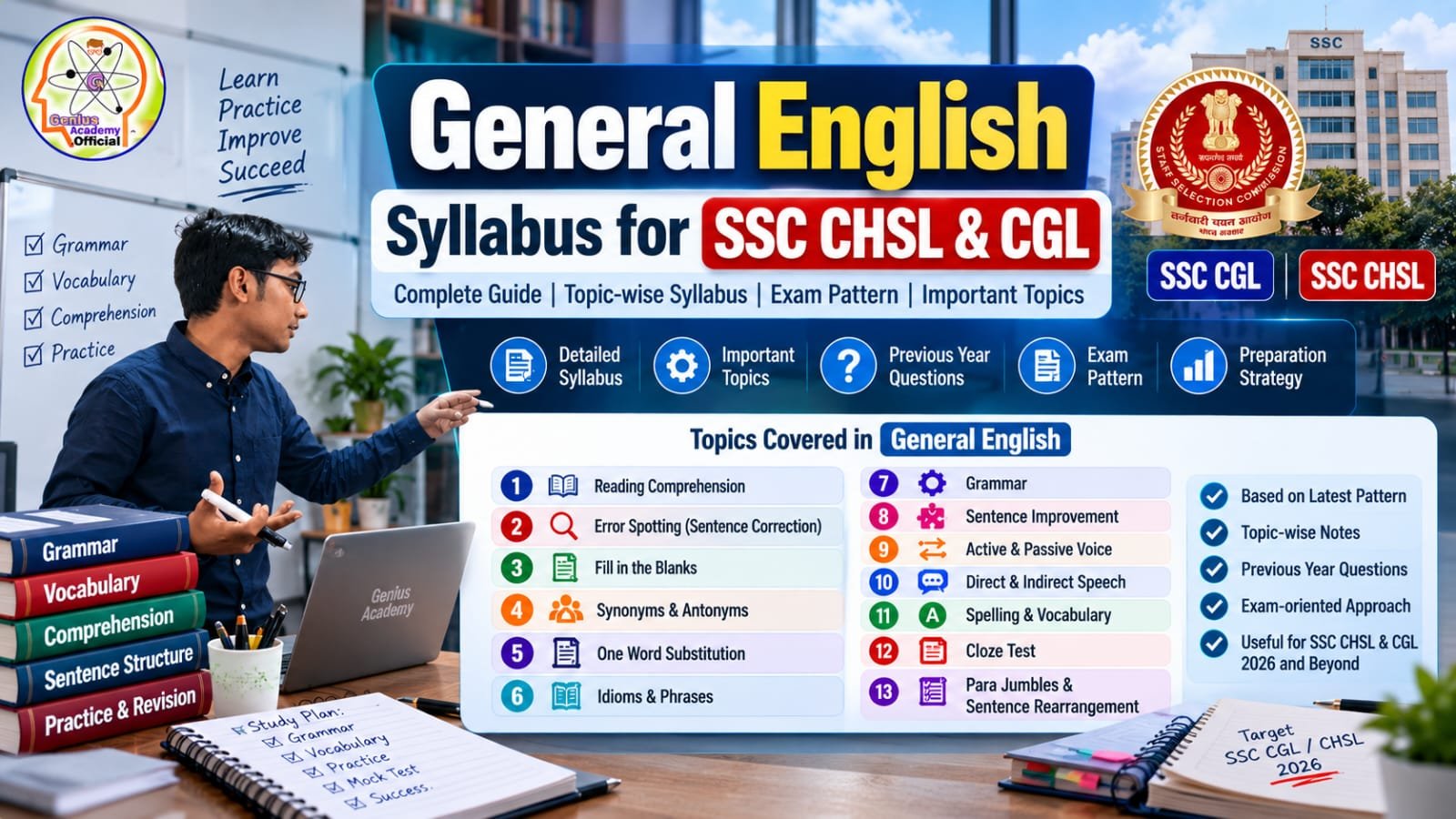
General English Syllabus for SSC CHSL & CGL
General English Syllabus for SSC CHSL & SSC CGL
Complete Detailed Coverage of Grammar, Vocabulary, Sentence Structure, Usage, Comprehension and Verbal Ability
General English for SSC CHSL & SSC CGL
For SSC CHSL and SSC CGL, English is not merely a vocabulary section. The syllabus tests a combination of grammar, vocabulary, sentence structure, usage, comprehension and verbal ability.
The official SSC CGL syllabus explicitly includes vocabulary, grammar, sentence structure, synonyms/homonyms, antonyms, spellings, idioms and phrases, one-word substitution, sentence improvement, active/passive voice, direct/indirect narration, sentence rearrangement, cloze passage and comprehension passages.
For preparation purposes, the official headings should therefore be expanded into a topic-wise study syllabus so that no important sub-topic is missed.
1. SSC English: Overall Structure
The English syllabus for SSC CGL and SSC CHSL can be organised into the following major areas:
MODULE I — Grammar
- Parts of Speech
- Tenses
- Verbs
- Subject–Verb Agreement
- Articles
- Prepositions
- Conjunctions
- Voice
- Narration
- Sentence Structure
MODULE II — Vocabulary
- Synonyms
- Antonyms
- Homonyms
- Spellings
- Idioms & Phrases
- One-Word Substitution
- Phrasal Verbs
- Confusing Words
MODULE III — Sentence Practice
- Spot the Error
- Fill in the Blanks
- Sentence Improvement
- Sentence Completion
- Sentence Rearrangement
- Part Shuffling
- Voice
- Narration
MODULE IV — Comprehension
- Cloze Test
- Reading Comprehension
- Para Jumbles
- Main Idea
- Inference
- Vocabulary in Context
- Tone
- Conclusion
Official SSC Coverage
The official CGL syllabus describes English through vocabulary, grammar, sentence structure, synonyms, antonyms and their correct usage, along with Spot the Error, Fill in the Blanks, Synonyms/Homonyms, Antonyms, Spellings, Idioms & Phrases, One-Word Substitution, Sentence Improvement, Active/Passive Voice, Direct/Indirect Narration, sentence shuffling, Cloze Passage and Comprehension Passage.
2. GRAMMAR
Grammar forms the foundation of SSC English. It is especially important because grammatical knowledge is tested directly as well as indirectly through error detection, sentence improvement, fill-in-the-blanks, cloze tests and sentence rearrangement.
2.1 Parts of Speech — Noun
Study:
- Definition and identification of nouns
- Common noun
- Proper noun
- Collective noun
- Abstract noun
- Material noun
- Countable nouns
- Uncountable nouns
- Singular and plural nouns
- Number of nouns
- Gender
- Possessive nouns
- Formation of nouns
- Compound nouns
- Correct use of nouns
- Noun + preposition combinations
- Common errors involving nouns
Important SSC Areas
- Singular/plural confusion
- Uncountable nouns
- Collective nouns
- Possessive case
- Nouns that appear plural but take singular verbs
- Nouns that are normally used in plural form
Mathematics is an interesting subject.
The news is true.
2.2 Pronoun
Study:
- Personal pronouns
- Possessive pronouns
- Reflexive pronouns
- Demonstrative pronouns
- Relative pronouns
- Interrogative pronouns
- Indefinite pronouns
- Distributive pronouns
- Reciprocal pronouns
Important Rules
- Pronoun–antecedent agreement
- Case of pronouns
- Correct use of who/whom
- Correct use of which/that
- Use of each/every/either/neither
- Reflexive pronouns
- Relative pronouns
- Pronoun reference
- Ambiguous pronoun usage
2.3 Adjective
Study:
- Definition and identification
- Adjective of quality
- Adjective of quantity
- Adjective of number
- Demonstrative adjective
- Possessive adjective
- Interrogative adjective
- Distributive adjective
- Proper adjective
- Comparison of adjectives
Degrees of Comparison
- Positive
- Comparative
- Superlative
tall → taller → tallest
Important SSC Areas
- Double comparatives
- Incorrect use of more
- Comparative + than
- Superlative constructions
- Positive degree transformation
- Irregular comparison
2.4 Adverb
Study:
- Adverb of manner
- Adverb of place
- Adverb of time
- Adverb of frequency
- Adverb of degree
- Adverb of reason
- Interrogative adverbs
- Relative adverbs
Important Areas
- Position of adverbs
- Adjective vs adverb
- Hard / hardly
- Late / lately
- Near / nearly
- High / highly
- Direct / directly
- Free / freely
2.5 Verb
This is one of the highest-priority grammar areas for SSC.
Types of Verbs
- Main verb
- Auxiliary verb
- Primary auxiliary
- Modal auxiliary
- Transitive verb
- Intransitive verb
- Linking verb
- Regular verb
- Irregular verb
- Finite verb
- Non-finite verb
Verb Forms
- V1 — base form
- V2 — past form
- V3 — past participle
- V4 — present participle / -ing form
- V5 — third-person singular form
2.6 Subject–Verb Agreement
A very important SSC topic.
Study:
- Singular subject + singular verb
- Plural subject + plural verb
- Compound subjects
- Either…or
- Neither…nor
- Not only…but also
- Collective nouns
- Indefinite pronouns
- Each/every
- Many a
- More than one
- A number of
- The number of
- Along with
- Together with
- As well as
- With
- One of
- None of
- Either/neither
- Distance/time/money as singular units
The number of students is increasing.
A number of students are absent.
2.7 Tenses
Study all three time categories:
Present Tense
- Simple Present
- Present Continuous
- Present Perfect
- Present Perfect Continuous
Past Tense
- Simple Past
- Past Continuous
- Past Perfect
- Past Perfect Continuous
Future Tense
- Simple Future
- Future Continuous
- Future Perfect
- Future Perfect Continuous
SSC Focus
- Correct tense selection
- Sequence of tenses
- Since/for
- Already/yet
- Just
- Ago
- Before/after
- When/while
- No sooner…than
- Hardly/scarcely…when
- Until/unless
- Conditional sentences
2.8 Modals
Study:
- Can
- Could
- May
- Might
- Shall
- Should
- Will
- Would
- Must
- Ought to
- Need
- Dare
- Used to
Important Meanings
- Ability
- Permission
- Possibility
- Probability
- Obligation
- Necessity
- Advice
- Request
- Habit
- Prediction
2.9 Non-Finite Verbs
Infinitive
Gerund
Participle
- Present participle
- Past participle
- Perfect participle
Important SSC Areas
- Gerund vs infinitive
- Bare infinitive
- Participial phrases
- Verbs followed by gerund
- Verbs followed by infinitive
- Used to / be used to / get used to
2.10 Active and Passive Voice
The official syllabus specifically includes Active/Passive Voice of Verbs.
Study:
- Active voice
- Passive voice
- Conversion rules
- Tense-wise conversion
- Modal verbs
- Imperative sentences
- Interrogative sentences
- Negative sentences
- Double-object sentences
- Passive with infinitive
- Passive with reporting verbs
People speak English.
→ English is spoken by people.
2.11 Direct and Indirect Speech
The official syllabus specifically includes conversion into Direct/Indirect Narration.
Types of Sentences
- Assertive
- Interrogative
- Imperative
- Exclamatory
- Optative
Rules
- Change of pronouns
- Change of tense
- Change of time expressions
- Change of place expressions
- Reporting verbs
- Questions
- Commands
- Requests
- Advice
- Exclamations
Important Changes
today → that day
tomorrow → the next day
yesterday → the previous day
2.12 Articles
Study:
- A
- An
- The
- Zero article
Important Rules
- Use before singular countable nouns
- Vowel sound vs vowel letter
- Unique objects
- Rivers
- Seas
- Oceans
- Mountain ranges
- Newspapers
- Historical buildings
- Superlatives
- Ordinal numbers
- Musical instruments
- Institutions
- Abstract nouns
- Geographical names
2.13 Prepositions
One of the most important areas for Error Detection and Fill in the Blanks.
Time
- At
- On
- In
- Since
- For
- By
- From
- Until
Place
- At
- In
- On
- Into
- Upon
- Over
- Above
- Under
- Below
- Between
- Among
- Beside
- Besides
Direction
- To
- Towards
- Into
- Onto
- Across
- Through
Important Prepositional Combinations
- Abide by
- Accused of
- Afraid of
- Agree with
- Apologise to
- Belong to
- Consist of
- Depend on
- Differ from
- Insist on
- Prefer to
- Prevent from
- Responsible for
- Suffer from
2.14 Conjunctions
Study:
- Coordinating conjunctions
- Subordinating conjunctions
- Correlative conjunctions
Important Pairs
- Either…or
- Neither…nor
- Both…and
- Not only…but also
- No sooner…than
- Hardly…when
- Scarcely…when
- Whether…or
- Though…yet
- Although…yet
- So…that
- Such…that
2.15 Subject–Verb Agreement + Conditional Sentences
Conditional sentences are important for advanced error detection.
Study:
- Zero Conditional — General truth.
- First Conditional — Real/possible future condition.
- Second Conditional — Unreal/hypothetical present/future.
- Third Conditional — Unreal past condition.
- Mixed Conditionals — For advanced questions.
2.16 Sentence Structure
Study:
- Subject
- Predicate
- Object
- Complement
- Phrase
- Clause
- Main clause
- Subordinate clause
- Coordinate clause
- Adjective clause
- Adverb clause
- Noun clause
Sentence Types
- Simple
- Compound
- Complex
- Compound-complex
This topic is especially useful for:
- Sentence improvement
- Rearrangement
- Error detection
- Transformation
3. VOCABULARY
Vocabulary is a major component of SSC English.
3.1 Synonyms
- Direct synonyms
- Contextual synonyms
- Advanced vocabulary
- Common SSC vocabulary
- One-word synonym questions
- Vocabulary from passages
Benevolent → Kind
3.2 Antonyms
- Direct antonyms
- Contextual antonyms
- Prefix-based opposites
- Vocabulary-based opposites
Expand ↔ Contract
3.3 Homonyms
The official syllabus explicitly mentions Synonyms/Homonyms.
- Affect / Effect
- Accept / Except
- Principal / Principle
- Stationary / Stationery
- Complement / Compliment
- Allusion / Illusion
- Advice / Advise
- Practice / Practise
- Loose / Lose
- Later / Latter
3.4 One-Word Substitution
Persons
- One who hates mankind
- One who loves mankind
- One who speaks many languages
- One who knows everything
- One who cannot read or write
Places
- Place where books are kept
- Place where animals are kept
- Place where aircraft are kept
Concepts
- Government by the people
- Government by a king
- Government by the wealthy
Common SSC Categories
- Study-related terms
- Profession-related terms
- Killing-related terms
- Fear-related terms
- Personality-related terms
- Places
- Government
- Science
- Literature
3.5 Idioms and Phrases
The official syllabus explicitly includes Idioms & Phrases.
Prepare:
- Meaning
- Contextual usage
- Sentence-based questions
- Common idioms
- Idioms derived from mythology
- Idioms related to animals
- Idioms related to body parts
- Idioms related to colours
- Idioms related to food
- Idioms related to nature
A blessing in disguise → something apparently bad that proves beneficial
3.6 Spelling
The SSC syllabus includes spellings/detecting misspelt words.
Prepare:
- Commonly misspelled words
- Double consonants
- Silent letters
- Homophone-based spelling
- British/standard English spellings used in SSC
- Prefix/suffix spelling patterns
- Plural spelling
- -able/-ible
- -ance/-ence
- -tion/-sion
- -ie/-ei patterns
Accommodation
Government
Privilege
Conscience
Maintenance
3.7 Phrasal Verbs
Important for vocabulary and contextual usage.
- Bring up
- Call off
- Carry on
- Come across
- Give up
- Look after
- Look into
- Put off
- Run into
- Take after
- Turn down
- Turn up
3.8 Prefixes and Suffixes
Prefixes
un-, dis-, im-, in-, ir-, il-, anti-, pre-, post-, re-, mis-
Suffixes
-ness, -ment, -tion, -ity, -ous, -ive, -ful, -less, -able
This helps with vocabulary, spelling and word formation.
4. ERROR DETECTION / SPOT THE ERROR
This is one of the most important practical areas of SSC English.
Questions can test errors in:
- Noun
- Pronoun
- Adjective
- Adverb
- Verb
- Tense
- Subject–verb agreement
- Articles
- Prepositions
- Conjunctions
- Modals
- Comparison
- Parallelism
- Word usage
- Redundancy
- Sentence structure
- Idiomatic usage
- Vocabulary
Common Error Patterns
The quality of these products are good.
Correct:
The quality of these products is good.
He is an European.
Correct:
He is a European.
Because European begins with a /juː/ sound.
He is good in mathematics.
In standard SSC-style usage:
He is good at mathematics.
5. FILL IN THE BLANKS
Fill in the Blanks is officially included in the syllabus.
Questions may test:
- Grammar
- Vocabulary
- Prepositions
- Articles
- Conjunctions
- Tenses
- Modals
- Phrasal verbs
- Idioms
- Contextual meaning
- Collocations
Important Preparation Areas
- Single blank
- Double blank
- Multiple blank
- Contextual blank
- Vocabulary-based blank
6. SENTENCE IMPROVEMENT
The official syllabus includes Improvement of Sentences.
Study:
- Grammar correction
- Word replacement
- Tense correction
- Preposition correction
- Article correction
- Subject–verb agreement
- Idiomatic usage
- Vocabulary
- Redundancy
- Parallelism
- Comparison
- Conditional sentences
He is senior than me.
Standard correction:
He is senior to me.
7. CLOZE TEST / CLOZE PASSAGE
Cloze passage is explicitly included in the SSC syllabus.
A passage contains blanks and the candidate selects the most appropriate words.
Questions may test:
- Grammar
- Vocabulary
- Preposition
- Conjunction
- Articles
- Verb
- Pronoun
- Contextual meaning
- Collocation
- Logical continuity
Skills Required
- Read the entire passage.
- Understand its theme.
- Identify grammatical requirements.
- Examine words before and after the blank.
- Check contextual meaning.
- Eliminate unsuitable options.
8. READING COMPREHENSION
The official CGL syllabus includes Comprehension Passage. The CGL notification specifies that three or more paragraphs may be given, including a simple passage based on a book/story and other passages based on current affairs, reports or editorials.
The CHSL notification similarly includes comprehension passage questions and specifies two or more paragraphs, including a simple book/story-based paragraph and another based on a current-affairs editorial or report.
Passage Types
- Narrative
- Descriptive
- Expository
- Argumentative
- Editorial
- Current-affairs based
- Scientific
- Social issues
- Economic issues
- Environmental issues
- Historical/cultural
Question Types
- Direct factual questions
- Main idea
- Central theme
- Title
- Inference
- Vocabulary in context
- Synonym
- Antonym
- Author’s argument
- Statement-based questions
- True/false type questions
- Conclusion
- Reference of pronouns
- Tone of passage
9. SENTENCE REARRANGEMENT
The official syllabus includes shuffling of sentence parts and shuffling of sentences in a passage.
Part Rearrangement
A sentence is divided into parts and the correct sequence has to be identified.
Para Jumble
Sentences are given in random order.
Find:
- Opening sentence
- Connecting sentence
- Cause-effect relationship
- Chronological order
- Pronoun reference
- Concluding sentence
Important Connectors
10. SENTENCE TRANSFORMATION
Although not always separately named in the short official syllabus, transformation skills are useful for several SSC question types.
- Affirmative ↔ Negative
- Active ↔ Passive
- Direct ↔ Indirect
- Simple ↔ Compound
- Simple ↔ Complex
- Comparative ↔ Superlative
- Degree transformation
- Assertive ↔ Interrogative
- Exclamatory transformation
11. COMMONLY CONFUSED WORDS
| Word Pair | Meaning / Difference |
|---|---|
| Accept / Except | receive / excluding |
| Affect / Effect | influence / result |
| Advice / Advise | noun / verb |
| Principal / Principle | head/main / rule |
| Stationary / Stationery | immobile / writing materials |
| Compliment / Complement | praise / complete |
| Loose / Lose | not tight / misplace |
| Later / Latter | afterward / second of two |
| Beside / Besides | next to / in addition |
| Economic / Economical | related to economy / cost-saving |
12. COLLOCATIONS
Important combinations of words.
- Make a decision
- Take a decision
- Heavy rain
- Strong argument
- Make an effort
- Pay attention
- Bear responsibility
- Commit a crime
- Break a promise
- Take advantage
- Draw a conclusion
Collocations are particularly useful for Fill in the Blanks, Sentence Improvement and Cloze Tests.
13. PUNCTUATION
For comprehensive SSC preparation, understand:
- Full stop
- Comma
- Semicolon
- Colon
- Apostrophe
- Question mark
- Exclamation mark
- Quotation marks
- Hyphen
- Apostrophe
- Commas
- Direct speech
- Possessive forms
14. CAPITALISATION
- Proper nouns
- Countries
- States
- Cities
- Institutions
- Days
- Months
- Historical events
- Titles
- Beginning of sentences
- Direct quotations
15. HIGH-PRIORITY GRAMMAR RULES
Subject–Verb Agreement
- Each/every
- Either/neither
- A number of/the number of
- Many a
- More than one
- Collective nouns
Tense
- Since/for
- Already/yet
- No sooner…than
- Hardly…when
- Before/after
- Until/unless
Articles
- A/an based on sound
- The with unique objects
- The with superlatives
- Zero article
Prepositions
- Since/for
- Between/among
- In/on/at
- By/with
- Beside/besides
- In/into
- On/upon
Comparison
- Senior to
- Junior to
- Prefer to
- Superior to
- Inferior to
- More than
- As…as
Pronouns
- Who/whom
- Each/every
- One’s
- Myself/yourself/themselves
- Relative pronouns
16. SSC CHSL vs SSC CGL English
The core English syllabus is substantially overlapping between CHSL and CGL. The official CGL notification provides the detailed list of English question areas, while the CHSL notification lists the same major question formats.
For preparation, however, it is useful to think of the difference as level and application rather than completely different topics.
| Area | SSC CHSL | SSC CGL |
|---|---|---|
| Grammar | Important | Very important |
| Vocabulary | Important | Important |
| Error Detection | Important | Important |
| Fill in the Blanks | Important | Important |
| Synonyms/Antonyms | Important | Important |
| Idioms & Phrases | Important | Important |
| One-Word Substitution | Important | Important |
| Spelling | Important | Important |
| Voice | Important | Important |
| Narration | Important | Important |
| Sentence Rearrangement | Important | Important |
| Cloze Test | Important | Important |
| Comprehension | Important | Important |
| Advanced contextual usage | Moderate | Greater importance |
| Complex grammar application | Moderate | Greater importance |
| Vocabulary depth | Moderate–High | High |
Important Preparation Point
Do not prepare CGL and CHSL English as two entirely separate subjects. A large common preparation base can be used for both.
17. Complete Topic-Wise SSC English Syllabus
A. Grammar
1. Parts of Speech
- Noun
- Pronoun
- Adjective
- Verb
- Adverb
- Preposition
- Conjunction
- Interjection
2. Noun
- Number
- Gender
- Countable/uncountable
- Possessive
- Collective nouns
3. Pronoun
- Personal
- Reflexive
- Demonstrative
- Relative
- Interrogative
- Indefinite
- Distributive
- Reciprocal
4. Adjective
- Degrees of comparison
- Order of adjectives
- Comparative structures
- Superlative structures
5. Verb
- Main verbs
- Auxiliary verbs
- Modal verbs
- Transitive/intransitive
- Regular/irregular verbs
- Finite/non-finite verbs
6. Tense
- 12 tense structures
- Sequence of tenses
- Tense-based error detection
7–11
- Subject–Verb Agreement
- Articles
- Prepositions
- Conjunctions
- Modals
12. Non-Finite Verbs
- Infinitive
- Gerund
- Participle
13–21
- Conditional Sentences
- Active and Passive Voice
- Direct and Indirect Speech
- Sentence Structure
- Clauses
- Phrases
- Parallelism
- Redundancy
- Comparison
B. Vocabulary
1. Synonyms
2. Antonyms
3. Homonyms
4. Homophones
5. One-Word Substitution
6. Idioms and Phrases
7. Phrasal Verbs
8. Spelling
9. Commonly Confused Words
10. Word Formation
11. Prefixes and Suffixes
12. Contextual Vocabulary
13. Collocations
C. Sentence-Based Questions
1. Spot the Error
2. Sentence Improvement
3. Fill in the Blanks
4. Sentence Completion
5. Active/Passive Transformation
6. Direct/Indirect Transformation
7. Sentence Rearrangement
8. Sentence Part Rearrangement
9. Word/Sentence Substitution
D. Passage-Based Questions
1. Cloze Test
2. Reading Comprehension
3. Para Jumble
4. Contextual Vocabulary
5. Inference-Based Questions
6. Main Idea/Theme
7. Author’s Viewpoint/Tone
18. Priority Order for Preparation
For a systematic preparation strategy, you can organise the syllabus into four levels.
FOUNDATION
CORE SSC
ADVANCED
Level 1 — Foundation
- Parts of Speech
- Noun
- Pronoun
- Adjective
- Verb
- Adverb
- Tense
- Subject–Verb Agreement
- Articles
- Prepositions
- Conjunctions
Level 2 — SSC Core
- Error Detection
- Fill in the Blanks
- Sentence Improvement
- Active/Passive Voice
- Direct/Indirect Speech
- Synonyms
- Antonyms
- Homonyms
- Idioms & Phrases
- One-Word Substitution
- Spelling
- Cloze Test
- Sentence Rearrangement
- Reading Comprehension
Level 3 — Advanced Application
- Advanced Error Detection
- Complex Sentence Structure
- Advanced Vocabulary
- Contextual Vocabulary
- Advanced Cloze Tests
- Para Jumbles
- Inference-Based Comprehension
- Tone/Attitude Questions
- Advanced Sentence Improvement
- Mixed Grammar Questions
19. Complete SSC English Checklist
Use this as your master syllabus checklist for Genius Academy.
Grammar
- Parts of Speech
- Noun
- Pronoun
- Adjective
- Adverb
- Verb
- Auxiliary Verb
- Modal Verb
- Tense
- Subject–Verb Agreement
- Articles
- Prepositions
- Conjunctions
- Non-Finite Verbs
- Infinitive
- Gerund
- Participles
- Conditionals
- Clauses
- Phrases
- Sentence Structure
- Comparison
- Parallelism
- Redundancy
- Active Voice
- Passive Voice
- Direct Speech
- Indirect Speech
Vocabulary
- Synonyms
- Antonyms
- Homonyms
- Homophones
- One-Word Substitution
- Idioms & Phrases
- Phrasal Verbs
- Spelling
- Commonly Confused Words
- Prefixes
- Suffixes
- Word Formation
- Collocations
- Contextual Vocabulary
Sentence-Based
- Spot the Error
- Fill in the Blanks
- Sentence Improvement
- Sentence Completion
- Sentence Rearrangement
- Part Shuffling
- Active/Passive
- Direct/Indirect
Passage-Based
- Cloze Passage
- Reading Comprehension
- Para Jumble
- Main Idea
- Central Theme
- Inference
- Vocabulary in Context
- Tone
- Author’s Argument
- Conclusion
Final Exam-Oriented Summary
The official SSC CGL English syllabus specifically identifies Vocabulary, Grammar, Sentence Structure, Synonyms, Antonyms, correct usage, Spot the Error, Fill in the Blanks, Synonyms/Homonyms, Antonyms, Spellings, Idioms & Phrases, One-Word Substitution, Improvement of Sentences, Active/Passive Voice, Direct/Indirect Narration, Shuffling of Sentence Parts, Shuffling of Sentences in a Passage, Cloze Passage and Comprehension Passage.
Therefore, for Genius Academy’s SSC CHSL & CGL General English course, the syllabus can be structured into four master modules:
Parts of Speech → Tense → Verb → SVA → Articles → Prepositions → Conjunctions → Modals → Non-finites → Clauses → Conditionals → Voice → Narration → Sentence Structure
Synonyms → Antonyms → Homonyms → Homophones → Spellings → Idioms & Phrases → One-Word Substitution → Phrasal Verbs → Confusing Words → Word Formation → Collocations
Error Detection → Fill in the Blanks → Sentence Improvement → Sentence Completion → Sentence Rearrangement → Sentence Parts → Voice → Narration
Cloze Test → Reading Comprehension → Para Jumbles → Main Idea → Inference → Vocabulary in Context → Tone → Conclusion
This structure is broader than simply reproducing the SSC notification: it converts SSC’s official topic headings into a complete study syllabus, while retaining the actual areas named by the Commission.
Staff Selection Commission (SSC) — Combined Graduate Level Examination and Combined Higher Secondary Level Examination official notifications.
Source Note: The topic-wise expansion on this page is an educational preparation framework based on the English-language areas explicitly listed by SSC. Candidates should always check the latest SSC notification for the examination year in which they are appearing.