
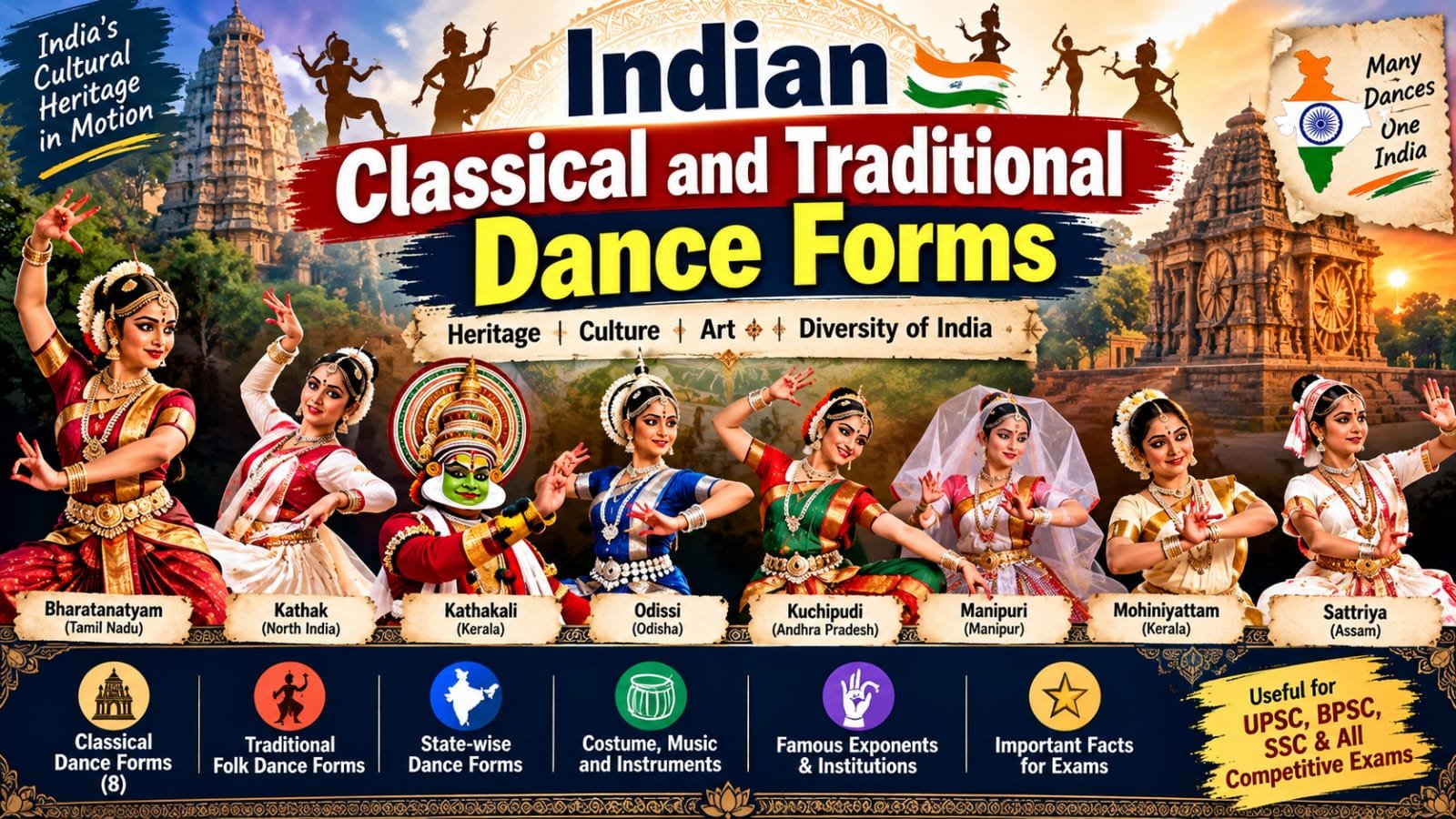
Indian Classical and Traditional Dance Forms
Indian Classical and Traditional Dance Forms
Detailed UPSC CSE, State PCS & SSC CGL Notes covering India’s classical dance traditions, regional forms, historical development, important personalities, technical terminology, UNESCO recognition and high-yield examination facts.
⚠️ Important Examination Correction
The eight officially recognised classical dance forms are Bharatanatyam, Kathak, Kathakali, Kuchipudi, Manipuri, Mohiniyattam, Odissi and Sattriya. Chhau should not be included among these eight classical dance forms. Chhau is a major traditional/semi-classical dance tradition of eastern India and has three principal styles — Seraikella, Purulia and Mayurbhanj.
Indian Classical and Traditional Dance Forms
Indian dance traditions represent a synthesis of religion, mythology, literature, music, sculpture, theatre and regional culture. For competitive examinations, it is important to distinguish between the eight officially recognised classical dance forms and other important traditional or semi-classical dance forms.
The eight classical dance forms are: Bharatanatyam, Kathak, Kathakali, Kuchipudi, Manipuri, Mohiniyattam, Odissi and Sattriya.
1. Bharatanatyam
Tamil Nadu • Classical Dance of India
Historical Background
Bharatanatyam is one of India’s major classical dance traditions and is particularly associated with the temples and cultural traditions of Tamil Nadu. Its earlier form was known as Sadir, Sadir Attam or Dasi Attam.
Historically, it was associated with the Devadasi tradition, in which women dedicated to temple service performed dance and music as part of religious and cultural practices. During the colonial period, such traditions came under severe social criticism, particularly through the anti-nautch movement.
The dance underwent a major transformation during the late 19th and early 20th centuries. The Tanjore Quartet played an important role in codifying and shaping its repertoire.
Tanjore Quartet
The four brothers collectively known as the Tanjore Quartet were:
- Chinnayya
- Ponnayya
- Sivanandam
- Vadivelu
They played an important role in shaping the modern Bharatanatyam repertoire and performance structure.
Major Features
Nritta, Nritya and Natya
| Term | Meaning |
|---|---|
| Nritta | Pure dance without explicit narrative meaning. |
| Nritya | Expressive dance involving gestures, facial expressions and interpretation of lyrics. |
| Natya | Dramatic representation involving acting and storytelling. |
Music
Bharatanatyam is traditionally accompanied by Carnatic music.
- Vocalist
- Mridangam
- Violin
- Flute
- Nattuvangam
Important Technical Terms
| Term | Meaning |
|---|---|
| Nritta | Pure rhythmic dance |
| Nritya | Expressive dance |
| Natya | Dramatic representation |
| Araimandi | Half-sitting/bent-knee posture |
| Mudra | Symbolic hand gesture |
| Abhinaya | Expressive communication |
| Nattuvangam | Rhythmic recitation/performance accompaniment |
Famous Bharatanatyam Dancers
One of the most influential figures in the 20th-century revival and institutionalisation of Bharatanatyam.
Founded Kalakshetra in Chennai in 1936.
Helped establish Bharatanatyam as a prestigious concert-stage art and contributed to its international dissemination.
Renowned for Bharatanatyam and Kuchipudi.
Known for powerful stage presence and expressive performance.
Became an important figure in popularising Indian classical dance internationally.
Founded Darpana Academy of Performing Arts, Ahmedabad.
Trained in Bharatanatyam and other Indian dance traditions.
Known for experimentation and choreography.
Awarded Padma Bhushan.
Major Bharatanatyam guru and choreographer.
Founder of Ganesa Natyalaya, New Delhi.
Awarded major national honours for contribution to dance.
Accomplished Bharatanatyam dancer as well as a major Indian film actress.
Helped bring classical dance vocabulary to a wider popular audience.
Major dancer, choreographer and scholar.
Known for research into ancient Indian dance traditions.
Developed choreographic interpretations based on historical sources.
Associated with the concept of Karanas described in the Natyashastra.
2. Kathak
North India • Particularly associated with Uttar Pradesh
Origin
The word Kathak is derived from Katha, meaning story or narrative.
The traditional storytellers were known as Kathakas, who narrated mythological stories through a combination of dance, music, gesture, recitation and storytelling.
Kathak subsequently evolved through several historical stages, including its association with the Bhakti movement and later with royal courts, particularly during the Mughal and post-Mughal periods.
Major Characteristics
Important Technical Terms
| Term | Meaning |
|---|---|
| Tatkar | Rhythmic footwork |
| Chakkar | Pirouette/spin |
| Thaat | Graceful introductory posture/movement |
| Amad | Entry/compositional section |
| Toda | Rhythmic composition |
| Tukra | Short rhythmic composition |
| Paran | Composition traditionally associated with pakhawaj bols |
| Gat | Stylised movement/storytelling sequence |
| Abhinaya | Expressive interpretation |
Gharanas of Kathak
Three major Kathak gharanas particularly important for examinations are:
- Lucknow Gharana
- Jaipur Gharana
- Banaras Gharana
The Raigarh Gharana also developed under royal patronage and is important in the modern history of Kathak.
| Gharana | Broad Characteristics |
|---|---|
| Lucknow | Grace, abhinaya, delicate movements and expressive storytelling. |
| Jaipur | Strong footwork, complex rhythms and powerful technical movements. |
| Banaras | Distinctive stylistic and rhythmic traditions within Kathak. |
| Raigarh | Developed under royal patronage and contributed to modern Kathak repertoire. |
Famous Kathak Dancers
One of the most influential Kathak gurus of modern India.
Belonged to the Lucknow Gharana.
Associated with the Kalka-Bindadin tradition.
Known for abhinaya, rhythm and storytelling.
Awarded Padma Vibhushan.
One of the most celebrated Kathak dancers.
Known for energetic performances.
Widely associated with popularising Kathak beyond traditional performance spaces.
Important Kathak guru.
Particularly associated with the Lucknow tradition.
Also contributed to dance choreography for Indian cinema.
Renowned Kathak dancer and choreographer.
Played an important role in taking classical dance to cinema and popular audiences.
Noted disciple of Pandit Birju Maharaj.
Known for abhinaya and graceful Kathak performance.
Leela Sokhey, popularly known as Menaka, was associated with the revival and modern presentation of Kathak during the 20th century.
3. Kathakali
Kerala • Classical Dance-Drama
Origin and Development
Kathakali emerged in Kerala through the evolution of earlier performance traditions including Koodiyattam, Krishnanattam, Ramanattam and Kerala’s temple and court performance traditions.
It developed particularly during the 17th century.
Major Features
Major Sources of Narratives
- Ramayana
- Mahabharata
- Puranic literature
- Other Hindu mythological narratives
Kathakali Character Types
| Type | General Characterisation |
|---|---|
| Pacha | Noble, divine and heroic characters |
| Kathi | Proud or aggressive characters |
| Thadi | Bearded characters |
| Kari | Dark, forest or demonic characters |
| Minukku | Gentle and refined characters |
Important Musical Instruments
- Chenda
- Maddalam
- Chengila
- Ilathalam
Famous Kathakali Artists
Major Kathakali performer and teacher. Known for mastery of character portrayal.
One of the most celebrated Kathakali performers.
Known for powerful acting and characterisation.
Legendary Kathakali artist.
Known for portraying major characters from epic narratives.
Awarded Padma Bhushan.
Important innovator and teacher.
Worked towards making Kerala’s classical dance traditions accessible to broader audiences.
Kathak is associated with North India, Hindustani music, intricate footwork and chakkars, whereas Kathakali is a Kerala dance-drama known for elaborate makeup, costumes, dramatic acting and epic narratives.
4. Kuchipudi
Andhra Pradesh • Classical Dance
Origin
Kuchipudi derives its name from the village traditionally known as Kuchipudi/Kuchelapuram in present-day Andhra Pradesh.
It developed as a dance-drama tradition and is closely associated with Siddhendra Yogi, generally regarded as an important figure in its development.
Historical Characteristics
Traditionally, Kuchipudi performances were associated with male Brahmin performers, particularly the Bhagavathulu tradition.
Over time, the form became increasingly performed by women as well.
Major Characteristics
Tarangam
One of the most famous features of Kuchipudi is Tarangam, in which the dancer may perform while standing on the edge of a brass plate.
This demonstrates:
- Balance
- Rhythmic control
- Technical precision
Famous Kuchipudi Artists
One of the most influential modern Kuchipudi gurus.
Systematised and expanded the modern Kuchipudi repertoire.
Established the Kuchipudi Art Academy in Chennai.
Awarded Padma Bhushan.
Important exponent of both Bharatanatyam and Kuchipudi.
Known for powerful performances.
Famous Kuchipudi dancer couple.
Known for synchronised performances and international promotion of Kuchipudi.
5. Odissi
Odisha • Classical Dance
Historical Background
Odissi is strongly associated with the temple traditions of Odisha.
Its historical development is connected with:
- Temple sculpture
- Mahari tradition
- Gotipua tradition
- Vaishnavism
- Jagannath culture
Mahari Tradition
Maharis were women associated with temple service and performance traditions.
Gotipua Tradition
Gotipua was traditionally performed by young boys dressed in feminine attire.
The Gotipua tradition played an important role in the transmission and preservation of dance techniques that later contributed to the modern reconstruction of Odissi.
Distinctive Postures
Tribhanga
One of the most famous features of Odissi. The body is divided into three bends:
- Head/neck
- Torso
- Legs
Chowka
A square, symmetrical stance associated with strength and stability.
Literary Sources
- Jayadeva’s Gitagovinda
- Odia devotional poetry
- Vaishnava traditions
- Jagannath worship
Major Themes
Famous Odissi Dancers
One of the central figures in the 20th-century revival of Odissi.
Developed and systematised modern Odissi choreography.
Awarded Padma Vibhushan.
Played an important role in popularising Odissi nationally and internationally.
Also trained in Bharatanatyam and other Indian dance traditions.
Major exponent of Bharatanatyam and Odissi.
Also known for choreography, scholarship and cultural work.
Awarded Padma Vibhushan.
Distinguished Odissi dancer and choreographer.
Known for refined technique and choreography.
Important guru in the modern Odissi tradition.
Contributed significantly to teaching and institutional transmission.
6. Manipuri
Manipur • Classical Dance
Religious Background
Manipuri dance has a strong connection with Vaishnavism, particularly the worship of Radha and Krishna.
One of its most famous traditions is Ras Lila/Raas Leela.
Major Features
Major Movement Traditions
| Tradition | Description |
|---|---|
| Jagoi | Graceful and relatively gentle dance movements. |
| Cholom | Vigorous and energetic movement traditions, often associated with male performers. |
Pung
The Pung, a traditional Manipuri drum, is an important component of Manipuri performance.
Ras Leela
Manipuri Ras Leela depicts the divine relationship between:
- Krishna
- Radha
- Gopis
It is deeply embedded in the Vaishnavite religious culture of Manipur.
Famous Artists
Major figure in the development and dissemination of Manipuri dance.
Contributed significantly to preserving its traditional character.
Prominent Manipuri dancer and performer.
Particularly associated with Ras traditions.
7. Mohiniyattam
Kerala • Classical Dance
Meaning
The word Mohiniyattam is derived from:
- Mohini – the enchanting female form of Lord Vishnu
- Attam – dance
Thus, it is commonly understood as the dance of Mohini/the enchantress.
Major Characteristics
Religious and Literary Themes
- Vishnu
- Krishna
- Bhakti
- Shringara
- Devotional poetry
Revival
The modern revival of Mohiniyattam was strongly associated with the cultural renaissance in Kerala in the early 20th century.
Vallathol Narayana Menon, founder of Kerala Kalamandalam, played an important institutional role in the revival and preservation of Kerala’s classical performing arts.
Famous Artists
One of the most important figures in the modern Mohiniyattam tradition.
Remembered as an influential guru of Mohiniyattam.
Associated with the preservation and transmission of the traditional form.
Mohiniyattam vs Kathakali
| Mohiniyattam | Kathakali |
|---|---|
| Graceful and lasya-oriented | Dramatic and vigorous |
| Traditionally female solo form | Traditionally male-dominated dance-drama |
| Soft circular movements | Powerful stylised movements |
| Subtle makeup | Elaborate makeup |
| Feminine aesthetic | Dramatic character types |
8. Sattriya
Assam • Classical Dance
Historical Background
Sattriya originated in the sattras, or Vaishnavite monasteries of Assam.
It emerged from the Neo-Vaishnavite movement associated with Srimanta Sankardeva in the 15th–16th centuries.
The word Sattriya is associated with the institutional tradition of the Satra.
Religious Background
Ankiya Naat
Sattriya is closely associated with Ankiya Naat, the one-act dramatic tradition associated with Sankardeva.
Traditional Performers
Historically, Sattriya was primarily performed within the monastic environment by male performers known as Bhokots.
Today, it is performed by both men and women.
Recognition as Classical Dance
Sattriya was recognised as a classical dance tradition by the Sangeet Natak Akademi in 2000.
Major Features
Famous Artists
Major Sattriya exponent and guru.
Played an important role in systematisation and propagation of the form.
Distinguished Sattriya dancer and guru.
Contributed to its wider recognition and teaching.
Prominent contemporary Sattriya exponent.
Has contributed to its national and international dissemination.
Associated with the preservation and propagation of Sattriya traditions.
9. Chhau
Odisha • Jharkhand • West Bengal
Chhau is not one of India’s eight officially recognised classical dance forms.
It is a major traditional/semi-classical dance tradition of eastern India and is especially important for examinations because of its three regional styles and UNESCO recognition.
Three Major Styles
| Style | State | Major Feature |
|---|---|---|
| Seraikella Chhau | Jharkhand | Uses masks |
| Purulia Chhau | West Bengal | Uses colourful masks |
| Mayurbhanj Chhau | Odisha | Generally performed without masks |
Historical Background
Chhau has strong connections with:
- Martial traditions
- Indigenous dance practices
- Local festivals
- Folk traditions
- Epic narratives
Its movement vocabulary includes mock combat, stylised movements of animals and birds, and other physical forms.
Themes
Chaitra Parva
Chhau is particularly associated with the spring festival of Chaitra Parva.
Music
- Drums
- Mohuri
- Shehnai
- Other traditional instruments
UNESCO Recognition
Famous Gurus
Major exponent and guru of Seraikella Chhau.
Associated with preservation and transmission of the Seraikella tradition.
Associated with Mayurbhanj Chhau.
Contributed to teaching and propagation of the tradition.
Comparative Table: Eight Classical Dances
State • Association • Music • Distinctive Features
| Dance | Major State/Region | Key Association | Music/Tradition | Distinctive Feature |
|---|---|---|---|---|
| Bharatanatyam | Tamil Nadu | Temple/Sadir tradition | Carnatic | Araimandi, Mudras |
| Kathak | North India/UP | Kathakas, Bhakti & courts | Hindustani | Tatkar, Chakkars |
| Kathakali | Kerala | Dance-drama | Kerala performance tradition | Makeup & costumes |
| Kuchipudi | Andhra Pradesh | Siddhendra Yogi | Carnatic | Tarangam |
| Odissi | Odisha | Temple/Jagannath tradition | Odissi music | Tribhanga, Chowka |
| Manipuri | Manipur | Vaishnavism/Ras Leela | Manipuri tradition | Fluid movements |
| Mohiniyattam | Kerala | Mohini/Vaishnavite themes | Carnatic | Lasya, graceful movements |
| Sattriya | Assam | Sankardeva/Satra | Assamese Vaishnavite tradition | Ankiya Naat |
Classical Dances: High-Yield Personalities
Important dancer–dance associations for objective examinations
| Personality | Dance / Contribution |
|---|---|
| Rukmini Devi Arundale | Bharatanatyam; Kalakshetra |
| Tanjore Quartet | Shaped Bharatanatyam repertoire |
| Padma Subrahmanyam | Bharatanatyam research, choreography and Karanas |
| Birju Maharaj | Kathak; Lucknow Gharana |
| Sitara Devi | Kathak |
| Lachhu Maharaj | Kathak; Lucknow tradition |
| Kunchu Kurup | Kathakali |
| Kalamandalam Krishnan Nair | Kathakali |
| Ramankutty Nair | Kathakali |
| Guru Gopinath | Kathakali innovation |
| Vempati Chinna Satyam | Kuchipudi |
| Raja–Radha Reddy | Kuchipudi |
| Kelucharan Mohapatra | Odissi revival |
| Sonal Mansingh | Odissi & Bharatanatyam |
| Indrani Rahman | Odissi popularisation |
| Guru Bipin Singh | Manipuri |
| Bimbavati Devi | Manipuri |
| Kalyanikutty Amma | Mohiniyattam |
| Srimanta Sankardeva | Sattriya / Neo-Vaishnavite movement |
| Ghanakanta Bora | Sattriya |
| Jatin Goswami | Sattriya |
| Shashadhar Acharya | Seraikella Chhau |
| Lingaraj Acharya | Mayurbhanj Chhau |
Important Concept: Natyashastra
Foundational text of Indian performing arts
For UPSC, the Natyashastra is extremely important.
It is traditionally attributed to Bharata Muni and is one of the foundational texts of Indian performing arts.
Major Areas Covered
Rasa Theory
The concept of Rasa is fundamental to Indian aesthetics.
| Rasa | General Meaning |
|---|---|
| Shringara | Love / Beauty |
| Hasya | Humour |
| Karuna | Compassion / Pathos |
| Raudra | Anger |
| Vira | Heroism |
| Bhayanaka | Fear |
| Bibhatsa | Disgust |
| Adbhuta | Wonder |
| Shanta | Peace / Tranquillity |
Nritta = Pure dance
Nritya = Expressive dance
Natya = Dramatic representation
Rasa = Aesthetic experience
Most Important State–Dance Pairs
| Region | Dance Association |
|---|---|
| South India |
Tamil Nadu →
Bharatanatyam Kerala → Kathakali + Mohiniyattam Andhra Pradesh → Kuchipudi |
| North India | Uttar Pradesh / North India → Kathak |
| East India |
Odisha → Odissi +
Mayurbhanj Chhau West Bengal → Purulia Chhau Jharkhand → Seraikella Chhau |
| North-East India |
Manipur → Manipuri Assam → Sattriya |
Frequently Confused Pairs
Important distinctions for MCQs
1. Bharatanatyam vs Kuchipudi
| Bharatanatyam | Kuchipudi |
|---|---|
| Tamil Nadu | Andhra Pradesh |
| Sadir tradition | Kuchipudi village tradition |
| Araimandi | More rounded/fluid movements |
| Tanjore Quartet | Siddhendra Yogi |
| Carnatic music | Carnatic music |
| Kalakshetra / Rukmini Devi | Vempati Chinna Satyam |
2. Kathak vs Kathakali
| Kathak | Kathakali |
|---|---|
| North India | Kerala |
| Kathakas/storytellers | Dance-drama tradition |
| Hindustani music | Kerala classical / performance tradition |
| Tatkar | Elaborate acting |
| Chakkars | Elaborate makeup |
| Gharanas | Character-based presentation |
3. Odissi vs Manipuri
| Odissi | Manipuri |
|---|---|
| Odisha | Manipur |
| Jagannath culture | Vaishnavism |
| Tribhanga | Fluid/circular movement |
| Chowka | Ras Leela |
| Gitagovinda | Radha-Krishna devotion |
Kathak and Kathakali are entirely different dance traditions despite the similarity in their names.
Likewise, Bharatanatyam and Kuchipudi are both associated with South India and Carnatic music, but their historical development, regional identity and technical traditions are distinct.
UNESCO and Indian Dance/Performance Traditions
A very important examination distinction is that UNESCO Intangible Cultural Heritage recognition is not the same as India’s classification of a dance as a classical dance.
| Tradition | UNESCO / Important Association |
|---|---|
| Chhau | UNESCO ICH — 2010 |
| Sankirtana of Manipur | UNESCO ICH — 2013 |
| Kutiyattam | UNESCO ICH — 2008 |
| Mudiyettu | UNESCO ICH — 2010 |
A cultural tradition can receive UNESCO Intangible Cultural Heritage recognition without being one of India’s eight officially recognised classical dance forms.
One-Page Revision Chart
                    INDIAN CLASSICAL DANCES
                            │
        ┌───────────────────┼────────────────────┐
        │                   │                    │
     SOUTH                 NORTH               EAST
        │                   │                    │
  ┌─────┼─────┐          Kathak          ┌──────┴──────┐
  │     │     │                          │             │
Bharat Kathakali Kuchipudi             Odissi        Chhau*
anatyam   │
          │
    Mohiniyattam

        NORTH-EAST
             │
       ┌─────┴─────┐
       │           │
   Manipuri     Sattriya

* Chhau is a major traditional/semi-classical form,
  not one of the eight officially recognised classical dances.
Ultra-High-Yield UPSC / PCS / SSC Facts
Rapid revision before examination
- Bharatanatyam → Tamil Nadu
- Kathak → North India
- Kathakali → Kerala
- Kuchipudi → Andhra Pradesh
- Odissi → Odisha
- Manipuri → Manipur
- Mohiniyattam → Kerala
- Sattriya → Assam
- Chhau → Odisha + Jharkhand + West Bengal
- Tanjore Quartet → Bharatanatyam
- Rukmini Devi Arundale → Kalakshetra
- Birju Maharaj → Kathak/Lucknow Gharana
- Siddhendra Yogi → Kuchipudi
- Vempati Chinna Satyam → Kuchipudi
- Kelucharan Mohapatra → Odissi
- Tribhanga → Odissi
- Chowka → Odissi
- Ras Leela → Manipuri
- Pung → Manipuri
- Srimanta Sankardeva → Sattriya
- Sattriya → Satra / Neo-Vaishnavism
- Mohiniyattam → Kerala
- Mohini → Vishnu’s enchanting female form
- Chhau → Three styles
- Seraikella → Jharkhand
- Purulia → West Bengal
- Mayurbhanj → Odisha
- Seraikella and Purulia Chhau → Masks
- Mayurbhanj Chhau → Generally no masks
- Chhau → UNESCO ICH, 2010
- Manipuri Sankirtana → UNESCO ICH, 2013
- Eight officially recognised classical dances → Bharatanatyam, Kathak, Kathakali, Kuchipudi, Manipuri, Mohiniyattam, Odissi and Sattriya.