
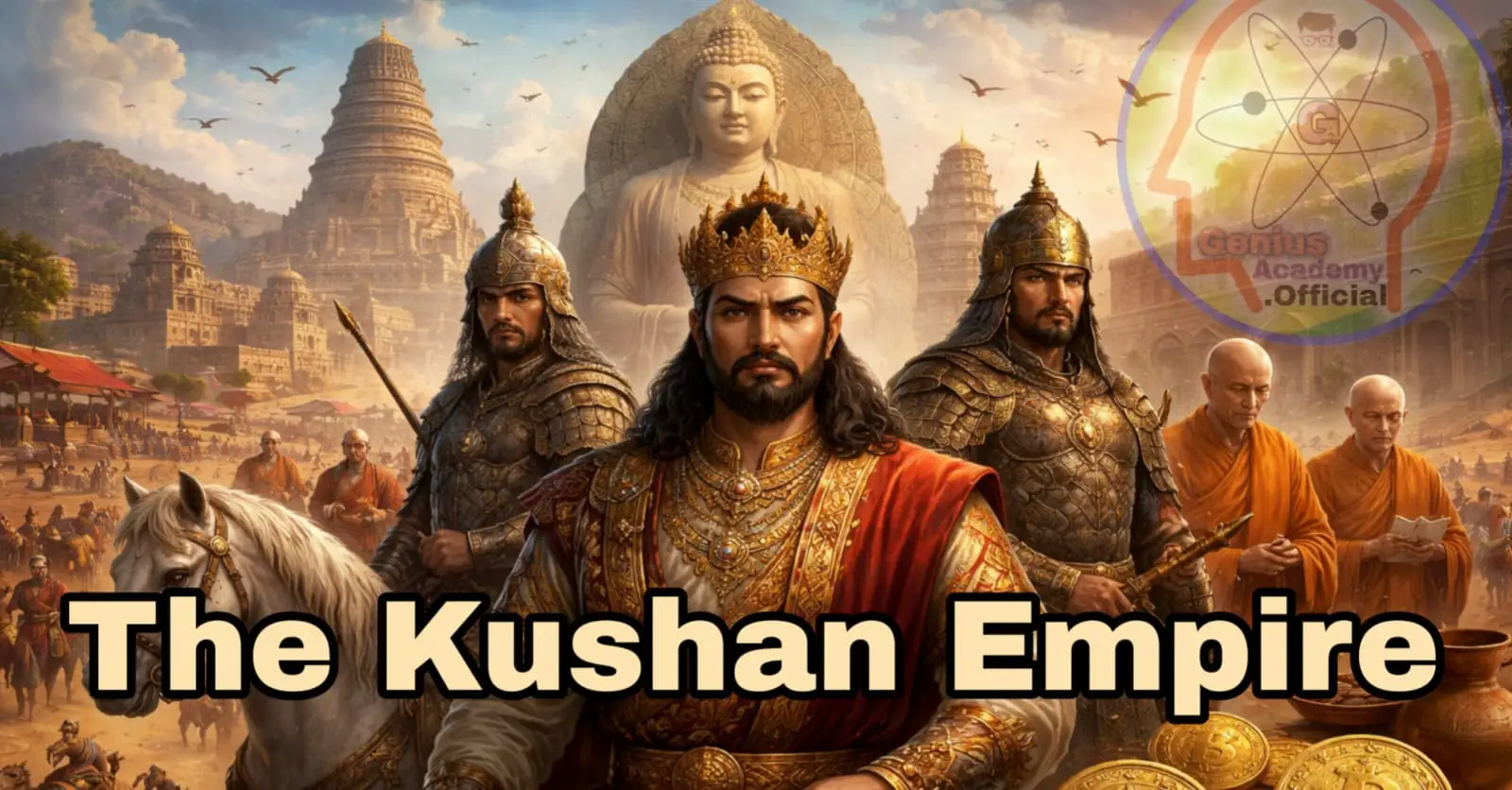
The Kushan Empire
Chapter: The Kushan Empire
1. Introduction
The Kushan Empire represents one of the most significant and transformative phases in ancient Indian history. Emerging after the decline of the Indo-Greeks, Shakas, and Pahlavas (Parthians), the Kushans established a powerful and expansive empire that connected India with Central Asia, China, and even the Roman world. Their rule marked a period of political consolidation, economic prosperity, cultural synthesis, and religious transformation.
The Kushans were originally not native to India. They were a branch of the Yuezhi (Yuchi) tribe, a nomadic group from the grasslands of Central Asia. Over time, due to continuous pressure from rival tribes such as the Xiongnu, they migrated westward and eventually entered the Indian subcontinent.
Unlike earlier invaders, the Kushans did not merely conquer territories; they integrated deeply into Indian society. They adopted Indian religions, patronized art and literature, encouraged trade, and created a cosmopolitan empire that acted as a bridge between East and West.
2. Origin of the Kushans
The Kushans belonged to the Yuezhi tribe mentioned in Chinese historical records. The Yuezhi were originally settled in the northwestern regions of China, near the borders of modern-day Xinjiang.
Migration due to Xiongnu Pressure
- The powerful nomadic tribe called the Xiongnu attacked the Yuezhi.
- The Yuezhi were defeated and forced to migrate westward.
- During this migration, they moved through Central Asia and eventually settled in Bactria (northern Afghanistan region).
Division into Five Clans
The Yuezhi were divided into five clans, and among them, the Kushan clan gradually became the most powerful. This clan unified the others and established a strong political authority.
3. Establishment of Kushan Power
- Conquered Bactria:- After settling in Bactria, the Kushans defeated the remnants of the Indo-Greek rulers. This marked the beginning of their political rise.
Expansion into India
From Bactria, the Kushans moved into India:
- Crossed the Hindukush Mountains
- Captured Kabul Valley and Gandhara
- Defeated Indo-Greeks and Parthians
- Expanded into Indus and Advanced towards the Gangetic plains
4. Early Kushan Rulers
Kujula Kadphises
- Founder of Kushan rule
- Defeated Indo-Greeks
- Issued coins with Greek influence
Vima Kadphises
- Expanded empire into India
- Introduced gold coinage
- Depicted Lord Shiva on coins
5. Kanishka – The Greatest Ruler
- Main Capital: Purushapura (Peshawar)
- Second Capital: Mathura
- Started Saka Era (78 CE)
Kanishka’s reign is considered the golden age of the Kushan Empire due to its military strength, religious contributions, and cultural achievements.
6. Religious Contributions
- Fourth Buddhist Council held at Kashmir
- Division into Hinayana and Mahayana
- Promoted Mahayana Buddhism
7. Administration
Nature of Kingship
- Maharajadhiraja
- Devaputra
Provincial System
- Kshatrapas (governors)
- Mahakshatrapas
Military
- Strong cavalry
- Central Asian warfare style
✔ Divine kingship concept
8. Society
- Cultural assimilation of foreigners
- Integration into Varna system
- Rise of urban classes
📘 Kushan Age: Administration, Society, Economy, Religion and Culture
9. Economy
Trade
- Silk Route control
- Indo-Roman trade
Exports
- Spices, textiles, gems
Imports
- Gold, wine, glassware
Guild System
- Shresthi, Sarthavaha, Jyestha
10. Religion
- Religious tolerance
- Buddhism, Jainism, Brahmanism coexisted
Mahayana Buddhism
- Buddha as deity
- Idol worship
- Bodhisattva concept
11. Art and Culture
Gandhara School
- Greek-Roman influence
- Realistic sculptures
Mathura School
- Indian style
- Red sandstone
Amaravati
- Detailed carvings
12. Literature & Science
- Ashvaghosha – Buddhacharita
- Charaka – Medicine
- Growth of Sanskrit
13. Urbanization
- Mathura, Ujjain, Varanasi
- Trade-based cities
- Craft specialization
14. Decline
- Rise of Sasanian Empire
- Weak successors
- Loss of trade routes
- Regional powers emerged
15. Historical Significance
- Cultural integration
- Spread of Buddhism
- Artistic achievements
- Trade expansion
16. Conclusion
The Kushan Empire acted as a bridge between East and West, promoting trade, religion, and culture. Its contributions left a lasting impact on Indian civilization.
Greatest ruler – Kanishka
Capitals – Peshawar & Mathura
Era – 78 CE
Art – Gandhara & Mathura
Religion – Mahayana Buddhism
The Kushan Empire
Related Chapters:— (Click on the chapter number button below to select one of the chapter numbers given below.)