
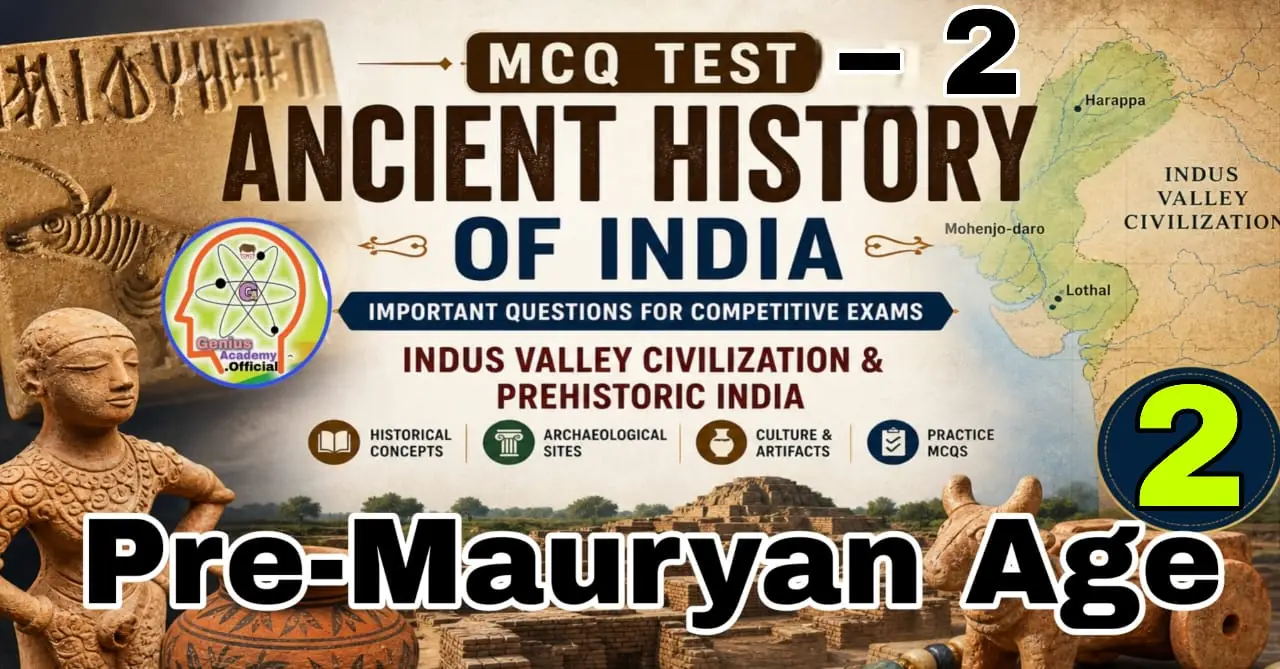
Test 02 Ancient India Pre Mauryan Age

Test 02 Ancient India Pre Mauryan Age

Test 02 Ancient India Pre Mauryan Age

IMPORTANT INSTRUCTIONS

This test consists of 25 questions.
At the end of the test, a “Final Submit” button will appear. Upon clicking it, your result will be displayed, including:—
Total marks obtained [after applying negative marking (-¼), if any],
● A clear indication of which questions were answered correctly or incorrectly, and
A complete view of all correct answers for your reference.
इस परीक्षा में 25 प्रश्न होंगे
परीक्षा के अंत में, एक “Final Submit” बटन दिखाई देगा। इस पर क्लिक करने पर, आपका परिणाम प्रदर्शित होगा, जिसमें शामिल होगा:—

कुल प्राप्तांक [यदि कोई हो, तो नकारात्मक अंकन (-¼) के बाद],

किस प्रश्न का उत्तर सही या गलत दिया गया, इसका स्पष्ट संकेत,

और
आपके के लिए सभी सही उत्तरों की एक पूरी सूची।

Quiz with Final Result Details

1. Who wrote the book Natural History in the first century CE?
प्रथम शताब्दी में नेचुरल हिस्ट्री नामक पुस्तक किसने लिखी?

The correct answer is (D) Pliny.

Pliny the Elder, a Roman author and natural philosopher, wrote the famous book Natural History in the first century CE. It is considered one of the earliest encyclopedic works and contains valuable information about geography, plants, animals, minerals, and ancient India’s trade relations with the Roman Empire.

प्लिनी द एल्डर, जो एक रोमन लेखक और प्रकृतिवेत्ता थे, ने प्रथम शताब्दी ईस्वी में प्रसिद्ध पुस्तक Natural History लिखी थी। यह विश्व की प्रारंभिक विश्वकोशीय कृतियों में से एक मानी जाती है। इसमें भूगोल, वनस्पति, जीव-जंतु, खनिज तथा भारत और रोमन साम्राज्य के व्यापार संबंधों के बारे में महत्वपूर्ण जानकारी मिलती है।

2. The ambassador of which ruler came to the court of Ashoka?
निम्नलिखित में से किसके राजदूत अशोक के राजदरबार में आया था?

The correct answer is (B) Ambassador of Egyptian king Ptolemy Philadelphus.

Historical sources mention diplomatic relations between the Mauryan Empire and Hellenistic kingdoms. Ptolemy II Philadelphus, the ruler of Egypt, is known to have maintained diplomatic contact with the court of Emperor Ashoka through ambassadors and exchanges.

ऐतिहासिक स्रोतों से ज्ञात होता है कि मौर्य साम्राज्य और हेलेनिस्टिक राज्यों के बीच कूटनीतिक संबंध थे। मिस्र के शासक टॉलमी द्वितीय फिलेडेल्फस ने सम्राट अशोक के दरबार में राजदूत भेजे थे और दोनों राज्यों के बीच राजनयिक संपर्क स्थापित थे।

3. Information about the guild of silk weavers is obtained from which inscription?
रेशम बुनकर की श्रेणियों की जानकारी किस अभिलेख से प्राप्त होती है?

The correct answer is (C) Mandsaur Inscription.

The Mandsaur Inscription of the Gupta period provides valuable information about the guild of silk weavers. It mentions that silk weavers migrated from Gujarat to Mandsaur and collectively built and repaired a Sun temple, reflecting the economic and social importance of guilds in ancient India.

गुप्तकालीन मंदसौर अभिलेख से रेशम बुनकरों की श्रेणी (Guild) के बारे में महत्वपूर्ण जानकारी प्राप्त होती है। इसमें उल्लेख है कि रेशम बुनकर गुजरात से मंदसौर आए थे और उन्होंने मिलकर सूर्य मंदिर का निर्माण एवं जीर्णोद्धार कराया था। यह प्राचीन भारत में श्रेणियों के आर्थिक और सामाजिक महत्व को दर्शाता है।

4. Which ruler is credited with issuing the first long inscription in Sanskrit?
निम्नलिखित में से किस शासक को संस्कृत में पहला लंबा शिलालेख जारी करने का श्रेय दिया जाता है?

The correct answer is (D) Rudradaman I.

Rudradaman I, the Shaka ruler, is credited with issuing the first long inscription in Sanskrit. His famous Junagadh (Girnar) inscription, dated around 150 CE, is considered the earliest extensive inscription written in classical Sanskrit. It highlights his achievements, administration, and the repair of the Sudarshana Lake.

शक शासक रुद्रदामन प्रथम को संस्कृत में पहला लंबा शिलालेख जारी करने का श्रेय दिया जाता है। उनका प्रसिद्ध जूनागढ़ (गिरनार) अभिलेख, लगभग 150 ईस्वी का, शुद्ध संस्कृत में लिखा गया प्रारंभिक विस्तृत अभिलेख माना जाता है। इसमें उनकी उपलब्धियों, प्रशासन तथा सुदर्शन झील की मरम्मत का वर्णन मिलता है।

5. From which of the following Indus Valley sites have horse remains NOT been found inside?
निम्नलिखित में से किस सैंधवकालीन प्रदेश से घोड़े का अस्तित्व अंदर नहीं मिले हैं?

The correct answer is (D) Banawali.

Evidence of horse remains has been reported from some Indus Valley sites such as Surkotada, Kalibangan, and Lothal. However, no confirmed evidence of horse remains has been found at Banawali. The issue of the horse in the Harappan Civilization remains a debated topic among historians and archaeologists.

सुतकोतदा, कालीबंगा और लोथल जैसे कुछ सैंधव स्थलों से घोड़े के अवशेष मिलने के प्रमाण प्राप्त हुए हैं। लेकिन बनावली से घोड़े के अस्तित्व के प्रमाण नहीं मिले हैं। हड़प्पा सभ्यता में घोड़े की उपस्थिति इतिहासकारों और पुरातत्वविदों के बीच अभी भी चर्चा का विषय है।

6. The Pashupati Seal was found at which site?
पशुपति मुहर किस स्थल से प्राप्त हुई है?

The correct answer is (D) Mohenjodaro.

The famous Pashupati Seal was discovered at Mohenjodaro, one of the major cities of the Indus Valley Civilization. The seal depicts a horned figure seated in a yogic posture surrounded by animals. Many historians identify this figure as a proto-form of Lord Shiva, known as “Pashupati” (Lord of Animals).

प्रसिद्ध पशुपति मुहर मोहनजोदड़ो से प्राप्त हुई थी, जो सिंधु घाटी सभ्यता का एक प्रमुख नगर था। इस मुहर पर सींगधारी आकृति योग मुद्रा में बैठी हुई दिखाई गई है तथा उसके चारों ओर पशु बने हुए हैं। कई इतिहासकार इस आकृति को भगवान शिव के प्रारंभिक रूप “पशुपति” (पशुओं के स्वामी) से जोड़ते हैं।

7. Which motif is most commonly found on Indus seals?
सिंधु सभ्यता में सबसे आम मुहर का चित्रण क्या है?

The correct answer is (B) Unicorn.

The unicorn motif, represented as a one-horned animal, is the most commonly found figure on Indus Valley seals. Although it resembles a mythical creature, it was widely used in Harappan seal art and remains one of the most distinctive symbols of the civilization.

एक सींग वाले पशु (Unicorn) का चित्र सिंधु घाटी सभ्यता की मुहरों पर सबसे अधिक पाया जाता है। यह एक काल्पनिक या प्रतीकात्मक पशु माना जाता है और हड़प्पा सभ्यता की कला का प्रमुख चिन्ह था।

8. Which famous bronze statue was found at Mohenjodaro?
मोहनजोदड़ो से प्राप्त प्रसिद्ध कांस्य मूर्ति क्या है?

The correct answer is (B) Dancing Girl.

The famous bronze statue known as the Dancing Girl was discovered at Mohenjodaro, one of the major cities of the Indus Valley Civilization. The statue is about 10.5 cm tall and was made using the lost-wax casting technique. It depicts a young girl standing confidently with one hand on her hip and is considered a masterpiece of ancient Indian art and metallurgy.

नृत्य करती लड़की (Dancing Girl) नामक प्रसिद्ध कांस्य मूर्ति मोहनजोदड़ो से प्राप्त हुई थी, जो सिंधु घाटी सभ्यता का एक प्रमुख नगर था। यह लगभग 10.5 सेमी ऊँची मूर्ति है और इसे लॉस्ट वैक्स तकनीक (मोम ढलाई विधि) से बनाया गया था। यह मूर्ति एक आत्मविश्वासी युवती को दर्शाती है और प्राचीन भारतीय कला एवं धातुकर्म का उत्कृष्ट उदाहरण मानी जाती है।

9. What was the economic base of the Indus Valley Civilization?
सिंधु घाटी सभ्यता का मुख्य आधार क्या था?

The correct answer is (D) All of the above.

The economy of the Indus Valley Civilization was based on multiple activities including agriculture, animal husbandry, crafts, and trade. People cultivated crops such as wheat and barley, domesticated animals like cattle and buffaloes, and produced various crafts including pottery, beads, and metal objects. Trade was highly developed, both within the civilization and with distant regions like Mesopotamia. Therefore, all the given options formed the economic base of the civilization.

सिंधु घाटी सभ्यता की अर्थव्यवस्था कृषि, पशुपालन, शिल्प तथा व्यापार पर आधारित थी। लोग गेहूँ और जौ जैसी फसलों की खेती करते थे, पशुओं को पालते थे तथा मिट्टी के बर्तन, मनके और धातु की वस्तुएँ बनाते थे। इस सभ्यता का व्यापार आंतरिक तथा बाहरी क्षेत्रों जैसे मेसोपोटामिया तक फैला हुआ था। इसलिए दिए गए सभी विकल्प इसके आर्थिक आधार थे।

10. Which of the following statements is NOT correct?
निम्नलिखित में से कौन सा कथन सही नहीं है?

The correct answer is (C) Mortimer Wheeler attributed the decline of the Indus Valley Civilization to floods.

This statement is incorrect because Mortimer Wheeler mainly supported the theory of an Aryan invasion as one of the causes for the decline of the Indus Valley Civilization. The flood theory was proposed by other scholars in relation to environmental changes and river floods. The other statements are historically correct: Stuart Piggott called Harappa and Mohenjo-daro twin capitals, Kalibangan’s lower town was fortified, and bead-making factories have been discovered at Lothal and Chanhudaro.

यह कथन गलत है क्योंकि मोर्टिमर व्हीलर ने सिंधु सभ्यता के पतन का मुख्य कारण आर्यों का आक्रमण माना था। बाढ़ का सिद्धांत अन्य विद्वानों द्वारा पर्यावरणीय परिवर्तनों और नदी की बाढ़ से जोड़ा गया था। अन्य सभी कथन सही हैं — स्टुअर्ट पिगोट ने हड़प्पा और मोहनजोदड़ो को जुड़वां राजधानियाँ कहा, कालीबंगा का निचला नगर किलेबंद था तथा लोथल और चन्हूदड़ो से मनके बनाने के कारखाने मिले हैं।

11. Which deity was primarily worshipped in the Indus Valley Civilization?
सिंधु सभ्यता में मुख्य रूप से किसकी पूजा होती थी?

The correct answer is (D) Mother Goddess.

Archaeological findings from the Indus Valley Civilization suggest that the Mother Goddess was widely worshipped. Many terracotta female figurines have been discovered at sites such as Harappa and Mohenjodaro, indicating the importance of fertility worship and the concept of a mother deity. Scholars believe that these figurines represented prosperity, fertility, and protection.

पुरातात्त्विक साक्ष्यों से पता चलता है कि सिंधु सभ्यता में मातृ देवी की पूजा प्रमुख रूप से की जाती थी। हड़प्पा और मोहनजोदड़ो जैसे स्थलों से बड़ी संख्या में मिट्टी की स्त्री मूर्तियाँ प्राप्त हुई हैं, जो उर्वरता एवं मातृत्व पूजा का संकेत देती हैं। विद्वानों के अनुसार ये मूर्तियाँ समृद्धि, उर्वरता और संरक्षण का प्रतीक थीं।

12. What is mentioned in Jabala Upanishad?
जबालोपनिषद् में किसका उल्लेख है?

The correct answer is (C) Four Ashramas.

The Jabala Upanishad is known for mentioning and discussing the concept of the four Ashramas — Brahmacharya (student life), Grihastha (householder life), Vanaprastha (retired life), and Sannyasa (renunciation). It especially emphasizes the importance of Sannyasa and spiritual liberation in later stages of life. The text is considered significant in the development of the Ashrama system in ancient Indian philosophy.

जबालोपनिषद् में चार आश्रमों — ब्रह्मचर्य, गृहस्थ, वानप्रस्थ और संन्यास — का उल्लेख मिलता है। इसमें विशेष रूप से संन्यास आश्रम और मोक्ष प्राप्ति के महत्व को बताया गया है। यह उपनिषद प्राचीन भारतीय आश्रम व्यवस्था के विकास में महत्वपूर्ण माना जाता है।

13. Jataka stories are related to which religion?
जातक कथाएँ किस धर्म से संबंधित हैं?

The correct answer is (A) Buddhism.

Jataka stories are related to Buddhism. These stories describe the previous births of Gautama Buddha in both human and animal forms. They were written to spread moral values, compassion, wisdom, and ethical teachings among people. Jataka tales are an important part of Buddhist literature and are found in the Pali Canon.

जातक कथाएँ बौद्ध धर्म से संबंधित हैं। इन कथाओं में गौतम बुद्ध के पूर्व जन्मों का वर्णन मिलता है, जिनमें वे मानव और पशु दोनों रूपों में जन्म लेते हैं। इन कथाओं का उद्देश्य नैतिक शिक्षा, करुणा, बुद्धिमत्ता और सदाचार का प्रसार करना था। जातक कथाएँ बौद्ध साहित्य का महत्वपूर्ण भाग हैं और पाली ग्रंथों में वर्णित हैं।

14. In the context of the Vedic Period, which of the following represents the correct ascending order of socio-political units?
वैदिक काल के संदर्भ में, निम्नलिखित में से कौन-सा सामाजिक-राजनीतिक इकाइयों का सही आरोही क्रम (सबसे छोटी से सबसे बड़ी) दर्शाता है?

The correct answer is (D) Kula — Grama — Jana — Vish — Rashtra / कुल – ग्राम – जन – विश् – राष्ट्र.

During the Vedic Period, society and administration were organized into different socio-political units. The smallest unit was the Kula (family), which formed a Grama (village). Several villages together formed a Jana (tribe/community). A larger grouping was called Vish, and the largest political unit was the Rashtra (kingdom/state). This arrangement reflects the gradual development of political organization in Vedic society.

वैदिक काल में समाज और प्रशासन विभिन्न सामाजिक-राजनीतिक इकाइयों में विभाजित था। सबसे छोटी इकाई कुल (परिवार) थी, कई कुल मिलकर ग्राम बनाते थे। अनेक ग्राम मिलकर जन (जनजाति/समुदाय) बनाते थे। इससे बड़ी इकाई विश् थी और सबसे बड़ी राजनीतिक इकाई राष्ट्र कहलाती थी। यह क्रम वैदिक समाज की राजनीतिक संरचना को दर्शाता है।

15. Match List-I with List-II and select the correct answer using the codes given below:
सूची-I को सूची-II से सुमेलित कीजिए तथा सूचियों के नीचे दिए गए कूट का प्रयोग करते हुए सही उत्तर चुनिए:

List-I (Religious scriptures and literary texts)
सूची-I (धार्मिक ग्रंथ और साहित्यिक रचनाएँ)
List-II (Descriptions)
सूची-II (विवरण)
a.) Jataka / जातक 1. Life and teachings of Mahavira / महावीर का जीवन और शिक्षाएँ
b.) Kalpasutra / कल्पसूत्र 2. Stories of the previous births of the Buddha / बुद्ध के पूर्व जन्मों की कथाएँ
c.) Kathavatthu / कथावस्तु 3. Hymn in praise of the Earth / पृथ्वी की स्तुति में भजन
d.) Prithvi Sukta / पृथ्वीसूक्त 4. Early history of Jainism / जैन धर्म का प्रारंभिक इतिहास
e.) Bhagavati Sutra / भगवती सूत्र 5. Doctrinal debates in early Buddhism / प्रारम्भिक बौद्ध धर्म में सिद्धान्तगत वाद-विवाद

Codes / कूट:

: —- a b c d e
The correct answer is (B) 2, 4, 5, 3, 1.

The correct matching is:

a.) Jataka → 2. Stories of the previous births of the Buddha
b.) Kalpasutra → 4. Early history of Jainism
c.) Kathavatthu → 5. Doctrinal debates in early Buddhism
d.) Prithvi Sukta → 3. Hymn in praise of the Earth
e.) Bhagavati Sutra → 1. Life and teachings of Mahavira


Jataka tales are Buddhist stories describing Buddha’s previous births. Kalpasutra is an important Jain text related to early Jain traditions. Kathavatthu discusses philosophical debates in Buddhism. Prithvi Sukta is a Vedic hymn praising the Earth, and Bhagavati Sutra contains details related to Mahavira’s life and teachings.

सही सुमेलन इस प्रकार है:

a.) जातक → 2. बुद्ध के पूर्व जन्मों की कथाएँ
b.) कल्पसूत्र → 4. जैन धर्म का प्रारम्भिक इतिहास
c.) कथावस्तु → 5. प्रारम्भिक बौद्ध धर्म में सिद्धान्तगत वाद-विवाद
d.) पृथ्वीसूक्त → 3. पृथ्वी की स्तुति में भजन
e.) भगवती सूत्र → 1. महावीर का जीवन और शिक्षाएँ


जातक कथाएँ बुद्ध के पूर्व जन्मों से संबंधित हैं। कल्पसूत्र जैन धर्म का महत्वपूर्ण ग्रंथ है। कथावस्तु में बौद्ध सिद्धांतों पर वाद-विवाद मिलते हैं। पृथ्वीसूक्त पृथ्वी की स्तुति में वैदिक भजन है तथा भगवती सूत्र में महावीर के जीवन और उपदेशों का वर्णन मिलता है।

16. What does Bhagavati Sutra describe?
भगवती सूत्र किसका वर्णन करता है?

The correct answer is (D) Life and deeds of Mahavira.

The Bhagavati Sutra is an important Jain religious text that mainly describes the life, teachings, and deeds of Lord Mahavira, the 24th Tirthankara of Jainism. It also contains discussions on philosophy, cosmology, ethics, and spiritual knowledge. The text is regarded as one of the significant scriptures in Jain literature.

भगवती सूत्र जैन धर्म का एक महत्वपूर्ण धार्मिक ग्रंथ है, जिसमें मुख्य रूप से भगवान महावीर के जीवन, उपदेशों और कृत्यों का वर्णन मिलता है। इसमें दर्शन, ब्रह्मांड विज्ञान, नैतिकता और आध्यात्मिक ज्ञान से संबंधित विषयों का भी उल्लेख है। यह जैन साहित्य के प्रमुख ग्रंथों में से एक माना जाता है।

17. The term Terracotta means:
टेराकोटा शब्द का अर्थ है?

The correct answer is (B) Baked Clay.

The term Terracotta comes from an Italian word meaning “baked earth” or baked clay. Terracotta objects are made by shaping clay and then hardening it through heating or firing. In ancient civilizations, terracotta was widely used for making pottery, toys, seals, figurines, and decorative items.

टेराकोटा शब्द का अर्थ “पकी हुई मिट्टी” होता है। यह शब्द इटालियन भाषा से आया है। टेराकोटा की वस्तुएँ मिट्टी को आकार देकर उसे आग में पकाकर बनाई जाती हैं। प्राचीन सभ्यताओं में इसका उपयोग बर्तन, खिलौने, मुहरें, मूर्तियाँ और सजावटी वस्तुएँ बनाने में किया जाता था।

18. What is primarily described in the Atharvaveda?
अथर्ववेद में किसका वर्णन मुख्य रूप से मिलता है?

The correct answer is (D) Purushartha Chatushtaya.

The Atharvaveda mainly contains knowledge related to daily life, healing practices, magic spells, prayers, social customs, and philosophical ideas. It also discusses concepts connected with the Purushartha Chatushtaya — Dharma (duty), Artha (wealth), Kama (desire), and Moksha (liberation). Unlike the Rigveda, which is mainly a collection of hymns, the Atharvaveda focuses more on practical and social aspects of life.

अथर्ववेद में मुख्य रूप से दैनिक जीवन, औषधि, जादू-टोना, प्रार्थनाएँ, सामाजिक परंपराएँ और दार्शनिक विचारों का वर्णन मिलता है। इसमें पुरुषार्थ चतुष्ट्य — धर्म, अर्थ, काम और मोक्ष — से संबंधित विचारों का भी उल्लेख है। ऋग्वेद जहाँ मुख्यतः ऋचाओं का संग्रह है, वहीं अथर्ववेद जीवन के व्यावहारिक और सामाजिक पक्षों पर अधिक केंद्रित है।

19. Prithvi Sukta is a part of which Veda?
पृथ्वी सूक्त किस वेद का हिस्सा है?

The correct answer is (B) Atharvaveda.

The Prithvi Sukta, also known as the Bhumi Sukta, is found in the Atharvaveda. It is a hymn dedicated to the Earth and praises nature, fertility, peace, and the relationship between humans and the environment. The hymn reflects deep respect for Mother Earth and highlights the ecological awareness present in ancient Indian thought.

पृथ्वी सूक्त, जिसे भूमि सूक्त भी कहा जाता है, अथर्ववेद का एक महत्वपूर्ण भाग है। यह पृथ्वी की स्तुति में रचित भजन है, जिसमें प्रकृति, उर्वरता, शांति और मानव तथा पर्यावरण के संबंध का वर्णन मिलता है। यह सूक्त प्राचीन भारतीय विचारधारा में पृथ्वी के प्रति सम्मान और पर्यावरणीय चेतना को दर्शाता है।

20. Match List-I with List-II and select the correct answer using the codes given below:
सूची-I को सूची-II से सुमेलित कीजिए तथा सूचियों के नीचे दिए गए कूट का प्रयोग करते हुए सही उत्तर चुनिए:

List-I (Mahajanapad)
सूची-I (महाजनपद)
List-II (Capital)
सूची-II (राजधानी)
a.) Vatsa / वत्स 1. Hatak / हाटक
b.) Kamboja / कम्बोज 2. Mathura / मथुरा
c.) Panchal / पंचाल 3. Kushavati / कुशावती
d.) Malla / मल्ल 4. Kaushambi / कौशाम्बी
e.) Shursen / शूरसेन 5. Ahichchhatra / अहिच्छत्र

Codes / कूट:

: —- a b c d e
The correct answer is (D) 4, 1, 5, 3, 2.

The correct matching is:

a.) Vatsa → 4. Kaushambi
b.) Kamboja → 1. Hatak
c.) Panchal → 5. Ahichchhatra
d.) Malla → 3. Kushavati
e.) Shursen → 2. Mathura


Vatsa Mahajanapada had its capital at Kaushambi. Kamboja was associated with Hatak. Panchal’s capital was Ahichchhatra, while Kushavati was an important center of the Malla Mahajanapada. The capital of Shursen was Mathura, which later became an important cultural and religious center.

सही सुमेलन इस प्रकार है:

a.) वत्स → 4. कौशाम्बी
b.) कम्बोज → 1. हाटक
c.) पंचाल → 5. अहिच्छत्र
d.) मल्ल → 3. कुशावती
e.) शूरसेन → 2. मथुरा


वत्स महाजनपद की राजधानी कौशाम्बी थी। कम्बोज की राजधानी हाटक मानी जाती है। पंचाल की राजधानी अहिच्छत्र थी, जबकि मल्ल महाजनपद का प्रमुख केंद्र कुशावती था। शूरसेन की राजधानी मथुरा थी, जो आगे चलकर महत्वपूर्ण सांस्कृतिक एवं धार्मिक केंद्र बना।

21. Which is the only site where the lower town was also fortified?
निम्नलिखित में से कौन सा स्थल एकमात्र ऐसा है जहाँ निचला शहर भी किलेबंद था?

The correct answer is (C) Kalibangan.

Kalibangan, an important site of the Indus Valley Civilization located in present-day Rajasthan, is known as the only Harappan site where the lower town was also fortified. Most Harappan cities had fortifications mainly around the citadel area, but Kalibangan had defensive walls around both the citadel and the lower town. This reflects advanced urban planning and security arrangements in the settlement.

कालीबंगा, जो वर्तमान राजस्थान में स्थित सिंधु सभ्यता का एक महत्वपूर्ण स्थल है, ऐसा एकमात्र हड़प्पाई नगर माना जाता है जहाँ निचला शहर भी किलेबंद था। अधिकांश हड़प्पा नगरों में केवल दुर्ग क्षेत्र (citadel) के चारों ओर किलेबंदी होती थी, लेकिन कालीबंगा में दुर्ग और निचले नगर दोनों के चारों ओर सुरक्षा दीवारें थीं। यह नगर की उन्नत नगर-योजना और सुरक्षा व्यवस्था को दर्शाता है।

22. Who was the head of the village (Gram) in the Vedic Period?
वैदिक काल में ग्राम का प्रधान कौन होता था?

The correct answer is (D) Gramini.

In the Vedic Period, the head of a village or Gram was known as the Gramini. He was responsible for maintaining law and order, managing village administration, and leading the villagers during wars or important activities. The Gramini played an important role in local governance in Vedic society.

वैदिक काल में ग्राम का प्रधान ग्रामिणी कहलाता था। वह गाँव के प्रशासन, शांति व्यवस्था तथा आवश्यक कार्यों का संचालन करता था। युद्ध या अन्य महत्वपूर्ण अवसरों पर वह ग्रामवासियों का नेतृत्व भी करता था। वैदिक समाज में ग्रामिणी स्थानीय प्रशासन का महत्वपूर्ण अधिकारी था।

23. In which Mandala of Rigveda is the Battle of Ten Kings described?
दशराज्ञ युद्ध ऋग्वेद के किस मंडल में वर्णित है?

The correct answer is (C) 7th Mandala.

The Battle of Ten Kings (Dasharajna Yuddha) is described in the 7th Mandala of the Rigveda. This battle was fought on the banks of the river Parushni (modern Ravi River) between King Sudas of the Bharata tribe and a confederation of ten tribes. The event is considered one of the most important political conflicts mentioned in the Rigveda and highlights the tribal rivalries of the early Vedic period.

दशराज्ञ युद्ध का वर्णन ऋग्वेद के सातवें मंडल में मिलता है। यह युद्ध परुष्णी नदी (वर्तमान रावी नदी) के किनारे भरत जन के राजा सुदास और दस जनों के संघ के बीच लड़ा गया था। यह ऋग्वेद में वर्णित सबसे महत्वपूर्ण राजनीतिक संघर्षों में से एक माना जाता है और प्रारम्भिक वैदिक काल की जनजातीय प्रतिद्वंद्विता को दर्शाता है।

24. Which learned woman is mentioned in the Brihadaranyaka Upanishad?
बृहदारण्यक उपनिषद् में किस विदुषी महिला का उल्लेख है?

The correct answer is (A) Gargi.

Gargi Vachaknavi was a famous learned woman philosopher mentioned in the Brihadaranyaka Upanishad. She is known for her intellectual discussions and debates with the sage Yajnavalkya during the court of King Janaka. Gargi asked profound philosophical questions about the nature of reality and the universe, showing the important role of women scholars in Vedic society.

गार्गी वाचक्नवी का उल्लेख बृहदारण्यक उपनिषद् में एक विदुषी दार्शनिक महिला के रूप में मिलता है। वे राजा जनक की सभा में ऋषि याज्ञवल्क्य से दार्शनिक प्रश्न पूछने और शास्त्रार्थ करने के लिए प्रसिद्ध थीं। गार्गी ने ब्रह्म और ब्रह्मांड की प्रकृति से संबंधित गहन प्रश्न पूछे, जो वैदिक समाज में महिलाओं की विद्वता और बौद्धिक भूमिका को दर्शाता है।

25. How many hymns (Suktas) are there in the Rigveda?
ऋग्वेद में कुल कितने सूक्त हैं?

The correct answer is (C) 1028.

The Rigveda, the oldest of the four Vedas, contains a total of 1028 hymns (Suktas) organized into 10 Mandalas (books). These hymns are dedicated to various Vedic deities such as Agni, Indra, Varuna, and Soma. The Rigveda is considered one of the oldest sacred texts in the world and provides valuable information about the early Vedic society, religion, and culture.

ऋग्वेद, जो चारों वेदों में सबसे प्राचीन है, में कुल 1028 सूक्त हैं, जिन्हें 10 मंडलों में विभाजित किया गया है। ये सूक्त अग्नि, इन्द्र, वरुण और सोम आदि वैदिक देवताओं को समर्पित हैं। ऋग्वेद विश्व के सबसे प्राचीन धार्मिक ग्रंथों में से एक माना जाता है और यह प्रारम्भिक वैदिक समाज, धर्म और संस्कृति की महत्वपूर्ण जानकारी प्रदान करता है।


All questions in this test series are carefully designed in alignment with the latest syllabus and exam trends, ensuring that learners practice the most relevant and concept-oriented material from Ancient Indian History (Pre-Mauryan Age). The content is regularly reviewed and updated to maintain accuracy, authenticity, and usefulness for various competitive examinations.

For reference and validation, the questions and explanations are prepared using standard and reliable sources such as NCERT textbooks, renowned history scholars, archaeological findings, and credible academic publications related to the Indus Valley Civilization, Chalcolithic cultures, and early Indian history.

This structured approach enhances conceptual understanding and helps aspirants build a strong foundation with fact-based, exam-oriented, and trustworthy content.

Test 02 Ancient India Pre Mauryan Age

Test 02 Ancient India Pre Mauryan Age

PIB

Leave a Reply

Your email address will not be published. Required fields are marked *